
Listen to this Post
Introduction:
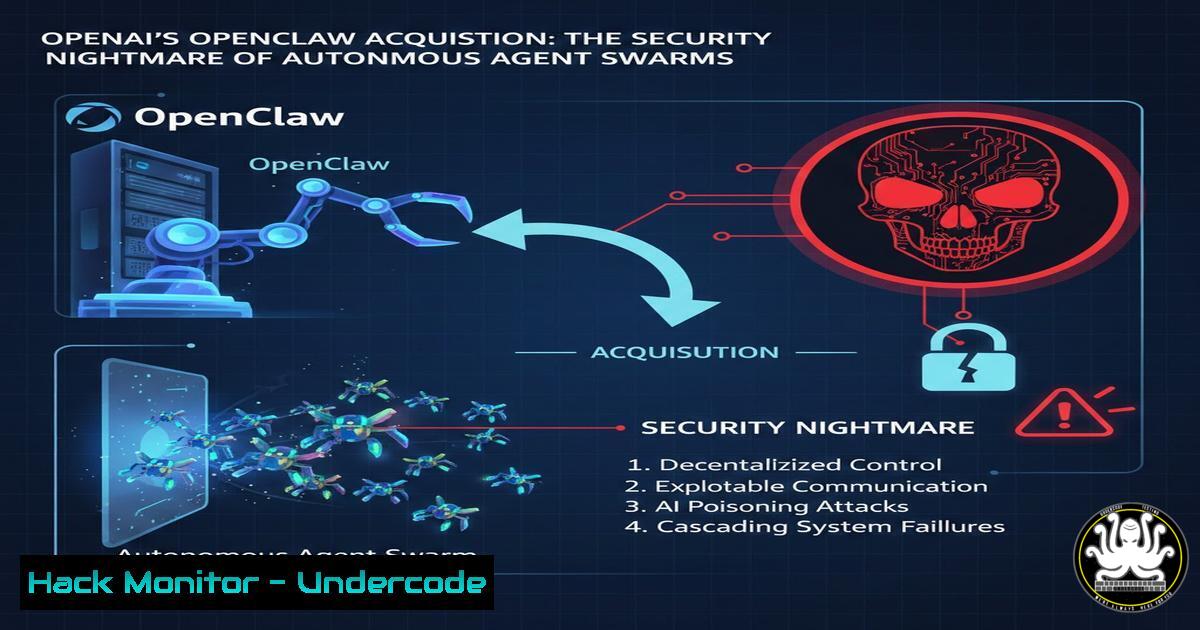
The AI landscape shifted dramatically with OpenAI’s acquisition of OpenClaw, a project that redefined open-source growth with 196,000 GitHub stars. While the tech world focuses on the transition from chatbots to action-oriented agents, the cybersecurity community is bracing for the implications. This move accelerates a future where AI doesn’t just generate text but executes commands, manages calendars, and coordinates with other agents—introducing a massive, distributed attack surface. For security professionals, this signals the end of simple prompt injection and the beginning of complex, multi-vector, inter-agent exploitation.
Learning Objectives:
- Analyze the security risks inherent in agentic AI architectures that perform real-world actions.
- Identify vulnerabilities in agent-to-agent (A2A) communication protocols and API chains.
- Implement hardening techniques to secure personal AI agents against privilege escalation and lateral movement.
You Should Know:
- The Shift from Passive Chatbots to Actionable Agents: A Security Paradigm Shift
The core of the OpenClaw technology, now under OpenAI, is the ability for AI to “do” rather than just “say.” This means agents will interface directly with CRMs, email servers, and financial platforms. From a red team perspective, this transforms a successful exploit from data theft to direct system manipulation. Instead of extracting a chat history, an attacker compromising an agent could instruct it to delete files, transfer funds, or propagate malicious payloads to connected enterprise systems.
Step‑by‑step guide: Simulating an Agent Action Exploit
This exercise demonstrates how an attacker might hijack an agent’s function call.
Note: This is a conceptual simulation for educational purposes using a mock API.
1. Intercept the Function Call: Using a proxy like Burp Suite, intercept the HTTP request made by the agent to a third-party API (e.g., POST /api/schedule).
2. Analyze the Payload: The request body might look like: {"action": "create_event", "params": {"summary": "Team Meeting", "attendees": ["[email protected]"]}}.
3. Modify the Parameters: Replay the request with altered parameters. If the agent’s authentication token is overly permissive, you could change the request to: {"action": "delete_calendar", "params": {"calendar_id": "primary"}}.
4. Command Injection Test: If the agent uses a system command to execute actions, test for injection:
 Vulnerable agent backend (pseudo-code)
 os.system(f"python calendar_tool.py --summary {user_input}")

Attacker input to the agent: "Team Meeting; rm -rf /important_data"
 The executed command becomes:
 python calendar_tool.py --summary Team Meeting; rm -rf /important_data
This highlights the critical need for strict input sanitization and parameterized API calls.
- Multi-Agent Architectures: The Rise of “Agent Mesh” Vulnerabilities
OpenAI’s focus on a “multi-agent” future implies agents will communicate and delegate tasks. This introduces a new attack vector: Agent-to-Agent (A2A) communication poisoning. If Agent A trusts Agent B implicitly, compromising Agent B allows an attacker to feed malicious instructions or false data back into Agent A, creating a lateral movement path within the AI infrastructure.
Step‑by‑step guide: Hardening A2A Communication with mTLS
To prevent man-in-the-middle attacks and ensure identity verification between agents, implement mutual TLS (mTLS).
1. Generate Certificates:
 Generate CA key and certificate
openssl genrsa -out ca.key 2048
openssl req -new -x509 -days 365 -key ca.key -out ca.crt

Generate certificate for Agent A
openssl genrsa -out agent-a.key 2048
openssl req -new -key agent-a.key -out agent-a.csr
openssl x509 -req -in agent-a.csr -CA ca.crt -CAkey ca.key -set_serial 01 -out agent-a.crt

Repeat for Agent B
2. Configure Agent Communication: Configure your agent service (e.g., a Python Flask app) to require client certificates.
 Flask app example with mTLS
import flask
import ssl

app = flask.Flask(<strong>name</strong>)

@app.route('/agent-task', methods=['POST'])
def receive_task():
 The request is now verified by the SSL context
data = flask.request.get_json()
 Process task only from verified peer
return {"status": "received"}

if <strong>name</strong> == '<strong>main</strong>':
context = ssl.SSLContext(ssl.PROTOCOL_TLS_SERVER)
context.load_cert_chain('agent-a.crt', 'agent-a.key')
context.load_verify_locations('ca.crt')
context.verify_mode = ssl.CERT_REQUIRED
app.run(ssl_context=context, host='0.0.0.0', port=8443)
3. API Security and Over-Permissive Agents
Agents require API keys to function. The “Claw” in OpenClaw implies gripping and manipulating data. A common pitfall is granting an agent an API key with write access when it only needs read access. If the agent is compromised, that over-privileged key becomes a powerful weapon.
Step‑by‑step guide: Implementing Least Privilege for Agent API Keys
1. Audit Current Scopes: List the permissions of your existing service accounts.
 Example for Google Cloud
gcloud iam service-accounts keys list [email protected]
gcloud projects get-iam-policy my-project --flatten="bindings[].members" --format='table(bindings.role)' --filter="bindings.members:'my-agent'"
2. Create a Restricted Key: Generate a new key with minimal scopes. For a calendar agent, it should only have `https://www.googleapis.com/auth/calendar.readonly` if it only reads data, not `https://www.googleapis.com/auth/calendar` which allows modification.
3. Environment Variable Security: Never hardcode keys. Use environment variables or secrets managers.
 In a systemd service file for the agent
[bash]
Environment="OPENAI_API_KEY=sk-..."
Environment="GOOGLE_CALENDAR_API_KEY=..."
RestrictAddressFamilies=AF_INET AF_INET6
PrivateTmp=yes
NoNewPrivileges=yes
4. Cloud Hardening for Agentic Workloads
Agents like OpenClaw likely run in cloud environments. Containerization is key, but misconfigurations can lead to host compromise.
Step‑by‑step guide: Docker Security for Agent Containers
- Run as Non-Root: Build your agent image to use a non-root user.
FROM python:3.11-slim
RUN useradd -m agentuser
USER agentuser
COPY --chown=agentuser:agentuser . /app
WORKDIR /app
CMD ["python", "agent.py"]
- Drop Capabilities: Run the container with minimal Linux capabilities.
docker run --cap-drop=ALL --cap-add=NET_BIND_SERVICE --read-only --tmpfs /tmp my-agent-image
– `–cap-drop=ALL` removes all root privileges.
– `–cap-add=NET_BIND_SERVICE` allows the agent to bind to a port (if needed).
– `–read-only` makes the root filesystem immutable, preventing an attacker from downloading tools or altering binaries.
5. Monitoring for Agent Anomalies (SIEM Integration)
Traditional EDR might not catch malicious agent behavior because the actions are performed via legitimate APIs. You need to monitor the agent’s logs and its API call patterns.
Step‑by‑step guide: Logging and Alerting with Auditd
Configure Linux auditd to monitor the agent’s configuration files and log its outgoing connections.
1. Add Audit Rules:
 Monitor changes to agent config
auditctl -w /etc/myagent/config.yaml -p wa -k agent_config

Monitor all execve calls made by the agent process
auditctl -a always,exit -S execve -F uid=1000 -k agent_exec
2. Search Logs:
ausearch -k agent_exec | aureport -f -i
3. Integrate with SIEM: Forward `/var/log/audit/audit.log` to your SIEM and create alerts for unusual patterns, such as the agent process spawning a shell (bash, sh) or connecting to unusual IP addresses.
What Undercode Say:
- The Agent is the New Endpoint: Security teams must now treat every active AI agent as a privileged user account and endpoint device, requiring identity management, behavioral analysis, and strict access controls.
- Supply Chain Attacks on AI Models: The acquisition highlights the risk of depending on open-source agent frameworks. A malicious pull request merged into a project like OpenClaw before acquisition could have backdoored thousands of enterprise deployments. Rigorous software composition analysis (SCA) is now mandatory for AI stacks.
The acquisition of OpenClaw is not just a product roadmap signal; it is a declaration of a new digital ecosystem. As agents become the primary interface between humans and the internet, they will become the primary target. The industry must shift focus from protecting data at rest to protecting actions in transit. We are entering an era where a successful hack doesn’t just steal your files; it uses your identity to book fraudulent transactions, sabotage your calendar, and manipulate other AI systems in a cascading failure. Defenders must build security directly into the agent’s runtime, not just its perimeter.
Prediction:
Within 12-18 months, we will see the emergence of “Agent Firewalls”—specialized security appliances designed to inspect, rate-limit, and validate inter-agent communication protocols. The first major data breach involving a hijacked personal AI agent will occur, prompting regulatory bodies to fast-track compliance frameworks specifically for autonomous AI actors, potentially requiring “agent bonding” or mandatory insurance for high-value autonomous operations.
▶️ Related Video (88% Match):
🎯Let’s Practice For Free:
IT/Security Reporter URL:
Reported By: Alexcinovoj Openai – Hackers Feeds
Extra Hub: Undercode MoN
Basic Verification: Pass ✅


