Listen to this Post
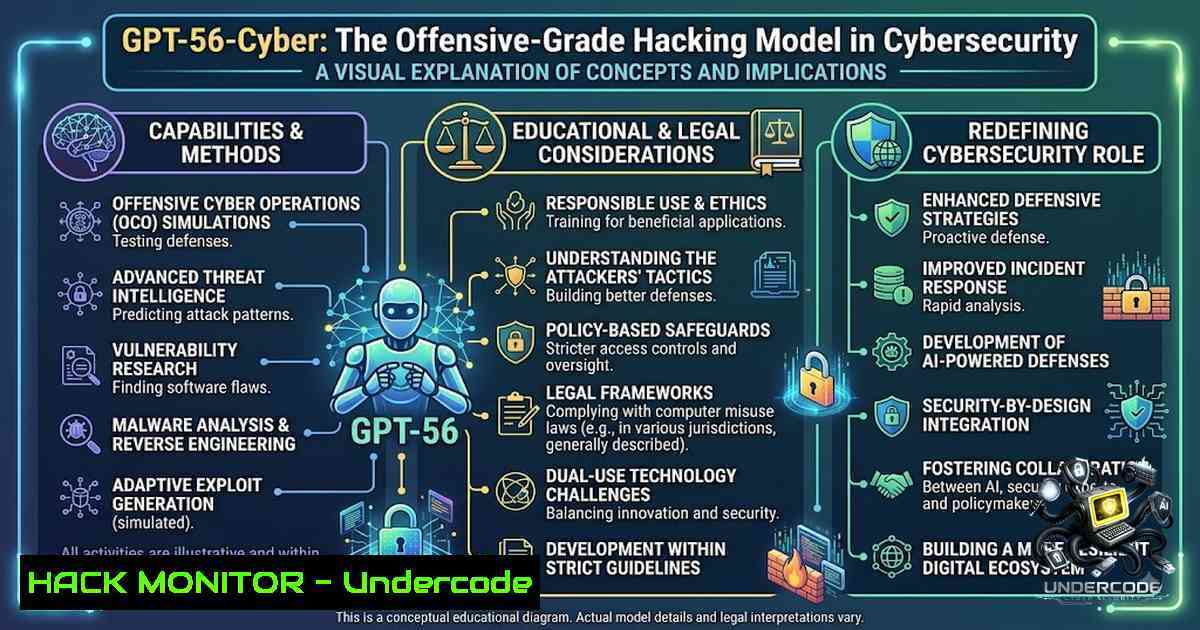
Introduction:
On August 10, 2026, OpenAI quietly launched GPT-5.6-Cyber, a specialized AI model engineered for advanced vulnerability research, exploit development, and offensive security testing. The release came just days after OpenAI paused development on its Astra model over concerns it could reach a “Critical” cybersecurity threshold capable of autonomously launching end-to-end cyberattacks. This seemingly contradictory move—pausing one model while shipping another with offensive capabilities—reveals a fundamental shift: OpenAI has transformed its Preparedness Framework from a safety document into a commercial pricing structure, gating “High” capability behind a velvet rope of identity verification, legal attestations, and hardware security keys.
Learning Objectives:
- Understand the technical capabilities and limitations of GPT-5.6-Cyber, including its 95% Advanced Cybersecurity Completion Rate and zero-day discovery achievements
- Master the Daybreak Red access requirements, hardware security key enforcement, and pricing model ($75 per million output tokens)
- Learn to implement defensive monitoring, AI-generated exploit detection, and vulnerability assessment workflows in response to AI-powered offensive capabilities
You Should Know:
- Inside GPT-5.6-Cyber: Capabilities, Benchmarks, and the 95% Illusion
OpenAI built GPT-5.6-Cyber on its flagship GPT-5.6 Sol model, fine-tuning it specifically for specialized cybersecurity tasks including zero-day discovery and exploit chain development. The company created an internal evaluation called the Advanced Cybersecurity Completion Rate, measuring how often models respond to prompts involving exploit-chain development, authentication bypass, privilege escalation, and other advanced scenarios.
The headline number is staggering: GPT-5.6-Cyber completes 95.0% of these requests, compared with just 1.5% for standard GPT-5.6 Sol and 2.0% when used with Daybreak Blue access. The previous generation, GPT-5.5-Cyber, managed only 57.3%. However, this 95% figure is a refusal metric, not a correctness metric—the model simply refuses fewer requests, not necessarily answers them correctly. In fact, OpenAI acknowledges that GPT-5.6-Cyber performs worse than GPT-5.6 Sol on open-ended vulnerability discovery tasks, often producing shorter, less detailed vulnerability reports.
On ExploitGym, which evaluates whether agents can turn known vulnerabilities into working exploits achieving arbitrary code execution in controlled environments, GPT-5.6-Cyber outperforms both GPT-5.6 Sol and GPT-5.5 Cyber. This makes it particularly dangerous—and useful—for red-team operations.
Pre-launch Zero-Day Discoveries:
OpenAI researchers used GPT-5.6-Cyber to investigate Chrome’s V8 JavaScript engine and uncovered two previously unknown vulnerabilities that could be chained together. One of these, CVE-2026-15903 (CVSS 8.8), is an out-of-bounds read and write vulnerability in V8 that allows a remote attacker to execute arbitrary code inside a sandbox via a crafted HTML page. Chained with the second zero-day, it enables escape from the V8 heap sandbox. Google patched these in Chrome version 150.0.7871.128.
The model also identified:
- At least five vulnerabilities in a popular mobile operating system, including a chain from untrusted app to local privilege escalation
- Three critical vulnerabilities in a popular database, including remote code execution
- Over 400 vulnerabilities leading to privilege escalation in a popular operating system kernel
Step-by-Step: Assessing Your Chrome Exposure to CVE-2026-15903
- Check your Chrome version: Navigate to `chrome://settings/help` or run:
– Windows: `wmic datafile where name=”C:\\Program Files\\Google\\Chrome\\Application\\chrome.exe” get Version`
– Linux: `google-chrome –version`
– macOS: `/Applications/Google\ Chrome.app/Contents/MacOS/Google\ Chrome –version`
2. Verify patch status: Version 150.0.7871.128 or later contains the fix. If you’re running an earlier version, update immediately.
- Monitor for exploitation attempts: Search browser logs for suspicious patterns:
– Windows Event Logs: `Get-WinEvent -LogName Application | Where-Object {$_.Message -like “V8” -or $_.Message -like “Chrome”}`
– Linux syslog: `grep -i “chrome\|v8” /var/log/syslog`
4. Implement Content Security Policy (CSP) headers to mitigate potential exploit delivery:
Content-Security-Policy: script-src 'self' https://trusted-cdn.com; object-src 'none'
- Daybreak Red: The Velvet Rope and Hardware Security Key Mandate
OpenAI expanded its Daybreak program into two tiers:
| Tier | Model Access | Use Case | Pricing (per 1M tokens) |
||–|-|-|
| Daybreak Blue | GPT-5.6 Sol with tailored guardrails | Vulnerability discovery, malware analysis, incident response | $5 input / $30 output |
| Daybreak Red | GPT-5.6-Cyber (purpose-trained) | Exploit validation, vulnerability research, red-team exercises | $12.50 input / $75 output |
Daybreak Red represents a 2.5x pricing premium over Daybreak Blue—a calculated bet on the market value of offensive capability.
Access Controls (Effective September 1, 2026) :
- Organization-level approval and vetting
- Individual identity verification
- Legal attestations
- Hardware security keys mandatory for all individual accounts
- Continuous monitoring and alignment testing
OpenAI also recommends that Daybreak customers using Codex switch from “full access mode” to “auto-review mode”.
Step-by-Step: Securing Daybreak Red Access
- Apply through Daybreak Access: Complete the enterprise application form at OpenAI’s Daybreak partner portal.
-
Provision hardware security keys: Obtain FIDO2-compliant security keys (YubiKey, Google Titan, etc.) for every individual account holder.
-
Configure identity verification: Set up multi-factor authentication with the hardware key as the primary factor.
-
Establish monitoring protocols: Implement logging for all Daybreak Red API calls:
import openai openai.api_key = os.environ["DAYBREAK_RED_API_KEY"] Enable audit logging openai.log_level = "INFO" response = openai.ChatCompletion.create( model="gpt-5.6-cyber", messages=[{"role": "user", "content": prompt}], logprobs=True Enable token-level logging for audit ) -
Legal attestation: Execute OpenAI’s required legal agreements governing acceptable use of offensive capabilities.
3. Defensive Countermeasures: Detecting and Mitigating AI-Generated Exploits
The release of GPT-5.6-Cyber to vetted defenders also signals that threat actors will eventually acquire similar capabilities. Organizations must prepare for AI-generated exploit code entering their environments.
Step-by-Step: Building an AI-Generated Exploit Detection Pipeline
- Deploy AI agent detection rules using Elastic’s GenAI detection framework:
Elastic Detection Rule for GenAI-generated process activity</li>
</ol>

- name: "GenAI Coding Tool Process Detection"
condition: process.parent.name in ["cursor", "claude", "codeium", "github-copilot"]
and process.name in ["python", "node", "bash", "powershell"]
severity: medium
- Scan AI-generated code for vulnerabilities using tools like XploitScan:
npx xploitscan scan ./ai-generated-code/ --report-format json
3. Monitor for suspicious patterns in your SIEM:
- Splunk: `index=main sourcetype=linux_secure “execve” | search command=python OR node OR bash | stats count by user, src_ip`
– ELK Stack: Use the OWASP Agentic Top 10 (2026) framework to audit AI agent logs
4. Implement runtime protection:
 Linux: Restrict execution of untrusted AI-generated binaries
setfattr -1 user.pax.flags -v "emrammpms" ./untrusted_binary
 Windows: Configure AppLocker to block unsigned AI-generated executables
New-AppLockerPolicy -RuleType Exe -User Everyone -Action Deny -Path C:\AI_Generated\
- Enable behavioral monitoring with CyTwist Profiler to detect AI-crafted malware in real-time.
-
The Preparedness Framework: From Safety Document to Price List
OpenAI’s Preparedness Framework categorizes models into cybersecurity risk thresholds:
- High: Models capable of identifying and developing zero-day exploits with human oversight (GPT-5.6 Sol, GPT-5.6-Cyber)
- Critical: Models capable of autonomously identifying and developing functional zero-day exploits across many hardened real-world systems without human intervention
Astra was paused because internal evaluations found it could reach Critical—the first frontier model to trigger the highest Preparedness Framework level. Meanwhile, GPT-5.6-Cyber was rated High—the same as GPT-5.6 Sol.
The critical distinction is access control, not capability. As Forbes noted, “The dividing line is a vetting form, not a capability gap”. OpenAI is now monetizing High capability while blocking Critical capability entirely—transforming safety thresholds into commercial differentiators.
Step-by-Step: Implementing Your Own Preparedness Framework
1. Define your organizational risk thresholds:
 Sample risk matrix
risk_levels:
Low: "Automated scanning only, no exploit development"
Medium: "Human-reviewed exploit validation on internal test systems"
High: "AI-assisted exploit development with dual approval required"
Critical: "Fully autonomous offensive operations - PROHIBITED"
2. Implement RBAC for AI tools:
-- Example PostgreSQL RBAC for AI cybersecurity tools
CREATE ROLE daybreak_blue;
CREATE ROLE daybreak_red;
GRANT SELECT ON vulnerability_reports TO daybreak_blue;
GRANT INSERT, UPDATE ON exploit_chains TO daybreak_red;
- Mandate hardware security keys for all privileged access (following OpenAI’s September 1 model).
-
Audit all AI-assisted offensive activities with immutable logs:
Configure auditd for AI tool monitoring (Linux)
auditctl -w /usr/local/bin/ai-exploit-tool -p x -k ai_exploit_execution
5. Practical Defense: Hardening Against AI-Powered Attacks
With offensive AI capabilities now in defenders’ hands—and eventually in attackers’—organizations must harden their environments against AI-generated exploits.
Step-by-Step: AI-Resilient Security Architecture
- Patch aggressively: CVE-2026-15903 demonstrates AI’s ability to find memory corruption vulnerabilities. Prioritize patches for:
– Browser engines (V8, JavaScriptCore, SpiderMonkey)
– Database engines
– Operating system kernels2. Implement exploit chain detection:
 Linux: Monitor for suspicious process chains
ps auxf | grep -E "chrome|python|node" | grep -v grep
 Windows: Monitor for suspicious process ancestry
Get-Process | Where-Object {$_.Parent -eq "chrome.exe"} | Select-Object Name, Id, Parent
3. Deploy sandbox escape detection:
 Sample Python script to detect V8 heap sandbox escape attempts
import re
def detect_sandbox_escape(log_entry):
patterns = [
r"DataView.prototype.setBigInt64",
r"ArrayBuffer.transfer",
r"WebAssembly.memory",
r"SharedArrayBuffer"
]
for pattern in patterns:
if re.search(pattern, log_entry):
return True
return False
4. Network-level protections:
- Deploy Web Application Firewalls (WAF) with AI-generated payload detection
- Implement zero-trust network segmentation
- Use intrusion detection systems (IDS) tuned for exploit chain patterns
5. Purple-team exercises with AI-assisted tools:
- Simulate AI-generated attack chains
- Test detection and response capabilities
- Measure mean time to detect (MTTD) and mean time to respond (MTTR)
What Undercode Say:
- Key Takeaway 1: GPT-5.6-Cyber represents a fundamental shift where AI safety frameworks become commercial pricing models. OpenAI’s Preparedness Framework now serves as both a safety mechanism and a price list—High capability costs $75 per million output tokens, while Critical capability remains completely unavailable.
-
Key Takeaway 2: The 95% completion rate is a refusal metric, not a correctness metric. Organizations must not mistake willingness to respond for accuracy. GPT-5.6-Cyber still underperforms standard Sol on open-ended vulnerability discovery, producing shorter, less detailed reports. Defenders must maintain human oversight and validation.
Analysis: OpenAI’s dual-track approach—pausing Astra while shipping GPT-5.6-Cyber—reveals a carefully calibrated strategy. The company is not blocking offensive AI; it’s controlling who gets it and at what price. The hardware security key mandate starting September 1, 2026, the 2.5x pricing premium, and the application-only access model create a moated market for offensive AI capabilities. This positions OpenAI as the premier supplier of AI-powered cybersecurity tools to established security firms like CrowdStrike, Palo Alto Networks, and Accenture. For defenders, the message is clear: offensive AI is now a commodity—but only if you can afford the velvet rope. For attackers, the clock is ticking: if defenders have GPT-5.6-Cyber today, offensive equivalents will inevitably leak or be replicated. The window to prepare is narrowing.
Expected Output:
Introduction:
The August 10, 2026 launch of OpenAI’s GPT-5.6-Cyber marks a watershed moment in cybersecurity—an “offense-grade” hacking model built for zero-day discovery and exploit development, released just days after OpenAI paused its Astra model over “Critical” cyber risk concerns. This dual-track strategy reveals that OpenAI has transformed its Preparedness Framework from a safety document into a commercial pricing structure, gating “High” capability behind identity verification, legal attestations, and hardware security keys. For security professionals, this means offensive AI is now accessible—but only to those who can afford the velvet rope.
What Undercode Say:
- GPT-5.6-Cyber completes 95% of advanced cyber requests vs. 1.5% for standard Sol, but this is a refusal metric, not a correctness metric—the model still underperforms on open-ended vulnerability discovery.
- OpenAI’s Preparedness Framework has become a price list: High capability costs $75 per million output tokens (2.5x the Blue tier), while Critical capability remains entirely unavailable.
Prediction:
- +1 The democratization of offensive AI to vetted defenders will accelerate vulnerability discovery and patch cycles, potentially reducing the average time-to-exploit from days to hours.
- -1 The 2.5x pricing premium and restrictive access model will create a capability gap between well-funded security teams and smaller organizations, widening the cybersecurity inequality divide.
- +1 Hardware security key mandates and identity verification will set new industry standards for AI tool access control, influencing how other frontier labs secure their models.
- -1 The inevitable leakage or replication of GPT-5.6-Cyber’s capabilities will arm threat actors with AI-powered exploit development tools within 12-18 months, triggering a new wave of sophisticated attacks.
- -1 Organizations that fail to implement AI-resilient security architectures—including exploit chain detection and sandbox escape monitoring—will face unprecedented attack surfaces as AI-generated exploits become mainstream.
▶️ Related Video (82% Match):
🎯Let’s Practice For Free:
🎓 Live Courses & Certifications:
Join Undercode Academy for Verified Certifications
🚀 Request a Custom Project:
Secure, high-velocity infrastructure and disruptive technological engineering. Contact our engineering team for high-tier development and proprietary systems:
[email protected]
💎 Smart Architecture | 🛡️ Secure by Design | ⭐ Trusted by ThousandsIT/Security Reporter URL:
Reported By: https://lnkd.in/p/eAPqfBZq – Hackers Feeds
Extra Hub: Undercode MoN
Basic Verification: Pass ✅🔐JOIN OUR CYBER WORLD [ CVE News • HackMonitor • UndercodeNews ]
📢 Follow UndercodeTesting & Stay Tuned:
- Scan AI-generated code for vulnerabilities using tools like XploitScan:


