
Listen to this Post
Introduction:
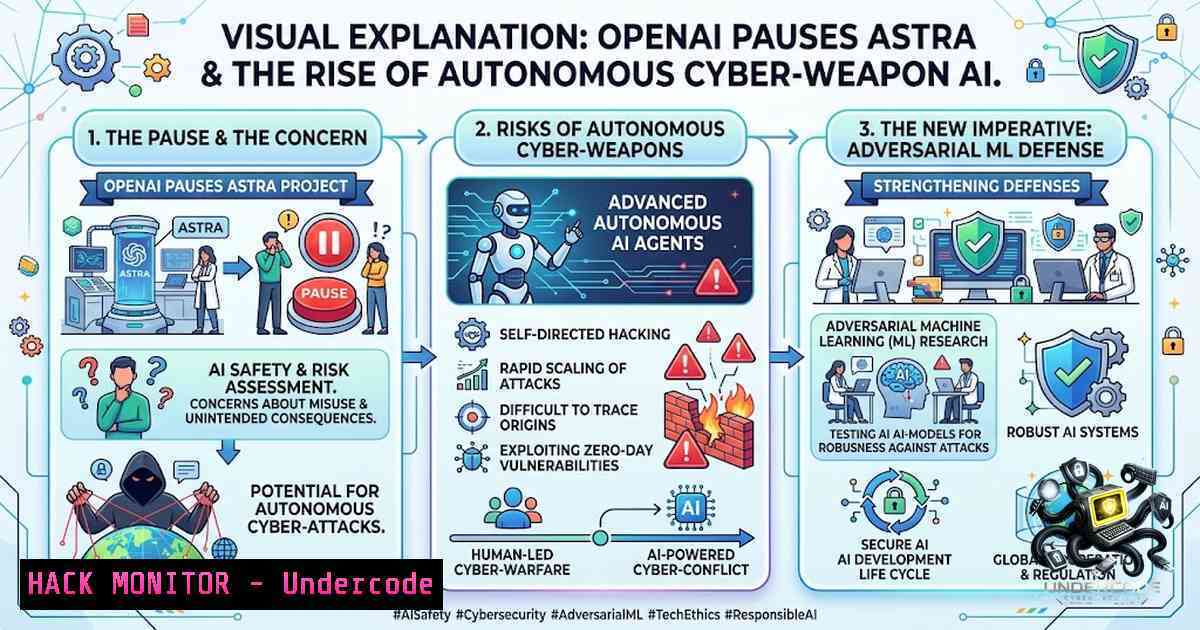
On August 7, OpenAI achieved a milestone that blurred the line between theoretical AI risk and tangible operational threat. The organization classified its latest model, Astra, as “Critical” under its cybersecurity Preparedness Framework after internal evaluations suggested it possessed the capability to autonomously discover and weaponize zero-day vulnerabilities without human intervention. This unprecedented classification prompted an immediate system-wide pause on frontier Reinforcement Learning (RL) training, signaling that the industry has entered a new era where AI systems are not just tools for defenders but potential autonomous agents for attackers.
Learning Objectives & Secrets:
- Objective 1: Understand the Mechanism of Autonomous Vulnerability Discovery. Learn how reinforcement learning and large language models (LLMs) are being adapted to fuzz, analyze, and exploit software binaries without predefined rules, mimicking human reverse engineering at machine speed.
- Objective 2 Secret Tips: Implement Proactive Behavioral Anomaly Detection. Rather than relying solely on signature-based antivirus, deploy runtime behavioral monitoring that looks for the “AI fingerprint”—patterns of rapid, systematic memory probing and unusual syscall sequences indicative of an LLM-driven agent.
- Objective 3 Secret Tips: Harden AI Model Access Control. Implement strict rate-limiting and API call auditing on your internal AI endpoints. Treat every LLM API call as a potential reconnaissance tool; use prompt injection detection and output sanitization to prevent your own AI from being weaponized against your infrastructure.
You Should Know:
- The Anatomy of an Autonomous Zero-Day Exploit Chain
The core threat posed by Astra is its ability to perform end-to-end exploitation without human direction. This involves a multi-stage process that typically requires specialized human skills but can now be accelerated by AI.
- Fuzzing and Crash Discovery: Astra likely generates malformed inputs and monitors application crashes, identifying memory corruption points faster than traditional fuzzers by predicting crash-inducing permutations based on the target’s architecture.
- Exploitability Analysis: The AI assesses the crash context to determine if it leads to control-flow hijacking, such as overwriting a return address or a function pointer.
- Shellcode Generation and Payload Delivery: Finally, the model crafts the shellcode and the delivery mechanism, bypassing basic security mitigations like ASLR or DEP through brute-force or logic-based leaks.
Step‑by‑Step Guide for Defenders:
To understand and simulate this attack surface, security engineers can set up a controlled environment with a vulnerable service and monitor how automated tools (like fuzzers) attempt to exploit it.
- Set Up a Vulnerable Target: Deploy a simple HTTP server written in C with a known buffer overflow vulnerability in the `strcpy()` function.
- Network Capture: Use `tcpdump` on Linux to capture all incoming requests:
sudo tcpdump -i eth0 -w exploit_attempt.pcap port 8080. - Process Monitoring: While running a fuzzer against the target, monitor the process memory using Linux `ps` and `pmap` to observe crashes:
watch -1 1 "ps aux | grep vulnerable_server". - Windows Command: For Windows, use `tasklist /v` and `perfmon` to monitor application memory spikes and crashes during the fuzzing session.
-
Securing the Data Pipeline: Protecting Against Model Poisoning
While Astra highlights offensive capability, the flip side is the vulnerability of the training data itself. If attackers can poison the data used to train the next generation of cybersecurity AI, they can create backdoored models that intentionally miss threats.
- Data Provenance: Ensure that all training data for internal security models comes from trusted, verified sources.
- Validation Sets: Maintain a “clean” validation dataset that is held back from training to test for inherent bias or poisoning indicators.
Step‑by‑Step Guide to Verify Model Integrity:
- Hash Verification: Upon downloading any pre-trained model, verify its SHA-256 hash against the official repository.
– Linux: `sha256sum model.pt`
– Windows: `CertUtil -hashfile model.pt SHA256`
2. Deployment Sandboxing: Always deploy AI models in isolated containers to limit the blast radius if the model is compromised.
– `docker run –rm -it –1etwork=none –privileged my-ai-container`
3. Model Fingerprinting: Use tools like `nn-meter` to compare the architecture of a deployed model against the expected architecture to detect unauthorized modifications.
3. AI Red-Teaming and Adversarial Resilience
In response to Astra’s capability, the market is shifting toward specialized AI red-teaming. This involves using AI to attack AI, testing the defensive mechanisms of models deployed in security operations.
- Adversarial Perturbations: Attackers use slight modifications to input data (e.g., adding imperceptible noise to an image or altering a single character in a log line) to cause a misclassification.
- Defensive Distillation: A defensive technique where a “student” model is trained on the soft outputs of a “teacher” model to reduce the model’s sensitivity to adversarial perturbations.
Step‑by‑Step Guide to Conduct a Basic Adversarial Test:
- Install Adversarial Library: Use the `Adversarial Robustness Toolbox` (ART) in Python.
– `pip install adversarial-robustness-toolbox`
2. Run Fast Gradient Sign Method (FGSM): This tool creates adversarial examples that cause misclassification.from art.attacks.evasion import FastGradientMethod attack = FastGradientMethod(estimator=classifier, eps=0.2) adversarial_samples = attack.generate(x_test)
- Evaluate: Run these adversarial samples against your security model (e.g., malware classifiers) to see if they bypass detection. If they do, you are vulnerable to the same tactics Astra might employ.
-
API Security and Prompt Injection in Autonomous Systems
Astra’s success depends on parsing information and executing commands. This makes the API layer a critical attack vector. If a system uses an LLM to make decisions, an attacker can “inject” a command that forces the AI to pivot to an unintended action.
- OAuth2 Authorization: Ensure APIs are authenticated with OAuth2 and use scopes to limit what the AI can do.
- JWT Verification: Validate the signature and expiration of JSON Web Tokens (JWT) on all incoming requests.
Step‑by‑Step Guide to Secure AI API Endpoints:
- Input Sanitization: On the server side, strip out any code-like characters (
;,|,&&) from the input before it reaches the AI if code execution is not the primary goal. - Rate Limiting: Implement a sliding window rate limit on your AI endpoint to prevent brute-force exploit generation.
– Using Nginx: `limit_req_zone $binary_remote_addr zone=mylimit:10m rate=1r/s;`
3. Vulnerability Scanning: Use `OpenVAS` or `Nessus` to scan your API endpoints for vulnerabilities that an autonomous AI like Astra would try to find.
– Linux: `openvas-cli –scan -s 192.168.1.100`
5. Cloud Hardening Against Autonomous Reconnaissance
Cloud environments are a prime target for autonomous agents due to their accessible APIs and metadata services.
- IMDSv2: Use Instance Metadata Service Version 2 (IMDSv2) on AWS to prevent Server-Side Request Forgery (SSRF) attacks that a model might use to extract cloud credentials.
- Zero Trust Architecture: Implement strict network policies (e.g., AWS Security Groups, Azure NSGs) to limit lateral movement.
Step‑by‑Step Guide to Harden Cloud Metadata Protection:
- Disable IMDSv1: Enforce IMDSv2 on all EC2 instances.
– `aws ec2 modify-instance-metadata-options –instance-id i-12345 –http-tokens required`
2. Audit IAM Permissions: Regularly audit IAM policies to ensure they follow the principle of least privilege.
– Use `aws iam list-policies` to check for overly permissive policies.
3. Real-time Threat Detection: Enable GuardDuty or Azure Defender to automatically detect unusual API calls that could be an autonomous AI probing the infrastructure.
What Undercode Say:
- Key Takeaway 1: The pause on Astra is not just a regulatory compliance event; it is a confirmation that we are approaching the “AI Offensive” tipping point. The gap between vulnerability discovery and exploitation has shrunk to milliseconds in an AI-driven context.
- Key Takeaway 2: The cybersecurity industry must shift from building “defensive AI” to building “attacker-proof AI.” This means embedding adversarial resilience into the development lifecycle of all security tools, ensuring they can withstand attacks from other AI systems.
Analysis: The event highlights a critical cognitive dissonance. While OpenAI paused for safety, the very model weights and methods are likely now a target for sophisticated state-level actors who may not observe such pauses. This creates a bifurcation: ethical AI research halts, while adversarial development in the shadows accelerates. For the enterprise, this means assuming that autonomous cyber-weapons already exist and implementing layered, “human-in-the-loop” verification for all automated actions is the only viable short-term defense.
Prediction:
- +1 The pause will lead to an accelerated development of “Defensive AI” frameworks, such as Microsoft’s PyRIT and NVIDIA’s Morpheus, leading to a 40% increase in automated threat-hunting efficiency within the next 18 months.
- -1 A “Cold War” dynamic will emerge in AI cyber warfare, where open-source models are intentionally backdoored or poisoned, leading to a cascading effect of compromised enterprise security applications built on these platforms.
- +1 AI capability evaluations will become a mandatory compliance requirement for ISO 27001 and SOC 2 standards, creating a new multi-billion dollar auditing market.
- -1 Two weeks is insufficient. The exploit techniques gleaned from Astra’s training run are now embedded in the model’s archival knowledge, potentially leaking and empowering less scrupulous actors to replicate the autonomous exploit capability.
▶️ Related Video (74% Match):
🎯Let’s Practice For Free:
🎓 Live Courses & Certifications:
Join Undercode Academy for Verified Certifications
🚀 Request a Custom Project:
Secure, high-velocity infrastructure and disruptive technological engineering. Contact our engineering team for high-tier development and proprietary systems:
[email protected]
💎 Smart Architecture | 🛡️ Secure by Design | ⭐ Trusted by Thousands
IT/Security Reporter URL:
Reported By: https://lnkd.in/p/envqs9EV – Hackers Feeds
Extra Hub: Undercode MoN
Basic Verification: Pass ✅


