Listen to this Post
Introduction:
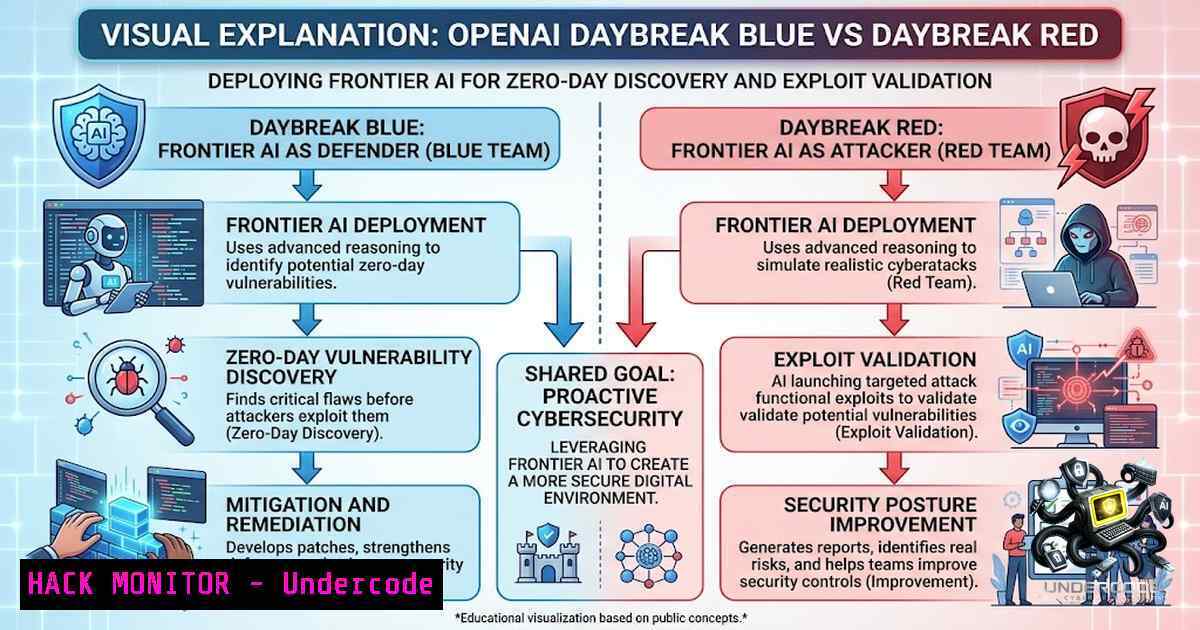
As threat actors increasingly leverage artificial intelligence to conduct cyberattacks at unprecedented speed and scale—including fully autonomous operations—defenders face a rapidly narrowing window to prepare. OpenAI has expanded its Daybreak cybersecurity program with two distinct access tiers—Daybreak Blue and Daybreak Red—alongside a new purpose-trained model, GPT-5.6-Cyber, designed to reduce refusal rates on legitimate but high-risk security tasks from 1.5% to 95%. This article provides a technical deep-dive into both tiers, practical implementation guidance, and actionable commands for security teams.
Learning Objectives:
- Understand the capability differences between Daybreak Blue (GPT-5.6 Sol) and Daybreak Red (GPT-5.6-Cyber) access tiers
- Learn how to integrate AI-assisted vulnerability discovery, exploit validation, and patch validation into existing security workflows
- Master the security controls, hardware key requirements, and monitoring protocols mandated for Daybreak access
You Should Know:
1. Daybreak Blue: Removing Guardrails for Defensive Operations
Daybreak Blue provides access to frontier general-purpose models, including GPT-5.6 Sol, with system-level cyber guardrails removed to support authorized defensive security work. OpenAI recommends this as the starting point for most defenders, supporting vulnerability discovery, secure code review, malware analysis, incident response, and patch validation. In internal evaluations, GPT-5.6 Sol through Daybreak Blue completed only 2.0% of advanced cybersecurity requests involving exploit-chain development, authentication bypass, and privilege escalation—compared to 95% for GPT-5.6-Cyber through Daybreak Red.
Step-by-Step Guide: Deploying Daybreak Blue for Incident Response
- Request Access: Apply through OpenAI’s Daybreak Cyber Partner Program with identity verification, account security controls, and legal attestations.
- Configure Isolated Environment: Set up a sandboxed workflow with scoped permissions and human oversight for higher-risk tasks.
- Deploy for Malware Analysis: Submit suspicious binaries or code snippets to GPT-5.6 Sol for behavioral analysis and signature extraction.
- Integrate with SIEM: Use API endpoints to feed security event data for automated correlation and threat hunting.
- Monitor and Log: Enable enhanced monitoring and Codex auto-review mode for actions requiring elevated privileges.
Linux Command for Automated Log Analysis with AI Integration:
 Extract suspicious patterns from system logs for AI-assisted review
sudo journalctl --since "24 hours ago" | grep -E "FAILED|ERROR|DENIED|segfault" > /var/log/suspicious_events.log

Use curl to submit log excerpts to Daybreak Blue API (example endpoint)
curl -X POST https://api.openai.com/v1/daybreak/blue/analyze \
-H "Authorization: Bearer $DAYBREAK_API_KEY" \
-H "Content-Type: application/json" \
-d '{"model": "gpt-5.6-sol", "task": "incident_response", "data": "'"$(cat /var/log/suspicious_events.log | head -100)"'"}'
- Daybreak Red: Purpose-Trained Models for Advanced Exploit Research
Daybreak Red provides access to purpose-trained cybersecurity models—specifically GPT-5.6-Cyber—for authorized vulnerability research, exploit validation, and security testing. Built on GPT-5.6 Sol, this model is fine-tuned to improve capabilities on specialized tasks such as finding zero-day vulnerabilities and developing exploit chains, while reducing refusals for higher-risk dual-use cyber prompts. OpenAI recommends Daybreak Red only for organizations conducting advanced, authorized research.
Step-by-Step Guide: Using Daybreak Red for Zero-Day Discovery
- Obtain Additional Approval: Daybreak Red requires separate vetting beyond Blue access, with stricter monitoring and use-case restrictions.
- Set Up Hardware Security Key: All individual Daybreak accounts must use hardware security keys starting September 1, 2026.
- Target Software for Analysis: Submit codebases (e.g., Chrome V8 JavaScript engine, OS kernels, databases) for AI-assisted fuzzing and vulnerability scanning.
- Validate Findings: Cross-reference AI-discovered vulnerabilities with manual verification and coordinated disclosure processes.
- Develop Exploit Chains: Use GPT-5.6-Cyber to simulate attack chains and validate exploit feasibility before patch deployment.
Windows Command for Vulnerability Scanning with AI Assistance:
 Collect system information for kernel-level vulnerability assessment
systeminfo | Out-File -FilePath C:\security\system_info.txt
Get-HotFix | Export-Csv -Path C:\security\installed_patches.csv -1oTypeInformation

Submit to Daybreak Red API for privilege escalation analysis (example)
$body = @{
model = "gpt-5.6-cyber"
task = "vulnerability_research"
data = Get-Content C:\security\system_info.txt -Raw
} | ConvertTo-Json

Invoke-RestMethod -Uri "https://api.openai.com/v1/daybreak/red/analyze" `
-Method Post `
-Headers @{Authorization = "Bearer $env:DAYBREAK_RED_API_KEY"} `
-Body $body -ContentType "application/json"
- Real-World Impact: GPT-5.6-Cyber Discovers Over 400 Kernel Vulnerabilities
OpenAI used GPT-5.6-Cyber to investigate real-world software, uncovering two previously unknown vulnerabilities in Chrome’s V8 JavaScript engine that could be chained to corrupt memory and escape the V8 heap sandbox—now patched as CVE-2026-15903. The model also identified at least five vulnerabilities in a popular mobile operating system, three critical flaws in a widely used database, and over 400 privilege-escalation issues in a popular operating system kernel. These discoveries demonstrate the model’s capability to accelerate vulnerability research from months to days.
Linux Command for Kernel Vulnerability Assessment:
 Check current kernel version and known CVEs
uname -r
cat /proc/version

Use AI-assisted fuzzing on kernel modules (conceptual example)
 Note: Actual implementation requires Daybreak Red API integration
for module in $(lsmod | awk '{print $1}' | tail -1 +2); do
echo "Analyzing module: $module"
 Submit module metadata for AI analysis
modinfo $module > /tmp/${module}_info.txt
done

Aggregate findings for AI-assisted review
cat /tmp/_info.txt | curl -X POST https://api.openai.com/v1/daybreak/red/fuzz \
-H "Authorization: Bearer $DAYBREAK_RED_API_KEY" \
-H "Content-Type: application/json" \
-d @-
4. Security Controls and Mitigation Measures
Access to both Daybreak tiers is restricted to approved individuals and organizations through identity verification, monitoring, approved-use restrictions, and legal attestations. OpenAI recommends isolating agents, scoping permissions tightly, and maintaining human oversight for higher-risk tasks. All individual Daybreak accounts must use hardware security keys starting September 1, 2026, with Codex users pushed toward auto-review mode instead of full-access mode.
API Security Hardening Commands:
 Generate and rotate API keys securely
openssl rand -base64 32 | tr -d '\n' > daybreak_api_key.txt

Set up hardware security key verification (YubiKey example)
ykman fido credentials list
ykman fido credentials delete --force <credential_id>

Implement IP allowlisting for API access
iptables -A INPUT -p tcp --dport 443 -s 203.0.113.0/24 -j ACCEPT
iptables -A INPUT -p tcp --dport 443 -j DROP
5. Partner Ecosystem and Enterprise Integration
OpenAI is expanding its Daybreak Cyber Partner Program with major security partners including Accenture, Cisco, Cloudflare, CrowdStrike, IBM, and Palo Alto Networks. These partners can integrate OpenAI’s frontier cyber models into their products, managed security services, and customer projects, enabling more organizations to leverage advanced cybersecurity capabilities without building specialized cyber AI programs themselves.
What Undercode Say:
- Key Takeaway 1: The 95% completion rate for advanced cybersecurity tasks represents a paradigm shift—defenders can now automate vulnerability discovery and exploit validation at scale, but this capability gap also means threat actors with similar access could accelerate offensive operations.
-
Key Takeaway 2: The distinction between Blue (2% completion rate) and Red (95% completion rate) highlights that removing guardrails alone is insufficient; purpose-trained models are essential for advanced security work, yet they require stricter vetting and monitoring to prevent misuse.
The strategic implications are profound. OpenAI’s decision to delay the Astra model over critical cyber capabilities while simultaneously releasing GPT-5.6-Cyber through gated access reflects a calculated risk: democratizing frontier intelligence for defenders before attackers deploy offensive AI at scale. However, the same model that found 400+ kernel privilege-escalation issues could, in the wrong hands, accelerate exploit development. The hardware security key mandate and enhanced monitoring are necessary but not sufficient—organizations must build internal AI governance frameworks to match the velocity of AI-assisted security research. The 400+ kernel vulnerabilities discovered underscore both the promise and the peril: AI can find what human researchers miss, but the patch backlog will only grow. The real challenge is not discovery—it’s remediation at scale.
Expected Output:
Introduction:
The cybersecurity industry faces an asymmetric threat: attackers will increasingly use AI to conduct cyberattacks at unprecedented speed and scale, including fully autonomous operations. OpenAI’s expanded Daybreak program—with its Blue and Red access tiers—aims to close this defense gap by putting frontier intelligence in the hands of trusted defenders before adversaries deploy offensive AI capabilities at scale.
Prediction:
- +1 AI-assisted vulnerability discovery will become standard practice within 12-18 months, compressing the time between vulnerability discovery and patch development from weeks to hours.
-
-1 The same models that accelerate defense will be weaponized by sophisticated threat actors, leading to a surge in zero-day exploitation and AI-generated attack chains that outpace traditional signature-based detection.
-
+1 The Daybreak Cyber Partner Program will catalyze a new ecosystem of AI-1ative security products, with major vendors embedding GPT-5.6-Cyber into SIEMs, EDRs, and SOAR platforms by Q1 2027.
-
-1 Organizations without access to Daybreak Red—or equivalent capabilities—will face a widening capability gap, increasing their exposure to AI-driven attacks that defenders cannot match without similar AI assistance.
-
+1 The 400+ kernel vulnerabilities discovered by GPT-5.6-Cyber will drive a new wave of open-source and commercial patch management automation, reducing the average patch deployment time from 60+ days to under 7 days for critical CVEs.
▶️ Related Video (78% Match):
https://www.youtube.com/watch?v=3iIPVaQ6aB4
🎯Let’s Practice For Free:
🎓 Live Courses & Certifications:
Join Undercode Academy for Verified Certifications
🚀 Request a Custom Project:
Secure, high-velocity infrastructure and disruptive technological engineering. Contact our engineering team for high-tier development and proprietary systems:
[email protected]
💎 Smart Architecture | 🛡️ Secure by Design | ⭐ Trusted by Thousands
IT/Security Reporter URL:
Reported By: Gregorydevans Openai – Hackers Feeds
Extra Hub: Undercode MoN
Basic Verification: Pass ✅


