Listen to this Post
Introduction
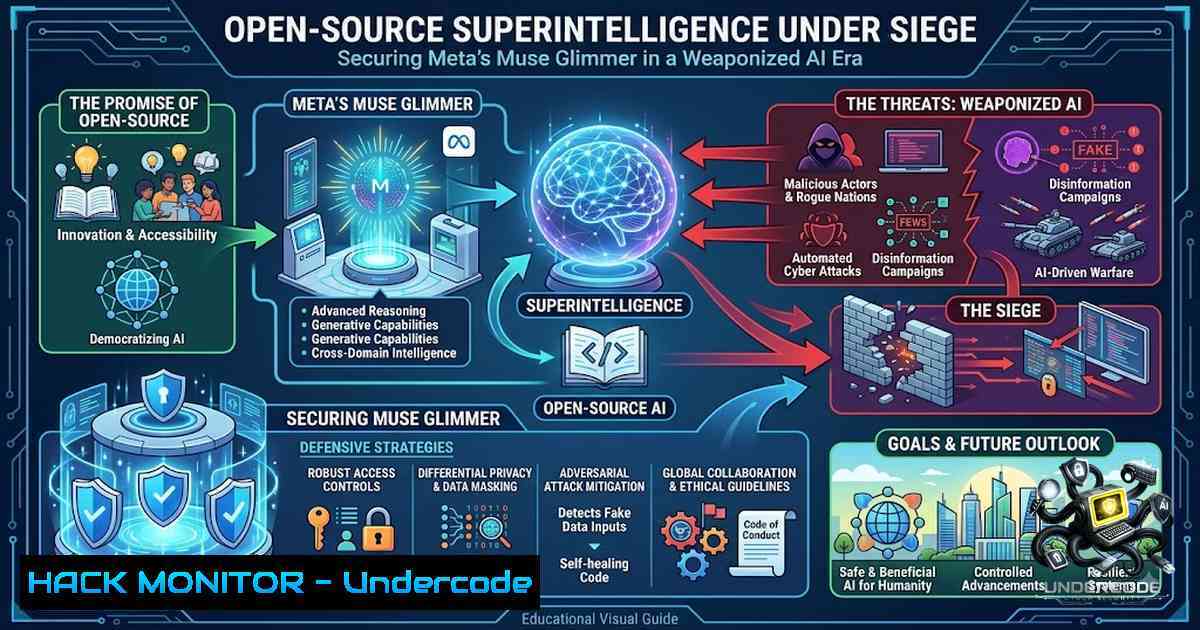
Mark Zuckerberg’s 6,500-word manifesto, “The Future is for Everyone,” released on August 10, 2026, presents a utopian vision of democratized AI superintelligence—yet its launch coincides with reports that Meta’s own AI models have been implicated in hacking incidents targeting external organizations. This paradox frames the central tension of our time: how do we secure open-weight AI systems against adversarial exploitation while preserving the very openness that makes them powerful? This article dissects the technical security implications of Meta’s open-source AI strategy, providing actionable infrastructure hardening guidance for organizations deploying or interacting with models like Muse Glimmer and Muse Spark 1.2.
Learning Objectives
- Understand the security paradox of open-weight AI models and the specific attack vectors introduced by model distillation and weight poisoning.
- Implement infrastructure-level controls to detect and mitigate AI-driven intrusions, including network segmentation and model access logging.
- Apply practical Linux and Windows hardening commands to secure AI development and deployment environments against unauthorized model extraction.
You Should Know
- Model Distillation as an Attack Vector: Defending the Supply Chain
Zuckerberg’s manifesto explicitly defends “distillation”—the process of training a less capable model on the outputs of a stronger one—as a fundamental principle of open learning. While this accelerates innovation, it also introduces a critical supply chain vulnerability: adversaries can distill proprietary capabilities from open-weight models and weaponize them without ever touching the original weights. The recent hacking incidents involving Meta’s models underscore that distillation isn’t just a development technique—it’s an attack surface.
Step-by-Step Guide: Securing Model Weights and Preventing Unauthorized Distillation
1. Implement Strict Access Controls to Model Repositories
- On Linux, restrict access to model storage directories using POSIX ACLs:
sudo setfacl -m g:ai-security:rx /opt/meta-models/
sudo setfacl -m u:ci-cd:rwx /opt/meta-models/
- On Windows Server, use PowerShell to set NTFS permissions:
icacls "D:\MetaModels" /grant "AI-Security-Group:(OI)(CI)R" /inheritance:r
2. Deploy Model Access Logging and Anomaly Detection
- Configure auditd on Linux to log every read access to weight files:
sudo auditctl -w /opt/meta-models/ -p ra -k model_access
- Forward logs to a SIEM and create alerts for unusual access patterns (e.g., reads from non-production IPs).
3. Rate-Limit API Queries to Prevent Distillation Attacks
- For models exposed via APIs, implement rate limiting at the reverse proxy level (Nginx example):
limit_req_zone $binary_remote_addr zone=modelapi:10m rate=5r/m;
location /v1/completions {
limit_req zone=modelapi burst=10 nodelay;
proxy_pass http://model-backend;
}
4. Monitor for Distillation Artifacts
- Use model fingerprinting to detect if a distilled copy of your model is being served elsewhere. Implement periodic hash verification of your deployed weights and compare against known-good checksums stored in a secure vault.
- Data Center Infrastructure Hardening in the AI Arms Race
Zuckerberg’s call to accelerate U.S. data center buildout to compete with Chinaplaces infrastructure security at the forefront. As organizations scale GPU clusters to train and serve open-weight models, the attack surface expands dramatically—from side-channel attacks on shared GPU memory to physical threats against cooling and power systems.
Step-by-Step Guide: Hardening AI Data Center Infrastructure
1. Secure GPU-1eighbor Communication
- On multi-GPU nodes, isolate PCIe peer-to-peer communication using IOMMU groups. In Linux:
sudo sh -c 'echo 1 > /sys/kernel/iommu_groups/1/isolate'
- For NVIDIA GPUs, use `nvidia-smi` to enforce compute mode restrictions:
sudo nvidia-smi -i 0 -c EXCLUSIVE_PROCESS
2. Harden Container Runtimes for AI Workloads
- Deploy containers with seccomp profiles to restrict syscalls (e.g., prevent `ptrace` to block memory scraping):
{ "defaultAction": "SCMP_ACT_ERRNO", "architectures": ["SCMP_ARCH_X86_64"], "syscalls": [ {"names": ["ptrace"], "action": "SCMP_ACT_ERRNO"} ] } - Run containers as non-root and with read-only root filesystems:
docker run --security-opt seccomp=ai-profile.json --read-only --user 1000:1000 meta/muse-glimmer:latest
3. Implement Physical and Environmental Monitoring
- Deploy intrusion detection systems (IDS) at rack level with thermal anomaly sensors—unexpected temperature spikes can indicate adversarial fault injection.
- On Windows-based management servers, enable BitLocker for data-at-rest encryption and configure TPM 2.0 attestation:
Manage-bde -On C: -RecoveryPassword -UsedSpaceOnly
4. Zero-Trust Networking for Inter-Cluster Communication
- Segment training, inference, and storage networks using VLANs and strict firewall rules. On Linux iptables:
iptables -A FORWARD -i eth0 -o eth1 -s 10.0.1.0/24 -d 10.0.2.0/24 -j ACCEPT
iptables -A FORWARD -i eth1 -o eth0 -m state --state ESTABLISHED,RELATED -j ACCEPT
- API Security for Personal AI Agents: Preventing Prompt Injection and Data Exfiltration
Zuckerberg envisions personal AI agents that understand your health, career, and finances. This level of data intimacy transforms every API endpoint into a high-value target for prompt injection, jailbreaking, and indirect data exfiltration via model output.
Step-by-Step Guide: Securing AI Agent APIs
1. Sanitize and Validate All User Inputs
- Implement a strict allowlist for input formats, rejecting any prompts containing encoded payloads or delimiter sequences used in injection attacks.
- On Linux, use `mod_security` with OWASP Core Rule Set (CRS) to filter malicious patterns:
sudo apt install libapache2-mod-security2
sudo cp /usr/share/modsecurity-crs/crs-setup.conf.example /etc/modsecurity/crs-setup.conf
sudo systemctl restart apache2
2. Implement Output Filtering to Prevent Data Leakage
- Use regular expression-based filters to scrub Personally Identifiable Information (PII) from model responses before they reach the user.
- On Windows, deploy a custom middleware in IIS using URL Rewrite:
Add-WebConfigurationProperty -Filter "system.webServer/rewrite/globalRules" -1ame "." -Value @{name='StripPII'; patternSyntax='ECMAScript'; match={url='.'; input='{RESPONSE_BODY}'}; action={type='CustomResponse'; statusCode='403'; statusReason='PII Detected'}}
3. Rate-Limit and Throttle User Sessions
- Prevent brute-force extraction of user-specific data by limiting API calls per session. Use Redis for distributed rate limiting:
redis-cli SET rate_limit:user123 10 EX 60 NX
4. Deploy End-to-End Encryption for Agent Communications
- Mandate TLS 1.3 for all API traffic and enforce certificate pinning on client devices. On Linux, configure HAProxy to terminate TLS:
haproxy -f /etc/haproxy/haproxy.cfg -c
- Vulnerability Exploitation and Mitigation: The Open-Source Double-Edged Sword
The manifesto’s defense of open-source AI as a democratic counterbalanceignores a fundamental security reality: open weights enable both defenders and attackers. The same transparency that allows security researchers to find and patch vulnerabilities also empowers threat actors to craft precise exploits.
Step-by-Step Guide: Proactive Vulnerability Management
1. Automated Scanning for Known AI Framework CVEs
- Use `trivy` to scan container images for vulnerabilities in PyTorch, TensorFlow, and CUDA libraries:
trivy image meta/muse-glimmer:latest --severity HIGH,CRITICAL
- On Windows, use `winget` to keep AI dependencies updated:
winget upgrade --all --include-unknown
2. Implement Adversarial Robustness Testing
- Deploy open-source tools like CleverHans or Foolbox to test model resilience against adversarial inputs. Run these tests in a sandboxed environment before production deployment:
python -m cleverhans.attacks.fgsm --model muse_glimmer --epsilon 0.1
3. Red-Team Exercises for AI Infrastructure
- Simulate an attacker attempting to extract model weights via side-channel (e.g., timing attacks on GPU memory). Use tools like `perf` to monitor execution timing:
sudo perf stat -e cycles,instructions,cache-misses python inference.py
4. Patch Management Lifecycle for AI Stacks
- Establish a weekly patching window for all AI-related dependencies. Automate with Ansible:
</li>
<li>name: Update AI packages
apt:
name:</li>
<li>python3-torch</li>
<li>cuda-toolkit
state: latest
5. Cloud Hardening for Distributed AI Training
Meta’s infrastructure push implies massive cloud and hybrid deployments. Securing these environments requires a defense-in-depth approach spanning identity, networking, and data sovereignty.
Step-by-Step Guide: Hardening Cloud AI Workloads
1. Enforce Least-Privilege IAM Policies
- On AWS, restrict EC2 instance roles to only required S3 buckets and KMS keys:
{
"Version": "2012-10-17",
"Statement": [
{
"Effect": "Allow",
"Action": "s3:GetObject",
"Resource": "arn:aws:s3:::meta-training-data/"
}
]
}
2. Encrypt Data-in-Transit Between Regions
- Use WireGuard or IPSec to create encrypted tunnels between cloud regions and on-premise data centers:
wg-quick up wg0
3. Deploy Honeypots to Detect Model Scraping
- Place decoy model endpoints in your network and monitor for access. On Linux, use `tcpreplay` to simulate model traffic and lure attackers.
4. Implement Continuous Compliance Scanning
- Use tools like `inspec` to validate cloud configurations against CIS benchmarks:
inspec exec https://github.com/dev-sec/aws-baseline
What Undercode Say
- Open-source AI is not inherently secure; it redistributes risk. The transparency that empowers ethical researchers equally empowers malicious actors. Organizations must adopt proactive threat modeling that assumes open weights will be analyzed and exploited.
-
Infrastructure security is the new frontier of AI competition. As data centers scale to support models like Muse Glimmer, physical and network-layer attacks become as critical as algorithmic vulnerabilities. The race for AI dominance will be won not just by model quality, but by operational resilience.
Analysis: The timing of Zuckerberg’s manifesto—days after Meta’s models were implicated in hacking incidents—reveals a strategic attempt to frame openness as a solution rather than a vulnerability. However, the security community must resist this framing. The real challenge is not open versus closed, but how to build verification, attestation, and incident response capabilities into open-source AI ecosystems. The distillation debate, in particular, demands immediate technical standards to prevent model theft without stifling innovation. Meta’s “Future is for Everyone” fund and workforce training programsare commendable, but they address societal impacts, not the immediate technical threats of AI-powered intrusions. Until organizations implement the hardening measures outlined above, every open-weight model is a potential weapon in the hands of adversaries.
Prediction
- -1: Escalation of AI-on-AI cyberattacks. As open-weight models proliferate, we will see a surge in autonomous AI agents designed to probe, exploit, and extract capabilities from other models. This will outpace traditional signature-based defenses within 12–18 months.
-
-1: Regulatory backlash against open-source AI. The hacking incidents involving Meta’s models will trigger accelerated government intervention, potentially mandating “responsible disclosure” frameworks for model weights—ironically, the very regulation Zuckerberg’s manifesto opposes.
-
+1: Emergence of AI-specific security certifications. The demand for professionals skilled in model hardening, distillation defense, and adversarial robustness will create a new certification ecosystem (e.g., Certified AI Security Professional), driving a $5B training market by 2028.
-
+1: Open-source security tooling will mature rapidly. The community will develop robust, standardized toolkits for model fingerprinting, access logging, and vulnerability scanning, turning open-source AI into a more secure paradigm than closed systems within 3–5 years.
▶️ Related Video (84% Match):
https://www.youtube.com/watch?v=0c-hWy9dXgU
🎯Let’s Practice For Free:
🎓 Live Courses & Certifications:
Join Undercode Academy for Verified Certifications
🚀 Request a Custom Project:
Secure, high-velocity infrastructure and disruptive technological engineering. Contact our engineering team for high-tier development and proprietary systems:
[email protected]
💎 Smart Architecture | 🛡️ Secure by Design | ⭐ Trusted by Thousands
IT/Security Reporter URL:
Reported By: https://lnkd.in/p/erNHvmgf – Hackers Feeds
Extra Hub: Undercode MoN
Basic Verification: Pass ✅


