
Listen to this Post
Introduction:
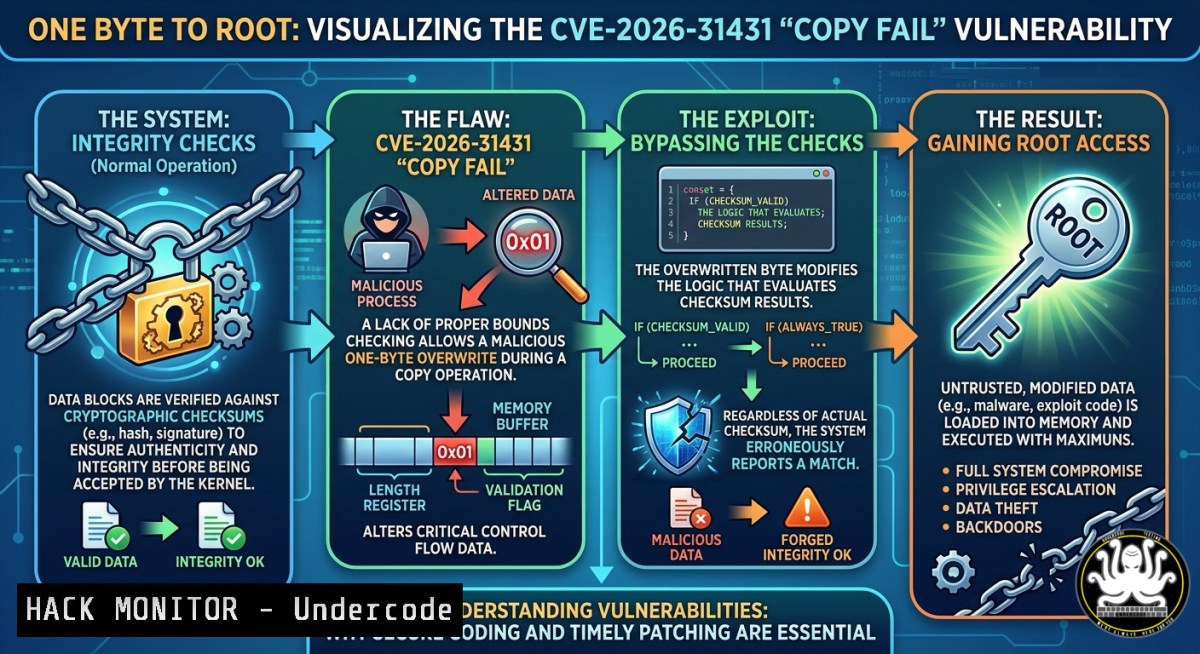
A newly disclosed Linux kernel vulnerability, CVE-2026-31431 (nicknamed “Copy Fail”), allows any unprivileged local user to gain root access by abusing a cryptographic operation to write a few bytes into the page cache – the kernel’s in‑memory representation of files. What makes this flaw exceptionally dangerous is that the malicious modification never touches the disk: trusted binaries like /usr/bin/su can be altered in memory only, rendering file‑based integrity checks and traditional forensic analysis completely blind.
Learning Objectives:
- Understand how CVE-2026-31431 exploits the kernel’s crypto interface (AF_ALG) to perform arbitrary write‑into‑page‑cache.
- Learn practical detection techniques using memory forensics and runtime integrity monitoring on Linux systems.
- Implement mitigation strategies including disabling the vulnerable kernel module, applying patches, and hardening shared environments (containers, CI/CD runners, bastions).
You Should Know:
- Understanding Copy Fail – Anatomy of a Memory‑Only Root Exploit
The vulnerability resides in the kernel’s cryptographic subsystem, specifically the `algif_aead` module. An unprivileged attacker can craft a series of AF_ALG socket calls that cause the kernel to write a controlled set of bytes into the page cache of an arbitrary file. Because the page cache is the kernel’s volatile buffer for file I/O, the modified content is served to any process that reads or executes the file – without the on‑disk copy ever changing.
Step‑by‑step mechanics (simplified):
- Attacker opens an AF_ALG socket and binds an AEAD algorithm (e.g.,
gcm(aes)). - Using a specific sequence of `sendmsg()` and `recvmsg()` calls with malformed scatter‑gather lists, the kernel incorrectly calculates page offsets.
- The flawed crypto operation writes a few bytes (e.g., 732) into a page cache page belonging to
/usr/bin/su. - Next time any user runs
/usr/bin/su, the kernel loads the in‑memory tampered version – for example, patching a conditional jump to bypass authentication.
Why it’s so stealthy:
- Disk hashes (SHA256, MD5) remain unchanged.
- File integrity monitors (AIDE, Tripwire, OSSEC) detect nothing.
- A simple reboot clears the malicious page cache, erasing all evidence.
Verification commands (Linux):
 Check if your kernel is vulnerable (example version range – consult vendor)
uname -r
 List loaded crypto modules – vulnerable if 'algif_aead' is present
lsmod | grep algif

Test for AF_ALG availability (attacker would use this)
cat /proc/crypto | grep "aead"
- Exploitation in Practice – From User to Root on Shared Systems
An attacker with a low‑privilege shell on a vulnerable Linux machine can escalate to full root without leaving disk artifacts. The most attractive targets are multi‑tenant environments: shared web hosting, CI/CD runners (GitHub Actions, GitLab CI), Kubernetes worker nodes, and bastion hosts. Because the exploit is reliable and does not cause kernel panics (unlike many memory‑corruption bugs), adversaries can silently pivot.
Attack flow:
- Gain initial foothold (e.g., via compromised container, SSH user, or web app RCE).
- Run the exploit binary (or Python/PoC script) that abuses AF_ALG.
- Patch `/usr/bin/su` in memory to always return root privileges.
4. Execute `su` and spawn a root shell.
- Install persistence (e.g., root SSH key, kernel module) – though the memory‑only change vanishes after reboot, so attackers typically deploy a backdoor.
Simple proof‑of‑concept idea (illustrative – not full exploit):
 Pseudo-code / educational example
import socket
import struct

sock = socket.socket(socket.AF_ALG, socket.SOCK_SEQPACKET, 0)
sock.bind(('aead', 'gcm(aes)'))
 Malformed sendmsg/recvmsg sequence triggers page cache write
 (actual offsets and ciphertext are carefully crafted)
Defenders should assume: an attacker who can run arbitrary code on a shared Linux host can trivially root it. This vulnerability raises the urgency of moving to zero‑trust and immutable infrastructure.
3. Detection and Forensic Countermeasures
Traditional file‑based forensics fails. Incident responders must adopt memory forensics and runtime integrity checks. The key is to detect inconsistencies between disk and live memory or to monitor AF_ALG usage.
Live detection commands:
 Compare running binary’s memory map with on‑disk file
cmp -l /proc/$(pgrep -f "/usr/bin/su")/exe /usr/bin/su

Use 'dmidecode' or 'sudo cat /proc/kpagecount' for advanced analysis
 Scan for unexpected AF_ALG sockets
ss -x | grep -i alg

Audit AF_ALG system calls (requires auditd)
auditctl -a always,exit -F arch=b64 -S socket -k AF_ALG
ausearch -k AF_ALG
Memory forensics with LiME and Volatility:
 Capture RAM (LiME kernel module)
insmod lime.ko "path=/tmp/mem.lime format=lime"

Volatility 3 plugin for page cache anomalies
vol3 -f /tmp/mem.lime linux.pslist
vol3 -f /tmp/mem.lime linux.malfind
Proactive monitoring: Deploy eBPF probes to detect writes to executable page cache pages not backed by disk writes. Example using bpftrace:
bpftrace -e 'kprobe:do_wp_page { @[bash] = count(); }'
- Mitigation – Disabling the Vulnerable Module (Temporary Workaround)
If patching is delayed (e.g., custom kernels, air‑gapped systems), disable the `algif_aead` module. This breaks the attack vector without requiring a reboot – but note: some applications may rely on AEAD via AF_ALG (rare). Always test first.
Immediate steps (Linux):
 Check if module is loaded
lsmod | grep algif_aead

Unload the module (as root)
modprobe -r algif_aead

Blacklist to prevent reload after reboot
echo "blacklist algif_aead" > /etc/modprobe.d/disable-af_alg.conf

Alternative: restrict AF_ALG via LSM (AppArmor/SELinux)
 For containers, use seccomp to block socket(AF_ALG)
Container hardening (Docker/Kubernetes):
 Pod Security Policy / seccomp profile
seccomp.security.alpha.kubernetes.io/pod: 'localhost/block-af_alg.json'
// block-af_alg.json – prevents socket(AF_ALG)
{"defaultAction":"SCMP_ACT_ALLOW","architectures":["SCMP_ARCH_X86_64"],"syscalls":[{"names":["socket"],"action":"SCMP_ACT_ALLOW","args":[{"index":0,"value":38,"op":"SCMP_CMP_NE"}]}]}
CI/CD runners: Enforce that untrusted code cannot load kernel modules or access /proc/crypto. Use user namespaces carefully – this vulnerability is exploitable from inside unprivileged containers if the kernel exposes AF_ALG.
- Patching and Recovery – Applying the Kernel Fix
Vendors have released patched kernels (e.g., for RHEL, Ubuntu, Debian, SUSE). The fix corrects the AEAD scatter‑gather length validation, preventing the out‑of‑bounds page cache write.
Step‑by‑step patching:
1. Update kernel packages:
 Debian/Ubuntu
sudo apt update && sudo apt upgrade linux-image-$(uname -r)
 RHEL/CentOS 8/9
sudo dnf update kernel
 SUSE
sudo zypper patch
2. Reboot immediately – the vulnerability is in the running kernel, so a reboot is mandatory (unlike many other CVEs).
sudo systemctl reboot
3. Verify the fix:
 Check kernel version (e.g., >= 5.15.120, 6.1.38, 6.4.12 depending on distro)
uname -r
 Attempt to trigger the bug (if you have a test system) – the exploit should fail.
4. After reboot, re‑enable AF_ALG only if absolutely required. Monitor for unusual AF_ALG socket creation.
Recovery from suspected compromise:
- If you suspect an attacker used this flaw, do not trust the system – memory changes are gone after reboot, but they may have installed persistent rootkits or SSH keys.
- Perform offline forensics on the disk (hash all binaries) and redeploy from a known‑good image.
- Rotate all secrets that touched the compromised host.
6. Long‑Term Hardening Against Memory‑Only Attacks
CVE-2026-31431 is a wake‑up call: integrity monitoring must move beyond disk hashes. Adopt the following practices:
- Runtime integrity (Linux Integrity Measurement Architecture – IMA): Enable IMA to measure files before they are executed or mmap()ed. Compare against a trusted database.
Enable IMA in kernel cmdline: ima=on ima_template=ima-ng
Measure all files executed
echo "measure func=BPRM_CHECK mask=MAY_EXEC" > /sys/kernel/security/ima/policy
- eBPF‑based page cache monitoring: Write eBPF programs that track writes to page cache pages belonging to executables.
- Reduce kernel attack surface: Remove unused crypto algorithms and restrict AF_ALG via seccomp in all containers and user sessions.
- Immutable infrastructure: Prefer stateless, ephemeral hosts that are rebuilt after each deployment. CVE-2026-31431 loses its power if the system reboots frequently.
What Undercode Say:
- Disk integrity is no longer sufficient. This vulnerability demonstrates that an attacker can completely subvert a trusted binary while leaving the filesystem “clean.” Red teams and auditors must adopt memory forensics and runtime verification.
- Shared environments are prime targets. CI/CD runners, shared hosting, and Kubernetes nodes running untrusted code are at highest risk. Isolate workloads with strict seccomp profiles that block
socket(AF_ALG). - Patching alone is not enough. A kernel update plus reboot is mandatory, but many organizations delay reboots for weeks. Blacklisting `algif_aead` provides immediate protection. Combine this with active monitoring of AF_ALG syscalls.
- This is not an isolated incident. As kernel complexity grows, similar “page cache write” bugs will emerge. Invest in eBPF‑based runtime security (e.g., Falco, Tetragon) and move toward zero‑trust execution (e.g., confidential computing).
Prediction:
CVE-2026-31431 will be weaponized within days of public disclosure. Expect widespread exploitation in shared hosting and CI/CD services, leading to supply‑chain attacks where code signing keys or secrets are stolen from vulnerable build runners. Cloud providers will urgently patch and force customer reboots, but legacy on‑premises Linux servers may remain exposed for months. In the long term, this flaw will accelerate the adoption of memory‑hardened kernels, eBPF integrity monitoring, and immutable OS designs – finally pushing the industry away from file‑centric trust models. Expect at least two similar “in‑memory only” kernel vulnerabilities to be disclosed in the next year as researchers turn their attention to page cache attack surfaces.
▶️ Related Video (78% Match):
🎯Let’s Practice For Free:
IT/Security Reporter URL:
Reported By: Kondah Quand – Hackers Feeds
Extra Hub: Undercode MoN
Basic Verification: Pass ✅


