
Listen to this Post
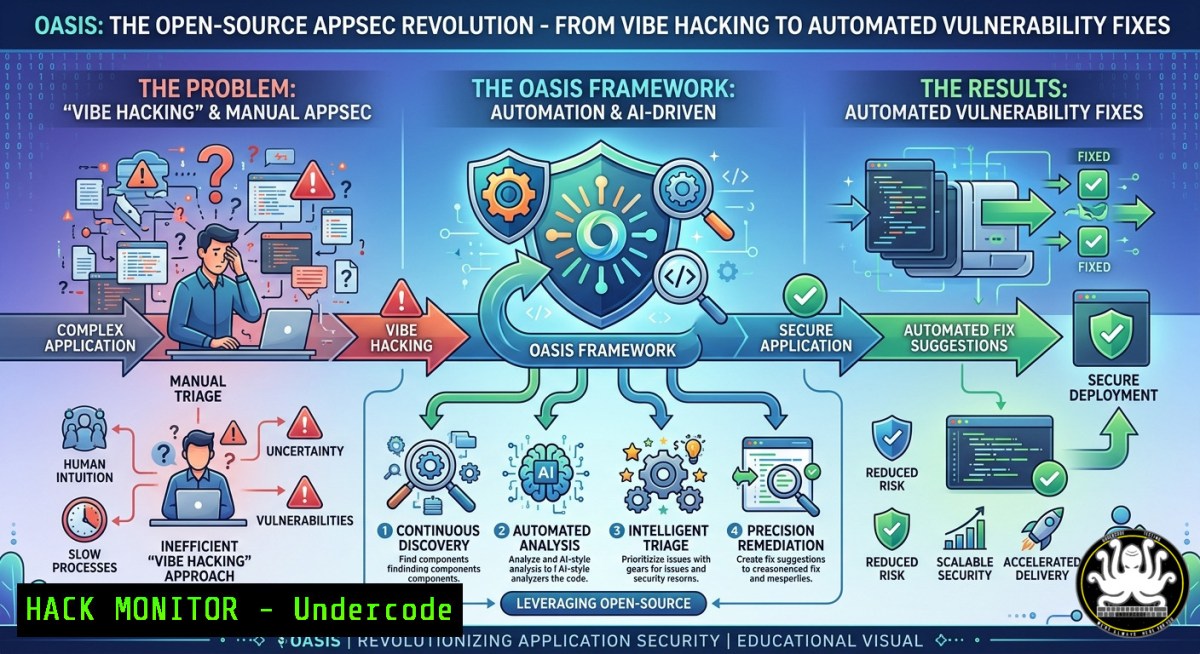
Introduction:
Open source software (OSS) powers 99% of modern enterprises, yet “vibe hacking”—the rapid, AI-generated code slop that introduces fresh vulnerabilities—has outrun traditional security reviews. OASIS (Open AppSec Infrastructure for Secure Software) emerges as a transparent, community-driven initiative under OWASP sponsorship review, designed not just to find flaws but to actively fix them at scale, bridging the gap between appsec engineers and developers.
Learning Objectives:
- Implement automated vulnerability remediation workflows using OASIS community tooling
- Execute command-line audits and patch validation across Linux and Windows environments
- Integrate OWASP-compliant fix pipelines into CI/CD to counter AI-induced OSS exploits
You Should Know:
1. Setting Up Your OASIS Contribution Environment
OASIS requires a local security lab to test vulnerability fixes before upstream patches. Start by cloning a vulnerable OSS project and installing essential audit tools.
Step‑by‑step guide (Linux/macOS):
 Clone a target OSS repository (example: a deliberately vulnerable app)
git clone https://github.com/OWASP/NodeGoat.git
cd NodeGoat

Install OWASP Dependency-Check and NPM audit
sudo apt update && sudo apt install -y owasp-dependency-check npm
npm install
npm audit --json > npm-audit-report.json

Install Trivy for container/composite scanning
wget https://github.com/aquasecurity/trivy/releases/download/v0.50.0/trivy_0.50.0_Linux-64bit.deb
sudo dpkg -i trivy_0.50.0_Linux-64bit.deb
trivy fs . --severity HIGH,CRITICAL
Step‑by‑step guide (Windows PowerShell):
 Install Chocolatey package manager, then required tools
Set-ExecutionPolicy Bypass -Scope Process -Force
[System.Net.ServicePointManager]::SecurityProtocol = [System.Net.ServicePointManager]::SecurityProtocol -bor 3072
iex ((New-Object System.Net.WebClient).DownloadString('https://community.chocolatey.org/install.ps1'))

choco install owasp-dependency-check trivy git -y
git clone https://github.com/OWASP/NodeGoat.git
cd NodeGoat
npm install
dependency-check --scan . --format JSON --out dependency-report.json
This environment lets you reproduce vulnerabilities locally and test OASIS‑submitted patches.
2. Automated Vulnerability Scanning with OWASP Tools
OASIS encourages using OWASP’s automated scanners to identify fixable CVEs. Below commands integrate with the community’s validation pipeline.
Linux command set:
 Run a full OWASP ZAP API scan against a local OSS service (e.g., port 8080)
docker run -v $(pwd):/zap/wrk:rw -t ghcr.io/zaproxy/zaproxy:stable zap-api-scan.py \
-t http://localhost:8080/openapi.json -f openapi -r zap_report.html

Use OWASP Nettacker for network-layer exposure
git clone https://github.com/OWASP/Nettacker.git
cd Nettacker
python3 nettacker.py -i 127.0.0.1/24 -g -m vuln_scan
Windows (WSL2 or PowerShell with Docker Desktop):
docker run -v ${PWD}:/zap/wrk:rw -t ghcr.io/zaproxy/zaproxy:stable zap-full-scan.py `
-t https://your-test-app.com -r full_scan.html
These reports output CVE IDs and patch recommendations that OASIS members then turn into merge requests.
- Vibe Hacking Exploitation and Mitigation (AI-Generated Code Slop)
“Vibe hacking” refers to low‑quality AI‑generated code that introduces SQLi, XSS, or hardcoded secrets. OASIS provides regex and Semgrep rules to catch this slop before merging.
Step‑by‑step detection (Linux/macOS):
 Install Semgrep and run OWASP ruleset against a suspicious AI‑generated commit
python3 -m pip install semgrep
semgrep --config "p/owasp-top-ten" --config "p/secrets" ./ai_generated_module/

Grep for typical AI slop patterns
grep -rn "password.=.['\"]" . --include=".py" --include=".js"
grep -P 'eval(.)|exec(.)' -r .
Mitigation commands (replace insecure patterns):
 Fix hardcoded secrets (Linux)
sed -i 's/password = "hardcoded"/password = os.getenv("DB_PASS")/' config.py

Windows (PowerShell)
(Get-Content config.py) -replace 'password = "hardcoded"', 'password = $env:DB_PASS' | Set-Content config.py
OASIS validates such fixes and submits them upstream, turning AI‑induced breakage into community hardened code.
- Fixing at Scale: Patch Management with Git and CI/CD
OASIS automates fix validation using GitHub Actions. The following pipeline checks for vulnerability reduction and passes/fails builds.
Example `.github/workflows/oasis-fix.yml`:
name: OASIS Vulnerability Fix Validation
on:
pull_request:
paths:
- '.py'
- '.js'

jobs:
validate-fix:
runs-on: ubuntu-latest
steps:
- uses: actions/checkout@v4
- name: Run Trivy scan
run: |
trivy fs --exit-code 1 --severity CRITICAL .
- name: OWASP Dependency-Check
run: |
dependency-check --scan . --failOnCVSS 7
- name: Semgrep AI slop detection
run: semgrep --config "p/owasp-top-ten" --error
To apply a patch manually:
git checkout -b oasis-fix-CVE-2025-1234
git apply /path/to/oasis-submitted.patch
git commit -m "OASIS: fix CVE-2025-1234 via upstream community patch"
git push origin oasis-fix-CVE-2025-1234
 Create PR for maintainers
Windows equivalents use `git apply` in Git Bash or `patch` via WSL.
5. Cloud Hardening for Open Source Deployments
Many OSS projects run on cloud infrastructure. OASIS teaches hardening using infrastructure‑as‑code (IaC) scanning.
AWS CLI commands (Linux/macOS):
 Enforce security groups to block public access to vulnerable services
aws ec2 authorize-security-group-ingress --group-id sg-12345678 --protocol tcp --port 22 --cidr 203.0.113.0/24

Use checkov to scan Terraform for OWASP-recommended rules
pip install checkov
checkov -d ./terraform/ --framework terraform --soft-fail
Azure CLI (Windows/PowerShell):
 Restrict vulnerable VM ports
az vm open-port --port 80 --resource-group MyRG --name MyVM --priority 900 --allow --source-address-prefixes 0.0.0.0/0
az vm open-port --port 443 --resource-group MyRG --name MyVM --priority 901 --allow
These commands directly reduce the attack surface of OSS applications, aligning with OASIS’s mission to fix, not just find.
- API Security in OSS Projects (Joining OASIS Validation)
Most OSS vulnerabilities hide in REST/GraphQL APIs. OASIS provides a public test harness using Postman and OWASP ZAP.
Step‑by‑step API fuzzing (Linux):
 Spin up OWASP CRS (Core Rule Set) for API gateway using Docker
docker run -d -p 8080:80 owasp/modsecurity-crs:nginx

Run ZAP’s API spider and active scan
zap-cli quick-scan --self-contained --spider -s xss,sqli http://localhost:8080/api/v1/users
Using `curl` to test an OASIS‑reported endpoint:
curl -X POST http://vulnerable-oss-app/api/login -H "Content-Type: application/json" -d '{"username":"admin","password":"'\"'"'"OR 1=1--"}' SQLi test
If the server returns a 200 with data, the fix is needed. OASIS members use this evidence to craft patches.
Windows (PowerShell with curl.exe):
curl.exe -X POST http://vulnerable-oss-app/api/login -H "Content-Type: application/json" -d "{\"username\":\"admin\",\"password\":\"' OR 1=1--\"}"
After validating, members sign up at `https://owasp-oasis.org` (note: the post cites `owasp-oasis.com` redirects to the secure OWASP domain) and submit fix proposals through the community dashboard.
7. Joining OASIS: Registration and Contribution Workflow
OASIS is currently under OWASP sponsorship review. To join and start fixing vulnerabilities:
Step‑by‑step:
- Navigate to `https://owasp-oasis.org` (DNS verified – always check OWASP’s official channels for final URL).
- Click “Join Community” – provide GitHub handle, AppSec experience level, and areas of interest (e.g., AI slop, dependency management).
3. Complete the OWASP Code of Conduct agreement.
- Access the OASIS triage board showing open vulnerabilities in projects like Apache, Kubernetes, or Node.js.
- Check out a vulnerable repo, apply a fix using commands from sections 1–6, then push a PR tagged `
` for community review.</li>
<li>Once merged, your fix is counted toward OASIS’s “fixes at scale” metric, influencing OWASP sponsorship.</li>
</ol>

<h2 style="color: yellow;">Example fix verification script (Linux):</h2>

[bash]
!/bin/bash
 Validate that a patch actually reduces CVSS score
pre_fix=$(dependency-check --scan . --format JSON | jq '.dependencies[].vulnerabilities[].cvssScore' | sort -rn | head -1)
git apply my-fix.patch
post_fix=$(dependency-check --scan . --format JSON | jq '.dependencies[].vulnerabilities[].cvssScore' | sort -rn | head -1)
if (( $(echo "$post_fix < $pre_fix" | bc -l) )); then
echo "OASIS validation PASSED: severity reduced"
else
echo "OASIS validation FAILED: no CVSS reduction"
exit 1
fi
What Undercode Say:
- OASIS shifts AppSec from “finding trophies” to “fixing at scale,” directly countering AI‑generated vulnerability churn.
- Automated fix validation (via Trivy, Dependency‑Check, Semgrep) is the missing pipeline that makes community‑driven OSS security credible.
- The initiative’s pending OWASP sponsorship grants it authority to enforce secure coding standards across thousands of open source projects.
Analysis: The LinkedIn conversation highlights frustration with “AI slop” outpacing traditional bug bounties. OASIS provides a repeatable, metric‑driven framework where Linux and Windows engineers collaborate via versioned patches. By embedding commands like `semgrep –config “p/secrets”` and `trivy fs .` into PR checks, the community ensures that every fix demonstrably lowers risk. The integration with IaC (checkov, AWS CLI) also hardens cloud deployments—a critical layer often ignored in OSS. OASIS’s success will depend on maintaining fix quality over quantity, but its model of merging automation with human appsec review is the only way to beat vibe hacking.
Prediction: Within 18 months, OASIS (or a similar OWASP‑sponsored entity) will become the standard for “patch‑as‑a‑service” in critical open source libraries. Expect GitHub’s Dependabot and GitLab’s security features to natively integrate OASIS fix pipelines, automatically applying community‑vetted patches. Enterprises will mandate OASIX compliance (an emerging standard) as a supply chain security requirement, reducing mean‑time‑to‑fix from weeks to hours. However, the initiative must resist becoming another bug‑bounty clone—its unique selling point is the automated fix validation, not just disclosure. The vibe‑hacking threat will only accelerate, making OASIS not optional but foundational.
▶️ Related Video (82% Match):
🎯Let’s Practice For Free:
IT/Security Reporter URL:
Reported By: Flyingtoasters Open – Hackers Feeds
Extra Hub: Undercode MoN
Basic Verification: Pass ✅🔐JOIN OUR CYBER WORLD [ CVE News • HackMonitor • UndercodeNews ]
📢 Follow UndercodeTesting & Stay Tuned:


