Listen to this Post
Introduction:
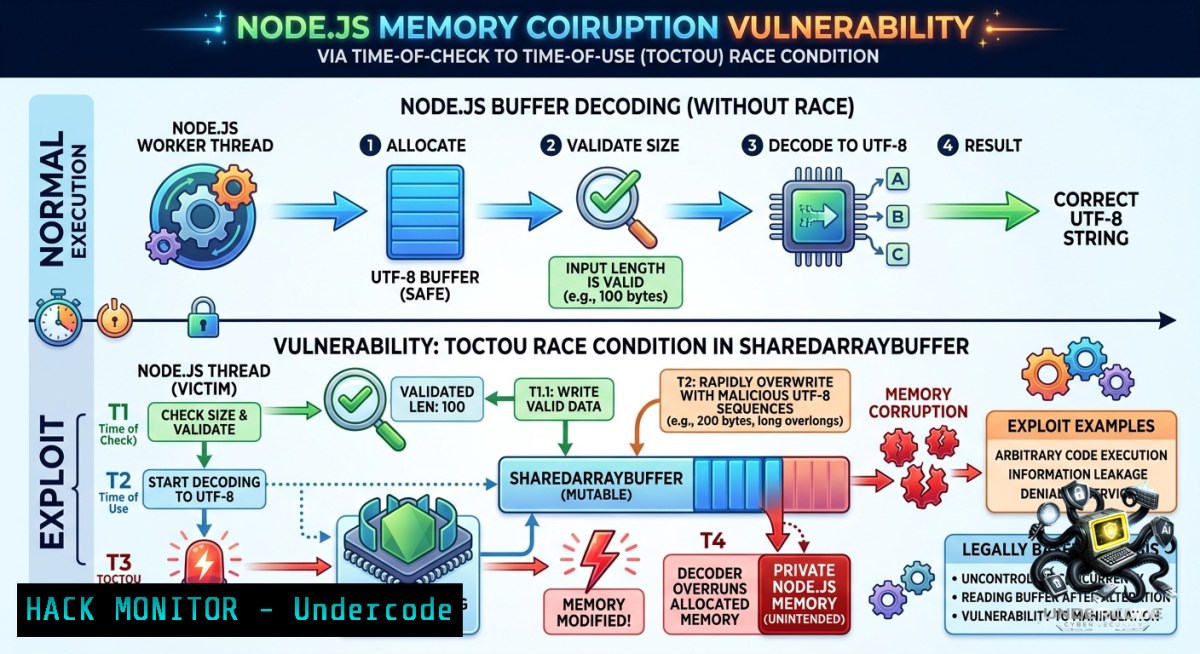
A TOCTOU (Time-Of-Check to Time-Of-Use) race condition in Node.js’s UTF-8 decoding process for SharedArrayBuffers can lead to memory corruption and application crashes. While the Node.js team classified this as “Informative,” the vulnerability is a textbook example of how modern, high-performance code paths can inadvertently create dangerous security holes. This issue underscores the critical need for secure coding practices when handling shared memory in concurrent JavaScript environments.
Learning Objectives:
- Understand the mechanics of a TOCTOU race condition and how it can compromise memory safety in Node.js applications.
- Learn to identify potential risks when using `SharedArrayBuffer` and `Buffer.prototype.toString(‘utf8’)` in multi-worker setups.
- Acquire practical knowledge of mitigation strategies, including defensive copying and fallback code paths, to prevent similar vulnerabilities.
1. Understanding the TOCTOU Vulnerability in `StringBytes::Encode`
The core of the issue lies in a performance optimization. When Node.js decodes a `SharedArrayBuffer` to a UTF-16 string using Buffer.prototype.toString(‘utf8’), the `StringBytes::Encode` function employs a fast-path that uses the `simdutf` library for large buffers (>=32 bytes). This fast-path performs three distinct steps: validation of the UTF-8 data, calculation of the required output length, and the actual conversion. However, because the data resides in a SharedArrayBuffer, another thread (e.g., a Web Worker) can modify that memory between any of these steps. If a malicious worker alters the buffer after validation but before conversion, the conversion routine may read invalid or unexpected byte patterns, leading to out-of-bounds reads, heap corruption, or a segmentation fault.
Step-by-step guide to reproduce the behaviour (Conceptual):
a) Create a SharedArrayBuffer and populate it with valid UTF-8 data:
// main.js - Main thread
const sab = new SharedArrayBuffer(1024);
const uint8View = new Uint8Array(sab);
// Fill with valid multi-byte UTF-8 sequences (e.g., 2-byte characters)
uint8View.set([0xC2, 0xA9, 0xC2, 0xAE]); // © and ® symbols
b) Spawn a worker to continuously corrupt the buffer:
// worker.js - Malicious worker
const parentPort = require(‘worker_threads’).parentPort;
let corrupt = false;
setInterval(() => {
const sab = getSharedBufferFromMain(); // Hypothetical function to get SAB reference
const uint8View = new Uint8Array(sab);
if (corrupt) {
// Restore valid UTF-8
uint8View.set([0xC2, 0xA9, 0xC2, 0xAE]);
} else {
// Corrupt the buffer with invalid UTF-8 sequences
uint8View.set([0xFF, 0xFE, 0x00, 0x00]);
}
corrupt = !corrupt;
}, 1);
c) Main thread repeatedly decodes the buffer:
// main.js - continued
setInterval(() => {
const buffer = Buffer.from(sab);
try {
const str = buffer.toString(‘utf8’); // The vulnerable point
} catch (e) {
console.error(“Crash or exception:”, e);
}
}, 1);
This racing condition between the main thread’s decode operation and the worker’s corruption attempt can trigger the memory fault.
2. Mitigating the Threat: Defensive Coding Strategies
To prevent this TOCTOU vulnerability, you must ensure that any validation and processing of a `SharedArrayBuffer` is performed on a local, immutable copy of the data. This is the primary remediation suggested by the security researcher.
Step-by-step guide to implement a safe decode function:
a) The unsafe pattern to avoid:
function unsafeDecode(sab) {
// Directly working on shared memory - DO NOT DO THIS
const buffer = Buffer.from(sab);
return buffer.toString(‘utf8’);
}
b) Implementing a safe, defensive decode function:
function safeDecodeFromSharedBuffer(sab, encoding = ‘utf8’) {
// 1. Create a local copy of the data.
// The slice() method creates a new ArrayBuffer and copies the data.
const localCopyBuffer = Buffer.from(sab.slice(0));
// 2. Now perform the decode on the local, isolated buffer.
// This copy is safe from concurrent modifications.
return localCopyBuffer.toString(encoding);
}
For Linux/macOS environments using bash, a similar principle applies when handling files in a multi-threaded context: always use `flock` or `fcntl` to lock files before checking and acting on them.
Windows PowerShell analogy:
 This script attempts to read a file, delete it, and is vulnerable to a TOCTOU race.
 A safer approach is to lock the file or perform actions atomically.
$filePath = "C:\temp\data.txt"
if (Test-Path $filePath) {
 The file could be deleted or changed by another process here
$content = Get-Content $filePath -Raw
Remove-Item $filePath
 Process $content
}
- Impact Analysis: From Denial of Service to Code Execution
While the immediate impact is a crash (DoS), memory corruption bugs often have more severe consequences. An attacker who can reliably control the corrupted memory could potentially achieve:
– Information Disclosure: Reading adjacent memory in the heap could leak sensitive data (API keys, session tokens, other user data).
– Privilege Escalation: In a Node.js application with elevated privileges (e.g., a background service or CLI tool), a successful exploit could lead to arbitrary code execution.
– Bypassing Security Controls: Memory corruption can be used to alter the logic of the running application, bypassing authentication or authorization checks.
The likelihood of exploitation is low but not zero. It requires precise timing across multiple CPU cores and a deep understanding of the `simdutf` library’s internals. The Node.js team’s classification as “Informative” suggests that, under their threat model, the race is too difficult to weaponize reliably for most applications.
4. Lessons for AI and API Security
This TOCTOU vulnerability offers valuable lessons for AI and API security, particularly when dealing with large, shared datasets.
– AI Model Serving: When an AI model server (e.g., TensorFlow Serving or a custom PyTorch deployment) processes input tensors from shared memory, a TOCTOU race could allow a malicious request to corrupt the input after validation but before inference, leading to incorrect results or a crash.
– API Gateway Hardening: API gateways that validate request bodies (e.g., checking size or format) before passing the raw buffer to a backend service must ensure the buffer is copied. A worker thread in a malicious client could modify the request content in the narrow window between validation and forwarding.
Protecting an API endpoint in Node.js:
app.post(‘/process’, (req, res) => {
// req.body might be backed by a SharedArrayBuffer in advanced scenarios
const safePayload = JSON.parse(JSON.stringify(req.body));
// safePayload is a deep copy, safe for further validation and processing
processData(safePayload);
});
5. Verification: Checking Your Node.js Environment
To determine if your application is affected by this vulnerability, you must check your Node.js version.
Linux/macOS commands:
node -v
 The vulnerability was demonstrated on Node.js v24.10.0
 It affects versions that integrated the 'simdutf' fast-path, which occurred in the Node.js 24.x line.
 Check for the specific commit using:
node -p “process.versions”
Windows Command
node -v
Impacted versions: The issue affects Node.js versions that use the `simdutf` fast-path for UTF-8 decoding when buffer length >= 32. This was introduced with the `simdutf` integration in a specific Node.js 24.x commit. The vulnerability was demonstrated on Node.js v24.10.0.
Mitigation: Update Node.js to a patched version if available. If you are locked into a vulnerable version, implement the defensive copying strategy described in Section 2. A more drastic but effective measure is to disable the use of `SharedArrayBuffer` by setting the `–no-harmony-sharedarraybuffer` flag, though this will break any legitimate use of the feature.
6. Technical Deep Dive: The `simdutf` Fast-Path
The `simdutf` library is a high-performance UTF-8 validation and transcoding library that uses SIMD (Single Instruction, Multiple Data) instructions. The vulnerability arises because Node.js’s implementation uses a two-phase approach. The first phase validates the UTF-8 sequences and calculates the required output length for the UTF-16 string. The second phase performs the actual conversion. Because the data is in a SharedArrayBuffer, the content can change between these phases. A corrupted sequence that bypasses the first-phase validation can cause the second-phase conversion to read past the buffer boundaries or misinterpret data, leading to memory corruption.
What Undercode Say:
- Key Takeaway 1: High-performance code paths that assume data immutability are a major source of subtle concurrency bugs, and this Node.js vulnerability is a prime example. Even mature runtimes like Node.js are susceptible to classic vulnerabilities like TOCTOU when dealing with shared memory.
- Key Takeaway 2: The best defense against TOCTOU races on shared data is to always work on a local, isolated copy. The performance penalty of copying is almost always worth the security benefit in contexts where data integrity is critical.
Analysis: This disclosure highlights a fascinating tension between performance and security in modern JavaScript runtimes. The `simdutf` fast-path was likely introduced to speed up common UTF-8 decoding operations, which is a very real concern for text-heavy applications. However, it failed to account for the concurrency guarantees of SharedArrayBuffer. The Node.js team’s response is pragmatic, but developers using `SharedArrayBuffer` for legitimate performance reasons in security-sensitive environments must be aware of this pitfall and implement their own safe wrappers. This isn’t just a Node.js issue; it’s a lesson for any system that tries to validate and process shared, mutable memory in separate steps without proper isolation.
Prediction:
– `-1` We will see a rise in similar TOCTOU disclosures across other runtimes and libraries that have recently integrated SIMD optimizations without fully considering the concurrency semantics of shared memory objects.
– `-1` The complexity of reasoning about concurrency in high-level languages like JavaScript will lead to an increased reliance on formal verification and fuzzing tools specifically designed to detect data races, such as ThreadSanitizer.
– `+1` This vulnerability will drive the adoption of memory-safe languages like Rust for implementing performance-critical components in Node.js native addons, as its ownership model eliminates data races at compile time.
▶️ Related Video (84% Match):
🎯Let’s Practice For Free:
🎓 Live Courses & Certifications:
Join Undercode Academy for Verified Certifications
🚀 Request a Custom Project:
Secure, high-velocity infrastructure and disruptive technological engineering. Contact our engineering team for high-tier development and proprietary systems:
[email protected]
💎 Smart Architecture | 🛡️ Secure by Design | ⭐ Trusted by Thousands
IT/Security Reporter URL:
Reported By: Memory Corruption – Hackers Feeds
Extra Hub: Undercode MoN
Basic Verification: Pass ✅


