Listen to this Post
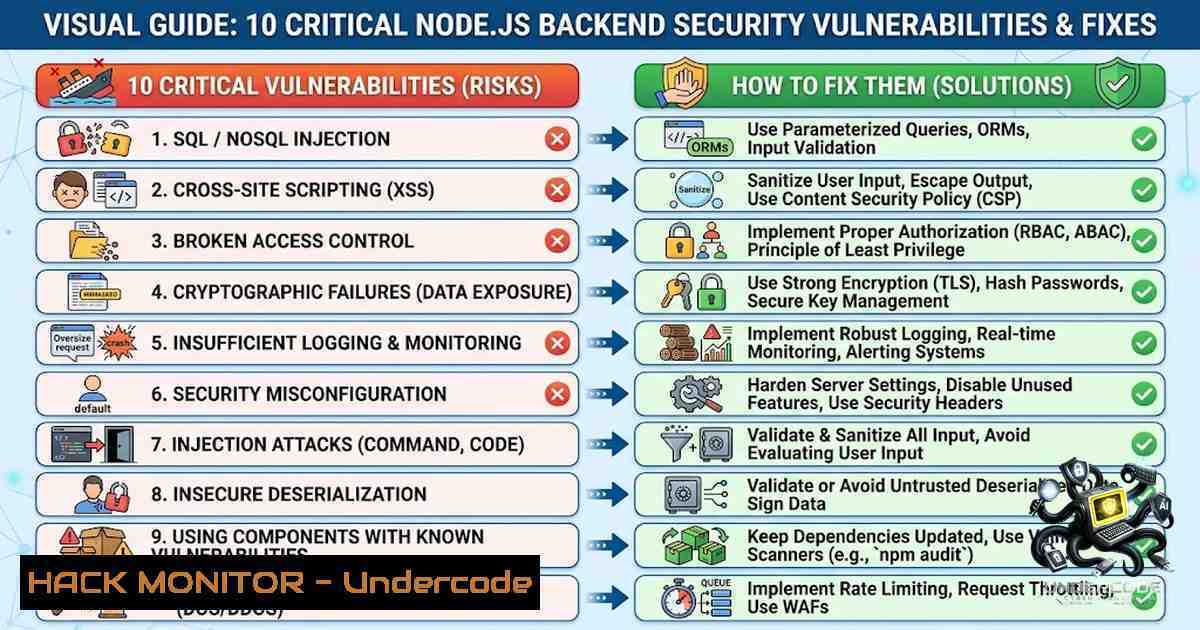
Introduction:
In the race to ship features and scale applications, backend security is often relegated to a post-launch afterthought — a costly mistake that has led to some of the most devastating data breaches in recent memory. Node.js, powering millions of APIs and microservices worldwide, presents a unique attack surface where a single misconfigured middleware or insecure JWT implementation can expose entire user databases. This article dissects the most common Node.js security pitfalls, provides battle-tested mitigation strategies, and offers actionable code-level hardening techniques to transform your backend from a vulnerability waiting to happen into a fortress of resilience.
Learning Objectives:
- Identify and remediate the OWASP Top 10 vulnerabilities specific to Node.js runtime environments.
- Implement enterprise-grade authentication, authorization, and session management using JWT, OAuth2, and refresh token rotation.
- Harden API endpoints against injection attacks, rate-limiting bypasses, and dependency poisoning through continuous security auditing.
You Should Know:
1. Securing Authentication: Beyond Basic JWT Implementation
The vast majority of Node.js authentication breaches stem not from algorithmic flaws but from implementation oversights — using weak secrets, omitting expiration checks, or failing to rotate refresh tokens. A secure JWT strategy requires layered defenses.
Step‑by‑step guide:
- Generate a cryptographically strong secret: Use `crypto.randomBytes(64).toString(‘hex’)` in Node.js to create a 512‑bit secret. Store it in environment variables, never in code.
- Implement short-lived access tokens (15 minutes) with refresh tokens (7 days): This limits the window of exploit if a token is compromised.
- Enable refresh token rotation: Issue a new refresh token with every access token refresh, invalidating the previous one to prevent replay attacks.
- Add token fingerprinting: Bind the JWT to a user‑specific device ID or IP hash to mitigate token theft across different environments.
// Example: Secure JWT sign and verify with fingerprint
const jwt = require('jsonwebtoken');
const crypto = require('crypto');

function generateToken(userId, fingerprint) {
return jwt.sign(
{ sub: userId, fpr: crypto.createHash('sha256').update(fingerprint).digest('hex') },
process.env.JWT_SECRET,
{ expiresIn: '15m', algorithm: 'HS256' }
);
}
- Implement a deny-list for revoked tokens using Redis with an expiration matching the token’s lifetime to ensure immediate invalidation upon logout or compromise.
- Hardening API Endpoints Against Injection and Mass Assignment
SQL/NoSQL injection and prototype pollution remain the top entry points for attackers exploiting Node.js backends. The remedy lies not in blacklisting but in strict input validation and parameterized queries.
Step‑by‑step guide:
- Use an ORM/ODM with built-in parameterization: Mongoose and Sequelize automatically escape inputs when using model methods. Avoid raw queries unless absolutely necessary.
- Implement a validation middleware using Joi or Zod: Define explicit schemas for every request body, query, and parameter. Reject any field not defined in the schema to prevent mass assignment attacks.
const Joi = require('joi');
const userSchema = Joi.object({
email: Joi.string().email().required(),
password: Joi.string().min(8).pattern(/^(?=.[a-z])(?=.[A-Z])(?=.\d)/).required(),
role: Joi.string().valid('user', 'admin').default('user')
});
// This rejects any extra fields like 'isAdmin' automatically
- Enable Helmet.js middleware to set secure HTTP headers, mitigating XSS and clickjacking attacks.
- Apply rate limiting using `express-rate-limit` with a store like Redis to prevent brute-force and DDoS attempts, configuring distinct limits for authentication endpoints (e.g., 5 attempts per 15 minutes).
3. Dependency Vulnerability Management: The Silent Killer
Node.js applications often include hundreds of npm packages, each a potential backdoor. The 2024 npm ecosystem saw a 200% increase in supply-chain attacks, making proactive auditing non‑negotiable.
Step‑by‑step guide:
- Run `npm audit` daily in CI/CD pipelines and block deployments on high‑severity findings.
- Integrate Snyk or Socket.dev for real‑time vulnerability scanning and automated pull request fixes.
- Lock dependencies with `package-lock.json` and use `npm ci` in production to ensure reproducible builds.
- Monitor for deprecated packages using `npm outdated` and plan migrations well before end‑of‑life.
Linux/Windows commands for dependency hardening:
 Linux/macOS
npm audit --production --json > audit-report.json
npx snyk test --severity-threshold=high
npm outdated --depth=0

Windows (PowerShell)
npm audit --production --json | Out-File audit-report.json
npx snyk test --severity-threshold=high
npm outdated --depth=0
- Implement a software bill of materials (SBOM) using `cyclonedx‑npm` to catalog every component for rapid vulnerability response.
4. Environment Secrets Management: Never Hard‑Code Credentials
Hard‑coded secrets in source code remain one of the most common, and easily preventable, attack vectors. Even staging environment credentials can be leveraged in privilege escalation attacks.
Step‑by‑step guide:
- Use `dotenv` for local development but never commit `.env` files. Add `.env` to
.gitignore. - In production, leverage cloud‑native secret stores: AWS Secrets Manager, Azure Key Vault, or HashiCorp Vault. Retrieve secrets at runtime via SDK, not environment variables which can be leaked through process inspection.
- Rotate secrets automatically using infrastructure‑as‑code (Terraform) with scheduled rotation policies.
// Example: AWS Secrets Manager retrieval
const { SecretsManagerClient, GetSecretValueCommand } = require('@aws-sdk/client-secrets-manager');
const client = new SecretsManagerClient({ region: 'us-east-1' });
const command = new GetSecretValueCommand({ SecretId: 'prod/db/credentials' });
const secret = await client.send(command);
const dbConfig = JSON.parse(secret.SecretString);
- Audit environment variables with tools like `envtrap` to detect accidental leaks in logs or error messages.
5. Secure Session Management: Stateless vs. Stateful Trade‑offs
Choosing between JWT‑based stateless sessions and database‑backed sessions involves critical security trade‑offs. Stateless JWTs offer scalability but cannot be easily invalidated; stateful sessions provide granular control but introduce database latency.
Step‑by‑step guide:
- For high‑security applications (finance, healthcare): Prefer stateful sessions with Redis-backed storage, implementing session timeouts, concurrent session limits, and force logout capabilities.
- For microservices with moderate security requirements: Use JWTs with short lifetimes and refresh token rotation, coupled with a centralized token revocation list.
- Implement CSRF protection: For stateful sessions, use the `csurf` middleware with SameSite=Strict cookies. For stateless JWTs, store tokens in memory (not localStorage) to prevent XSS exfiltration.
// Redis session store configuration
const session = require('express-session');
const RedisStore = require('connect-redis')(session);
const redisClient = require('redis').createClient({ url: process.env.REDIS_URL });
app.use(session({
store: new RedisStore({ client: redisClient }),
secret: process.env.SESSION_SECRET,
resave: false,
saveUninitialized: false,
cookie: { secure: true, httpOnly: true, sameSite: 'strict', maxAge: 3600000 }
}));
- Monitor session anomalies using login location and device fingerprinting, triggering MFA challenges for unusual patterns.
- Input Sanitization and Output Encoding for XSS Prevention
Cross‑Site Scripting (XSS) remains a prevalent threat, especially in applications rendering user‑generated content. The defense is two‑pronged: sanitize on input, encode on output.
Step‑by‑step guide:
- Sanitize HTML inputs using `DOMPurify` on the server side before storage to remove malicious scripts.
- Escape dynamic content in templates using framework‑specific auto‑escaping (e.g., EJS’s `<%=` escapes HTML, `<%-` does not).
- Set Content‑Security‑Policy (CSP) headers to restrict script sources and disable inline scripts.
const helmet = require('helmet');
app.use(helmet.contentSecurityPolicy({
directives: {
defaultSrc: ["'self'"],
scriptSrc: ["'self'", "https://trusted-cdn.com"],
objectSrc: ["'none'"],
upgradeInsecureRequests: []
}
}));
- Validate all redirect URLs to prevent open redirect vulnerabilities, using a whitelist of allowed domains.
7. Logging and Monitoring: Detect Before Disaster
Security is not complete without visibility. Proper logging enables rapid incident response, while poor logging leaves you blind to ongoing attacks.
Step‑by‑step guide:
- Implement structured logging using Winston or Pino with JSON format for easy parsing by SIEM tools.
- Log all authentication events (success, failure, lockout), authorization failures, and configuration changes.
- Never log sensitive data — passwords, tokens, or PII. Use redaction middleware to scrub these fields automatically.
const winston = require('winston');
const logger = winston.createLogger({
level: 'info',
format: winston.format.combine(
winston.format.timestamp(),
winston.format.json(),
winston.format.redact({ paths: ['password', 'token', 'ssn'] })
),
transports: [new winston.transports.File({ filename: 'security.log' })]
});
- Set up real‑time alerts for anomalous spikes in 4xx/5xx errors, failed logins, or unusual geo‑locations using tools like Datadog or Splunk.
8. Secure File Uploads: Beyond Size Limits
File upload endpoints are prime vectors for remote code execution and denial‑of‑service attacks. Size limits alone are insufficient.
Step‑by‑step guide:
- Validate file type using magic number detection (e.g., `file-type` npm package) rather than relying on MIME types or extensions.
- Scan uploaded files with antivirus or malware detection APIs before storage.
- Store files outside the web root and serve them via authenticated routes with permission checks.
- Implement rate limiting per IP for upload endpoints to prevent disk‑filling attacks.
const fileType = require('file-type');
const upload = multer({ dest: 'uploads/' });
app.post('/upload', upload.single('file'), async (req, res) => {
const type = await fileType.fromFile(req.file.path);
if (!type || !['image/jpeg', 'image/png', 'application/pdf'].includes(type.mime)) {
fs.unlinkSync(req.file.path);
return res.status(400).json({ error: 'Invalid file type' });
}
// Process file...
});
9. API Rate Limiting and DDoS Mitigation
Unprotected APIs are susceptible to brute‑force, credential stuffing, and resource exhaustion attacks. Layered rate limiting is essential.
Step‑by‑step guide:
- Apply global rate limiting to all endpoints (e.g., 100 requests per minute per IP).
- Apply stricter limits to authentication, password reset, and registration endpoints (e.g., 5 attempts per 15 minutes).
- Use a distributed store like Redis to share rate limits across multiple Node.js instances.
- Implement circuit breakers to temporarily block IPs that exceed thresholds, using tools like `express‑rate‑limit` with custom handlers.
const rateLimit = require('express-rate-limit');
const RedisStore = require('rate-limit-redis');

const authLimiter = rateLimit({
store: new RedisStore({ sendCommand: (...args) => redisClient.sendCommand(args) }),
windowMs: 15  60  1000, // 15 minutes
max: 5, // 5 requests
message: 'Too many login attempts, please try again later',
skipSuccessfulRequests: true // Only count failures
});
app.use('/api/auth', authLimiter);
10. Continuous Security Testing: Shift‑Left Culture
Security must be integrated into every stage of the development lifecycle, from design to deployment.
Step‑by‑step guide:
- Conduct threat modeling during architecture design to identify potential attack vectors early.
- Implement SAST (Static Application Security Testing) using tools like ESLint with security plugins (
eslint‑plugin‑security) in pre‑commit hooks. - Perform DAST (Dynamic Application Security Testing) using OWASP ZAP or Burp Suite in staging environments.
- Run regular penetration tests and bug bounty programs to uncover vulnerabilities that automated tools miss.
- Maintain an incident response playbook with clear roles, communication channels, and rollback procedures.
 Pre-commit hook example (Linux/macOS)
!/bin/sh
npx eslint --plugin security --ext .js src/
npx snyk test --severity-threshold=high
npm audit --production
What Undercode Say:
- Key Takeaway 1: Security is not a feature — it’s a foundational responsibility that must be woven into every line of code and every architectural decision. The most expensive vulnerabilities are those discovered in production, not in development.
- Key Takeaway 2: The Node.js ecosystem’s strength — its vast package repository — is also its greatest weakness. Proactive dependency management, continuous auditing, and strict input validation are non‑negotiable for any production‑grade application.
Analysis: The landscape of backend security is shifting from reactive patching to proactive, shift‑left engineering. Organizations that embed security into their CI/CD pipelines, enforce strict coding standards, and cultivate a culture of security awareness among developers will not only reduce breach risks but also accelerate compliance with regulations like GDPR and HIPAA. The tools and practices outlined above represent a comprehensive baseline; however, security is an ongoing journey, not a destination. Regular training, threat intelligence integration, and incident simulation exercises are essential to stay ahead of adversaries who are constantly refining their techniques.
Prediction:
- -1 The average cost of a data breach will exceed $5 million by 2027, with Node.js‑based applications accounting for a disproportionate share due to the prevalence of insecure third‑party dependencies and misconfigured authentication flows.
- +1 The adoption of AI‑driven security testing tools will reduce false positives by 40% and accelerate vulnerability remediation, enabling development teams to ship secure code faster without sacrificing velocity.
- +1 Regulatory frameworks will mandate SBOM generation and dependency auditing for all production applications, driving widespread adoption of tools like CycloneDX and OWASP Dependency Check.
- -1 The rise of serverless and edge computing will introduce new attack surfaces, including cold‑start vulnerabilities and insecure function‑to‑function communication, requiring a paradigm shift in how we secure distributed Node.js workloads.
- +1 Open‑source security initiatives, such as the OpenSSF Scorecard and npm’s upcoming security reviews, will significantly improve the baseline security of the npm ecosystem, reducing supply‑chain risks for millions of developers.
▶️ Related Video (72% Match):
🎯Let’s Practice For Free:
🎓 Live Courses & Certifications:
Join Undercode Academy for Verified Certifications
🚀 Request a Custom Project:
Secure, high-velocity infrastructure and disruptive technological engineering. Contact our engineering team for high-tier development and proprietary systems:
[email protected]
💎 Smart Architecture | 🛡️ Secure by Design | ⭐ Trusted by Thousands
IT/Security Reporter URL:
Reported By: Mansi Rauthan – Hackers Feeds
Extra Hub: Undercode MoN
Basic Verification: Pass ✅


