Listen to this Post
Introduction:
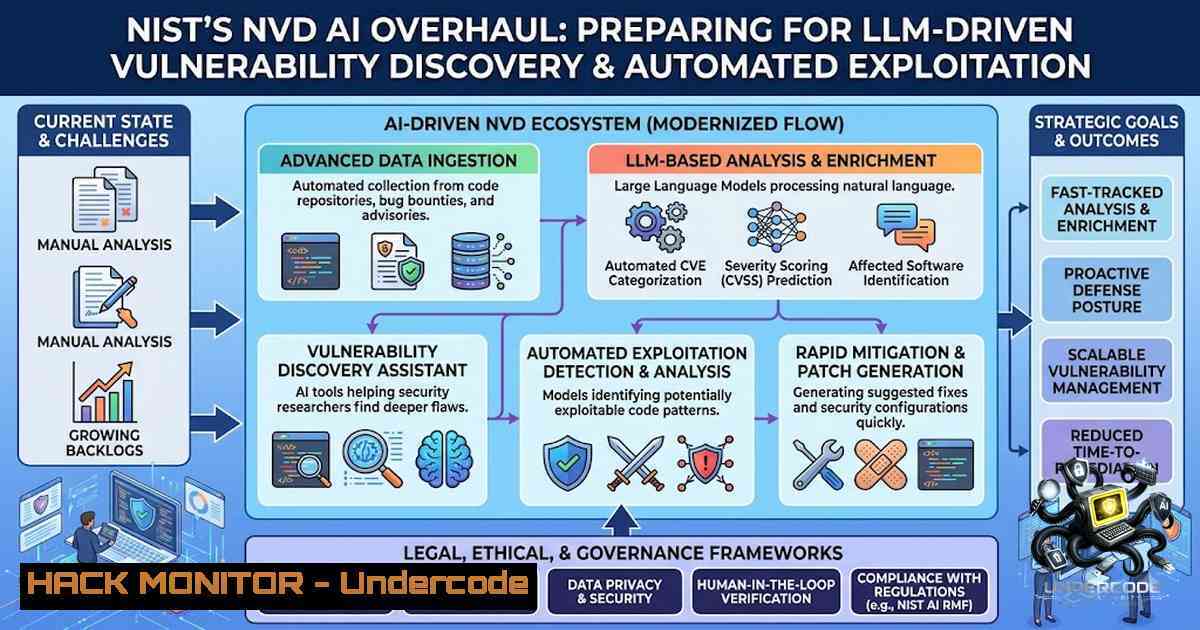
The National Institute of Standards and Technology (NIST) has officially acknowledged a critical inflection point in cybersecurity: large language models (LLMs) are rapidly becoming capable of finding and exploiting vulnerabilities at machine scale, rendering traditional vulnerability management processes obsolete. In an August 2026 Request for Information (RFI), NIST declared that “the inadequacies of traditional vulnerability management approaches, which center on periodic scanning, static prioritization, and manual remediation, are increasingly apparent”. This article dissects NIST’s proposed overhaul of the National Vulnerability Database (NVD), provides hands-on technical guidance for security professionals navigating this transition, and explores the profound implications of AI-driven vulnerability discovery for the cybersecurity ecosystem.
Learning Objectives:
- Understand NIST’s strategic vision for modernizing the NVD in response to AI-accelerated vulnerability discovery and the agency’s shift to a risk-based triage model.
- Master practical techniques for querying the NVD via its API, automating vulnerability intelligence with Python, and integrating LLM-powered triage into security workflows.
- Evaluate the security implications of LLM-driven vulnerability research and implement defensive strategies to protect against AI-augmented threats.
- The NVD Under Siege: Understanding the Data Tsunami and NIST’s Response
Between 2020 and 2025, Common Vulnerabilities and Exposures (CVE) submissions to the NVD grew by an astounding 263 percent, with 48,185 vulnerabilities published in 2025 alone. Researchers identified 40,000 new vulnerabilities in 2025 and are on track to discover 60,000 in 2026. This exponential growth, fueled in part by AI-assisted vulnerability discovery tools, has overwhelmed NIST’s capacity to enrich every CVE entry with comprehensive metadata, CVSS scores, and CWE classifications.
On April 15, 2026, NIST formally acknowledged it could no longer enrich all incoming CVEs and announced a risk-based triage policy. Under this new model, full enrichment is prioritized only for vulnerabilities listed in CISA’s Known Exploited Vulnerabilities (KEV) catalog, those affecting federal software, and “critical software” as defined by Executive Order 14028. Approximately 29,000 backlogged CVEs with publication dates before March 1, 2026, were moved to a “Not Scheduled” category, effectively abandoning full analysis for lower-priority vulnerabilities.
Step-by-Step Guide: Querying the NVD API for Real-Time Intelligence
Given NIST’s shift to a triage model, security teams must proactively query the NVD API to prioritize vulnerabilities affecting their environments. Below is a Python script to fetch and filter CVE data based on product and severity:
import requests
import json
from datetime import datetime, timedelta

NVD API endpoint
NVD_API_URL = "https://services.nvd.nist.gov/rest/json/cves/2.0"

def fetch_cves_by_product(product_name, days_back=7):
"""Fetch CVEs for a specific product published in the last N days."""
start_date = (datetime.now() - timedelta(days=days_back)).isoformat() + 'Z'
params = {
'keywordSearch': product_name,
'pubStartDate': start_date,
'resultsPerPage': 100
}
response = requests.get(NVD_API_URL, params=params)
if response.status_code == 200:
data = response.json()
return data.get('vulnerabilities', [])
else:
print(f"Error: {response.status_code}")
return []

def check_kev_status(cve_id):
"""Check if a CVE is in CISA's Known Exploited Vulnerabilities catalog."""
 Simplified check - in production, use CISA's KEV API
kev_url = f"https://www.cisa.gov/sites/default/files/feeds/known_exploited_vulnerabilities.json"
response = requests.get(kev_url)
if response.status_code == 200:
kev_data = response.json()
for item in kev_data.get('vulnerabilities', []):
if item.get('cveID') == cve_id:
return True
return False

Example: Fetch CVEs for Nginx in the last 7 days
cves = fetch_cves_by_product('nginx', 7)
for cve in cves:
cve_id = cve['cve']['id']
description = cve['cve']['descriptions'][bash]['value']
cvss_score = cve['cve'].get('metrics', {}).get('cvssMetricV31', [{}])[bash].get('cvssData', {}).get('baseScore', 'N/A')
is_kev = check_kev_status(cve_id)
print(f"{cve_id} | CVSS: {cvss_score} | KEV: {is_kev} | {description[:100]}...")
This script enables security analysts to automatically pull recent vulnerabilities for their critical assets, cross-reference with CISA’s KEV catalog, and prioritize remediation efforts accordingly.
2. Automating Vulnerability Triage with Large Language Models
As NIST explicitly seeks input on “which capabilities, products and processes would help more quickly disseminate information to stakeholders” and “what role AI should play in automated vulnerability remediation,” security teams are already deploying LLMs to accelerate triage. Open-source frameworks such as `vuln-triage-llm` and `LLM-Driven-Automated-Vulnerability-Exploitation-Framework` demonstrate the potential of LLMs to automate vulnerability assessment.
Step-by-Step Guide: LLM-Powered Vulnerability Triage with Python and Ollama
This guide demonstrates how to use a local LLM (via Ollama) to triage CVEs fetched from the NVD, generating structured risk assessments:
1. Install Ollama and pull a local model:
 Install Ollama (Linux/macOS)
curl -fsSL https://ollama.com/install.sh | sh
 Pull a lightweight model for triage
ollama pull llama3.2:3b
2. Python script for LLM-based CVE triage:
import requests
import json
import ollama

def fetch_cve_details(cve_id):
"""Fetch detailed CVE information from NVD."""
url = f"https://services.nvd.nist.gov/rest/json/cves/2.0?cveId={cve_id}"
response = requests.get(url)
if response.status_code == 200:
data = response.json()
vuln = data.get('vulnerabilities', [{}])[bash].get('cve', {})
return {
'id': vuln.get('id'),
'description': vuln.get('descriptions', [{}])[bash].get('value', 'N/A'),
'cvss_score': vuln.get('metrics', {}).get('cvssMetricV31', [{}])[bash].get('cvssData', {}).get('baseScore', 'N/A'),
'published': vuln.get('published', 'N/A')
}
return None

def triage_with_llm(cve_data):
"""Use Ollama LLM to generate a triage report."""
prompt = f"""
You are a cybersecurity vulnerability analyst. Analyze the following CVE and provide:
1. Exploit likelihood (High/Medium/Low) with reasoning
2. Affected asset types (e.g., web servers, databases, endpoints)
3. Recommended immediate actions (max 3 bullet points)

CVE ID: {cve_data['id']}
Description: {cve_data['description']}
CVSS Score: {cve_data['cvss_score']}

Provide your analysis in structured JSON format.
"""

response = ollama.chat(model='llama3.2:3b', messages=[{'role': 'user', 'content': prompt}])
return response['message']['content']

Example: Triage a specific CVE
cve_id = "CVE-2024-12345"  Replace with actual CVE
cve_data = fetch_cve_details(cve_id)
if cve_data:
report = triage_with_llm(cve_data)
print(f"Triage Report for {cve_id}:")
print(report)
- Critical Warning: As noted by the `vuln-triage-llm` repository, “hallucination risk — the LLM may fabricate exploitation details; always cross-reference CISA KEV”. LLM-generated triage should augment, not replace, human analysis.
3. Defending Against AI-Driven Vulnerability Exploitation
NIST’s RFI explicitly acknowledges that “large language models become more capable of finding and exploiting vulnerabilities at scale”. This capability is already being operationalized through frameworks like AutoSecagent, which uses “real-time Retrieval-Augmented Generation (RAG) to source up-to-date vulnerability data from repositories such as NVD and CVE”.
Step-by-Step Guide: Implementing Defensive Controls Against LLM-Powered Attacks
1. Harden API Endpoints Against Automated Reconnaissance:
- Implement rate limiting and anomaly detection on public-facing APIs.
- Use Web Application Firewall (WAF) rules to block suspicious scanning patterns.
- Deploy API security gateways with schema validation to prevent injection attacks.
2. Deploy LLM-Specific Security Tools:
- Garak (NVIDIA): An open-source LLM vulnerability scanner that probes for prompt injection, data leakage, and jailbreak attempts.
- HarmBench: A framework for evaluating adversarial robustness of LLM systems.
- NIST AI RMF: Align your AI security posture with NIST’s AI Risk Management Framework, which provides “foundational context for the attack class”.
3. Monitor for LLM-Generated Exploit Activity:
 Linux: Monitor for unusual outbound connections indicative of exploit attempts
sudo tcpdump -i any -1 'dst port 80 or dst port 443' | grep -v "your.trusted.ip"

Windows: Enable advanced audit logging and monitor for suspicious process creation
wevtutil qe Security /c:100 /rd:true /f:text | findstr "4688"
4. Implement Zero-Trust Architecture:
- Assume breach and segment networks to limit lateral movement.
- Enforce least-privilege access controls.
- Deploy continuous monitoring with SIEM integration to detect anomalies indicative of automated exploitation.
4. Modernizing Vulnerability Data Standards for Machine Consumption
NIST’s RFI emphasizes the need for “machine-consumable security data” and improved “interoperability”. The Vulnerability Description Ontology (VDO) framework, developed by NIST, aims to standardize vulnerability characterization across 27 categories. Security teams must align their internal vulnerability management processes with these evolving standards.
Step-by-Step Guide: Integrating NVD Data with Security Tools
1. Automate NVD Data Ingestion:
- Use the NVD’s JSON feeds for automated ingestion into SIEM and SOAR platforms.
- Implement delta updates to minimize bandwidth and processing overhead.
2. Map CVEs to MITRE ATT&CK Techniques:
- Research demonstrates that LLMs can effectively “map CVEs to relevant techniques from the ATT&CK knowledge base”.
- Use this mapping to prioritize vulnerabilities based on adversary tactics and techniques.
3. Generate Structured Threat Reports:
 Example: Fetch CVEs and generate threat reports via Groq (Llama 3.3 70B)
 Reference: https://github.com/vanshkamra12/CyberThreat-Intel-LLM
 This pipeline pulls REAL vulnerability data from NIST's NVD
 and sends each vulnerability to an LLM to write a structured threat report
5. The Future of Automated Remediation
NIST is exploring “AI’s potential role in automated remediation, including what standards, procedures, and safeguards could prevent erroneous AI-generated fixes”. While full automated patching remains aspirational, organizations can begin implementing semi-automated remediation workflows.
Step-by-Step Guide: Building a Semi-Automated Remediation Pipeline
1. Vulnerability Prioritization:
- Use CVSS scores, KEV status, and exploit availability to prioritize vulnerabilities.
- Implement a risk-based scoring model that incorporates business context.
2. Automated Patch Testing:
- Deploy a staging environment that mirrors production.
- Use infrastructure-as-code (IaC) to automate patch deployment and rollback.
3. Remediation Verification:
- After patching, re-scan to confirm vulnerability remediation.
- Use NVD’s API to verify that the CVE is no longer applicable.
4. Feedback Loop:
- Document successful and failed remediation attempts.
- Use this data to train internal LLM models for improved future recommendations.
What Undercode Say:
- The NVD’s triage model is a pragmatic admission of defeat against AI-scale vulnerability discovery. NIST’s shift to enriching only 15-20% of incoming CVEs represents a fundamental restructuring of the vulnerability management ecosystem. Security teams can no longer rely on the NVD as a comprehensive source of enriched vulnerability data; they must build internal capabilities to augment NVD’s有限 enrichment.
-
LLMs are both the problem and the solution. While LLMs are accelerating vulnerability discovery and exploitation, they also offer powerful capabilities for automated triage, threat intelligence generation, and remediation guidance. Organizations that successfully integrate LLMs into their security operations will gain a significant advantage over adversaries who are already using these tools.
Analysis: NIST’s RFI represents a watershed moment in cybersecurity. The agency is effectively crowdsourcing the solution to a problem it can no longer solve alone. Security professionals must engage with this RFI, providing input on automation, data standards, and AI governance. Meanwhile, the practical implications are immediate: security teams must adapt to a world where the NVD is no longer a complete source of truth, where LLMs are generating exploits faster than humans can patch, and where defensive AI is the only viable countermeasure. The organizations that thrive in this new era will be those that embrace automation, invest in AI-1ative security tools, and build resilient, adaptive vulnerability management programs.
Prediction:
- -1: The NVD’s transition to a risk-based triage model will create a “vulnerability inequality” where only high-profile CVEs receive full enrichment, leaving thousands of lower-severity vulnerabilities underexplored and potentially exploited by sophisticated adversaries who can afford to conduct their own analysis.
-
-1: As LLMs become more capable of generating exploit code from CVE descriptions, the window between vulnerability disclosure and weaponization will shrink from days to hours, overwhelming traditional patch management cycles.
-
+1: NIST’s public RFI and the broader push for AI-enabled vulnerability management will accelerate the development of open-source LLM-powered security tools, democratizing advanced threat intelligence for organizations of all sizes.
-
+1: The integration of LLMs into vulnerability triage and remediation workflows will enable security teams to process the growing volume of CVEs more efficiently, potentially reducing mean time to remediate (MTTR) by 30-50%.
-
-1: The lack of standardized safeguards for AI-generated fixes poses a significant risk of cascading failures, where erroneous automated patches introduce new vulnerabilities or disrupt production systems.
-
+1: NIST’s modernization efforts, combined with initiatives like the Gold Eagle clearinghouse and VINCE, will create a more coordinated and resilient vulnerability management ecosystem that can better withstand AI-driven threats.
▶️ Related Video (82% Match):
https://www.youtube.com/watch?v=3cNGmXaK1iQ
🎯Let’s Practice For Free:
🎓 Live Courses & Certifications:
Join Undercode Academy for Verified Certifications
🚀 Request a Custom Project:
Secure, high-velocity infrastructure and disruptive technological engineering. Contact our engineering team for high-tier development and proprietary systems:
[email protected]
💎 Smart Architecture | 🛡️ Secure by Design | ⭐ Trusted by Thousands
IT/Security Reporter URL:
Reported By: https://lnkd.in/p/es5knJ9C – Hackers Feeds
Extra Hub: Undercode MoN
Basic Verification: Pass ✅


