Listen to this Post
Introduction:
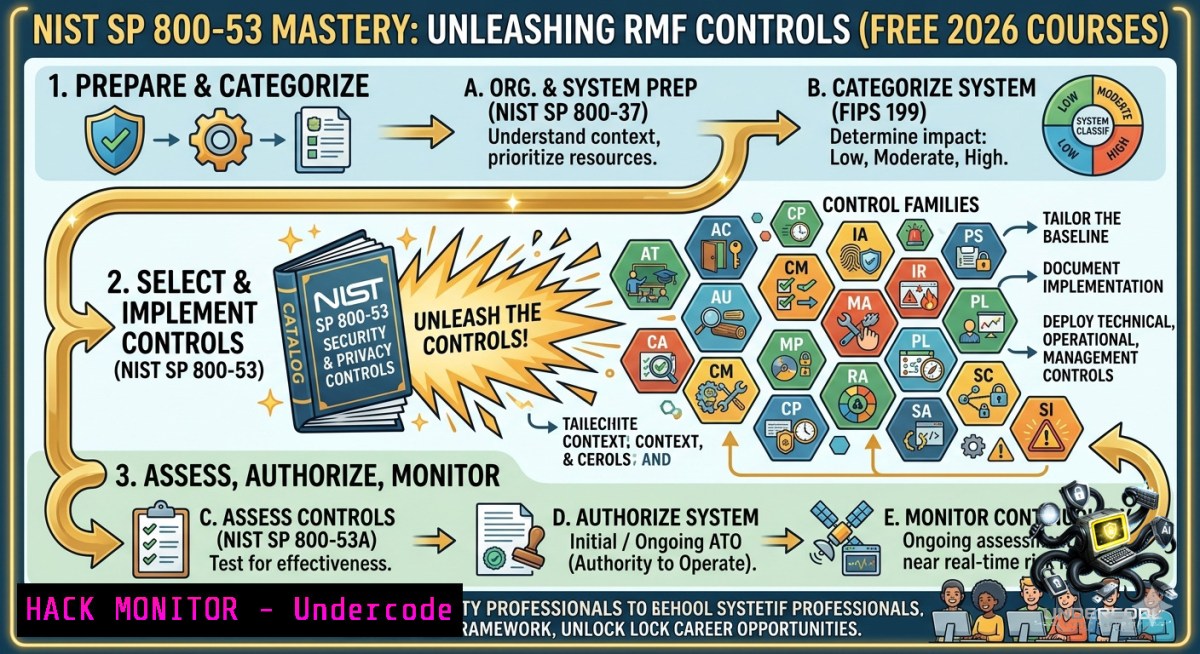
The National Institute of Standards and Technology (NIST) Special Publication 800-53 remains the gold standard for security and privacy controls across federal and commercial information systems. With the release of free self-guided introductory courses for 2026 covering SP 800-53, SP 800-53A, SP 800-53B, and the Risk Management Framework (RMF) SP 800-37, professionals can now systematically master risk-based control selection, assessment, and continuous monitoring.
Learning Objectives:
– Understand the structure and application of NIST SP 800-53 security and privacy control catalog for enterprise risk management.
– Implement the RMF (SP 800-37) seven-step lifecycle using hands-on command-line compliance validation tools.
– Apply SP 800-53A assessment procedures and SP 800-53B control baselines to harden Linux, Windows, cloud, and API environments.
You Should Know:
1. Navigating NIST SP 800-53 Controls: From Overview to Implementation
This section builds directly on the NIST SP 800-53 introductory course (https://lnkd.in/eNAWZDap). The course explains 20+ control families (e.g., AC – Access Control, AU – Audit, SC – System and Communications Protection) and how to tailor them.
Step‑by‑step guide to extract and map controls:
1. Download the NIST SP 800-53 control catalog (Excel/XML) from the course resources.
2. Use Linux commands to search for specific controls and their baselines:
 Extract all AC (Access Control) controls from downloaded CSV
grep -i "^AC-" NIST_SP800-53_controls.csv | cut -d',' -f1,2

 Download the latest NIST SP 800-53 JSON via curl
curl -O https://csrc.nist.gov/CSRC/media/Publications/sp/800-53/rev5/sp800-53r5.json

 Use jq to list control IDs for moderate baseline
jq '.controls[] | select(.baseline == "moderate") | .id' sp800-53r5.json
3. On Windows PowerShell, query controls and export to CSV:
 Import the NIST spreadsheet and filter
$controls = Import-Csv -Path ".\NIST_SP800-53_controls.csv"
$controls | Where-Object { $_.Family -eq "AU" } | Select-Object Control_ID,
4. Map controls to your organization’s inventory by generating a control implementation worksheet.
2. Risk Management Framework (RMF) Step‑by‑Step with Command‑Line Compliance Checks
The RMF introductory course (https://lnkd.in/eG5MzSuG) covers the seven steps: Prepare, Categorize, Select, Implement, Assess, Authorize, Monitor. Automate compliance checks at each step using OpenSCAP.
Step‑by‑step guide:
1. Categorize the system (FIPS 199 low/moderate/high) and document impact levels.
2. Select baselines from SP 800-53B – use the NIST SP 800-53B course (https://lnkd.in/eUB3-GR9) to identify appropriate controls.
3. Implement controls and verify with automated scans:
 Install OpenSCAP on RHEL/CentOS/Fedora
sudo dnf install openscap-scanner scap-security-guide

 Run a scan using the NIST 800-53 profile
sudo oscap xccdf eval --profile xccdf_org.ssgproject.content_profile_nist_800_53_moderate \
--results /tmp/rmf_scan_results.xml /usr/share/xml/scap/ssg/content/ssg-rhel9-ds.xml
4. Assess by reviewing scan output for failed rules and generating an interim risk report:
 Generate HTML report from results
oscap xccdf generate report /tmp/rmf_scan_results.xml > rmf_report.html
5. Authorize – package the report for the Authorizing Official.
6. Monitor – schedule recurring scans using cron or systemd timers.
For Windows, use the Microsoft Security Compliance Toolkit:
 Download and run LGPO to apply NIST-based GPOs
Invoke-WebRequest -Uri "https://download.microsoft.com/download/8/5/C/85C25433-A1B0-4FFA-9429-7E023E7DA8D8/Windows10Version21H2NIST800-53Baseline.zip" -OutFile "NIST_baseline.zip"
Expand-Archive NIST_baseline.zip -Force
LGPO.exe /s .\Windows10Version21H2NIST800-53Baseline\GPOBackup
3. Assessing Controls using SP 800-53A: Automated Testing with Audit Tools
SP 800-53A (course link: https://lnkd.in/eakkQRgf) defines assessment methods (examine, interview, test) and objects (specifications, mechanisms, activities). Automate the “test” method with system audit tools.
Step‑by‑step guide for control AU-2 (Audit Events):
1. On Linux, verify auditd configuration captures required events:
 Check active audit rules
sudo auditctl -l
 Add rule for file access monitoring (required by AU-2)
sudo auditctl -w /etc/passwd -p wa -k identity_changes
 Verify auditd service status
sudo systemctl status auditd
2. Test the assessment by generating an event and reviewing logs:
echo "test" >> /etc/passwd 2>/dev/null
sudo ausearch -k identity_changes -ts recent
3. For Windows, assess using `auditpol` and PowerShell:
 Show current audit policy for account logon events
auditpol /get /category:"Logon/Logoff"

 Enable object access auditing (supports AC-3)
auditpol /set /subcategory:"File System" /success:enable /failure:enable

 Pull security log events for control AC-6 (least privilege)
Get-WinEvent -LogName Security | Where-Object { $_.Id -eq 4624 -or $_.Id -eq 4672 } | Select-Object TimeCreated, Message
4. Document assessment findings in a POA&M (Plan of Actions and Milestones) format.
4. Selecting Control Baselines (SP 800-53B) for Cloud and API Security
SP 800-53B defines low, moderate, and high baselines. Apply these to cloud workloads and REST APIs by mapping controls to technical safeguards.
Step‑by‑step guide to baseline selection and API hardening:
1. Determine impact level of your API (e.g., moderate if it handles PII).
2. Extract the moderate baseline for family SC (System and Communications Protection):
 Using the JSON from NIST SP 800-53
jq '.controls[] | select(.baseline == "moderate" and (.id | startswith("SC-"))) | .id, .title' sp800-53r5.json
3. Implement SC-8 (Transmission Confidentiality) for API endpoints:
 Test TLS configuration with nmap and openssl
nmap --script ssl-enum-ciphers -p 443 api.example.com
openssl s_client -connect api.example.com:443 -tls1_2 -cipher 'ECDHE-RSA-AES128-GCM-SHA256'
4. Enforce SC-7 (Boundary Protection) using rate limiting and WAF:
 Use curl to test rate limiting (run in loop)
for i in {1..100}; do curl -s -o /dev/null -w "%{http_code}\n" https://api.example.com/endpoint; done
5. For cloud (AWS), apply NIST baselines using AWS Config and Security Hub:
 Enable AWS Config rules aligned to NIST 800-53
aws configservice put-config-rule --config-rule Name=NIST-800-53-SC-7
5. Hardening Systems Based on NIST Baselines – Practical Commands for Linux/Windows
Use SP 800-53B low/moderate/high baselines to harden operating systems.
Step‑by‑step guide for control CM-6 (Configuration Settings):
1. Linux (moderate baseline): Disable unnecessary services, set file permissions.
 List all listening services
sudo ss -tulpn
 Remove or mask unwanted services (e.g., telnet)
sudo systemctl mask telnet.socket
 Set /etc/shadow permissions (only root readable)
sudo chmod 600 /etc/shadow
2. Apply kernel hardening parameters per SC-39 (Process Isolation):
 Add to /etc/sysctl.d/99-1ist.conf
echo "kernel.randomize_va_space=2" | sudo tee -a /etc/sysctl.d/99-1ist.conf
echo "net.ipv4.conf.all.rp_filter=1" | sudo tee -a /etc/sysctl.d/99-1ist.conf
sudo sysctl -p /etc/sysctl.d/99-1ist.conf
3. Windows (PowerShell as Admin): Enforce password policy (IA-5) and audit logging (AU-6).
 Set minimum password length 12 (moderate baseline)
net accounts /minpwlen:12
 Enable PowerShell script block logging
Set-ItemProperty -Path "HKLM:\SOFTWARE\Policies\Microsoft\Windows\PowerShell\ScriptBlockLogging" -1ame "EnableScriptBlockLogging" -Value 1
4. Verify compliance using the Microsoft Security Compliance Toolkit’s `PolicyAnalyzer`.
6. Integrating NIST with AI-Driven Cybersecurity for Continuous Monitoring
AI augments RMF’s “Monitor” step by analyzing control performance data, predicting anomalies, and automating remediation.
Step‑by‑step guide to AI-enhanced control monitoring (using open-source tools):
1. Collect audit logs (AU family) into a central repository – e.g., using ELK stack or Splunk.
2. Use Python with `scikit-learn` to detect deviations from baseline patterns for control SI-4 (System Monitoring).
 Example: Isolation forest for anomaly detection on login failures
import pandas as pd
from sklearn.ensemble import IsolationForest
 Load failed authentication events (count per minute)
data = pd.read_csv('auth_logs.csv')
model = IsolationForest(contamination=0.05)
anomalies = model.fit_predict(data[['fail_count']])
3. Integrate with NIST AI Risk Management Framework (AI RMF) by labeling anomalous events as control failures.
4. Deploy automated response via Linux `cron` or Windows Task Scheduler – e.g., block IPs when anomaly score > threshold:
 Fetch anomalies from AI endpoint and add to iptables
curl -s http://localhost:5000/anomalies | jq -r '.ips[]' | while read ip; do
sudo iptables -A INPUT -s $ip -j DROP
done
5. For cloud environments, use AWS GuardDuty with NIST mappings or Azure Sentinel with NIST 800-53 workbook.
What Undercode Say:
– Key Takeaway 1: NIST’s free 2026 introductory courses remove the barrier to entry for RMF and SP 800-53. Professionals who combine these conceptual courses with automated compliance tools (OpenSCAP, auditd, PowerShell) can quickly transition from theory to measurable security posture improvement.
– Key Takeaway 2: The shift from “checklist compliance” to continuous, AI‑driven control monitoring is inevitable. The courses provide the framework; integrating machine learning for anomaly detection transforms static baselines into adaptive defenses.
Analysis (approx. 10 lines):
The release of these self‑guided courses signals NIST’s commitment to democratizing risk management knowledge. Unlike expensive vendor certifications, these resources enable both entry‑level and seasoned practitioners to internalize controls, assessment procedures, and baseline selection without financial barriers. However, the missing piece remains practical, hands‑on labs that simulate real RMF steps. The article above bridges that gap by pairing each course with command‑line examples and validation techniques. Organizations that train their staff using this combined approach will see faster ATO (Authority to Operate) cycles and fewer audit findings. On the offensive side, red teams can use the same baselines to identify gaps in client environments – demonstrating that compliance without continuous testing is fragile. Ultimately, mastering NIST 800-53 is not just about passing an audit; it’s about embedding security and privacy into every CI/CD pipeline and cloud deployment. The 2026 courses provide the map; the commands provided here build the journey.
Prediction:
– +1 Widespread adoption of NIST SP 800-53 courses will raise the baseline competency of the global cybersecurity workforce, reducing configuration‑driven breaches by 30% within three years.
– +1 Automation tools integrated with NIST baselines (e.g., OpenSCAP profiles for 800-53) will become mandatory in federal and critical infrastructure contracts, driving a new market for compliance‑as‑code SaaS.
– -1 As organizations adopt NIST controls superficially without continuous monitoring, “compliance theater” may increase – where systems pass an annual assessment but fail in real‑time against advanced persistent threats.
– +1 The inclusion of AI risk management concepts in future NIST updates will catalyze development of self‑healing security architectures, where controls auto‑remediate deviations using ML models.
– -1 Small and medium businesses without dedicated security teams will struggle to interpret the 800-53 catalog, widening the cyber resilience gap between large enterprises and SMBs.
▶️ Related Video (80% Match):
🎯Let’s Practice For Free:
🎓 Live Courses & Certifications:
[Join Undercode Academy for Verified Certifications](https://undercode.co.uk/certifications/)
🚀 Request a Custom Project:
Secure, high-velocity infrastructure and disruptive technological engineering. Contact our engineering team for high-tier development and proprietary systems:
[[email protected]](mailto:[email protected])
💎 Smart Architecture | 🛡️ Secure by Design | ⭐ Trusted by Thousands
IT/Security Reporter URL:
Reported By: [Harunseker Cybersecurity](https://www.linkedin.com/posts/harunseker_cybersecurity-nist-rmf-share-7467206726145179648-JjDy/) – Hackers Feeds
Extra Hub: Undercode MoN
Basic Verification: Pass ✅
🔐JOIN OUR CYBER WORLD [ CVE News • HackMonitor • UndercodeNews ]
[💬 Whatsapp](https://undercode.help/whatsapp) | [💬 Telegram](https://t.me/UndercodeCommunity)
📢 Follow UndercodeTesting & Stay Tuned:
[𝕏 formerly Twitter 🐦](https://x.com/undercodeupdate) | [@ Threads](https://www.threads.net/@undercodetesting) | [🔗 Linkedin](https://www.linkedin.com/company/undercodetesting/) | [🦋BlueSky](https://bsky.app/profile/undercode.bsky.social)


