
Listen to this Post
Introduction:
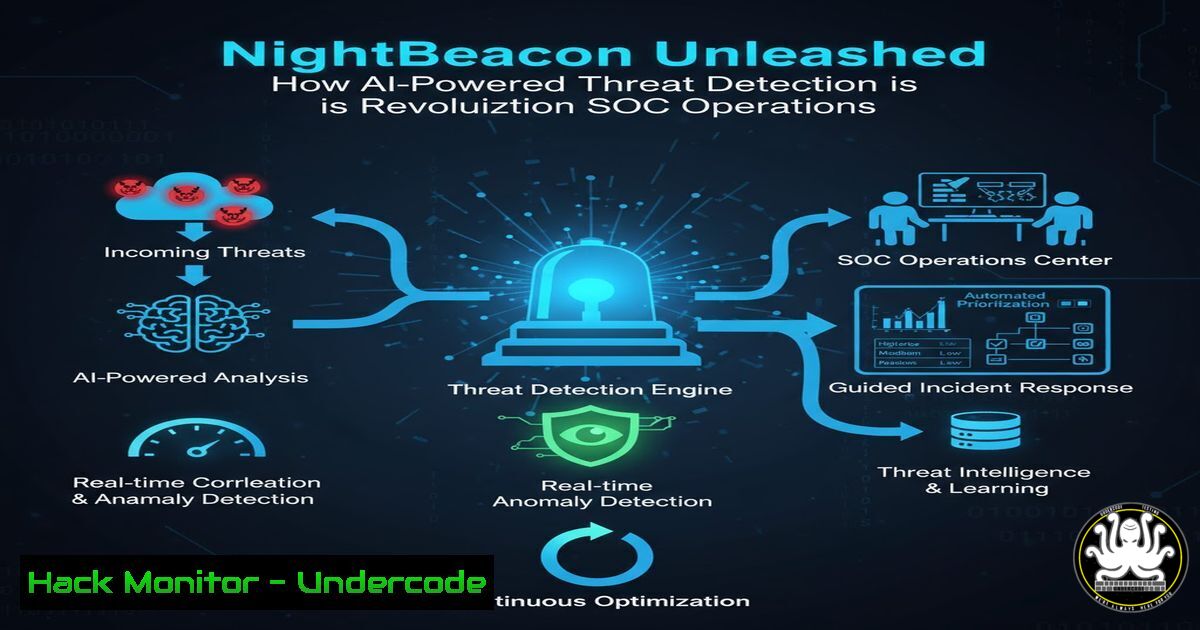
The modern Security Operations Center (SOC) is drowning in alerts, logs, and repetitive tasks while facing increasingly sophisticated adversaries. Enter NightBeacon—an AI-native platform developed by Binary Defense that augments human analysts with machine intelligence. By training proprietary models on internal analyst knowledge, automating sandbox detonation, and generating dynamic playbooks, NightBeacon slashes mean time to respond (MTTR) and reduces false positives through continuous learning. This article unpacks the core capabilities of such a system and provides actionable steps to implement similar techniques using open-source tools and best practices.
Learning Objectives:
- Understand how AI models can be trained on internal SOC data to improve threat detection accuracy.
- Learn to automate malware analysis, log parsing, and IOC extraction using sandboxing and YARA.
- Explore methods to integrate AI-generated playbooks with existing SOAR/SIEM platforms for rapid response.
You Should Know:
- Deep-Scan Malware Analysis with Sandboxing and Shellcode Emulation
NightBeacon’s deep-scan feature detonates suspicious files in a controlled sandbox and emulates shellcode execution to extract IOCs without risking the production environment. To replicate this:
– Linux: Use Cuckoo Sandbox (open-source) to automate malware analysis. Install with:
sudo apt-get install cuckoo
cuckoo init
cuckoo community
– Windows: Deploy CAPE (Cuckoo-modified) for advanced emulation. Submit a sample via REST API:
curl -F [email protected] http://localhost:8090/tasks/create/file
– Extract IOCs by parsing the sandbox report (JSON/MAEC) using jq:
cat report.json | jq '.signatures[] | select(.name=="network_connections")'
2. Automatic Playbook Generation and SOAR Integration
NightBeacon creates custom playbooks tailored to each attack. In a SOAR like TheHive or Shuffle, you can automate response actions based on enriched alerts.
– TheHive + Cortex setup:
docker run -d --name thehive -p 9000:9000 thehiveproject/thehive:latest
– Create a playbook that triggers on high-severity alerts:
1. Ingest alert via API:
curl -H "Authorization: Bearer $API_KEY" -X POST http://thehive:9000/api/alert -d '{"title":"Suspicious EXE","severity":3}'
2. Automate IOC enrichment with Cortex analyzers (VirusTotal, AbuseIPDB).
3. Generate a response task in your ticketing system.
3. YARA Rule Integration and MITRE ATT&CK Mapping
NightBeacon leverages 9000+ YARA rules and maps findings to MITRE ATT&CK. To emulate:
– Create a custom YARA rule to detect Cobalt Strike beacons:
rule cobalt_strike_http {
strings:
$a = "Mozilla/4.0 (compatible; MSIE 8.0; Windows NT 6.1)"
$b = "Accept: application/x-ms-application"
condition:
all of them
}
– Scan a directory:
yara -r cobalt.yar /path/to/suspicious/files
– Map alerts to MITRE using ATT&CK Navigator:
import stix2
attack = stix2.TAXIICollectionSource(stix2.MemorySource())
techniques = attack.query([stix2.Filter("type", "=", "attack-pattern")])
4. Universal Log Parsing with AI Context
NightBeard’s log handler parses any format (EVTX, PCAP, JSON). Use Logstash to normalize logs from diverse sources:
– Logstash config for Windows Event Logs:
input {
file {
path => "C:/logs/security.evtx"
codec => "json"
}
}
filter {
if [bash] == 4688 {
mutate { add_tag => ["process_creation"] }
}
}
output {
elasticsearch { hosts => ["localhost:9200"] }
}
– For packet dumps, use tshark to extract metadata:
tshark -r capture.pcap -T fields -e ip.src -e ip.dst -e dns.qry.name > flows.csv
5. Synthetic Training Data Generation
NightBeacon generates synthetic attack data without exposing customer information. Tools like Log-synth can create realistic logs:
– Install and generate web logs:
git clone https://github.com/Netflix/log-synth
cd log-synth
./gradlew installDist
./build/install/log-synth/bin/log-synth --schema weblog-schema.json --count 10000
– For Windows events, use Wevtutil to export templates:
wevtutil epl Security C:\templates\security_template.evtx
Then inject variations with a Python script using python-evtx.
6. Reducing False Positives with Contextual AI
NightBeacon retrains models on analyst feedback. Implement a feedback loop with Elasticsearch and a simple ML classifier:
– Index alerts with labels (TP/FP) in Elasticsearch.
– Use Elastic’s supervised learning to create a model:
PUT _ml/datafeeds/datafeed-logs
{
"job_id": "fp-reduction",
"indices": ["logs-"]
}
– Automate retraining weekly via cron:
0 2 0 curl -X POST http://elastic:9200/_ml/anomaly_detectors/fp-reduction/_update
7. API Integration with Existing EDR/SIEM
NightBeacon ingests data via APIs. Example: pulling alerts from Microsoft Defender for Endpoint:
 Get access token
token=$(curl -X POST https://login.microsoftonline.com/$TENANT_ID/oauth2/token \
-d "resource=https://api.securitycenter.microsoft.com" \
-d "client_id=$APP_ID" \
-d "client_secret=$SECRET" \
-d "grant_type=client_credentials" | jq -r '.access_token')

Fetch latest alerts
curl -H "Authorization: Bearer $token" \
https://api.securitycenter.microsoft.com/api/alerts > alerts.json
Then feed this JSON to NightBeacon (or your custom AI pipeline) for enrichment.
What Undercode Say:
- Key Takeaway 1: AI-driven SOC tools like NightBeacon don’t replace analysts—they amplify them by automating triage, enriching data, and generating actionable playbooks. The key is training on internal, high-fidelity data to reduce noise.
- Key Takeaway 2: Synthetic data generation preserves customer privacy while allowing models to learn from diverse attack patterns. This approach is critical for compliance in regulated industries.
- Key Takeaway 3: Integration with existing stacks (EDR, SIEM, SOAR) via APIs is non‑negotiable; a tool that requires forklift upgrades will fail. The future belongs to open, composable security architectures.
The rapid evolution of AI in cybersecurity means defenders must embrace automation while maintaining human oversight. NightBeacon exemplifies how specialized AI can turn a reactive SOC into a proactive force—by learning from every interaction and continuously sharpening its detection capabilities.
Prediction:
Within three years, AI-native security platforms will become the default in enterprise SOCs, with 80% of tier‑1 alerts handled automatically. However, this will trigger an arms race: adversaries will deploy similar AI to evade detection, leading to AI‑vs‑AI cat‑and‑mouse games. The winning organizations will be those that, like Binary Defense, build their own models on proprietary data rather than relying on generic third‑party AI.
▶️ Related Video (88% Match):
🎯Let’s Practice For Free:
IT/Security Reporter URL:
Reported By: Davidkennedy4 Heres – Hackers Feeds
Extra Hub: Undercode MoN
Basic Verification: Pass ✅


