
Listen to this Post
Introduction:
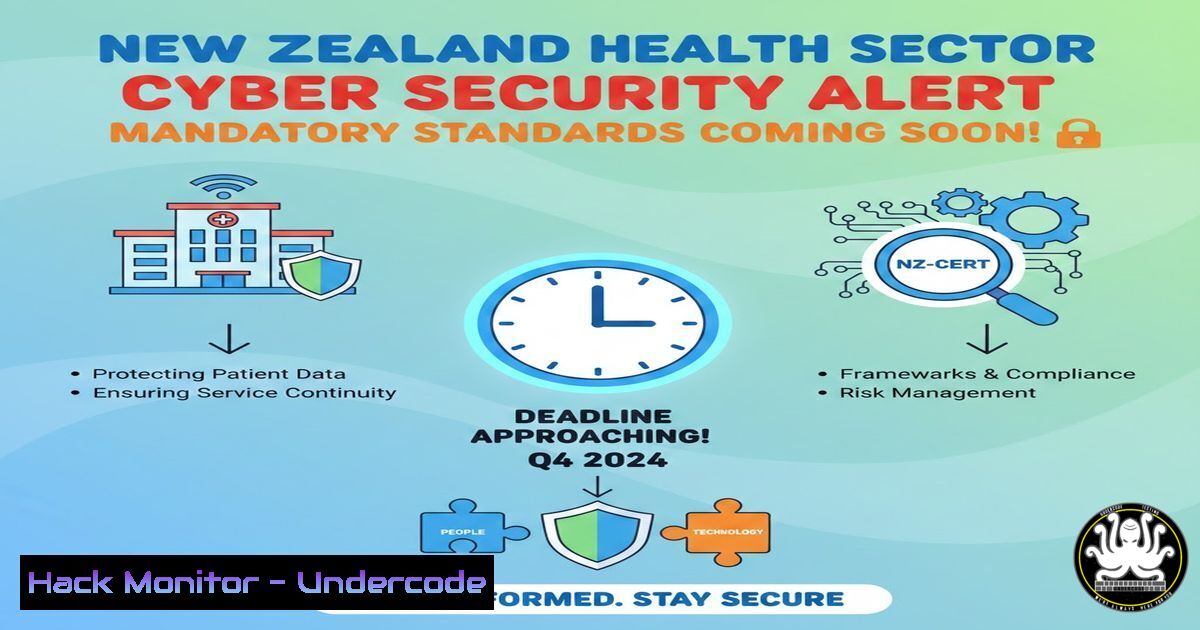
The landscape of cyber security regulation in New Zealand is set for a seismic shift. A recent report from the Department of the Prime Minister and Cabinet (DPMC), the New Zealand’s Cyber Security Strategy 2026–2030, has explicitly called out the health sector for increased scrutiny. Following a series of high-profile breaches, the era of voluntary “guidance” is ending. The government is moving toward a mandatory regulatory regime for critical infrastructure, including healthcare, which will establish and enforce minimum cyber security standards. This article dissects the implications of this regulatory pivot, the technical debt challenges faced by the public sector, and provides a technical roadmap for organizations to prepare for enforceable compliance.
Learning Objectives:
- Understand the impending regulatory shift for New Zealand’s critical infrastructure and its specific impact on the health sector.
- Identify the technical debt challenges and remediation strategies for legacy systems in public healthcare.
- Learn step-by-step commands and configurations for auditing, hardening, and monitoring systems to align with future minimum security standards.
You Should Know:
1. Auditing Legacy Systems for Regulatory Compliance
Before any organization can meet new minimum standards, they must understand their current security posture, especially regarding technical debt. Legacy systems often run on outdated operating systems that cannot support modern security agents. The first step is a comprehensive audit.
Step‑by‑step guide to inventory and patch auditing:
On Linux (Debian/Ubuntu):
To get a list of installed packages and check for known vulnerabilities (CVEs) against the current distribution, you would typically use the package manager and cross-reference with security advisories.
 List all manually installed packages
apt-mark showmanual

Check for available updates (security patches)
sudo apt update && sudo apt list --upgradable

For a deeper audit, use 'debsecan' (Debian Security Analyzer)
sudo apt install debsecan
sudo debsecan --suite $(lsb_release -cs) --only-fixed
On Windows (PowerShell):
To identify missing patches and gather a software inventory for compliance reporting.
 Get a list of installed hotfixes (patches)
Get-HotFix | Sort-Object InstalledOn -Descending | Format-Table -AutoSize

Inventory all installed software
Get-WmiObject -Class Win32_Product | Select-Object Name, Version, Vendor

Use the PSWindowsUpdate module to check for missing updates (requires install)
 Install-Module PSWindowsUpdate
 Get-WUList
Tool Configuration (Nmap for Network Segmentation Audits):
To ensure that critical health infrastructure is properly segmented, an external and internal network scan is necessary.
 Scan for open ports on a specific medical device subnet (e.g., 10.10.20.0/24)
nmap -sS -sV -p 1-1000 10.10.20.0/24

Check for default credentials or vulnerable services running on legacy systems
nmap --script vuln 10.10.20.50
2. Implementing Minimum Security Standards: The Technical Baseline
Once the audit is complete, the focus shifts to implementing the “minimum standards” likely to be mandated. This involves enforcing configuration baselines, disabling outdated protocols, and ensuring secure authentication.
Step‑by‑step guide to system hardening:
On Linux (SSH Hardening):
Edit the SSH configuration to disable weak authentication methods.
sudo nano /etc/ssh/sshd_config
 Ensure the following lines are set:
 PasswordAuthentication no
 PermitRootLogin no
 Protocol 2
 X11Forwarding no

Restart the service
sudo systemctl restart sshd
On Windows (Group Policy & Security Baselines):
Using PowerShell to apply security baselines (like those from CIS or Microsoft).
 Enable Windows Defender Real-Time Monitoring
Set-MpPreference -DisableRealtimeMonitoring $false

Enable BitLocker on all drives (for data-at-rest protection)
 Manage-bde -on C: -used -rp -sk

Disable SMBv1 (a common vector for ransomware)
Set-SmbServerConfiguration -EnableSMB1Protocol $false -Force
3. Vulnerability Exploitation and Mitigation in Healthcare IoT
Medical devices are notoriously difficult to patch. Understanding how they are vulnerable helps in building mitigating controls (like strict firewalling) rather than relying on the device itself to be secure.
Exploitation Context (Conceptual – Educational Use Only):
Many legacy medical devices run embedded Windows XP or custom Linux builds with known vulnerabilities (e.g., EternalBlue for SMBv1 on older imaging systems).
Mitigation Step‑by‑step (Network Segmentation):
If a device cannot be patched, it must be isolated.
 Using iptables on a Linux-based firewall/gateway to block a vulnerable device from reaching the internet but allowing it to talk to its specific server.
sudo iptables -A FORWARD -s 10.10.30.100 -d 0.0.0.0/0 -j DROP
sudo iptables -A FORWARD -s 10.10.30.100 -d 192.168.50.10 -j ACCEPT
 (Where 10.10.30.100 is the vulnerable device and 192.168.50.10 is its management server)
4. Preparing for Accountability and Board-Level Reporting
With increased accountability, including potential board member liability, security metrics must be translated into business risk. Automation in reporting is key.
Step‑by‑step guide to generating a compliance dashboard (using OpenVAS/gvm-cli):
First, ensure your vulnerability scanner is running.
 Run a scan on your critical asset range
gvm-cli --gmp-username admin --gmp-password yourpassword socket --socketpath /var/run/gvmd.sock --xml "<create_task><name>Health_Scan</name><target id='target-id-here'/></create_task>"

After the scan, generate a report
gvm-cli --gmp-username admin --gmp-password yourpassword socket --socketpath /var/run/gvmd.sock --xml "<get_reports format_id='a994b278-1c62-11e1-96ac-406186ea4fc5' report_id='report-id-here'/>" > report.pdf
This allows the CISO to present tangible data on unpatched systems directly correlated to potential regulatory fines.
5. Cloud Hardening for Health Data
If health data is stored in the cloud (e.g., AWS, Azure), “minimum standards” will require robust cloud security configurations.
Step‑by‑step guide for AWS S3 bucket security:
Misconfigured S3 buckets are a leading cause of data leaks.
 Use AWS CLI to check for public buckets
aws s3api list-buckets --query 'Buckets[].Name' | xargs -I {} aws s3api get-bucket-acl --bucket {} --query 'Grants[?Grantee.URI==`http://acs.amazonaws.com/groups/global/AllUsers`]'

Apply a bucket policy to block public access
aws s3api put-public-access-block --bucket health-data-bucket --public-access-block-configuration BlockPublicAcls=true,IgnorePublicAcls=true,BlockPublicPolicy=true,RestrictPublicBuckets=true
6. API Security for Interoperable Health Systems
Modern health systems rely heavily on APIs (FHIR – Fast Healthcare Interoperability Resources). Securing these APIs is critical.
Step‑by‑step guide to testing API endpoints:
Using `curl` and `nmap` to test for exposed API endpoints and transport security.
 Test for API endpoint exposure and weak TLS
curl -I https://health-api.example.com/fhir/Patient
 Check response headers for security misconfigurations (e.g., missing HSTS)

Use testssl.sh to check TLS strength
./testssl.sh --protocols https://health-api.example.com
What Undercode Say:
- Regulation is Inevitable: The shift from “guidance” to “enforcement” in New Zealand’s health sector mirrors global trends (like Australia’s SOCI Act). Organizations that treat this as a compliance checkbox rather than a security uplift will find themselves non-compliant and insecure.
- Technical Debt is the Real Enemy: The comments in the source post highlight a critical truth: the cost of remediation for public sector technical debt is politically and financially painful. The only viable path is a phased approach—isolating legacy systems while gradually modernizing them, rather than attempting a “big bang” fix that will fail.
The analysis suggests that while cynicism about watered-down legislation is warranted, the momentum is too strong to ignore. The strategy explicitly mentions “board member liability,” which moves cyber security from an IT problem to a governance crisis waiting to happen. Organizations must start now by inventorying their legacy assets, segmenting networks aggressively, and automating their compliance reporting. Waiting for the final regulation will leave them scrambling to catch up, exposing patient data and incurring heavy penalties in the process.
Prediction:
Within the next 24 months, we will see a bifurcation in the New Zealand health sector. Major District Health Boards (DHBs) with resources will adopt frameworks like the Health Information Security Framework (HISF) as mandatory, leading to a surge in demand for security automation tools. Smaller private practices will consolidate into Managed Security Service Providers (MSSPs) to handle the compliance burden. Failure to adapt will result in the first board-level prosecutions for negligence in data security by 2028, setting a legal precedent that will ripple through all critical infrastructure sectors.
▶️ Related Video (84% Match):
🎯Let’s Practice For Free:
IT/Security Reporter URL:
Reported By: Luke Thomas – Hackers Feeds
Extra Hub: Undercode MoN
Basic Verification: Pass ✅


