
Listen to this Post
Introduction:
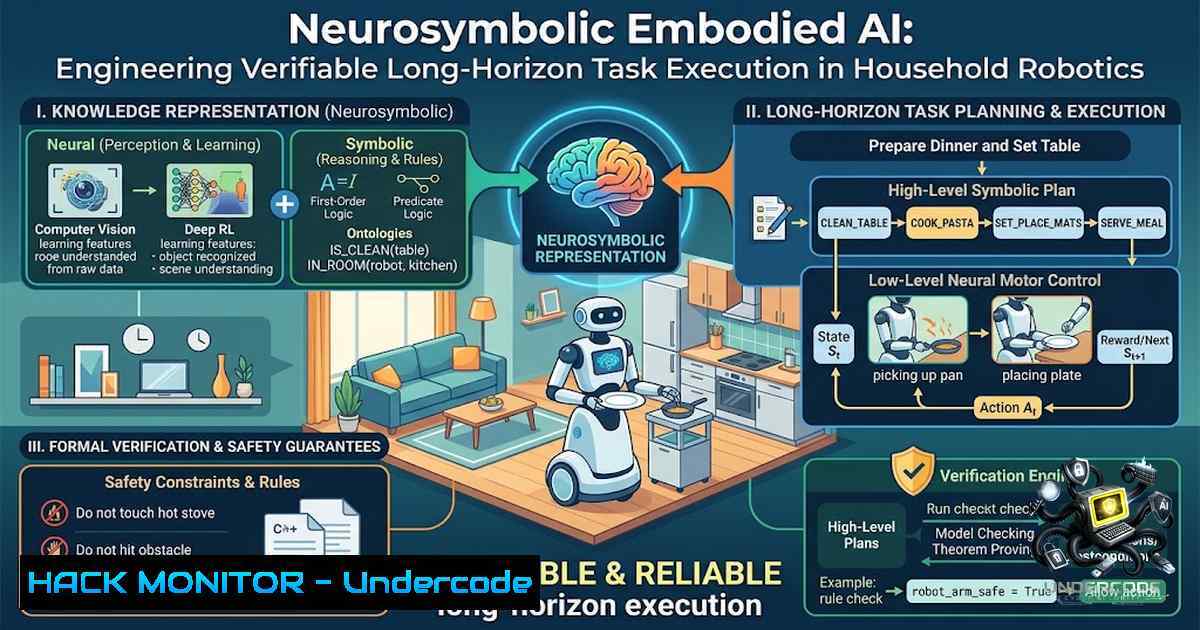
The deployment of autonomous agents in unstructured household environments represents a frontier challenge in artificial intelligence, where the fusion of neural perception and symbolic reasoning is proving essential for reliable long-horizon task planning. A recent breakthrough from researchers demonstrates a neurosymbolic architecture that achieves 90-99% task success rates by decoupling visual perception from logical planning, addressing the critical failure modes where pure end-to-end learning systems falter in multi-object rearrangement and containment tasks. This approach, validated on VirtualHome and ALFWorld benchmarks, establishes a new paradigm for embodied AI that prioritizes plan executability and resource efficiency over brute-force model scaling, with profound implications for secure, verifiable automation systems in critical infrastructure.
Learning Objectives & Secrets:
- Objective 1: Master the Grounded Symbolic Interface – Learn to construct a symbolic state representation from egocentric RGB inputs by employing targeted visual exploration and vision-language models to bind objects to their physical properties and spatial relationships, forming the foundation for verifiable planning.
- Objective 2 Secret Tip: Optimize Monte Carlo Tree Search (MCTS) for Action Constraints – Enhance planning efficiency by pruning the search space using a learned symbolic transition model that restricts plan decoding to applicable actions, thereby reducing computational overhead and eliminating invalid action sequences before they are evaluated.
- Objective 3 Secret Tip: Implement Failure Localization Through Perception-Planning Separation – Systematically isolate errors by treating state acquisition (perception) as a distinct module from plan validation (planning), allowing for targeted retraining or sensor calibration to mitigate residual failures without compromising the integrity of the plan validity component.
You Should Know:
- Setting Up the Neurosymbolic Environment for Household Robotics
To replicate and experiment with this architecture, establish a development environment that integrates large-scale vision-language models with a symbolic reasoning engine. Begin by creating a Python virtual environment and installing the core dependencies: PyTorch, Transformers, and the VirtualHome simulator. The following commands set up the base system on Ubuntu 22.04:sudo apt update && sudo apt install python3-pip python3-venv git python3 -m venv neurosymbolic_env source neurosymbolic_env/bin/activate pip install torch torchvision transformers opencv-python gym git clone https://github.com/xingdi-eric-yuan/VirtualHome-2.0.git cd VirtualHome-2.0 && pip install -e .
For Windows users, utilize WSL2 for native Linux kernel support or install the equivalent packages via Anaconda
conda create -1 neurosym python=3.9
conda activate neurosym
pip install torch torchvision --index-url https://download.pytorch.org/whl/cu118
This step ensures you have a simulated environment to test the agent’s perception and planning pipeline, crucial for verifying the symbolic state extraction from visual inputs.
2. Implementing Grounded Scene Acquisition and Object Binding
The first phase of the pipeline involves acquiring scene facts and grounding them into a symbolic initial state. This process uses a vision-language model like CLIP or a fine-tuned object detector to identify objects and their attributes from egocentric RGB frames. After detection, you must bind these detections to a knowledge graph that represents object states (e.g., “apple is on table,” “fridge is open”). A Python script to mock this binding process might involve:
import torch
from transformers import CLIPProcessor, CLIPModel

model = CLIPModel.from_pretrained("openai/clip-vit-base-patch32")
processor = CLIPProcessor.from_pretrained("openai/clip-vit-base-patch32")
 Simulated image and object list
image = load_egocentric_frame()
objects = ["apple", "table", "fridge", "cup"]
inputs = processor(text=objects, images=image, return_tensors="pt", padding=True)
outputs = model(inputs)
probs = outputs.logits_per_image.softmax(dim=1)
grounded_objects = {objects[bash]: probs[bash][i].item() for i in range(len(objects))}
To harden this for deployment, ensure the object detection service is containerized with Docker, and implement a caching mechanism to reduce repeated inference costs, aligning with the paper’s emphasis on reducing token generation and observation costs.
- Symbolic Transition Model and Action Restriction for Plan Decoding
The core of the neurosymbolic approach is the symbolic transition model that restricts plan decoding. This model encodes the physical and logical rules of the environment (e.g., “a cup cannot be inside a closed fridge”). Implement this as a state machine or a PDDL (Planning Domain Definition Language) domain file. The following PDDL snippet illustrates a simple action restriction:(:action put-in :parameters (?obj - object ?container - container) :precondition (and (hand-empty) (at ?obj ?loc) (not (in ?obj ?container)) (open ?container)) :effect (and (in ?obj ?container) (not (at ?obj ?loc))))
To integrate with MCTS, you would evaluate the applicability of each action by querying this symbolic model, pruning branches where preconditions are not met. This reduces the search space exponentially, allowing for long-horizon planning. Use the `pddl` Python library to parse and validate actions programmatically:
from pddl import PDDL_Parser parser = PDDL_Parser() parser.parse_domain('domain.pddl') parser.parse_problem('problem.pddl') applicable_actions = parser.ground_actions() -
Monte Carlo Tree Search (MCTS) for Plan Evaluation and Execution
MCTS is employed to evaluate the long-term viability of plans by simulating random rollouts from a given state. Implement MCTS with a rollout policy that uses the symbolic model to ensure simulations respect physical constraints. The key is to weight the exploration vs. exploitation using the UCT (Upper Confidence Bound for Trees) formula. Below is a simplified implementation of the MCTS node and selection function:class MCTSNode: def <strong>init</strong>(self, state, parent=None): self.state = state self.parent = parent self.children = [] self.visits = 0 self.value = 0.0</p></li> </ol> <p>def select_child(node): best_child = None best_score = -float('inf') for child in node.children: score = child.value / (child.visits + 1) + math.sqrt(2 math.log(node.visits) / (child.visits + 1)) if score > best_score: best_score = score best_child = child return best_childFor cloud deployment, use AWS SageMaker or Azure ML to scale MCTS rollouts across multiple instances, ensuring fault tolerance and load balancing. Implement a watchdog timer to abort simulations that exceed a resource budget, preventing denial-of-service scenarios in multi-agent environments.
5. API Security and Cloud Hardening for Deployment
When deploying such agents in smart home infrastructure, securing the API endpoints and data pipelines is paramount. Implement mutual TLS (mTLS) for communication between the perception module, planning engine, and the cloud orchestrator. Utilize HashiCorp Vault to manage secrets (API keys for vision models, database credentials) and enforce strict IAM roles. For monitoring, integrate with SIEM tools like Splunk or ELK stack to audit plan execution logs and detect anomalies that may indicate adversarial perturbations. The following iptables rule restricts access to the planning service to only the internal subnet:
sudo iptables -A INPUT -p tcp --dport 5000 -s 192.168.1.0/24 -j ACCEPT
sudo iptables -A INPUT -p tcp --dport 5000 -j DROP
On Windows, use the `New-1etFirewallRule` PowerShell cmdlet:
New-1etFirewallRule -DisplayName "Allow Planning API" -Direction Inbound -LocalPort 5000 -Protocol TCP -Action Allow -RemoteAddress 192.168.1.0/24
6. Vulnerability Exploitation and Mitigation in Neuro-Symbolic Systems
The factorized architecture introduces specific attack surfaces: adversarial perturbations on egocentric RGB inputs can corrupt the grounded symbolic state, leading to invalid plans. To mitigate, implement input sanitization using adversarial training on the vision-language model and employ a robust symbolic verifier that cross-checks plausible state transitions. For instance, if the symbolic state claims “apple is on the table,” but the transition model knows the table is occupied by a cup, the verifier flags the inconsistency. Integrate the CLEVER (Cross-Layer Explanations and Verification) framework to certify the robustness of the grounding module. A mitigation script to preprocess input frames might include:
import cv2
def preprocess_frame(frame):
 Apply Gaussian blur to reduce noise and adversarial perturbations
return cv2.GaussianBlur(frame, (5, 5), 0)
This ensures that even if the input is tampered with, the symbolic grounding remains within expected bounds, maintaining plan validity.
What Undercode Say:
- Key Takeaway 1: The separation of perception from planning through a grounded symbolic interface is a game-changer for reliable AI, as it allows each module to be optimized and certified independently, significantly reducing the compounding errors seen in monolithic deep learning models.
- Key Takeaway 2: The demonstration that smaller, constrained models can outperform larger unconstrained policies validates the hypothesis that architectural structure and domain knowledge are more critical than sheer model size for complex reasoning tasks.
- Analysis: This research underscores a pivotal shift in embodied AI from brute-force learning to structured reasoning. The ability to localize failures to state acquisition rather than planning validity provides a clear roadmap for incremental improvements. For cybersecurity, this architecture offers a tamper-proof planning layer that can be formally verified, making it suitable for critical robotic applications in healthcare, logistics, and defense. The reduction in token and observation costs also makes deployment on edge devices more feasible, reducing latency and bandwidth requirements. However, the reliance on symbolic models demands rigorous domain engineering, which may limit adaptability to novel environments. Future work should focus on automated domain acquisition and robust adversarial defenses for the perception module.
Prediction:
- +1: This neurosymbolic approach will accelerate the adoption of trustworthy autonomous agents in regulated industries, where formal verification of plans is mandatory, potentially leading to new ISO standards for robotic planning systems.
- +1: The demonstrated efficiency gains will democratize advanced robotics, enabling smaller companies to deploy competitive solutions without access to massive compute clusters, fostering innovation and reducing barriers to entry.
- -1: The complexity of designing and maintaining the symbolic domain models could lead to brittle systems in highly dynamic environments, requiring continuous human oversight and domain updates, which may introduce new operational security risks.
- +1: We will likely see the integration of this factorized architecture into existing MLOps and LLMOps pipelines, creating hybrid systems that leverage both neural and symbolic components for enhanced decision-making in IoT and edge computing scenarios.
- -1: Adversarial attacks targeting the symbolic interface could become a new vector of exploitation, prompting a race between attackers and defenders to secure the grounding and verification layers, potentially leading to an arms race in AI security.
- +1: The emphasis on reducing token generation costs aligns with the broader industry push for sustainable AI, potentially lowering the carbon footprint of large-scale robotic simulations and deployments.
- +1: This research will likely inspire new benchmarks and competition challenges focused on neurosymbolic reasoning, driving further innovation in the field and attracting more researchers to the intersection of AI and formal methods.
- -1: The reliance on egocentric RGB inputs makes the system susceptible to occlusions and lighting changes, which could degrade performance in real-world settings, necessitating multi-modal sensor fusion for robust operation.
- +1: The framework provides a solid foundation for transfer learning, where domain-specific knowledge can be injected via the symbolic model without retraining the perception backbone, enabling rapid adaptation to new household environments.
- +1: The clear separation of modules will facilitate better auditability and accountability in AI systems, making it easier to pinpoint responsibility when failures occur, which is crucial for legal and ethical compliance.
▶️ Related Video (86% Match):
🎯Let’s Practice For Free:
🎓 Live Courses & Certifications:
Join Undercode Academy for Verified Certifications
🚀 Request a Custom Project:
Secure, high-velocity infrastructure and disruptive technological engineering. Contact our engineering team for high-tier development and proprietary systems:
[email protected]
💎 Smart Architecture | 🛡️ Secure by Design | ⭐ Trusted by ThousandsIT/Security Reporter URL:
Reported By: https://lnkd.in/p/e_Z_hsvp – Hackers Feeds
Extra Hub: Undercode MoN
Basic Verification: Pass ✅🔐JOIN OUR CYBER WORLD [ CVE News • HackMonitor • UndercodeNews ]
📢 Follow UndercodeTesting & Stay Tuned:


