Listen to this Post
Introduction:
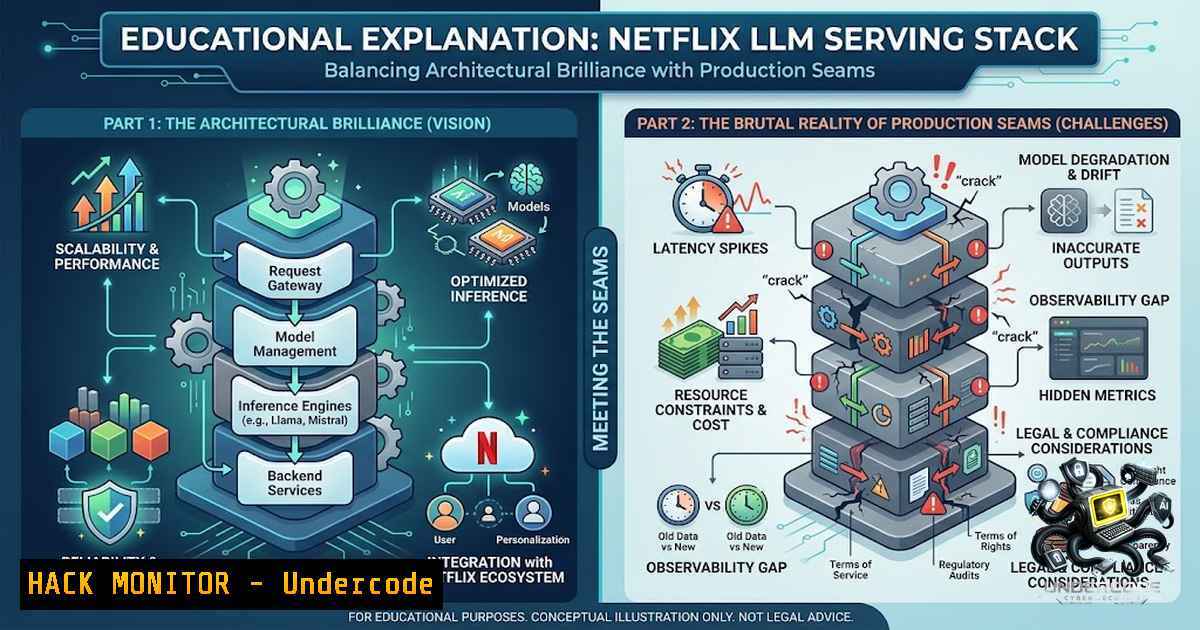
Most organizations consume large language models through hosted APIs, but Netflix chose a different path—running the full stack in-house, from model deployment through inference, directly inside their existing production environment rather than a separate ML silo. The company’s AI Platform’s Model Runtime team and Inference team built a unified JVM-based serving system that integrates vLLM and NVIDIA Triton Inference Server behind a unified API surface, supporting both gRPC and OpenAI-compatible HTTP paths. While headline architectural decisions—engine selection, API design, and deployment strategies—are critical, Netflix’s production experience reveals that the failures that actually wake you up at 3 AM live in the seams: version mismatches, silently dropped API fields, and state machines that break under real traffic patterns no design review could anticipate.
Learning Objectives:
- Understand the architectural decisions behind building a production-grade LLM serving platform using vLLM and Triton Inference Server
- Identify common failure modes that emerge only under production load, including version drift, API compatibility gaps, and preemption handling
- Learn practical deployment strategies, version pinning techniques, and operational hardening measures for LLM inference infrastructure
- Gain hands-on knowledge of configuring Triton with vLLM backend, model repository structures, and Kubernetes-based deployment patterns
- Architecture Deep Dive: Netflix’s Unified LLM Serving Platform
Netflix’s Model Scoring Service (MSS) serves as the shared inference backend, supporting XGBoost, TensorFlow, PyTorch, and LLMs behind a unified interface. Underneath, NVIDIA Triton Inference Server manages model loading, batching, and GPU scheduling, with a Java control plane handling deployment, versioning, health checking, autoscaling, and multi-region rollouts.
The platform originally ran on TensorRT-LLM, but by summer 2025, open-source engines had largely closed the performance gap. Netflix re-benchmarked against their workload mix—embedding generation, prefill-only inference for ranking and retrieval, autoregressive decoding, and custom models with per-step constraint logic—and selected vLLM as their paved-path engine. The decision was driven by vLLM’s ability to load custom model architectures without multi-step compilation, extensibility hooks for custom decoding logic, debuggability, and practitioner familiarity.
Triton Integration Models. Triton supports two packaging approaches for vLLM models, with significant maintainability implications:
- Python backend: Model artifacts include a Python script that loads vLLM and handles inference logic. This approach offers flexibility but couples models to the frontend upgrade cycle.
- vLLM backend: The artifact is simply a JSON config pointing to model weights and tokenizer. Triton’s vLLM backend reads this config and generates I/O tensor specs dynamically at deployment time—models and frontend evolve independently.
The vLLM backend approach ultimately won out, enabling faster iteration and cleaner separation of concerns.
2. The Production Seams: What Design Reviews Miss
Netflix’s post-mortem analysis reveals a pattern that any serious platform team should internalize: while big architectural bets are usually sound if you’ve done your homework, the failure modes that actually cost time lie in the seams.
Silently Dropped Response Format Fields. A seemingly innocuous API field—response_format—was dropped silently in production, breaking applications that depended on structured output. This type of failure doesn’t appear in design documents or unit tests; it only emerges when real traffic exercises the full stack.
Triton/vLLM Version Mismatch. Triton’s vLLM backend is compiled against a specific vLLM API surface. When the two drift—for example, Triton 25.09 importing vllm.engine.metrics, a module removed in vLLM 0.11.2—the backend fails to load entirely. This isn’t a graceful degradation; it’s a hard failure that blocks deployment.
State Machine Failure on Preemption. When vLLM preempts a request mid-decode—a routine occurrence under memory pressure—the state machine can fail catastrophically. The scheduler sets a sequence status to `RUNNING` during Scheduler.schedule(); preemption triggers a transition back to `WAITING` when resources need to be freed. But under async scheduling with KV-cache pressure, `num_output_placeholders` can underflow, leading to EngineCore crashes. These bugs don’t appear in staging with synthetic traffic—they require real concurrency, long inputs, and the specific interplay of speculative decoding and pipeline parallelism.
3. Step-by-Step: Deploying vLLM with Triton Inference Server
Prerequisites:
- NVIDIA GPU with compatible drivers
- Docker installed
- Hugging Face account with access to desired models
Step 1: Start the Triton vLLM Container
mkdir vllm_workspace && cd vllm_workspace

sudo docker run --gpus all -it \
--1et=host -p 8001:8001 --shm-size=12G \
--ulimit memlock=-1 --ulimit stack=67108864 \
-v ${PWD}:/vllm_workspace \
-w /vllm_workspace \
nvcr.io/nvidia/tritonserver:24.12-vllm-python-py3 \
/bin/bash
Important: Triton’s vLLM container was introduced in the 23.10 release. For multi-LoRA support, use version 24.05 or higher. Never use latest—pin to a specific release tag.
Step 2: Prepare the Model Repository
The model repository structure must follow Triton’s conventions:
model_repository/
└── vllm_model/
├── config.pbtxt
└── 1/
└── model.json
Step 3: Create model.json
{
"model": "facebook/opt-125m",
"gpu_memory_utilization": 0.5,
"max_model_len": 8192,
"tensor_parallel_size": 1,
"dtype": "float16",
"enable_chunked_prefill": true,
"max_num_seqs": 128
}
This file configures the vLLM engine parameters. The `gpu_memory_utilization` setting controls how much GPU memory vLLM reserves for KV cache—tune this based on your workload.
Step 4: Create config.pbtxt
backend: "vllm"
max_batch_size: 0
model_transaction_policy { decoupled: True }

input [
{ name: "text_input" data_type: TYPE_STRING dims: [ 1 ] },
{ name: "stream" data_type: TYPE_BOOL dims: [ 1 ] },
{ name: "sampling_parameters" data_type: TYPE_STRING dims: [ 1 ] optional: true }
]

output [
{ name: "text_output" data_type: TYPE_STRING dims: [ -1 ] }
]
Step 5: Launch Triton Server
tritonserver --model-repository=/vllm_workspace/model_repository --log-verbose=1
Step 6: Send Inference Requests
Use the Triton client to send requests:
python3 triton-client.py --model-1ame vllm_model --input-prompts prompts.txt --results-file results.txt
4. Kubernetes Deployment: Production-Grade LLM Serving
For production deployments, Kubernetes provides the orchestration layer for the entire stack. Here’s a production-ready deployment pattern:
Model Repository as ConfigMap:
apiVersion: v1
kind: ConfigMap
metadata:
name: triton-vllm-config
namespace: ai-inference
data:
config.pbtxt: |
backend: "vllm"
max_batch_size: 0
model_transaction_policy { decoupled: True }
input [
{ name: "text_input" data_type: TYPE_STRING dims: [ 1 ] },
{ name: "stream" data_type: TYPE_BOOL dims: [ 1 ] },
{ name: "sampling_parameters" data_type: TYPE_STRING dims: [ 1 ] optional: true }
]
output [
{ name: "text_output" data_type: TYPE_STRING dims: [ -1 ] }
]
model.json: |
{
"model": "mistralai/Mistral-7B-Instruct-v0.3",
"disable_log_requests": true,
"gpu_memory_utilization": 0.85,
"max_model_len": 8192,
"tensor_parallel_size": 1,
"dtype": "float16",
"enable_chunked_prefill": true,
"max_num_seqs": 128,
"enforce_eager": false
}
Deployment with GPU Support:
apiVersion: apps/v1
kind: Deployment
metadata:
name: triton-vllm
namespace: ai-inference
spec:
replicas: 1
selector:
matchLabels:
app: triton-vllm
template:
metadata:
labels:
app: triton-vllm
spec:
containers:
- name: triton
image: nvcr.io/nvidia/tritonserver:24.12-vllm-python-py3
args:
- tritonserver
- --model-repository=/model-repository
- --log-verbose=1
ports:
- containerPort: 8000
name: http
- containerPort: 8001
name: grpc
- containerPort: 8002
name: metrics
env:
- name: HUGGING_FACE_HUB_TOKEN
valueFrom:
secretKeyRef:
name: hf-token
key: token
- name: TRANSFORMERS_CACHE
value: /cache/huggingface
resources:
limits:
nvidia.com/gpu: 1
memory: 48Gi
cpu: "8"
requests:
memory: 24Gi
cpu: "4"
volumeMounts:
- name: config
mountPath: /model-repository/mistral-7b/config.pbtxt
subPath: config.pbtxt
- name: config
mountPath: /model-repository/mistral-7b/1/model.json
subPath: model.json
Horizontal Pod Autoscaling. Deploy Prometheus and Grafana to collect custom metrics and enable HPA-based scaling based on inference demand.
- Version Pinning: The Boring Infrastructure That Pays Back
Version pinning is the single most important operational practice for LLM inference infrastructure. Netflix’s production experience with Triton/vLLM version mismatches underscores this painfully.
What to Pin:
 Pin NVIDIA driver version
 Pin CUDA version
 Pin Triton Inference Server version
docker pull nvcr.io/nvidia/tritonserver:24.12-vllm-python-py3

Pin vLLM version in requirements.txt
vllm==0.6.4.post1

Pin PyTorch version
torch==2.3.0

Pin model commit SHA
git clone https://huggingface.co/meta-llama/Llama-2-7b-chat-hf
 Checkout specific commit SHA
Environment Variables for Performance:
 Pin inference to specific GPU
export CUDA_VISIBLE_DEVICES=0

Enable Triton FlashAttention (40% KV-cache memory reduction on Ampere+)
export VLLM_USE_TRITON_FLASH_ATTN=1

Set attention backend
export VLLM_ATTENTION_BACKEND=TRITON_ATTN
Version Compatibility Matrix. Always validate version compatibility before deployment. The Triton vLLM backend has known limitations—for example, it doesn’t support tensor parallelism sizes greater than 1 with the default `distributed_executor_backend` setting when using explicit model control mode.
6. API Security and Gateway Patterns
Netflix exposes an OpenAI-compatible HTTP frontend alongside their gRPC path. For production LLM serving, an API gateway provides critical security and control capabilities:
LLM Gateway Capabilities:
- Multi-provider routing and failover
- Semantic caching for cost reduction
- Budget and spend caps
- PII redaction and guardrails
- Audit logging and encrypted API keys
- Rate limiting and access control
Deploying an LLM Gateway:
 Example using a self-hosted gateway
docker run -d \
-p 8080:8080 \
-e OPENAI_API_KEY=your-key \
-e MODEL_PROVIDER=vllm \
-e MODEL_ENDPOINT=http://triton-vllm:8000 \
llm-gateway:latest
For production, the gateway should sit between applications and the model serving layer, providing a unified OpenAI-compatible API that routes to multiple backends—whether hosted providers or self-hosted vLLM instances.
7. Operational Hardening: Beyond the Happy Path
Netflix’s experience reveals several operational lessons that extend beyond initial design:
Constrained Decoding at Scale. Initial per-request Python logits processors hit CPU/GIL bottlenecks under batching. Netflix rewrote this using vLLM V1’s batch-level API with a C++ multi-threaded hot path, resolving the scaling issue.
Model Caching and Unified Metrics. Implement model caching to avoid repeated loading of large weight files. Use unified metrics across the entire serving stack for observability and autoscaling decisions.
Deployment Strategies. Netflix evaluated Red-Black versus versioned rollouts. The choice depends on your risk tolerance and rollback capabilities. Red-Black provides instant rollback but doubles resource requirements; versioned rollouts are more resource-efficient but require careful state management.
Zero-Downtime Upgrades. Netflix built a Triton manager (server manager + proxy) providing a backward-compatible, drop-in replacement enabling zero-downtime rollouts.
What Undercode Say:
- The big architectural decisions are usually sound if you’ve done your homework—it’s the stuff three layers down that actually pages you at 3 AM. Netflix’s experience with vLLM preemption mid-decode is the perfect example: no design review catches that, only real traffic does.
-
Version pinning isn’t glamorous, but it pays back the first time something breaks. Pin everything in the GPU stack—NVIDIA driver, CUDA, Triton, vLLM, PyTorch, and model commit SHAs. Update on maintenance windows, not on a whim.
-
The failure modes that cost time lie in the seams: version drift between Triton and vLLM, silent API gaps like dropped `response_format` fields, and assumptions about state that fail under memory pressure. Design for those seams, not just the happy path.
-
Open-source engines like vLLM have largely closed the performance gap with specialized stacks, but they introduce new operational complexity. The trade-off is worth it for faster iteration and better debuggability—provided your team invests in the operational hardening to match.
-
Netflix’s decision to run the full stack in-house rather than use hosted APIs reflects a strategic bet on control, cost predictability, and the ability to optimize for their specific workload mix. This isn’t right for every organization, but for those with the scale and expertise, the payoff is substantial.
Prediction:
-
+1 The trend toward in-house LLM serving will accelerate as organizations seek cost predictability at high request volumes and control over data residency. The hybrid approach—running open-source models locally for high-volume workloads while using managed APIs for specialized tasks—will become the dominant pattern.
-
+1 vLLM will continue to gain market share as the default inference engine for self-hosted LLM deployments, driven by its OpenAI-compatible API, PagedAttention memory management, and active open-source community. Triton’s vLLM backend will become the standard for multi-model serving in enterprise environments.
-
-1 Version compatibility issues between Triton and vLLM will remain a persistent pain point, requiring rigorous CI/CD validation and pinning strategies. Organizations that don’t invest in automated compatibility testing will experience frequent production incidents.
-
-1 The complexity of stateful inference—particularly around preemption, partial prefills, and constrained decoding—will continue to challenge platform teams. Expect more incidents related to state machine failures and memory management edge cases as workloads grow in complexity and concurrency.
-
+1 The emergence of vLLM V1’s batch-level API and C++-based hot paths represents a significant step forward for constrained decoding at scale. This will enable more sophisticated output control without the performance penalties that plagued earlier approaches.
-
+1 LLM gateways with semantic caching, PII redaction, and multi-provider routing will become essential infrastructure for production deployments. These gateways will evolve to handle increasingly complex routing logic, cost optimization, and security requirements, becoming the control plane for all LLM traffic.
▶️ Related Video (80% Match):
https://www.youtube.com/watch?v=1D1-trjgywA
🎯Let’s Practice For Free:
🎓 Live Courses & Certifications:
Join Undercode Academy for Verified Certifications
🚀 Request a Custom Project:
Secure, high-velocity infrastructure and disruptive technological engineering. Contact our engineering team for high-tier development and proprietary systems:
[email protected]
💎 Smart Architecture | 🛡️ Secure by Design | ⭐ Trusted by Thousands
IT/Security Reporter URL:
Reported By: Longren I – Hackers Feeds
Extra Hub: Undercode MoN
Basic Verification: Pass ✅


