Listen to this Post
Introduction:
Artificial intelligence is no longer an abstract enabler on the horizon—it is actively compressing decision cycles, reshaping the offense-defense balance in cyberspace, and introducing new escalation risks that demand a fundamental rethink of military education. Recognizing this paradigm shift, NATO’s Defence Education Enhancement Programme (DEEP) is developing a modular Reference Curriculum on AI as a Tool for Military Power, designed to equip officers and defense professionals with the critical frameworks needed to navigate an era of agentic autonomy and AI-driven warfare. This initiative moves beyond technical literacy to address the strategic, operational, and normative dimensions of AI, ensuring that the Alliance can harness these transformative capabilities while mitigating the profound security risks they introduce.
Learning Objectives:
- Understand the architecture and operational implications of agentic AI systems, including their potential for autonomous intelligence analysis, direction of fires, and mission adaptation.
- Master the essential security protocols and cryptographic trust frameworks required to secure military AI against adversarial attacks, including prompt injection, jailbreaking, and data poisoning.
- Develop the ability to integrate AI-enabled decision support into multi-domain operations, leveraging tools for cyber resilience, threat detection, and command and control.
You Should Know:
- Understanding Agentic AI and the Cryptographic Kill Web
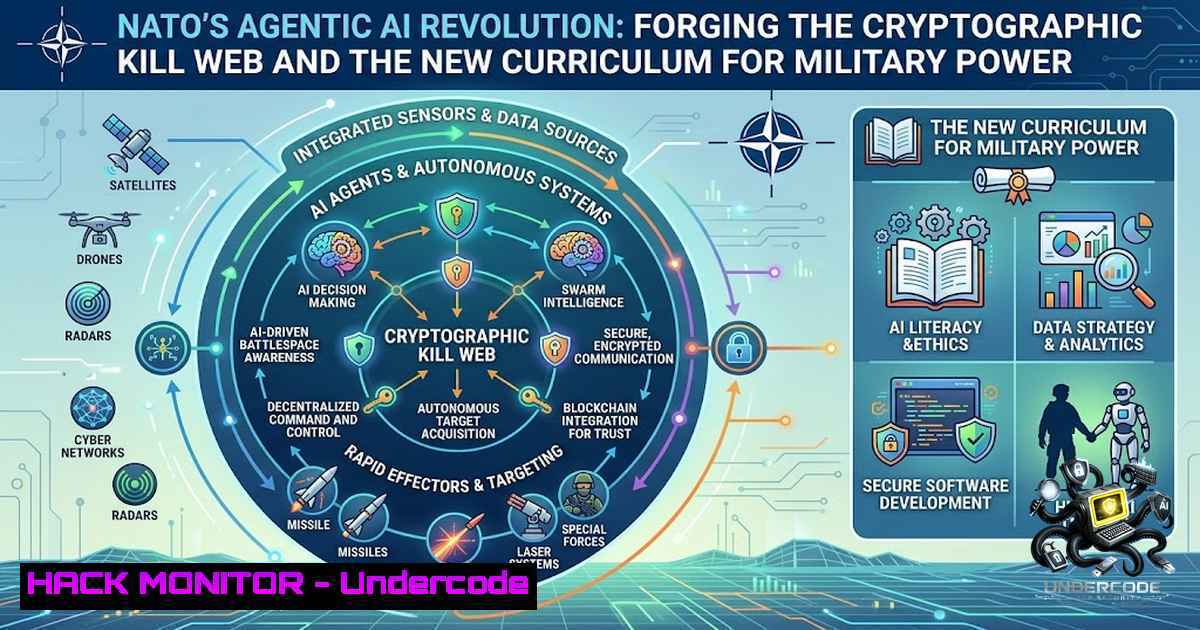
Agentic AI represents a leap beyond traditional automation. These systems, characterized by their ability to affect system performance or the physical environment subject to permission policies, are poised to transform military operations. Recent NATO exercises and workshops have highlighted the emergence of the “Kill Web”—a complex digital matrix linking satellites, reconnaissance drones, radars, terrestrial sensors, and AI-driven command nodes. Unlike rigid legacy command structures, the Kill Web enables dynamic, AI-facilitated targeting and decision-making across all domains.
To operationalize this, NATO is exploring multi-agent AI systems like ODIN, which integrates information, filters irrelevant inputs, and provides commanders with a real-time, clear operational picture. However, the authority of an AI-generated common operating picture introduces risks—accelerating wrong decisions if provenance and cryptographic verification are not enforced. A cryptographic trust framework is therefore essential, where agentic interaction, code integrity, and operational scope are each independently maintained by cryptographic authorization. This ensures that every action taken by an AI agent is verifiable, auditable, and aligned with mission intent.
2. Securing AI Against Adversarial Threats
The security risks of military agentic AI are critical and growing. These systems can be exploited through adversarial attacks such as jailbreaking (bypassing safety filters), prompt injection (manipulating inputs to cause unintended actions), and data poisoning (corrupting training data to introduce backdoors). To counter these threats, NATO’s research community is developing a governance framework that includes an “Agent-Guard”—a policy-enforcing AI that supervises a Primary-Agent.
Step‑by‑step guide to implementing an Agent-Guard constraint enforcement framework:
– Step 1: Define Mission Constraints in Natural Language. Translate operational rules (e.g., “Do not engage targets within 500 meters of a civilian structure”) into clear, unambiguous natural language policies.
– Step 2: Dynamically Translate Constraints into Formal Policies. The Agent-Guard converts these natural language constraints into machine-readable, formal policies stored in a secure, tamper-proof database.
– Step 3: Enforce Pre-Execution Validation. Before any action is executed by the Primary-Agent, an execution monitor and risk estimation guard validate the proposed action against the formal policies.
– Step 4: Integrate Human-in-the-Loop Oversight. The architecture balances autonomy with granular human oversight, allowing commanders to review and override high-risk decisions flagged by the Agent-Guard.
- AI-Enabled Cyber Defense and the Collapse of Patching Timelines
NATO has issued stark warnings that AI is collapsing traditional cyber defense timelines, compressing the window to patch vulnerabilities from days to minutes. In response, AI is being embedded at the core of command through decision-support tools that analyze threat data, predict adversary behavior, and automate defensive responses.
Practical Linux/Windows commands for AI-driven threat hunting and log analysis:
– Linux (Log Analysis with AI/ML tools):
– `journalctl -f | grep -i “failed\|error\|attack” | tee /var/log/threat_feed.log` – Real-time monitoring of system logs for suspicious activity.
– `cat /var/log/auth.log | awk ‘{print $1″ “$2” “$3” “$9}’ | sort | uniq -c | sort -1r` – Aggregating failed login attempts to identify brute-force patterns.
– `python3 -c “import pandas as pd; from sklearn.ensemble import IsolationForest; …”` – Example of invoking a Python script that uses an Isolation Forest model to detect anomalies in network traffic data.
– Windows (PowerShell for Threat Hunting):
– `Get-WinEvent -LogName Security | Where-Object {$_.Id -eq 4625} | Group-Object -Property TargetUserName | Sort-Object -Property Count -Descending` – Lists failed logon attempts, grouping by username to identify potential password spraying.
– `Get-WinEvent -LogName Microsoft-Windows-Sysmon/Operational | Where-Object {$_.Message -match “Process Create”} | Select-Object TimeCreated, Message` – Monitors for suspicious process creation events, a key indicator of malware execution.
- Practical Hands-On: Building a Simple AI Agent for Intelligence Filtering
Following the model of the ODIN multi-agent system, defense professionals can prototype a simple AI agent that filters and prioritizes intelligence feeds.
Step‑by‑step guide to prototyping an intelligence filtering agent:
- Step 1: Set Up the Environment. Install Python 3.8+, along with libraries for natural language processing (NLP) and data manipulation:
pip install transformers torch pandas numpy. - Step 2: Define the Data Sources. Simulate intelligence feeds by ingesting data from multiple CSV or JSON files representing different sensors or reconnaissance platforms.
- Step 3: Implement a Filtering Algorithm. Use a pre-trained BERT or similar transformer model to classify each intelligence report by relevance and threat level. For example:
from transformers import pipeline classifier = pipeline("text-classification", model="bert-base-uncased") reports = ["Report 1: Enemy movement detected at grid 1234", ...] for report in reports: result = classifier(report) if result['label'] == 'HIGH_THREAT' and result['score'] > 0.85: print(f"PRIORITY ALERT: {report}") - Step 4: Integrate with a Simple Dashboard. Use Flask or Streamlit to create a real-time display that shows filtered intelligence, allowing a human operator to validate and act on high-priority alerts.
- The Reference Curriculum: Preparing for the AI-Driven Battlefield
The NATO DEEP Reference Curriculum on AI as a Tool for Military Power is not just a technical manual; it is a strategic framework for rethinking military education. It emphasizes practical AI applications across targeting, Intelligence, Surveillance, and Reconnaissance (ISR), logistics, electronic warfare, cyber operations, and decision superiority. The curriculum includes modules on explainable AI (xAI), model robustness, and the risks from adversarial attacks. As part of this initiative, NATO DEEP eAcademy has released over 70 courses, including an “ADL Development with GenAI Masterclass,” providing scalable digital learning for personnel across the Alliance.
Step‑by‑step guide to integrating AI into military training:
- Step 1: Adopt the NATO DEEP eAcademy Framework. Access the updated course catalogue and select modules relevant to your service branch or operational role.
- Step 2: Implement AI Bootcamps. Follow the model of the NATO DEEP eAcademy AI Bootcamp, combining short theoretical inputs with hands-on exercises using accessible tools like ChatGPT, Gemini, and Replit.
- Step 3: Develop AI-Supported Wargaming. Use AI to generate storylines, events, and adversary behaviors for exercises, as demonstrated by NATO’s Allied Command Transformation.
- Step 4: Emphasize Responsible AI. Integrate NATO’s six Principles of Responsible Use (PRUs) into all training, ensuring that ethical and legal considerations are embedded in AI adoption.
What Undercode Say:
- Key Takeaway 1: NATO’s shift toward a modular, scalable AI curriculum marks a critical inflection point—military power in the 21st century will be defined not by the quantity of platforms, but by the quality of AI integration and the cryptographic trust underpinning it.
- Key Takeaway 2: The emergence of agentic AI demands a fundamental rethinking of command and control; the future of warfare is not about replacing human decision-makers, but about augmenting them with secure, verifiable, and constrained AI agents that can operate at machine speed while remaining under human oversight.
Analysis:
The NATO DEEP workshops and the development of the Reference Curriculum represent a proactive, institutional response to the accelerating AI arms race. The focus on agentic AI, cryptographic trust, and adversarial resilience highlights a mature understanding that AI is both a force multiplier and a vulnerability vector. By prioritizing education and standardized frameworks, NATO is not only preparing its personnel but also setting a global benchmark for the responsible militarization of AI. However, the success of this initiative hinges on the ability of member states to harmonize their national AI strategies with Alliance-wide standards, a challenge compounded by varying levels of technological maturity and differing threat perceptions. Furthermore, the emphasis on cryptographic provenance and constraint enforcement reveals a growing recognition that in an AI-driven battlespace, the most critical battle may be for the integrity of the data and the trustworthiness of the algorithms themselves.
Prediction:
- +1: The NATO DEEP curriculum will become the de facto standard for Professional Military Education (PME) globally, influencing partner nations and shaping the next generation of military AI leaders.
- +1: Advances in cryptographic trust frameworks for agentic AI will likely spin off into commercial and civilian sectors, enhancing the security of critical infrastructure and financial systems against AI-driven cyber threats.
- -1: The compression of cyber defense timelines to “minutes to patch” will continue to outpace traditional security operations, potentially leading to a significant cyber incident that exposes the fragility of legacy IT systems within defense establishments.
- -1: The proliferation of agentic AI capabilities among state and non-state actors will increase the risk of unintended escalation, particularly in contested environments where AI systems may misinterpret signals or act on corrupted data.
- +1: The integration of AI into NATO’s “Kill Web” and decision-support tools will enhance situational awareness and reduce decision latency, providing a tangible tactical advantage in multi-domain operations.
▶️ Related Video (76% Match):
🎯Let’s Practice For Free:
🎓 Live Courses & Certifications:
Join Undercode Academy for Verified Certifications
🚀 Request a Custom Project:
Secure, high-velocity infrastructure and disruptive technological engineering. Contact our engineering team for high-tier development and proprietary systems:
[email protected]
💎 Smart Architecture | 🛡️ Secure by Design | ⭐ Trusted by Thousands
IT/Security Reporter URL:
Reported By: Blagojdelipetrev Ai – Hackers Feeds
Extra Hub: Undercode MoN
Basic Verification: Pass ✅


