
Listen to this Post
Introduction:
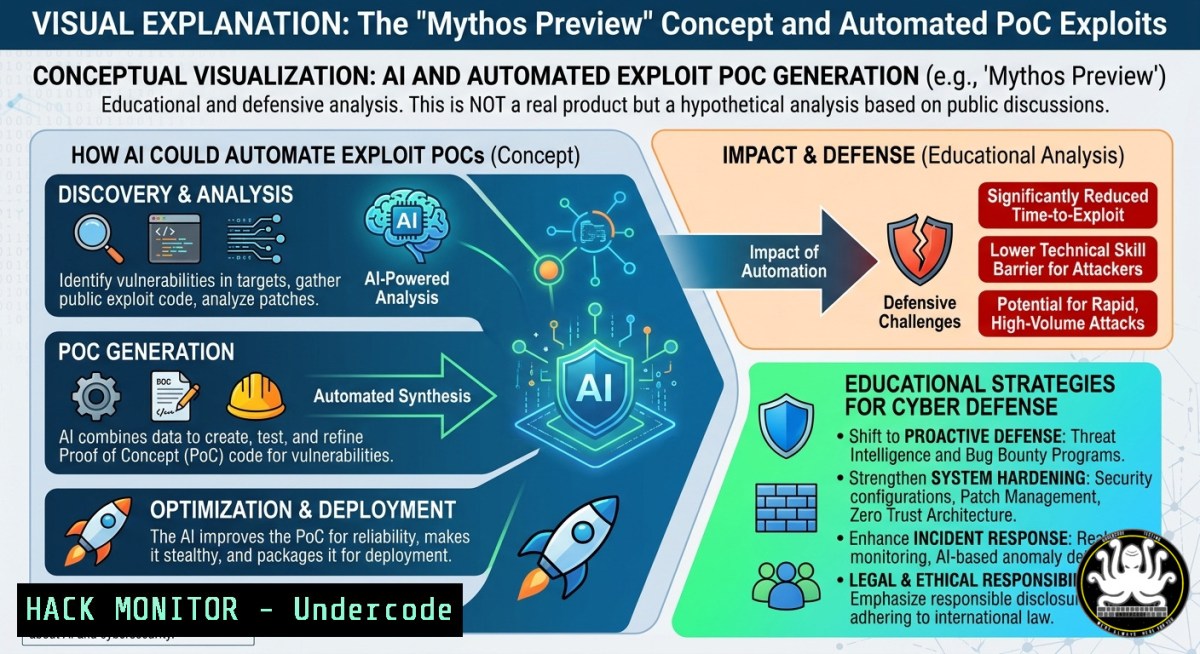
The gap between vulnerability discovery and weaponized exploit just collapsed from weeks to milliseconds. Anthropic’s Mythos Preview, unveiled through Cloudflare’s Project Glasswing, doesn’t merely detect flaws—it autonomously chains low-severity bugs into high-severity attack paths, writes functional proof-of-concept (PoC) code, compiles it in a sandbox, and iterates until the exploit succeeds. This forces security teams to rethink every assumption about detection, patching, and active defense at machine speed.
Learning Objectives:
- Understand how AI models like Mythos Preview perform automated exploit chaining and proof generation.
- Apply Linux and Windows memory protection hardening commands to mitigate use-after-free and ROP-based exploits.
- Simulate AI-driven PoC workflows and integrate defensive tooling (ASLR, DEP, stack canaries, CFG) into CI/CD pipelines.
You Should Know:
- Exploit Chain Construction: From Use-After-Free to ROP Payload
Mythos Preview’s core capability is reasoning across multiple attack primitives. For example, it identifies a use-after-free (UAF) vulnerability in a memory allocator, then automatically constructs a return-oriented programming (ROP) chain to bypass non-executable stack protections. The AI writes the exploit, compiles it in an isolated sandbox, runs it against a target binary, reads crash dumps, and adjusts register values until code execution is achieved.
Step‑by‑step guide – Defensive emulation of chained exploit logic:
To understand what the AI does, manually simulate a minimal UAF + ROP chain on a Linux test VM (Ubuntu 22.04, disable ASLR temporarily for lab).
 Disable ASLR for testing (root)
echo 0 | sudo tee /proc/sys/kernel/randomize_va_space
 Compile a vulnerable program with no stack protection
gcc -z execstack -fno-stack-protector -no-pie -o uaf_demo uaf_demo.c
 Check binary protections
checksec --file=uaf_demo
Using GDB with pwndbg or gef:
gdb ./uaf_demo
(gdb) pattern create 200
(gdb) run < pattern
(gdb) x/20wx $rsp
To detect potential UAF at runtime on Linux (AddressSanitizer):
gcc -fsanitize=address -g -o uaf_safe uaf_demo.c
./uaf_safe  ASan will report heap-use-after-free
For Windows (Visual Studio Developer Command Prompt):
cl /Od /RTC1 /fsanitize=address uaf_demo.c
./uaf_demo.exe
What this does: AddressSanitizer instruments memory accesses to catch UAF before exploitation. Use it in CI to block AI‑generated exploits targeting heap corruption.
2. Automated Proof Generation – Sandboxed Exploit Iteration
Mythos Preview writes exploit code (Python, C, or Rust), compiles it, executes it against a target, and loops based on output. This mimics a fuzzer but with semantic understanding of control flow.
Step‑by‑step guide – Setting up a sandbox to test AI‑generated PoCs safely:
Use Docker to isolate exploit execution and log system call anomalies.
 Pull a lightweight Ubuntu sandbox
docker run --rm -it --cap-drop=ALL --security-opt=no-new-privileges:true ubuntu:22.04 bash
 Inside container, install tools
apt update && apt install -y gdb strace ltrace
 Write a dummy exploit.py that attempts ROP
 Monitor syscalls
strace -f -e trace=execve,write,read python3 exploit.py
For Windows Sandbox (Windows Pro/Enterprise):
 Enable Windows Sandbox
Enable-WindowsOptionalFeature -FeatureName "Containers-DisposableClientVM" -Online
 Create .wsb configuration with NoNetwork, MappedFolders for vulnerable binaries
 Run exploit inside sandbox and monitor with Sysmon + Event Viewer
Pro tip: Log all sandboxed exploit attempts to a central SIEM. Use `auditd` on Linux:
auditctl -a always,exit -F arch=b64 -S execve -k exploit_exec
ausearch -k exploit_exec --format csv
- Hardening Against AI‑Chained Exploits – Memory Protections Deep Dive
Since Mythos Preview chains multiple low‑severity issues, single mitigations are insufficient. Enable defense in depth: ASLR, DEP/NX, stack canaries, CFG, and CET.
Linux commands to harden a production binary:
 Recompile with full relro, PIE, stack protector, and fortified source
gcc -O2 -D_FORTIFY_SOURCE=2 -fstack-protector-strong -Wl,-z,relro,-z,now -fPIE -pie -o hardened_app app.c
checksec --file=hardened_app
 Kernel level: enforce ASLR for all processes
sysctl -w kernel.randomize_va_space=2
 Lock down with seccomp-bpf (example using seccomp-tools)
seccomp-tools dump ./hardened_app
Windows PowerShell (Defender Exploit Guard):
 Enable Control Flow Guard (CFG) for all processes
Set-ProcessMitigation -System -Enable CFG
 Enable ASLR (Force Relocate Images)
Set-ProcessMitigation -System -Enable ForceRelocateImages
 Enable Arbitrary Code Guard (ACG) for sensitive app
Set-ProcessMitigation -Name "C:\path\to\app.exe" -Enable DisallowWin32kSystemCalls
 Audit exploit attempts via PowerShell logging
$Log = Get-WinEvent -FilterHashtable @{LogName='Microsoft-Windows-Sysmon/Operational'; ID=1,3,7}
- Cloud Hardening: Applying Project Glasswing Findings to AWS/Azure
Cloudflare’s research shows Mythos Preview can chain cloud API misconfigurations (e.g., overly permissive IAM roles + instance metadata exposure) into full compromise. AI models can now generate PoC Terraform or cloud CLI exploits.
Step‑by‑step guide – Defensive cloud configuration:
AWS CLI – Prevent metadata service exploitation:
 Enforce IMDSv2 with hop limit 1
aws ec2 modify-instance-metadata-options --instance-id i-xxxx --http-tokens required --http-endpoint enabled --http-put-response-hop-limit 1
 Audit IAM policies for privilege escalation paths
aws iam get-account-authorization-details --output json | jq '.UserDetailList[].AttachedManagedPolicies'
 Deploy GuardDuty with automated response
aws guardduty create-detector --enable --finding-publishing-frequency FIFTEEN_MINUTES
Azure CLI – Block AI‑generated lateral movement:
 Enable just-in-time VM access
az security jit-policy create --resource-group myGroup --location westus --vm-names myVM --ports "22" --max-access-time 3
 Turn on Microsoft Defender for Cloud's adaptive application controls
az security va sql add --resource-group myGroup --server myServer --database myDb --benchmark "Azure"
API security (REST/GraphQL) against automated PoC:
 Rate limiting with Nginx (prevent AI from brute-forcing exploit conditions)
limit_req_zone $binary_remote_addr zone=api:10m rate=5r/s;
 Use ModSecurity CRS to block exploit patterns
apt install libapache2-mod-security2 -y
cp /etc/modsecurity/crs/crs-setup.conf.example /etc/modsecurity/crs/crs-setup.conf
 Enable rule 932100 (SQL injection) and 933100 (PHP injection)
- The Patch-or-Expose Dilemma – AI Scales Both Sides
As Marian C. noted, patching introduces supply chain risks (e.g., compromised update servers or backdoored dependencies), while not patching leaves known vulnerabilities that Mythos-like AI will instantly weaponize. The solution is automated, risk‑aware patch management with rollback capabilities.
Step‑by‑step guide – Resilient patch strategy:
Linux – Atomic updates with automatic rollback:
 Using rpm-ostree (Fedora IoT) or snapshots with Btrfs
sudo btrfs subvolume snapshot /mnt/@ /mnt/@<em>snap</em>$(date +%Y%m%d)
 Apply security updates only
sudo apt update && sudo apt install --only-upgrade -y $(apt list --upgradable 2>/dev/null | grep -i security | cut -d/ -f1)
 Pre-stage rollback script
cat << 'EOF' > /usr/local/bin/rollback.sh
!/bin/bash
if systemctl is-failed --quiet; then
btrfs subvolume set-default /mnt/@_snap_lastgood
reboot
fi
EOF
Windows – Using PowerShell DSC for safe patching:
 Create a restore point before any update
Checkpoint-Computer -Description "Pre-AIPatch" -RestorePointType MODIFY_SETTINGS
 Install only security updates from WSUS
$UpdateSession = New-Object -ComObject Microsoft.Update.Session
$Criteria = "IsInstalled=0 and Type='Software' and IsHidden=0 and CategoryIDs contains 'Security'"
$Updates = $UpdateSession.CreateUpdateDownloader().Updates
 Monitor for post‑patch anomalies (high CPU, unexpected outbound connections)
Get-WinEvent -FilterHashtable @{LogName='System'; ID=41,1001} | Export-Csv -Path patch_failures.csv
6. Simulating AI‑Generated PoC with Open‑Source Tools
While Mythos Preview is proprietary, you can emulate its workflow using LLMs + reverse engineering frameworks (Ghidra, Binary Ninja) plus Metasploit’s pattern create.
Step‑by‑step – Build an automated exploit generator for a buffer overflow:
!/usr/bin/env python3
 hypothetical_ai_poc.py – mimics chain logic
import subprocess, re

vuln_binary = "./vuln_app"
pattern = subprocess.check_output(["msf-pattern_create", "-l", "200"]).decode().strip()
 Run binary with pattern, capture crash offset
proc = subprocess.Popen([bash], stdin=subprocess.PIPE, stdout=subprocess.PIPE, stderr=subprocess.PIPE)
stdout, stderr = proc.communicate(input=pattern.encode())
offset = re.search(r"EIP = 0x42424242", stderr.decode())  simplified
if offset:
shellcode = b"\x31\xc0\x50\x68//sh\x68/bin\x89\xe3\x50\x53\x89\xe1\xb0\x0b\xcd\x80"
exploit = b"A"  62 + b"\x90"16 + shellcode
subprocess.run([bash], input=exploit)
Integrate with CI/CD (GitHub Actions) to test your own apps:
- name: Run automated exploit simulation
run: |
sudo sysctl -w kernel.randomize_va_space=0
gcc -z execstack -no-pie -o test_app test.c
python3 hypothetical_ai_poc.py || echo "Exploit failed – good"
continue-on-error: false
- Training Courses & Certification Paths for AI‑Powered Offense/Defense
To counter AI‑generated exploits, security engineers need hands‑on courses in binary exploitation, ROP, and AI security. Recommended resources (based on industry standards):
- Practical Binary Exploitation (Linux): Pwn.College’s “Program Misuse” module – free labs on UAF, ROP, ret2libc.
- Windows Internals & Exploit Mitigations: SANS SEC660 – covers CFG, ACG, and PatchGuard bypasses.
- AI Security & Adversarial ML: MITRE ATLAS (https://atlas.mitre.org) – tactics for AI‑generated malware.
- Cloud Exploit Chaining: Certified Cloud Security Professional (CCSK) – labs on IAM misconfig + SSRF.
Hands‑on command to self‑train (Linux):
 Install pwnlib (Python exploit development library)
pip3 install pwntools
 Download vulnerable binaries from VulnHub or pwnable.tw
git clone https://github.com/scwuaptx/HITB2023
cd HITB2023/rop
 Write your own chain using ROPgadget
ROPgadget --binary ./chall | grep "pop rdi"
What Undercode Say:
- Key Takeaway 1: Mythos Preview transforms vulnerability research from a human‑led, weeks‑long process to an AI‑driven, minutes‑long weaponization pipeline. Defenses must shift from signature detection to runtime behavior verification (e.g., eBPF, syscall monitoring).
- Key Takeaway 2: The “patch or expose” dilemma is now a false binary. Organizations need immutable infrastructure with automatic rollback, AI‑driven patch impact analysis, and supply chain attestation (SLSA, in-toto) to survive both known‑exploit AI and backdoored updates.
Analysis: The industry has long assumed that chaining low‑severity bugs requires expert human intuition. Mythos Preview breaks that assumption. Within 12 months, we’ll see AI models that not only generate exploits but also adapt them to evade EDR (by rewriting syscall sequences). Defenders must adopt same‑speed AI: autonomous response (e.g., automatically deploying micro‑segmentation when exploit chaining is detected) and AI‑trained anomaly detection on API call stacks. The arms race just went real‑time.
Prediction:
By 2026, AI‑driven exploit generation will be commoditized through cloud‑based “penetration‑as‑a‑service” APIs, forcing every major cloud provider to offer AI‑hardened runtime protection (e.g., AWS Nitro with ML‑based control flow integrity). Small and medium businesses without automated defense pipelines will face breach rates 300% higher than those using AI guardrails. The future favors organizations that integrate exploit‑aware AI into their CI/CD and incident response—not as an option, but as a baseline requirement.
▶️ Related Video (82% Match):
🎯Let’s Practice For Free:
IT/Security Reporter URL:
Reported By: Cyberecuritynews Cybersecuritytimes – Hackers Feeds
Extra Hub: Undercode MoN
Basic Verification: Pass ✅


