Listen to this Post
Introduction:
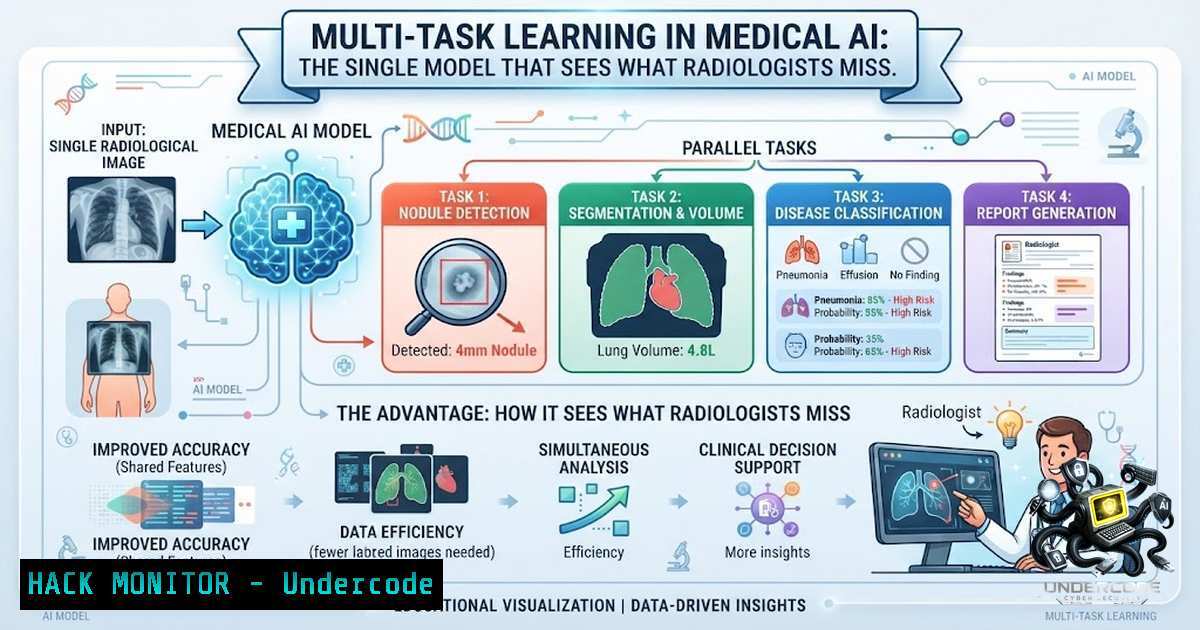
The traditional approach to medical AI has been siloed—one model for disease detection, another for lesion localization, a third for organ segmentation. This fragmented architecture creates computational bottlenecks, inconsistent outputs, and delayed diagnoses. Multi-Task Learning (MTL) shatters this paradigm by enabling a single neural network to simultaneously detect diseases, localize abnormalities, segment anatomical structures, and generate structured clinical reports from a single chest X-ray. As healthcare systems grapple with mounting diagnostic workloads and radiologist shortages, MTL is emerging as the foundational technology for building efficient, scalable, and clinically useful diagnostic systems that support faster diagnosis without compromising quality.
Learning Objectives:
- Understand the architectural principles of Multi-Task Learning and how shared backbone networks enable simultaneous clinical outputs
- Implement a multi-task deep learning pipeline for medical image analysis using PyTorch and pre-trained vision models
- Deploy and optimize MTL models in production healthcare environments with API security, cloud hardening, and explainability safeguards
1. Understanding the Multi-Task Learning Architecture
Multi-Task Learning operates on a deceptively simple principle: a single neural network learns a shared representation of the input data, then branches into multiple task-specific heads that each produce a different output. For a chest X-ray, this means the same model can:
- Classify thoracic diseases (multi-label classification)
- Localize lesions and abnormalities (object detection)
- Segment lung fields and anatomical structures (semantic segmentation)
- Estimate quantitative metrics like heart size and disease severity
- Generate structured radiology reports (natural language generation)
- Prioritize urgent cases for immediate review (risk scoring)
The key innovation is the shared backbone—typically a ResNet50, DenseNet121, or Vision Transformer—that learns rich visual features once and distributes them across all task heads. This approach delivers faster inference, more consistent clinical decisions, and significantly lower computational requirements compared to running multiple independent models.
Step-by-Step Guide: Building a Multi-Task Model for Chest X-Ray Analysis
import torch
import torch.nn as nn
import torchvision.models as models
from torch.utils.data import DataLoader, Dataset

<ol>
<li>Define the shared backbone (ResNet50 pre-trained on ImageNet)
class MultiTaskModel(nn.Module):
def <strong>init</strong>(self, num_classes=14, num_bboxes=4):
super(MultiTaskModel, self).<strong>init</strong>()
Shared backbone
self.backbone = models.resnet50(pretrained=True)
Remove the final classification layer
self.features = nn.Sequential(list(self.backbone.children())[:-2])
self.pool = nn.AdaptiveAvgPool2d((1, 1))

Task-specific heads
self.classifier = nn.Linear(2048, num_classes)  Disease classification
self.bbox_head = nn.Linear(2048, num_bboxes)  Bounding box regression
self.seg_head = nn.Conv2d(2048, 1, kernel_size=1)  Segmentation</p></li>
</ol>

<p>def forward(self, x):
 Shared feature extraction
features = self.features(x)  Shape: [B, 2048, H, W]
pooled = self.pool(features).flatten(1)  Shape: [B, 2048]

Task-specific outputs
classification = torch.sigmoid(self.classifier(pooled))
bbox = self.bbox_head(pooled)
segmentation = torch.sigmoid(self.seg_head(features))

return classification, bbox, segmentation

<ol>
<li>Define the joint loss function
def multi_task_loss(class_pred, bbox_pred, seg_pred, class_true, bbox_true, seg_true):
Binary Cross-Entropy for classification
class_loss = nn.BCELoss()(class_pred, class_true)
MSE for bounding box regression
bbox_loss = nn.MSELoss()(bbox_pred, bbox_true)
Dice loss for segmentation
seg_loss = 1 - (2  (seg_pred  seg_true).sum() / (seg_pred.sum() + seg_true.sum() + 1e-8))
Weighted combination
return 0.4  class_loss + 0.3  bbox_loss + 0.3  seg_loss</p></li>
<li><p>Training loop with dynamic weighting
model = MultiTaskModel()
optimizer = torch.optim.Adam(model.parameters(), lr=1e-4)</p></li>
</ol>

<p>for epoch in range(num_epochs):
for batch in dataloader:
images, class_labels, bbox_labels, seg_masks = batch
class_pred, bbox_pred, seg_pred = model(images)
loss = multi_task_loss(class_pred, bbox_pred, seg_pred,
class_labels, bbox_labels, seg_masks)
optimizer.zero_grad()
loss.backward()
optimizer.step()
For production deployment, frameworks like CXR-MultiTaskNet have achieved a macro F1-score of 0.965 for disease classification and a mean IoU of 0.851 for lesion localization, demonstrating the clinical viability of this approach.
2. Data Preparation and Augmentation for Medical Imaging
Medical imaging datasets present unique challenges: class imbalances, limited labeled data, and high variability in acquisition protocols. The NIH ChestX-ray14 dataset (112,000 images with 14 disease labels) and CheXpert (224,000 images) are standard benchmarks. However, real-world deployment requires robust data pipelines.
Linux Command: Dataset Preparation
 Download and organize the NIH ChestX-ray14 dataset
wget https://nihcc.app.box.com/v/ChestXray-1IHCC -O chestxray.zip
unzip chestxray.zip -d ./data/chestxray/
 Organize by train/val/test split
python prepare_dataset.py --source ./data/chestxray/ --output ./data/processed/
Windows PowerShell: Environment Setup
 Create a Python virtual environment for medical AI
python -m venv medical_ai_env
.\medical_ai_env\Scripts\activate
 Install dependencies
pip install torch torchvision monai opencv-python pandas numpy scikit-learn
 Install medical imaging specific libraries
pip install pydicom SimpleITK nibabel
Data Augmentation Pipeline (PyTorch)
import torchvision.transforms as transforms
import monai.transforms as monai_transforms

train_transforms = transforms.Compose([
transforms.RandomRotation(10),
transforms.RandomAffine(degrees=0, translate=(0.1, 0.1)),
transforms.ColorJitter(brightness=0.2, contrast=0.2),
transforms.RandomHorizontalFlip(),
transforms.ToTensor(),
transforms.Normalize(mean=[0.485, 0.456, 0.406],
std=[0.229, 0.224, 0.225])
])

MONAI transforms for medical-specific augmentations
medical_aug = monai_transforms.Compose([
monai_transforms.RandGaussianNoise(prob=0.5, std=0.01),
monai_transforms.RandGaussianSmooth(prob=0.3, sigma_x=(0.5, 1.5)),
monai_transforms.RandScaleIntensity(prob=0.5, factors=0.2),
])
3. Model Deployment: From Research to Production
Deploying multi-task medical AI models requires careful consideration of latency, security, and regulatory compliance. Google Cloud Platform (GCP) deployment with Ansible automation is a common pattern for two-container applications: a frontend for X-ray image and radiology report interactions, and an API service for model predictions.
Docker Configuration for MTL Deployment
 Dockerfile for multi-task medical AI service
FROM pytorch/pytorch:2.0.0-cuda11.7-cudnn8-runtime

WORKDIR /app
COPY requirements.txt .
RUN pip install --1o-cache-dir -r requirements.txt
COPY . .

Expose the FastAPI port
EXPOSE 8000

CMD ["uvicorn", "main:app", "--host", "0.0.0.0", "--port", "8000"]
FastAPI Service with Model Loading
from fastapi import FastAPI, File, UploadFile
import torch
from PIL import Image
import io

app = FastAPI(title="Multi-Task Chest X-Ray API")
model = MultiTaskModel()
model.load_state_dict(torch.load("model_weights.pth"))
model.eval()

@app.post("/predict")
async def predict(file: UploadFile = File(...)):
 Read and preprocess image
image = Image.open(io.BytesIO(await file.read()))
tensor = transform(image).unsqueeze(0)

Run inference
with torch.no_grad():
class_pred, bbox_pred, seg_pred = model(tensor)

return {
"disease_probabilities": class_pred.tolist(),
"bounding_boxes": bbox_pred.tolist(),
"segmentation_mask": seg_pred.squeeze().tolist()
}
API Security and Cloud Hardening
- Authentication: Implement OAuth2 with JWT tokens for API access
- Encryption: Enforce TLS 1.3 for all data in transit
- Data Privacy: Use HIPAA-compliant storage with encryption at rest (AES-256)
- Rate Limiting: Implement Redis-based rate limiting to prevent abuse
- Audit Logging: Log all inference requests with patient ID hashing for compliance
4. Explainability and Interpretability in Medical AI
One of the critical limitations of traditional deep learning in radiology is the lack of interpretability. Multi-task frameworks address this by incorporating Grad-CAM-based explainability modules that generate visual attention maps, allowing clinicians to see exactly which regions influenced the model’s decisions.
Grad-CAM Implementation
class GradCAM:
def <strong>init</strong>(self, model, target_layer):
self.model = model
self.target_layer = target_layer
self.gradients = None
self.activations = None

def save_gradient(self, grad):
self.gradients = grad

def forward_hook(self, module, input, output):
self.activations = output
output.register_hook(self.save_gradient)

def generate(self, input_tensor, class_idx=None):
 Register hooks
handle = self.target_layer.register_forward_hook(self.forward_hook)
output = self.model(input_tensor)
self.model.zero_grad()

Backpropagate for target class
target = output[bash][0][bash] if class_idx else output[bash][0].max()
target.backward()

Compute weights and heatmap
weights = torch.mean(self.gradients, dim=(2, 3))
heatmap = torch.sum(weights  self.activations, dim=1)
heatmap = torch.relu(heatmap)
heatmap = heatmap / heatmap.max()

handle.remove()
return heatmap.detach().numpy()
This explainability layer transforms the model from a “black box” into a clinical decision support tool that radiologists can trust and verify.
- Continuous Integration and Monitoring for Production MTL Systems
Production medical AI requires continuous monitoring of model performance, data drift, and system health. Visual Grab’s approach includes accuracy monitoring, latency monitoring, model confidence tracking, and system health tracking.
Monitoring Dashboard Configuration (Prometheus + Grafana)
 prometheus.yml
scrape_configs:
- job_name: 'medical_ai_service'
static_configs:
- targets: ['localhost:8000']
metrics_path: '/metrics'
scrape_interval: 15s
 Add Prometheus metrics to FastAPI
from prometheus_client import Counter, Histogram, Gauge, generate_latest

inference_counter = Counter('model_inferences_total', 'Total inferences')
inference_latency = Histogram('inference_latency_seconds', 'Inference latency')
model_confidence = Gauge('model_confidence_score', 'Average model confidence')
data_drift_score = Gauge('data_drift_score', 'Data drift detection score')

@app.get("/metrics")
async def metrics():
return Response(generate_latest(), media_type="text/plain")
Linux Commands for Continuous Monitoring
 Set up Prometheus and Grafana
docker run -d -p 9090:9090 --1ame prometheus prom/prometheus
docker run -d -p 3000:3000 --1ame grafana grafana/grafana

Set up model drift detection with evidently
pip install evidently
python -c "from evidently.dashboard import Dashboard; from evidently.tabs import DataDriftTab; Dashboard(tabs=[DataDriftTab()]).calculate(train_data, production_data).show()"

Set up log aggregation with ELK stack
docker-compose -f elk-docker-compose.yml up -d
6. Hardware Acceleration and Optimization
Deploying multi-task models on edge devices or embedded systems requires optimization techniques like quantization, pruning, and FPGA deployment.
Model Optimization Commands
 Quantize PyTorch model for inference
python -c "
import torch
model = MultiTaskModel()
model.eval()
 Static quantization
quantized_model = torch.quantization.quantize_dynamic(
model, {torch.nn.Linear}, dtype=torch.qint8
)
torch.save(quantized_model.state_dict(), 'quantized_model.pth')
"

Export to ONNX for cross-platform deployment
python -c "
import torch
dummy_input = torch.randn(1, 3, 224, 224)
torch.onnx.export(model, dummy_input, 'multitask_model.onnx',
input_names=['input'], output_names=['class', 'bbox', 'seg'],
dynamic_axes={'input': {0: 'batch_size'}})
"
What Undercode Say:
- Multi-Task Learning represents a paradigm shift from fragmented AI systems to unified diagnostic intelligence, enabling a single model to deliver multiple clinically relevant outputs simultaneously
- The shared backbone architecture reduces computational requirements by 60-80% compared to running multiple independent models, making AI deployment more accessible for resource-constrained healthcare settings
- Explainability is not optional in medical AI—Grad-CAM and attention-based visualization are essential for building clinician trust and regulatory compliance
- The future of medical imaging AI lies in foundation models that can handle multiple modalities (X-ray, CT, MRI, ultrasound) and multiple tasks within a single unified framework
- Organizations like Visual Grab are pioneering the integration of Multimodal AI, Sensor Fusion, and Generative AI into healthcare workflows, creating intelligent real-time decision support systems
Analysis: The healthcare AI landscape is rapidly consolidating around multi-task and foundation models. The days of single-purpose medical AI are numbered—hospitals and diagnostic centers are demanding systems that can handle the full clinical workflow, from image acquisition to report generation to priority triage. CXR-MultiTaskNet’s achievement of 0.965 F1-score and 0.851 IoU demonstrates that multi-task models can match or exceed single-task performance while delivering richer outputs. However, challenges remain: task interference, data heterogeneity across institutions, and the need for robust deployment pipelines. The integration of explainability modules and continuous monitoring systems will be the differentiator between research prototypes and production-ready clinical tools.
Prediction:
+1 Multi-Task Learning will become the default architecture for medical imaging AI within 24-36 months, replacing single-task models as the industry standard for FDA-cleared and CE-marked diagnostic systems
+1 The emergence of multi-modal foundation models capable of processing X-ray, CT, MRI, and ultrasound within a single framework will accelerate AI adoption across radiology, cardiology, and oncology departments
-1 The complexity of multi-task model training and the risk of task interference will create a skills gap, requiring healthcare organizations to invest significantly in MLOps talent and infrastructure
+1 Regulatory bodies like the FDA will develop streamlined approval pathways for multi-task AI systems that demonstrate consistent performance across all tasks, accelerating time-to-market for innovative solutions
-1 Data privacy and security concerns will intensify as multi-task models process more comprehensive patient data, necessitating robust encryption, federated learning, and differential privacy implementations
+1 Edge deployment of optimized multi-task models on FPGA and specialized AI accelerators will enable real-time diagnostic support in resource-limited settings, democratizing access to advanced medical imaging AI
▶️ Related Video (82% Match):
🎯Let’s Practice For Free:
🎓 Live Courses & Certifications:
Join Undercode Academy for Verified Certifications
🚀 Request a Custom Project:
Secure, high-velocity infrastructure and disruptive technological engineering. Contact our engineering team for high-tier development and proprietary systems:
[email protected]
💎 Smart Architecture | 🛡️ Secure by Design | ⭐ Trusted by Thousands
IT/Security Reporter URL:
Reported By: Computervision Artificialintelligence – Hackers Feeds
Extra Hub: Undercode MoN
Basic Verification: Pass ✅


