Listen to this Post
Introduction:
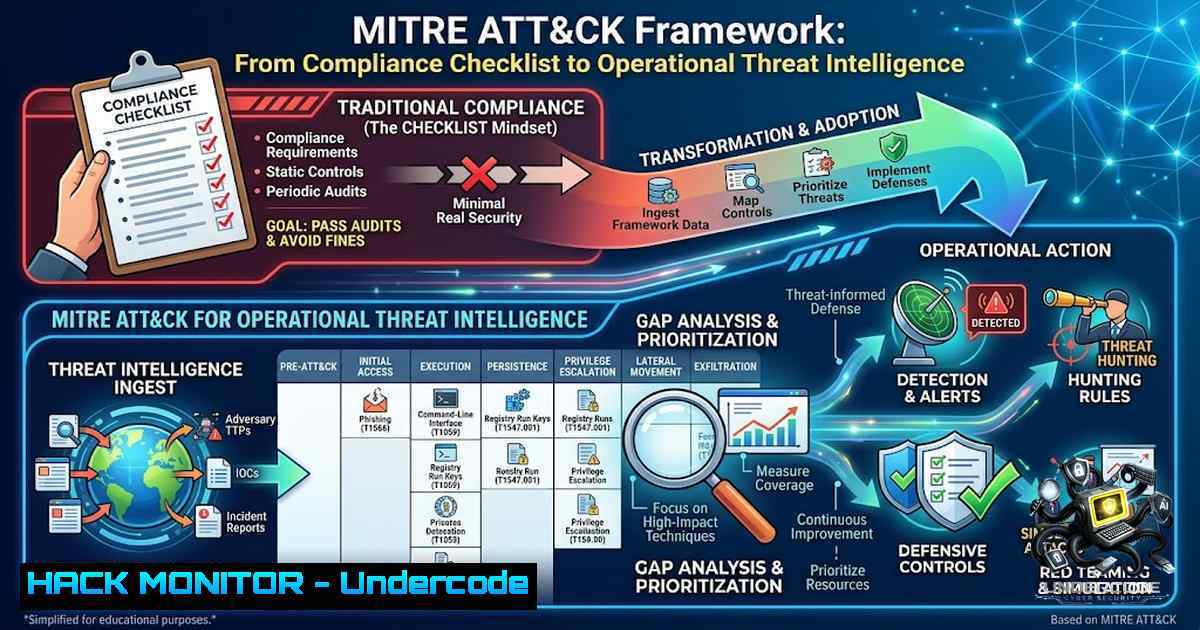
The MITRE ATT&CK framework has become the de facto standard for understanding adversary behavior, yet many organizations still treat it as a static compliance checklist rather than a dynamic operational tool. The true power of ATT&CK lies in its ability to operationalize threat intelligence, providing defenders with a standardized, common language to trace the entire adversary lifecycle from initial reconnaissance to data exfiltration. This article transforms the framework from a theoretical knowledge base into a practical, hands-on defense strategy that security teams can immediately implement.
Learning Objectives:
- Master the hierarchical structure of tactics, techniques, sub-techniques, and procedures (TTPs) within the MITRE ATT&CK framework
- Implement detection engineering and threat hunting workflows mapped directly to adversary behaviors
- Design and execute purple team exercises that validate security controls through adversary emulation
- Understanding the ATT&CK Hierarchy: Tactics, Techniques, Sub-Techniques, and Procedures
The MITRE ATT&CK framework organizes adversarial behavior into a four-tier hierarchy that every security professional must internalize.
What This Means:
- Tactics represent the adversary’s “why”—the tactical objectives they aim to achieve, such as Reconnaissance, Persistence, or Privilege Escalation. These are displayed as column headers in the ATT&CK Matrix.
- Techniques represent the “how”—specific methods adversaries use to accomplish each tactic. For example, under Reconnaissance, the Active Scanning technique (T1595) describes how attackers probe target environments.
- Sub-Techniques provide granular variations of techniques. Active Scanning breaks down into Scanning IP Blocks, Vulnerability Scanning, and Wordlist Scanning.
- Procedures describe how specific threat actors implement these techniques in real-world attacks, combining multiple techniques into a cohesive campaign. APT29 and FIN6 are well-documented examples of procedures.
How to Use This Knowledge:
- Navigate to the MITRE ATT&CK Matrix and familiarize yourself with the 14 tactics spanning the attack lifecycle.
- Select a technique relevant to your environment (e.g., T1059 Command and Scripting Interpreter).
- Expand to view sub-techniques and review the procedure examples, mitigations, and detection methods provided on each technique’s detail page.
- Use the ATT&CK Navigator to annotate and explore matrices, creating custom heatmaps for your organization.
-
Detection Engineering: Building Analytics That Actually Detect Adversaries
Detection engineering transforms ATT&CK knowledge into actionable security analytics that identify adversary behavior in real-time.
Step-by-Step Implementation:
- Select High-Priority Techniques: Use threat intelligence to identify which TTPs are most relevant to your industry and environment. Focus detection engineering on these high-risk techniques.
-
Map Data Sources to Techniques: Each ATT&CK technique lists required data sources. For example, detecting PowerShell abuse (T1059.001) requires Windows Event Logs (specifically ScriptBlock logging and Module logging).
3. Develop Detection Logic:
-
Linux Example – Detecting Persistence via Cron Jobs:
Monitor for unauthorized cron job creation
auditctl -w /etc/crontab -p wa -k crontab_changes
auditctl -w /etc/cron.d/ -p wa -k cron_d_changes
auditctl -w /var/spool/cron/ -p wa -k user_cron_changes

Search for suspicious cron entries in logs
grep -i "cron" /var/log/syslog | grep -E "(REPLACE|INSERT|DELETE)"
-
Windows Example – Detecting LSASS Memory Access (T1003.001):
Enable PowerShell script block logging
Set-ItemProperty -Path "HKLM:\SOFTWARE\Policies\Microsoft\Windows\PowerShell\ScriptBlockLogging" -1ame "EnableScriptBlockLogging" -Value 1

Query Security Event Log for suspicious LSASS access (Event ID 4656, 4663)
Get-WinEvent -LogName Security | Where-Object { $<em>.Id -in 4656,4663 -and $</em>.Message -like "LSASS" }
-
Tune and Test: Run detection rules against historical data to reduce false positives. Use MITRE ATT&CK Evaluations methodology to validate your detection coverage.
-
Create a Detection Coverage Matrix: Map your existing detections to ATT&CK techniques to identify coverage gaps and prioritize development efforts.
3. Threat Hunting: Proactively Searching for Adversary Behavior
Threat hunting leverages the ATT&CK framework to proactively uncover adversaries that have evaded existing defenses.
Six-Step TTP-Based Hunting Methodology:
- Select a Hypothesis: Choose an adversary behavior pattern based on threat intelligence. Example: “Attackers are using living-off-the-land binaries (LOLBins) for lateral movement.”
-
Identify Relevant ATT&CK Techniques: Map your hypothesis to specific techniques. Lateral Movement via SMB/Windows Admin Shares (T1021.002) or Remote Services (T1021).
-
Define Hunt Analytics: Create queries to search for evidence of these techniques across your environment.
Linux Command – Hunting for Lateral Movement via SSH:
 Check for unusual SSH connections from internal hosts
journalctl -u ssh -f | grep -E "Accepted password for (root|admin)" | awk '{print $9}'

Investigate .bash_history for suspicious commands
find /home -1ame ".bash_history" -exec grep -l "ssh" {} \;
Windows Command – Hunting for Scheduled Task Persistence (T1053.005):
 List all scheduled tasks created in the last 7 days
Get-ScheduledTask | Where-Object { $_.Date -gt (Get-Date).AddDays(-7) }

Query Event Log for Task Scheduler creation (Event ID 4698)
Get-WinEvent -LogName Security | Where-Object { $_.Id -eq 4698 }
- Investigate Anomalies: When potential findings emerge, conduct deep-dive analysis using additional data sources and timeline reconstruction.
-
Document and Respond: Formalize findings and initiate incident response procedures if malicious activity is confirmed.
-
Feed Back into Detection Engineering: Convert successful hunts into automated detection rules to improve future coverage.
4. Purple Team Exercises: Bridging Offense and Defense
Purple teaming combines red team adversary emulation with blue team defensive analysis to validate security controls and improve detection capabilities.
How to Conduct a Purple Team Exercise:
- Select an Adversary Profile: Choose a threat actor relevant to your organization (e.g., APT29, FIN7, or a ransomware group).
-
Map Their TTPs to ATT&CK: Document the specific techniques, sub-techniques, and procedures used by the selected adversary.
-
Emulate Adversary Behavior using tools like Atomic Red Team or MITRE Caldera:
Atomic Red Team Example – T1059.001 PowerShell Command Execution:
 Import Atomic Red Team module
Install-Module -1ame AtomicRedTeam -Force

Execute T1059.001 test
Invoke-AtomicTest T1059.001
Linux Adversary Emulation – T1059.004 Unix Shell:
 Simulate reverse shell attempt
nc -lvp 4444 -e /bin/bash &
- Monitor Defensive Response: Observe how your SIEM, EDR, and other security tools detect and alert on the emulated activity.
-
Analyze Gaps: Document which techniques were detected, which were missed, and why. Identify visibility gaps and tuning opportunities.
-
Remediate and Retest: Implement improvements to detection rules, logging configurations, or security controls, then rerun the exercise to validate effectiveness.
-
Cloud Hardening with ATT&CK: Securing AWS, Azure, and GCP
The ATT&CK framework now includes extensive cloud-specific tactics and techniques, enabling defenders to secure modern cloud environments.
Cloud-Specific Attack Techniques to Address:
- Cloud Credential Access (T1552): Attackers steal cloud provider credentials from instance metadata services or configuration files.
AWS Mitigation – Restrict Instance Metadata Service Access:
 Set IMDSv2 (requires token for metadata access)
aws ec2 modify-instance-metadata-options --instance-id i-1234567890abcdef0 --http-tokens required --http-endpoint enabled
Azure Mitigation – Disable VM Public IPs and Enforce Just-In-Time Access:
 Enable JIT VM access via Azure CLI
az security jit-policy create --resource-group myResourceGroup --location eastus --vm-1ame myVM --ports 22 3389
- Cloud Service Abuse: Attackers abuse legitimate cloud services for command and control or data exfiltration.
Detection – Monitor for Unusual API Calls:
 AWS CloudTrail search for suspicious S3 bucket enumeration
aws cloudtrail lookup-events --lookup-attributes AttributeKey=EventName,AttributeValue=ListBuckets --start-time 2026-01-01T00:00:00Z
Detection – Azure Activity Log Monitoring:
 Query Azure Activity Log for suspicious role assignments
Get-AzActivityLog -StartTime (Get-Date).AddDays(-7) | Where-Object { $_.OperationName -eq "Microsoft.Authorization/roleAssignments/write" }
- Container and Kubernetes Attacks: Techniques targeting containerized environments (T1610 Deploy Container, T1613 Container Discovery).
Kubernetes Hardening:
 Enforce Pod Security Standards
kubectl apply -f - <<EOF
apiVersion: policy/v1beta1
kind: PodSecurityPolicy
metadata:
name: restricted
spec:
privileged: false
allowPrivilegeEscalation: false
runAsUser:
rule: MustRunAsNonRoot
EOF
6. Vulnerability Exploitation and Mitigation Through ATT&CK
The ATT&CK framework provides explicit guidance on mitigating specific techniques, enabling targeted vulnerability management.
Mapping CVEs to ATT&CK Techniques:
1. CVE-2021-44228 (Log4Shell) → T1190 Exploit Public-Facing Application:
- Detection: Monitor for JNDI lookup patterns in logs
Linux - Search for Log4Shell indicators grep -r "\${jndi:ldap://" /var/log/ 2>/dev/null - Mitigation: Patch Log4j to version 2.17.0 or later; set `log4j2.formatMsgNoLookups=true`
- CVE-2023-23397 (Microsoft Outlook Elevation of Privilege) → T1134 Access Token Manipulation:
– Detection: Monitor for unusual NetBIOS name resolution requests (Event ID 4624 with elevated tokens)
 PowerShell - Search for suspicious token elevation events
Get-WinEvent -LogName Security | Where-Object { $<em>.Id -eq 4672 -and $</em>.TimeCreated -gt (Get-Date).AddDays(-30) }
– Mitigation: Apply Microsoft patches; disable unnecessary NTLM authentication
3. General Vulnerability Mitigation Workflow:
- Identify CVE relevant to your environment
- Map to ATT&CK technique using MITRE’s CVE mapping resources
- Apply technique-specific mitigations (e.g., application whitelisting, network segmentation, principle of least privilege)
- Validate mitigation effectiveness through adversary emulation
7. Building an ATT&CK-Driven Security Operations Center (SOC)
Transform your SOC from reactive alert-firing to proactive threat-informed defense using ATT&CK as the operational backbone.
Implementation Roadmap:
- Establish ATT&CK as the Common Language: Train all SOC analysts on ATT&CK terminology and structure. Use the framework to describe incidents, write reports, and communicate with stakeholders.
-
Map All Security Controls to ATT&CK: Document which techniques each control detects or prevents. Identify coverage gaps using the ATT&CK Navigator.
-
Prioritize Based on Threat Intelligence: Use threat intelligence feeds to identify which techniques are actively targeting your industry. Focus resources on these high-priority TTPs.
4. Implement Continuous Validation:
- Weekly: Run automated adversary emulation tests for high-priority techniques
- Monthly: Conduct purple team exercises focused on specific adversary groups
- Quarterly: Perform full ATT&CK coverage assessments
5. Measure and Improve:
- Track detection coverage percentage across ATT&CK techniques
- Measure mean time to detect (MTTD) and mean time to respond (MTTR) for ATT&CK-mapped incidents
- Use metrics to justify security investments and demonstrate ROI to leadership
What Undercode Say:
-
Key Takeaway 1: The MITRE ATT&CK framework is not a compliance checkbox—it is a dynamic operational tool that transforms how security teams understand, detect, and respond to adversaries. Organizations that treat it as a checklist miss its true strategic value.
-
Key Takeaway 2: Successful ATT&CK implementation requires cross-functional collaboration between red teams, blue teams, threat hunters, and detection engineers. Purple teaming bridges the gap between offense and defense, producing measurable security improvements.
-
Key Takeaway 3: The framework’s true power lies in its practical application—building detection rules, hunting for threats, emulating adversaries, and continuously validating security controls. This threat-informed defense approach enables organizations to stay ahead of evolving attacker TTPs.
Analysis: The MITRE ATT&CK framework has evolved from a niche knowledge base into the industry standard for adversary behavior modeling. Its expansion across platforms—Windows, Linux, macOS, cloud, mobile, and ICS—reflects the broadening attack surface modern defenders must protect. However, the framework’s sheer volume (over 600 techniques and sub-techniques) can overwhelm security teams. The key is prioritization: focus on techniques most relevant to your environment, use threat intelligence to guide investments, and continuously validate through adversary emulation. Organizations that successfully operationalize ATT&CK gain a significant advantage—they move from reactive incident response to proactive threat hunting, reducing both dwell time and breach impact. The framework also enables better communication between technical teams and business leadership by translating complex adversary behavior into understandable risk language.
Prediction:
- +1 Organizations that fully operationalize the MITRE ATT&CK framework will reduce their average breach detection time by 40-60% within 18 months, as detection engineering and threat hunting become systematically embedded into SOC operations.
-
+1 The integration of AI and machine learning with ATT&CK-mapped detection rules will automate much of the threat hunting process, allowing security analysts to focus on high-value investigations rather than manual log review.
-
+1 Cloud providers will increasingly embed ATT&CK technique detection natively into their platforms, making cloud security more accessible to organizations without dedicated cloud security expertise.
-
-1 The growing complexity of the ATT&CK framework (with new techniques added quarterly) will create a skills gap, as many security teams struggle to keep pace with the expanding knowledge base.
-
-1 Adversaries will increasingly develop techniques that deliberately evade ATT&CK mapping, exploiting the gap between framework updates and real-world attacker innovation.
-
+1 Purple teaming will become a standard compliance requirement for regulated industries, driving widespread adoption of adversary emulation and continuous security validation.
-
+1 The MITRE ATT&CK framework will serve as the foundation for next-generation security orchestration, automation, and response (SOAR) platforms, enabling automated threat response based on technique identification.
▶️ Related Video (88% Match):
https://www.youtube.com/watch?v=2icKi2q6NS4
🎯Let’s Practice For Free:
🎓 Live Courses & Certifications:
Join Undercode Academy for Verified Certifications
🚀 Request a Custom Project:
Secure, high-velocity infrastructure and disruptive technological engineering. Contact our engineering team for high-tier development and proprietary systems:
[email protected]
💎 Smart Architecture | 🛡️ Secure by Design | ⭐ Trusted by Thousands
IT/Security Reporter URL:
Reported By: Dlross Cybersecurity – Hackers Feeds
Extra Hub: Undercode MoN
Basic Verification: Pass ✅


