
Listen to this Post
Introduction:
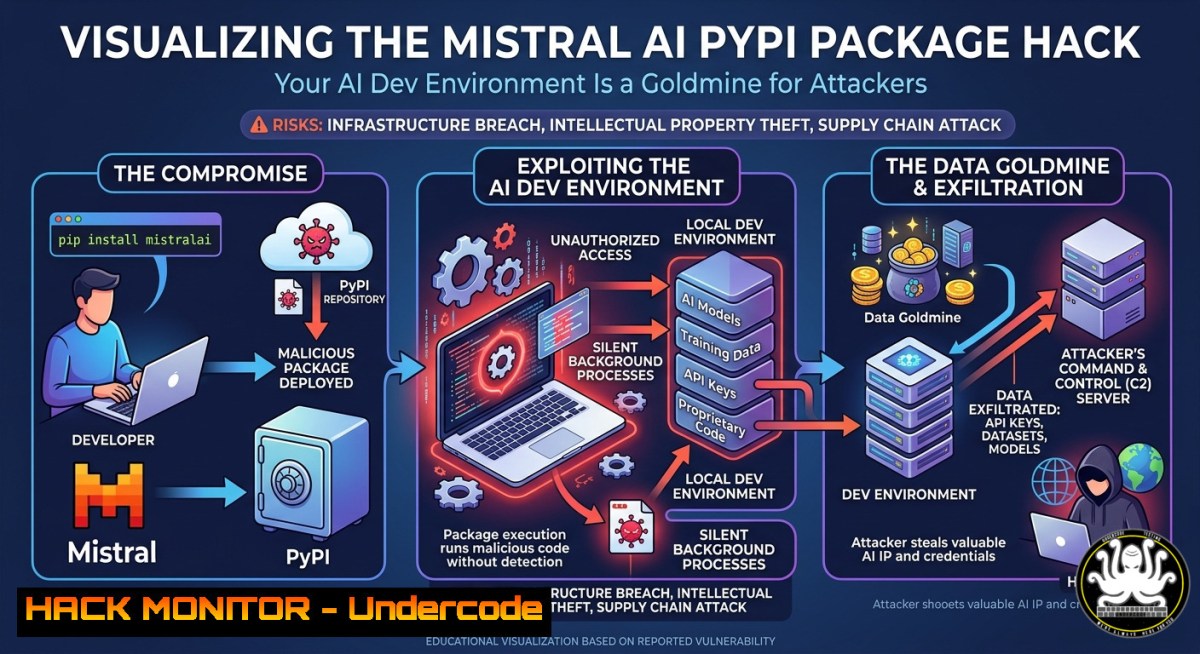
A routine `pip install` may have just handed attackers the keys to your entire development infrastructure. On May 12, 2026, Microsoft Threat Intelligence confirmed that version 2.4.6 of the official Mistral AI Python package on PyPI was compromised with malicious code that executes automatically when the library is imported—no user interaction required. This supply chain attack is part of a wider “Mini Shai-Hulud” campaign that has poisoned over 170 npm packages and at least two PyPI packages, exposing GitHub tokens, cloud credentials, and CI/CD secrets across the AI and crypto developer ecosystem. The compromised package carries CVE-2026-45321 with a CVSS score of 9.6, rating it critical severity—yet no prior signature or security tool raised an alarm.
Learning Objectives:
- Understand the exact technical mechanism of the Mistralai PyPI supply chain attack and the geo-aware destructive logic
- Learn how to detect compromise indicators (IOCs) using Linux commands and forensic analysis
- Implement immediate remediation and long-term mitigation strategies across development pipelines
- Anatomy of the Attack: How a Single Import Silently Owns Your Machine
The attackers inserted malicious code directly into mistralai/client/__init__.py—the file that executes the moment a developer writes `import mistralai` in their Python code. This is not a pre-install hook that requires user confirmation; it’s guaranteed execution upon import.
What actually happens when the package is imported:
 The moment a developer runs this line of code:
import mistralai

The backdoored <strong>init</strong>.py silently executes:
 1. Sets environment flag MISTRAL_INIT=1
 2. Downloads second-stage payload from 83.142.209.194/transformers.pyz
 3. Saves payload to /tmp/transformers.pyz
 4. Spawns detached background process running python /tmp/transformers.pyz
The filename `transformers.pyz` is deliberately chosen to mimic Hugging Face’s widely used Transformers AI framework, making it blend seamlessly into ML development workflows and evade casual inspection.
Credential Stealing and Geo-Targeted Destruction
Once executed, the second-stage payload functions primarily as a credential stealer, targeting:
- Cloud platform credentials (AWS, GCP)
- Model repository tokens
- SSH keys
- 1Password and Bitwarden vaults
- GitHub tokens and npm publishing credentials
- Kubernetes service accounts
- CI/CD pipeline secrets
The malware also contains a country-aware logic that deliberately avoids Russian-language environments but includes a geofenced destructive branch with a 1-in-6 chance of executing `rm -rf /` when the system appears to be located in Israel or Iran. Persistence is established via a `pgmonitor.py` file and a `pgsql-monitor.service` systemd unit, mimicking legitimate database monitoring services to avoid detection.
2. Immediate Incident Response: Detect, Contain, and Remediate
If your environment had any exposure to `mistralai==2.4.6` during the window from May 11 at 22:45 UTC to May 12 at 01:53 UTC (or if the version appears in any lockfile, container image, or deployment artifact), consider the environment fully compromised.
Step-by-step detection and forensic analysis:
1. Check installed version of mistralai:
pip show mistralai | grep -i ^version
2. Scan dependency files for the compromised version:
grep -n -E 'mistralai\b.2.4.6' requirements.txt pyproject.toml uv.lock poetry.lock Pipfile Pipfile.lock 2>/dev/null
- Check for IOCs on any Linux host that may have imported the package:
 Check for the downloaded payload
ls -la /tmp/transformers.pyz

Check for the environment variable
env | grep MISTRAL_INIT

Check for network connections to attacker-controlled IP
netstat -an | grep 83.142.209.194
ss -tnp | grep 83.142.209.194

Check for persistence artifacts
systemctl status pgsql-monitor.service
ls -la /etc/systemd/system/pgsql-monitor.service

Check for running processes
ps aux | grep transformers.pyz
ps aux | grep pgmonitor.py
- Rotate ALL credentials immediately — assume everything on the compromised system has been exfiltrated:
- All GitHub tokens and personal access tokens
- All cloud provider API keys (AWS, GCP, Azure)
- All CI/CD secrets (GitHub Actions, GitLab CI, Jenkins)
- All npm publishing credentials
- All password vault master passwords
- All SSH private keys
- Quarantine and rebuild — do not attempt to “clean” the system. The safest path is to isolate the compromised host, wipe it, and rebuild from a known-clean baseline.
3. Strengthening Your Supply Chain Defenses: Practical Configuration
The Mistral AI incident demonstrates that implicit trust in open-source packages is no longer tenable. Here are actionable configurations to implement immediately.
Deploy Supply-Chain Firewall (SCFW)
Datadog’s Supply-Chain Firewall blocks malicious package installations before they reach your system by verifying against reputable datasets of known malware:
 Install using pipx (recommended for isolated environment)
pipx install scfw

Run configuration wizard
scfw configure

Test the firewall — this will block known malicious packages
scfw run pip install mistralai==2.4.6
The tool blocks 100% of known-malicious packages within its data sources and presents warnings for suspicious packages before installation proceeds.
Implement Package Pinning with Hash Verification
Never install unpinned dependencies. Use hash verification to ensure package integrity:
 Using pip with hash verification
pip install mistralai==2.4.5 --hash=sha256:expected_hash_here

Using pip-tools to generate hash-pinned requirements
pip-compile --generate-hashes requirements.in

Using uv (modern Python package manager)
uv pip install mistralai==2.4.5 --require-hashes
Configure Private Artifact Repository
Dependency pinning alone is insufficient when the pinned version itself becomes malicious. A private artifact repository (JFrog Artifactory, Sonatype Nexus, or GitHub Packages) allows you to:
- Cache approved packages before developers install them
- Scan all packages for vulnerabilities before they enter your environment
- Block newly released packages with a “cooldown period” before they are allowed for installation
CI/CD Pipeline Hardening
The same attack vectors that compromised TanStack and Mistral AI exploited `pull_request_target` triggers and GitHub Actions cache poisoning. Implement these controls:
 GitHub Actions security hardening example
name: Secure CI Pipeline
on:
pull_request:
types: [opened, synchronize]
 Avoid pull_request_target unless absolutely necessary

jobs:
dependency-audit:
runs-on: ubuntu-latest
permissions:
contents: read
 Minimize permissions — do not grant write access
steps:
- uses: actions/checkout@v4
with:
persist-credentials: false  Prevent token leakage

<ul>
<li>name: Scan dependencies
run: |
pip install pip-audit
pip-audit --requirement requirements.txt --strict
4. Long-term Defense: Cryptographic Verification and SLSA Provenance
The SLSA Problem
What made this attack structurally unprecedented was that the malicious TanStack packages carried valid SLSA Build Level 3 provenance attestations—cryptographic certificates meant to verify packages were built from trusted sources. SLSA provenance, once considered a gold standard, proved demonstrably insufficient.
Migrate to PEP 740 Digital Attestations
PyPI now supports PEP 740 digital attestations—cryptographically verifiable statements about package provenance, including the exact source repository that produced them. Enable this for your own packages:
 For package maintainers: Use Trusted Publishing with attestations
 In your GitHub Actions workflow:
- name: Publish to PyPI
uses: pypa/[email protected]  Attestations enabled by default
with:
attestations: true
For package consumers, verify attestations before installation:
 Using PyPI’s attestation verification tools
pip install mistralai --require-attestation
Use Red Hat Trusted Libraries
For enterprise environments, Red Hat Trusted Libraries provides verifiably rebuilt open-source libraries with complete supply chain transparency, including SLSA build attestations signed with Sigstore.
5. Automated Monitoring and Detection Tools
Deploy continuous monitoring to catch supply chain compromises in near real-time:
Elastic Supply Chain Monitor
Automates diffing of new package releases against predecessors and uses LLM analysis to classify changes as benign or malicious:
 Clone and install
git clone https://github.com/elastic/supply-chain-monitor.git
cd supply-chain-monitor
pip install -r requirements.txt

Monitor top 1000 PyPI packages
python monitor.py --top 1000 --interval 300
When a malicious diff is detected, the tool triggers a Slack alert automatically.
Packj Security Scanner
Packj flags malicious, vulnerable, abandoned, and typosquatted packages from PyPI, npm, and RubyGems:
 Run via Docker
docker run -v /tmp:/tmp/packj -it ossillate/packj:latest --help

Audit your requirements.txt
docker run -v $(pwd):/app -it ossillate/packj:latest \
python3 main.py audit pypi --file /app/requirements.txt
Packj has identified over 70 malicious PyPI and RubyGems packages through deep static and dynamic code analysis.
What Undercode Say
- Trust no dependency, even from official sources. The Mistral AI compromise shows that package signatures, SLSA attestations, and official branding provide no guarantee of safety when account takeovers or compromised developer devices are in play.
-
The AI developer ecosystem is now a prime target. Attackers are weaponizing the very trust that drives rapid AI adoption—long build pipelines, heavy dependency trees, and credential-rich environments make every AI developer a high-value target.
-
Proactive defense requires architectural change. Pinning versions and rotating credentials after an incident is no longer sufficient. Organizations must adopt private artifact repositories, supply-chain firewalls, and cryptographic attestation verification as standard practice.
Prediction:
The Mistral AI PyPI compromise foreshadows a fundamental shift in software security. Expect a wave of copycat supply-chain attacks targeting AI SDKs across all major languages in the coming months. The security industry will accelerate toward mandatory package signing, short-lived package lifetimes (30-day expiration for developer dependencies), and the emergence of “security-gated” package indexes that scan every update before distribution. Within 18 months, organizations that fail to implement private artifact caching and real-time diff monitoring will face inevitable breaches through their dependency chains. The era of implicit trust in open-source repositories is over—cryptographic verification and runtime behavioral analysis will become as standard as firewalls and antivirus.
▶️ Related Video (78% Match):
🎯Let’s Practice For Free:
IT/Security Reporter URL:
Reported By: Varshu25 Microsoft – Hackers Feeds
Extra Hub: Undercode MoN
Basic Verification: Pass ✅


