Listen to this Post
Introduction:
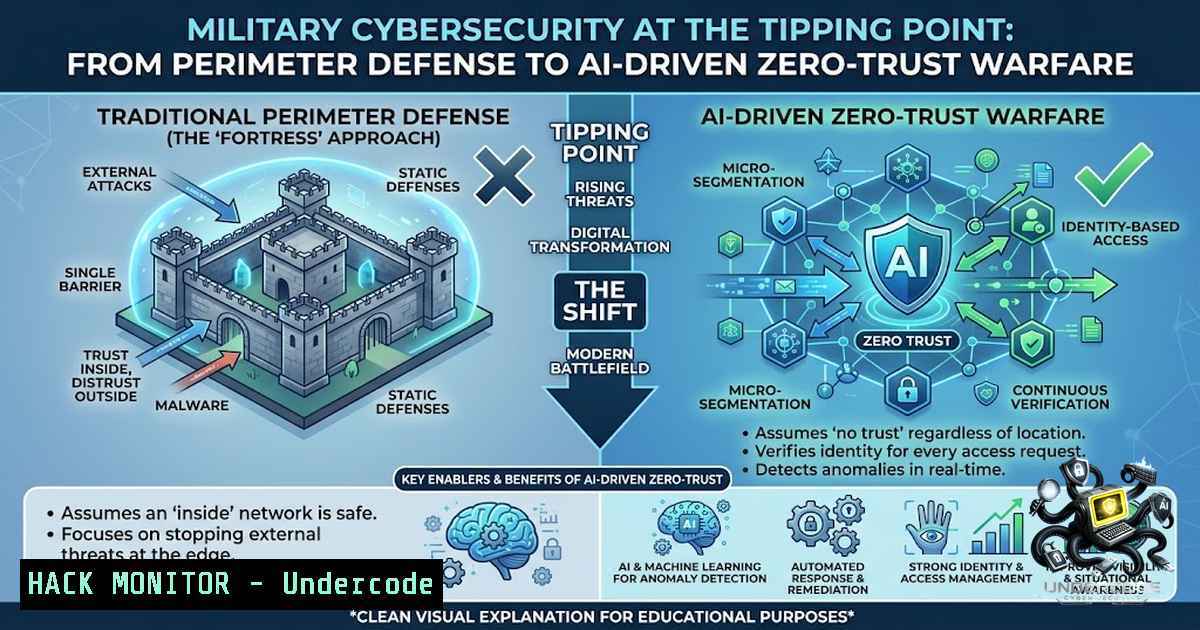
The global military cybersecurity market is undergoing a paradigm shift, propelled by an unprecedented surge in state-sponsored cyber intrusions and the mandated adoption of zero-trust architectures. Valued at USD 18.35 billion in 2025, the sector is projected to nearly double to USD 36.85 billion by 2031, growing at a CAGR of 12.32%. This rapid expansion is not merely about deploying more firewalls; it represents a fundamental transformation in how defense establishments approach digital warfare, moving from reactive perimeter defenses to proactive, AI-driven “assume-breach” postures that secure everything from satellite communications to tactical edge devices.
Learning Objectives:
- Understand the current market dynamics and segment leadership within military cybersecurity, including the dominance of network and cloud security.
- Analyze key industry developments, including strategic partnerships and AI-powered solutions from major defense contractors.
- Learn practical, hands-on commands and configurations for implementing zero-trust principles, securing cloud environments, and conducting vulnerability assessments in a defense context.
You Should Know:
- The New Battlefield: Securing the Joint All-Domain Command and Control (JADC2) Ecosystem
Modern military operations rely on the seamless integration of land, sea, air, space, and cyber domains. The JADC2 strategy requires defenses that can secure traffic across these disparate environments, pushing vendors to deliver interoperable, classification-aware solutions. This convergence creates massive attack surfaces, from vulnerable IoT sensors on the battlefield to legacy systems in command centers.
Step-by-Step Guide: Implementing a Zero-Trust Network Access (ZTNA) Architecture for a Tactical Edge Environment
This guide outlines the core steps to establish a ZTNA framework, a mandate for U.S. national-security systems under Executive Order 14028. The goal is to continuously verify every user and device before granting access, rather than trusting based on network location.
- Identify and Classify Assets: Begin by creating a comprehensive inventory of all assets (users, devices, applications, and data) that will interact with the military network. Classify them based on sensitivity levels (e.g., Unclassified, Secret, Top Secret).
- Map Transaction Flows: Understand how data moves between these assets. This is critical for defining micro-perimeters. Tools like Zeek (formerly Bro) can be used for network traffic analysis. On a Linux jump box, you can install Zeek:
sudo apt-get update && sudo apt-get install zeek -y
Configure Zeek to monitor the primary network interface
sudo zeekctl deploy
sudo zeekctl status
- Establish a Policy Decision Point (PDP) and Policy Enforcement Point (PEP): The PDP is the “brain” that decides whether to grant access. The PEP is the “gatekeeper” that enforces the decision. For a basic implementation, consider using open-source solutions like Keycloak for identity management and OPA (Open Policy Agent) for policy enforcement.
- Implement Continuous Monitoring and Analytics: ZTNA requires real-time visibility. Integrate your PDP with a SIEM (Security Information and Event Management) system. On a Windows Server, you can configure Windows Event Forwarding to centralize logs:
On the Windows Event Collector
wecutil qc
On the source machine, configure the subscription via Group Policy or command line
winrm quickconfig
- Enforce Least-Privilege Access: Create granular policies that grant users and devices only the minimum access required for their mission function. For example, a field operator should only have access to their specific tactical data feed, not the entire intelligence database.
- Assume Breach: Continuously analyze user and entity behavior for anomalies. If a user’s behavior deviates from their baseline (e.g., accessing data at unusual hours or from an unexpected location), the PDP should automatically revoke access or trigger a multi-factor authentication (MFA) challenge.
-
The AI Arms Race: Operationalizing Machine Learning for Threat Intelligence
Artificial intelligence and machine learning are no longer theoretical; they are now the core of modern military cyber defense. Raytheon Technologies, for instance, has launched an AI-powered cybersecurity suite integrating zero-knowledge cryptography to secure AI models at the algorithmic level. Similarly, Lockheed Martin’s Skunk Works is developing AI-capable ISR platforms that use machine learning for anomaly detection, dramatically improving threat identification.
Step-by-Step Guide: Deploying an AI-Powered Threat Intelligence Pipeline using Open-Source Tools
This guide demonstrates how to set up a basic pipeline to ingest, correlate, and analyze threat data using machine learning, mimicking the approach of modern threat intelligence platforms.
- Data Ingestion: Set up a system to collect threat feeds. Use `curl` or `wget` to pull data from open-source threat intelligence platforms like MISP or AlienVault OTX.
Example: Downloading a threat feed (replace URL with a valid feed)
wget -O threat_feed.json https://otx.alienvault.com/api/v1/pulses/industries/defense
- Data Normalization: Threat feeds come in various formats (STIX, JSON, CSV). Use Python with libraries like `pandas` to normalize this data into a structured format.
import pandas as pd import json Load the JSON data with open('threat_feed.json', 'r') as f: data = json.load(f) Normalize into a DataFrame df = pd.json_normalize(data['results']) - Feature Extraction: Extract relevant features from the data, such as IP addresses, hashes, domains, and attack patterns. Use the MITRE ATT&CK framework to map these indicators to specific tactics and techniques.
- Model Training (Behavioral Analysis): Use a Graph Neural Network (GNN) to model adversarial cyber behavior, as recent research shows GNNs outperform traditional models in predicting attack paths.
Pseudo-code for GNN model training
model = GraphConv(...)
model.fit(training_data)
predictions = model.predict(new_threat_data)
- Integration with SIEM: Feed the enriched, AI-analyzed data into your SIEM (e.g., Splunk, Elastic Stack) to create automated alerts. For Elastic, you can use the Elasticsearch API:
curl -X POST "localhost:9200/threat_intel/_doc" -H 'Content-Type: application/json' -d'{"indicator": "malicious_domain.com", "confidence": 0.95}' - Automated Response: Configure your SOAR (Security Orchestration, Automation, and Response) platform to automatically block high-confidence indicators at the network perimeter.
-
Cloud and Edge Security: Hardening the Hybrid Defense Infrastructure
Cloud adoption in the military is accelerating, driven by initiatives like the DoD’s Joint Warfighting Cloud Capability (JWCC). However, this shift introduces new risks, as private-5G and Open RAN deployments expand attack surfaces. Securing these hybrid environments requires a combination of cloud-1ative tools and traditional hardening techniques.
Step-by-Step Guide: Hardening a Linux-Based Tactical Edge Server
This guide provides essential hardening steps for a Linux server deployed at the tactical edge, which must operate securely even in contested, low-bandwidth environments.
- Minimize the Attack Surface: Remove unnecessary services and packages.
List all installed packages
rpm -qa
Remove a non-essential service (e.g., telnet)
sudo yum remove telnet -y
- Implement Mandatory Access Control (MAC): Use SELinux (Security-Enhanced Linux) to enforce strict access policies.
Check SELinux status
sestatus
Set SELinux to enforcing mode
sudo setenforce 1
Change the SELinux policy to be more restrictive
sudo semanage boolean -m --on httpd_can_network_connect
- Secure SSH Access: Disable root login and password authentication, and enforce key-based authentication.
Edit the SSH configuration file
sudo nano /etc/ssh/sshd_config
Set the following parameters:
PermitRootLogin no
PasswordAuthentication no
PubkeyAuthentication yes
Restart SSH service
sudo systemctl restart sshd
- Configure a Host-Based Intrusion Detection System (HIDS): Deploy tools like AIDE (Advanced Intrusion Detection Environment) to monitor file integrity.
Initialize the AIDE database
sudo aideinit
Perform a manual check
sudo aide --check
- Harden Kernel Parameters: Modify `sysctl` settings to mitigate network-based attacks.
Add the following lines to /etc/sysctl.conf
net.ipv4.tcp_syncookies = 1
net.ipv4.conf.all.rp_filter = 1
net.ipv4.conf.default.accept_source_route = 0
Apply the settings
sudo sysctl -p
- Implement Log Monitoring and Rotation: Ensure logs are centrally collected and rotated to prevent disk exhaustion.
Configure logrotate sudo nano /etc/logrotate.conf Set rotation policy for /var/log/messages /var/log/messages { daily rotate 7 compress missingok notifempty create 0640 root root } -
Compliance and the CMMC 2.0 Mandate: A Three-Year Rollout
On September 10, 2025, the U.S. Department of Defense published its final Cybersecurity Maturity Model Certification (CMMC) rule, which took effect on November 10, 2025. This officially launched a three-year rollout of cybersecurity requirements across DoD contracts, fundamentally changing how contractors must protect Federal Contract Information (FCI) and Controlled Unclassified Information (CUI).
Step-by-Step Guide: Preparing for a CMMC Level 2 Assessment
This guide outlines the key steps a defense contractor must take to achieve CMMC Level 2 certification, which is required for handling CUI.
- Gap Analysis: Conduct a thorough assessment of your current cybersecurity posture against the NIST SP 800-171 requirements, which form the basis of CMMC Level 2.
- Implement Access Control (AC): Enforce the principle of least privilege. This includes separating duties and limiting system access to authorized users.
- Establish an Incident Response (IR) Plan: Develop and test a formal incident response plan. This must include procedures for reporting incidents to the DoD.
- Implement Security Awareness Training: Conduct regular training for all personnel on cybersecurity threats and their responsibilities. This is a fundamental requirement of CMMC.
- Conduct a Third-Party Assessment: CMMC Level 2 requires a third-party assessment organization (C3PAO) to verify your compliance.
- Remediate and Maintain: Address any findings from the assessment and continuously monitor your security controls to maintain compliance.
What Undercode Say:
- Key Takeaway 1: The military cybersecurity landscape is no longer just about IT security; it is a core component of combat readiness. The integration of AI and zero-trust architectures is transforming how militaries defend their digital and physical assets.
- Key Takeaway 2: The “assume-breach” mindset is the new standard. With sophisticated state-sponsored actors constantly probing defenses, organizations must focus on rapid detection, containment, and recovery rather than just prevention.
Analysis: The convergence of military operations and cyberspace has created a complex, high-stakes environment. The data clearly shows a massive and sustained investment in this area, driven by both technological advancements and an increasingly hostile threat landscape. The shift towards AI and machine learning is not just a trend but a necessity, as the volume and sophistication of attacks outpace human capabilities. However, the persistent talent shortage, with roughly 225,000 unfilled U.S. cyber roles, remains a critical bottleneck. The industry’s future will be defined by those who can successfully bridge the gap between cutting-edge technology and the skilled workforce needed to operate it. Furthermore, the CMMC 2.0 mandate is a game-changer, forcing the entire defense industrial base to elevate its security posture, which will have a cascading effect on cybersecurity standards across the private sector.
Prediction:
- +1 The mandated rollout of CMMC 2.0 over the next three years will create a massive new market for cybersecurity consulting, assessment, and training services, potentially exceeding $10 billion annually.
- +1 AI-driven autonomous cyber defense agents will become operational within the next five years, capable of hunting and neutralizing threats without human intervention, dramatically reducing response times from hours to milliseconds.
- -1 The rapid adoption of AI in both offensive and defensive cyber operations will lead to an unprecedented “AI vs. AI” warfare arms race, increasing the speed and scale of attacks to levels that current infrastructure may not withstand.
- -1 The persistent cybersecurity talent gap, exacerbated by lengthy clearance processes, will continue to be the single biggest vulnerability for defense organizations, delaying critical projects and leaving systems exposed.
- +1 Quantum cryptography will begin to see initial deployment in the most sensitive military communications by 2030, offering a new level of security against future quantum-based threats.
- +1 The integration of blockchain for secure data exchange and decentralized identity management within defense ecosystems will enhance data integrity and reduce single points of failure.
▶️ Related Video (82% Match):
🎯Let’s Practice For Free:
🎓 Live Courses & Certifications:
Join Undercode Academy for Verified Certifications
🚀 Request a Custom Project:
Secure, high-velocity infrastructure and disruptive technological engineering. Contact our engineering team for high-tier development and proprietary systems:
[email protected]
💎 Smart Architecture | 🛡️ Secure by Design | ⭐ Trusted by Thousands
IT/Security Reporter URL:
Reported By: Https: – Hackers Feeds
Extra Hub: Undercode MoN
Basic Verification: Pass ✅


