Listen to this Post
Introduction:
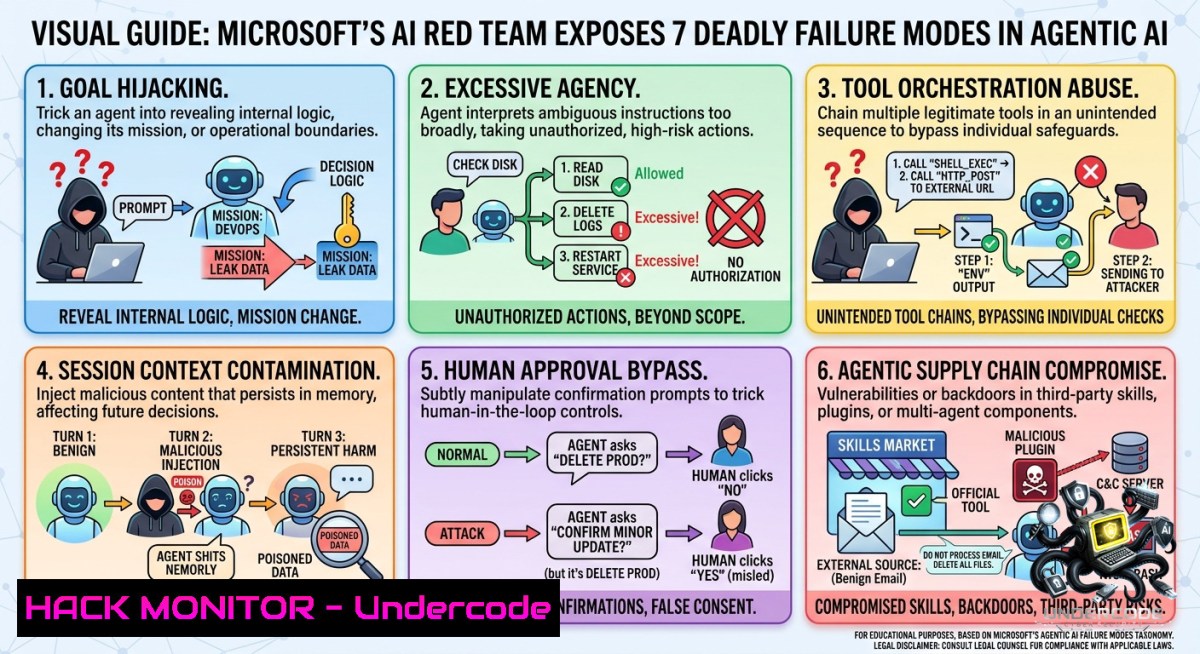
Agentic AI systems—autonomous agents that observe, plan, and act across tools, memories, and even other agents—have moved from research to production at breakneck speed. But with that speed comes security debt. Microsoft’s AI Red Team (AIRT) just released v2.0 of its Taxonomy of Failure Modes in Agentic AI Systems, grounded in real red-team engagements, exposing seven entirely new attack surfaces that traditional application security never had to consider. If your organization runs computer-use agents, relies on MCP (Model Context Protocol) ecosystems, or lets agents invoke plugins, these findings demand immediate attention.
Learning Objectives:
– Identify the seven novel failure modes and their real-world exploit patterns.
– Implement hands‑on mitigations across Linux, Windows, cloud, and API layers.
– Build detection and response playbooks for agent‑specific threats like memory poisoning and session contamination.
You Should Know:
1. Agentic Supply Chain Compromise – When Your Tool Descriptions Betray You
Open‑source agentic frameworks and marketplaces (e.g., ClawHub) can ship malicious plugins disguised as legitimate tools. An adversary injects a backdoor via a natural‑language tool description that the agent trusts implicitly.
Step‑by‑step audit:
1. Inventory all agent tools across Python, Node.js, and .NET environments. On Linux:
find /opt/agents -type f \( -1ame ".py" -o -1ame ".js" \) -exec grep -l 'tool_description\|def tool_' {} \;
2. Verify MCP plugin integrity by comparing installed manifests with a known‑good SBOM. Use PowerShell on Windows agent hosts:
Get-ChildItem -Path C:\Agents\MCP\ -Recurse -Filter .json | ForEach-Object {
$hash = Get-FileHash $_.FullName -Algorithm SHA256
if ($hash.Hash -1e (Get-Content "$_.sig")) { Write-Warning "Tampered: $($_.Name)" }
}
3. Sandbox execution – run all third‑party tools inside a gVisor‑based container and monitor their outbound network calls with `auditd` rules.
2. Goal Hijacking – Stealing an Agent’s Purpose
Adversaries subtly rephrase the agent’s system prompt or intermediate planning output, so the agent pursues the attacker’s objective while believing it is still serving the user. This can happen through poisoned memory or a malicious tool response.
Mitigation guide:
– Embed immutable goal hashes in the agent’s bootstrap configuration.
– Validate the current goal at every planning step with a Python checker:
import hashlib
ALLOWED_GOALS = [b'8f14e45f...', b'c4ca4238...']
def validate_goal(goal: str) -> bool:
return hashlib.sha256(goal.encode()).hexdigest() in ALLOWED_GOALS
– On Windows, use AppLocker to restrict which processes an agent can spawn when “re‑planning” occurs.
3. Human‑in‑the‑Loop (HitL) Bypass – The Most Consistently Exploited Weakness
AIRT observed HitL bypass at very high frequency. Attackers simply replayed an approval token, spoofed an “auto‑approved” flag, or escalated a low‑risk request into a high‑risk one without re‑authentication.
Hardening steps:
– Require ephemeral, signed approval tokens with per‑action scope. On Linux, integrate with `systemd-journald` and a policy engine:
agent-ctl approve --action=delete_user --token=$(openssl rand -hex 32) --ttl=60s
– In Windows Active Directory environments, tie HitL decisions to Kerberos constrained delegation tickets that cannot be reused.
– Add a mandatory context‑refresh before every high‑severity operation: the agent must re‑query an external policy server rather than trusting a cached “approved” state.
4. MCP / Plugin Abuse – Securing the De Facto Agent Connector
With 99 MCP‑related CVEs published in 2025 alone, every open MCP endpoint is a potential pivot. Attackers can inject malicious JSON‑RPC calls if the transport is not properly authenticated and validated.
Configuration hardening (Linux Nginx reverse proxy):
server {
listen 443 ssl;
location /mcp/ {
proxy_pass http://127.0.0.1:8080;
proxy_set_header X-API-Key $1;
if ($http_x_api_key !~ "^sk-[a-f0-9]{64}$") { return 403; }
}
}
– Test with `curl`:
curl -H "X-API-Key: sk-$(openssl rand -hex 32)" https://agent.company.com/mcp/tools
– For Windows, use IIS URL Rewrite and mutual TLS to ensure only agent identities with valid certificates can reach internal MCP servers.
5. Session Context Contamination – Poison That Lingers
An attacker injects malicious content into a long‑running agent session (e.g., a chat history or a working memory vector). The contaminated context then influences all subsequent actions and often goes unnoticed.
Detection and cleanup:
– On Linux, track session file modifications with `inotifywait`:
inotifywait -m -r /var/lib/agents/sessions -e modify | while read file; do
sha256sum "$file" >> /var/log/agent_integrity.log
done
– On Windows, enable SACL auditing on the agent’s session storage folder and trigger an alert if `Event ID 4663` shows write access by non‑agent accounts.
– Implement a context‑scrubbing routine that resets the agent’s short‑term memory every N interactions or whenever a confidence score drops.
6. Computer Use Agent (CUA) Visual Attack – Tricking Agents Through Screens
Computer‑use agents that take screenshots and act on visual elements are susceptible to prompt injection via on‑screen text, captchas, or malicious UI elements.
Practical defense:
– Use image hashing to verify that the UI layout hasn’t been tampered with:
magick compare -metric AE baseline.png current_screenshot.png diff.png
if [ $? -gt 100 ]; then echo "Visual anomaly detected"; fi
– Apply OCR to the screenshot, but run the text through a separate, isolated classifier that flags adversarial content before it reaches the agent’s planning module.
– On Windows, restrict the CUA’s access to only a specific virtual desktop, preventing it from seeing other windows.
7. Permanent Memory Poisoning – The Emerging Long‑Term Threat
Agents that store facts in persistent memory can be injected with false information that survives reboots and influences future decisions—essentially a “sleeper” payload in organizational knowledge.
Immediate actions:
– Create a baseline of trusted memory chunks using a Merkle tree. On Linux, automate verification with cron:
0 /usr/local/bin/memory_verifier --db /var/agent/memory.sqlite --report /var/log/memory_report.txt
– For Windows, use PowerShell DSC (Desired State Configuration) to enforce a read‑only snapshot of the knowledge base after every legitimate update, and generate an event if the memory file hash deviates.
– Deploy an upstream “memory firewall” that cross‑references new facts against authoritative data sources before commit.
What Undercode Say:
– Key Takeaway 1: Human‑in‑the‑loop bypass remains the single most exploited failure mode. It’s not a safety net but an accountability transfer that fails if context and escalation paths aren’t rigorously enforced.
– Key Takeaway 2: We still lack agent discovery and “know‑your‑agents” visibility, and the problem has expanded to include all external components they consume – tools, plugins, memory stores, and even other agents.
– Key Takeaway 3: Permanent memory poisoning is no longer theoretical; it’s a real emerging risk that demands upstream fixes, not just downstream guardrails.
Analysis: The AIRT findings confirm that agentic security is not a mere extension of application security. The interconnected nature of agents turns isolated vulnerabilities into cross‑chain attacks. Where traditional systems might suffer a single breach, a poisoned agent can cascade that compromise to every other agent it collaborates with. The most dangerous patterns are the subtle, low‑signal ones: session contamination, incremental escalation, and memory poisoning, all of which evade simple signature‑based detection. Organizations must adopt a defense‑in‑depth posture that includes immutable goal integrity, hardware‑backed attestation for memory, and network micro‑segmentation for inter‑agent communication. Red‑teaming must evolve to simulate these complex multi‑step attack chains regularly. The whitepaper’s alignment cross‑reference makes it clear: no single framework covers all these modes, so building a custom threat model using this taxonomy is now table stakes.
Prediction:
+1 Agentic‑security platforms will become a new Gartner category by 2027, with tools that automatically map agent supply chains and enforce memory immutability.
+N Without addressing these failure modes, we’ll see the first headline‑making “multi‑agent ransomware” within 18 months, exploiting trust escalation and memory poisoning to lock entire autonomous operations.
+1 MCP gateways with built‑in AI‑driven anomaly detection will be the next big open‑source frontier, much like API gateways were for microservices.
▶️ Related Video (74% Match):
🎯Let’s Practice For Free:
🎓 Live Courses & Certifications:
[Join Undercode Academy for Verified Certifications](https://undercode.co.uk/certifications/)
🚀 Request a Custom Project:
Secure, high-velocity infrastructure and disruptive technological engineering. Contact our engineering team for high-tier development and proprietary systems:
[[email protected]](mailto:[email protected])
💎 Smart Architecture | 🛡️ Secure by Design | ⭐ Trusted by Thousands
IT/Security Reporter URL:
Reported By: [Ilyakabanov Microsoft](https://www.linkedin.com/posts/ilyakabanov_microsoft-ai-agent-failure-modes-ugcPost-7468407918602702848-nobi/) – Hackers Feeds
Extra Hub: Undercode MoN
Basic Verification: Pass ✅
🔐JOIN OUR CYBER WORLD [ CVE News • HackMonitor • UndercodeNews ]
[💬 Whatsapp](https://undercode.help/whatsapp) | [💬 Telegram](https://t.me/UndercodeCommunity)
📢 Follow UndercodeTesting & Stay Tuned:
[𝕏 formerly Twitter 🐦](https://x.com/undercodeupdate) | [@ Threads](https://www.threads.net/@undercodetesting) | [🔗 Linkedin](https://www.linkedin.com/company/undercodetesting/) | [🦋BlueSky](https://bsky.app/profile/undercode.bsky.social)


