Listen to this Post
Introduction
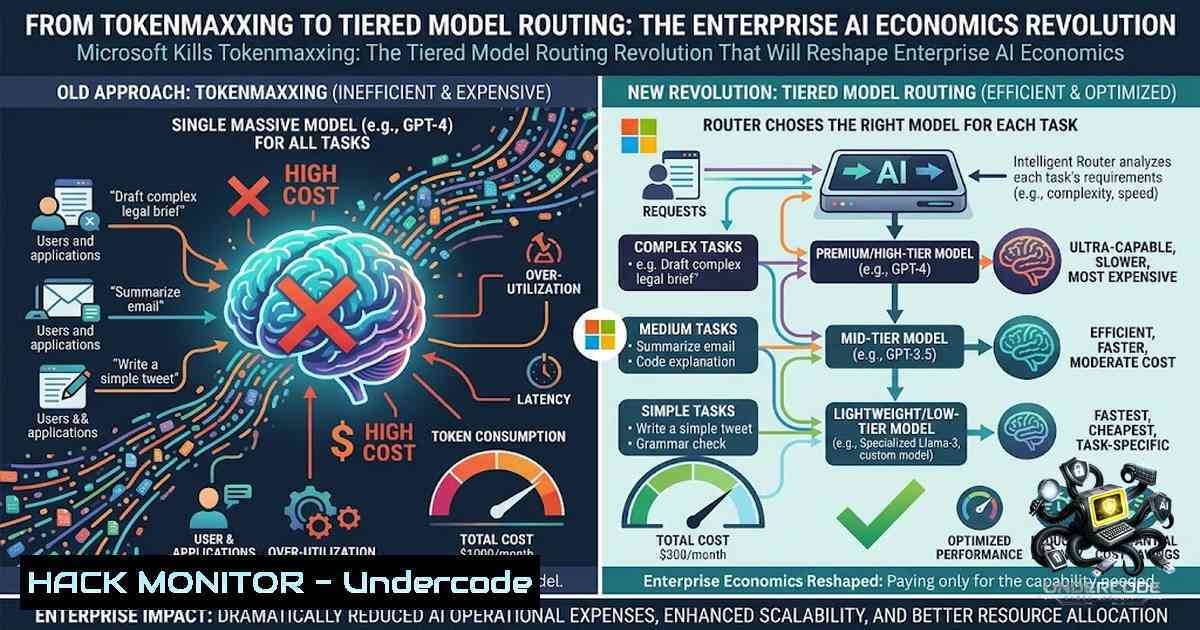
In August 2026, Microsoft issued two seemingly contradictory internal documents: EVP Jay Parikh’s cost-discipline memo introducing division-level AI token budget targets, and CEO Satya Nadella’s aspirational post declaring that “the next measure of AI momentum is work transformed.” Together, they expose the existential tension facing every enterprise AI deployment—unconstrained token consumption delivers the MIT NANDA result: 95% of pilots with zero measurable P&L impact. The resolution is tiered model routing: using the cheapest model that produces acceptable output for a given task, and measuring success by work outcomes rather than token throughput.
Learning Objectives
- Understand the economic imperative behind Microsoft’s internal AI token budget targets and the “tokenmaxxing” phenomenon
- Master tiered model routing architectures that can reduce AI operational costs by 50–89% across security, contact center, and knowledge worker workloads
- Implement AI FinOps practices using Viva Insights, model routing harnesses, and cost-aware prompt engineering
You Should Know
- The Tokenmaxxing Problem: Why Microsoft Put a Ceiling on AI Spend
Since July 2026, every Microsoft division has carried an AI token budget target, and employees can now look up their individual spend on an internal dashboard. The guidelines reveal that many engineers were burning through hundreds to thousands of dollars in tokens each month. Parikh’s memo states directly: “Tokenmaxxing is not what we are optimizing for.”
Tokenmaxxing is workplace shorthand for treating AI consumption as a proxy for productivity—the more tokens you burn, the harder you’re presumably working. It produced internal leaderboards and widespread frontier-model usage on problems that never required a frontier model. Nadella himself admitted at a Hard Fork taping in June that “plenty of tokenmaxxing was happening inside Microsoft,” called the habit “addictive,” and delivered the policy preview: don’t use frontier models for non-frontier problems.
Step‑by‑step guide to audit your own AI token consumption:
- Enable token tracking in your AI platform (Azure OpenAI, AWS Bedrock, or Google Vertex AI). For Azure OpenAI, navigate to Azure Monitor > Metrics > Tokens processed.
- Create a token budget dashboard using Azure Workbooks or Power BI. Query the `GPTTokenUsage` table:
SELECT UserPrincipalName, ModelName, SUM(Tokens) AS TotalTokens,
SUM(Cost) AS TotalCost
FROM GPTTokenUsage
WHERE TimeGenerated > ago(30d)
GROUP BY UserPrincipalName, ModelName
ORDER BY TotalCost DESC
- Identify top consumers and analyze whether their use cases genuinely require frontier models.
- Implement token budget alerts in Azure Budgets or AWS Budgets when monthly spend exceeds 80% of your target.
- Review prompt complexity—many tasks can be handled by smaller models with well-engineered prompts.
-
Tiered Model Routing: The Architecture That Cuts AI Costs by 50–89%
Microsoft’s resolution to the tokenmaxxing problem is tiered model routing. The company has applied this across its product stack with dramatic results:
| Workload | High-Volume Model | Escalation Model | Cost Reduction |
|-|-||-|
| Security scanning | MAI-Cyber-1-Flash (90% of tasks) | GPT-5.4 (10% of tasks) | 50% |
| Contact center audio | MAI-Voice-2-Flash | Higher-capability models | 50–89% |
| Knowledge worker tasks | GPT-5.6 (default) | GPT-5.4/frontier models | Significant |
Microsoft’s MAI-Cyber-1-Flash, the company’s first in-house cybersecurity model, scored 96% on the CyberGym benchmark while cutting costs by approximately 50%. Mustafa Suleyman, Microsoft AI CEO, explained: “MAI-Cyber-1-Flash was built to handle up to 90% of security tasks, while MDASH sends the remaining 10% of harder problems to OpenAI’s GPT-5.4.”
Step‑by‑step guide to implement tiered model routing:
- Classify your AI workloads by complexity and criticality. Create a taxonomy:
– Tier 1 (Flash): Simple classification, extraction, summarization, basic Q&A
– Tier 2 (Mid): Reasoning, moderate complexity coding, sentiment analysis
– Tier 3 (Frontier): Complex reasoning, advanced code generation, security vulnerability discovery
- Build a routing harness using semantic routing or LLM-as-a-judge. Example Python implementation using Azure OpenAI:
import openai</li> </ol> def route_model(prompt, complexity_score=None): if complexity_score is None: Use a lightweight classifier to determine complexity response = openai.ChatCompletion.create( model="gpt-3.5-turbo", messages=[{"role": "system", "content": "Classify this task as 'simple', 'medium', or 'complex'. Respond with only one word."}, {"role": "user", "content": prompt}], max_tokens=10 ) complexity = response.choices[bash].message.content.strip().lower() else: complexity = complexity_score if complexity == "simple": return "gpt-4o-mini" or MAI-Cyber-1-Flash for security elif complexity == "medium": return "gpt-4o" else: return "gpt-5.4" or your frontier model- Set up cost-aware fallbacks—if a model times out or returns low-confidence results, escalate to the next tier.
-
Monitor routing decisions and continuously refine your classifier based on output quality and cost metrics.
-
AI FinOps: Viva Insights and the Productization of AI Spend Visibility
The token budget memo signals what Microsoft will eventually productize. Copilot AI Spend Insights in Viva Insights, currently in preview, provides group- and team-level visibility into AI spend (Copilot credit usage). The dashboard is enabled by default for managers with at least five direct reports, Insights Analysts, and Global Administrators.
The services in scope include Cowork and Work IQ API—both usage-based billing services. Organizations can now answer critical questions: Which departments consume the most Copilot Credits? Which services drive the highest spend? Analysts can export data as CSV or connect to Power BI for custom reporting.
Step‑by‑step guide to implement AI FinOps with Viva Insights:
- Ensure prerequisites: You need at least 50 Microsoft 365 Copilot licenses with agent activity.
- Access the Agent Dashboard in the Viva Insights web app (left navigation panel).
- Delegate access to Insights Analysts and AI Administrators as needed.
- Enable the public preview (disabled by default)—Insights Administrators can opt in.
- Create custom queries in Advanced Insights to analyze AI spend by team, service, and user.
- Export to Power BI for executive dashboards and trend analysis.
Linux/Windows command to monitor AI API costs via CLI:
 Azure CLI - Get OpenAI usage for the last 30 days
az monitor metrics list --resource <OpenAI-Resource-ID> \
--metric "ProcessedTokens" \
--start-time 2026-07-01T00:00:00Z \
--end-time 2026-08-01T00:00:00Z \
--interval P1D \
--output table

PowerShell - Export Copilot usage data
Connect-ExchangeOnline
Get-CopilotUsageReport -StartDate (Get-Date).AddDays(-30) -EndDate (Get-Date) |
Export-Csv -Path "CopilotUsage.csv" -1oTypeInformation
- GPT-5.6 as Default: The Economics of “Good Enough”
Microsoft made OpenAI’s GPT-5.6 the default internal model not because it is the most capable option available, but because it costs less to run than its predecessors at acceptable quality for most tasks. This decision followed the realization that Microsoft’s internal GitHub Copilot configuration previously ran on an auto-router that leaned mostly on Anthropic’s Claude models—thousands of engineers were writing code with Claude tokens without ever choosing Claude, and Microsoft was paying for it.
Parikh framed the shift as efficiency: “We are not optimizing for fewer tokens. We are optimizing for more impact per token.”
Step‑by‑step guide to select the right model for your use case:
- Establish quality benchmarks for each of your AI use cases. Define acceptable accuracy, latency, and cost thresholds.
- Run A/B tests comparing multiple models on a representative sample of your production prompts.
- Calculate total cost of ownership (TCO) per task:
TCO = (Tokens per request × Cost per token) + (Error rate × Cost of human intervention)
- Set default models based on the “cheapest acceptable” principle—not the most capable.
- Create override mechanisms for power users who genuinely need frontier capabilities.
- Review default selections quarterly as model capabilities and pricing evolve.
-
Security AI at Scale: MAI-Cyber-1-Flash and the MDASH Harness
Microsoft’s MDASH multi-agent system for finding and fixing software vulnerabilities now uses MAI-Cyber-1-Flash for 90% of tasks, reserving GPT-5.4 for the hardest 10%. The unified system scored 96% on CyberGym—12 percentage points above Mythos—at 50% of the cost of the previous GPT-5.4 + mini + codex configuration.
The system processes more than 100 trillion security signals daily, drawing on data from 1.6 million customers. Suleyman described the harness as “a router that matches incoming problems to the model best suited to solve them.”
Step‑by‑step guide to implement a security AI harness:
- Identify your security workflows: vulnerability scanning, threat hunting, incident triage, remediation.
- Build a multi-agent system with specialized agents (red team for attack simulation, blue team for investigation, green team for remediation).
- Implement model routing based on task complexity—use compact models for routine scanning, frontier models for complex reasoning.
- Monitor and audit all AI security actions with tenant isolation, auditing, and sandboxed execution environments.
- Roll out access in stages—Microsoft started with tens of users, then hundreds, then thousands.
Security hardening commands for AI deployments:
Linux - Restrict API key permissions chmod 600 /etc/ai-api-keys.conf setfacl -m u:ai-service:rx /etc/ai-api-keys.conf Windows - Enable audit logging for AI API calls auditpol /set /subcategory:"Application Group Management" /success:enable /failure:enable wevtutil set-log Microsoft-Windows-API-Audit /enabled:true /retention:false /maxsize:1073741824 Azure - Enable diagnostic settings for OpenAI az monitor diagnostic-settings create --1ame "OpenAIAudit" \ --resource <OpenAI-Resource-ID> \ --logs '[{"category": "Audit", "enabled": true}]' \ --workspace <Log-Analytics-Workspace-ID>- Work Transformed: Beyond Token Throughput to Business Outcomes
Nadella’s framing is explicit: “The productivity layer era, where AI assists individual tasks, is giving way to the work transformation era, where AI redesigns how entire workflows operate.” The question for enterprise buyers is whether their own AI deployments use the same logic—or run every prompt through the same model tier regardless of what the task requires.
The key insight: unconstrained token spend produces the MIT NANDA result—95% of pilots with zero measurable P&L impact. Engineers burning thousands of dollars in tokens per month are, in most cases, not transforming work. They are tokenmaxxing.
Step‑by‑step guide to measure work transformation:
- Define outcome metrics for each AI use case—not token counts, but business KPIs (time saved, revenue impacted, defects reduced).
- Implement outcome tracking in your AI platform using custom dimensions and tags.
- Create cost-per-outcome dashboards that show the relationship between AI spend and business value.
- Run regular reviews of AI usage patterns and adjust routing rules based on outcome data.
- Communicate the “work transformed” narrative to stakeholders—shift focus from AI adoption to AI impact.
What Undercode Say
- Tokenmaxxing is the new shadow IT. Just as uncontrolled cloud spend emerged in the early 2010s, uncontrolled AI token consumption is now the hidden cost center. Organizations that don’t implement AI FinOps today will face budget shocks tomorrow. Microsoft’s internal memo is a canary in the coal mine—if the world’s largest AI vendor can’t afford unlimited token consumption, neither can your enterprise.
-
Tiered model routing is the defining AI architecture of 2026–2027. The era of running every prompt through GPT-5 is over. The winning strategy is a routing harness that matches tasks to the cheapest capable model. Microsoft’s 50–89% cost reductions are not theoretical—they’re achievable with proper classification, routing, and monitoring. The question isn’t whether to implement tiered routing, but how quickly.
-
Enterprise AI buyers now have a playbook. Microsoft has inadvertently published the definitive guide to AI cost optimization: set budgets, track individual spend, route tasks intelligently, and measure outcomes, not tokens. The Viva Insights AI spend dashboard productizes this playbook for every Microsoft 365 customer. The vendors who resist this trend—those pushing frontier models for every use case—will lose enterprise trust.
-
The “work transformed” metric is the new north star. Nadella’s framing is a strategic masterstroke. It shifts the conversation from AI adoption (which vendors love to report) to AI impact (which buyers actually care about). Enterprises should demand the same framing from their AI vendors: show me the work transformed, not the tokens consumed.
-
Security AI is the canary for the broader trend. MAI-Cyber-1-Flash proves that specialized, compact models can outperform frontier models on specific tasks at half the cost. This pattern will replicate across every domain—legal, finance, healthcare, customer service. The winners will be those who build the best routing harnesses, not those who train the biggest models.
Prediction
-
+1 By Q1 2027, tiered model routing will become a standard feature in every major AI platform (Azure OpenAI, AWS Bedrock, Google Vertex AI). Vendors will compete on routing intelligence, not just model capability.
-
+1 AI FinOps will emerge as a distinct discipline, with certifications, conferences, and dedicated software categories. Viva Insights AI spend will be just the first of many products in this space.
-
-1 Organizations that fail to implement AI cost controls will face budget overruns of 300–500% by mid-2027, leading to mass AI project cancellations and a “AI winter” perception in the business press.
-
+1 The “work transformed” metric will become the standard for enterprise AI ROI, displacing token counts, user adoption, and other vanity metrics. Vendors will be forced to prove business impact, not just usage.
-
-1 The shift to compact models will create a two-tier AI economy: enterprises with sophisticated routing harnesses will thrive, while those locked into single-model vendors will face unsustainable cost structures and vendor lock-in.
-
+1 Security AI will lead the tiered routing revolution, with MAI-Cyber-1-Flash-style architectures becoming the template for every specialized AI domain. The “harness” will become more valuable than the model.
▶️ Related Video (80% Match):
https://www.youtube.com/watch?v=-v_a0ZvfJSw
🎯Let’s Practice For Free:
🎓 Live Courses & Certifications:
Join Undercode Academy for Verified Certifications
🚀 Request a Custom Project:
Secure, high-velocity infrastructure and disruptive technological engineering. Contact our engineering team for high-tier development and proprietary systems:
[email protected]
💎 Smart Architecture | 🛡️ Secure by Design | ⭐ Trusted by ThousandsIT/Security Reporter URL:
Reported By: Markingram1 Microsoftai – Hackers Feeds
Extra Hub: Undercode MoN
Basic Verification: Pass ✅🔐JOIN OUR CYBER WORLD [ CVE News • HackMonitor • UndercodeNews ]
📢 Follow UndercodeTesting & Stay Tuned:


