Listen to this Post
Introduction:
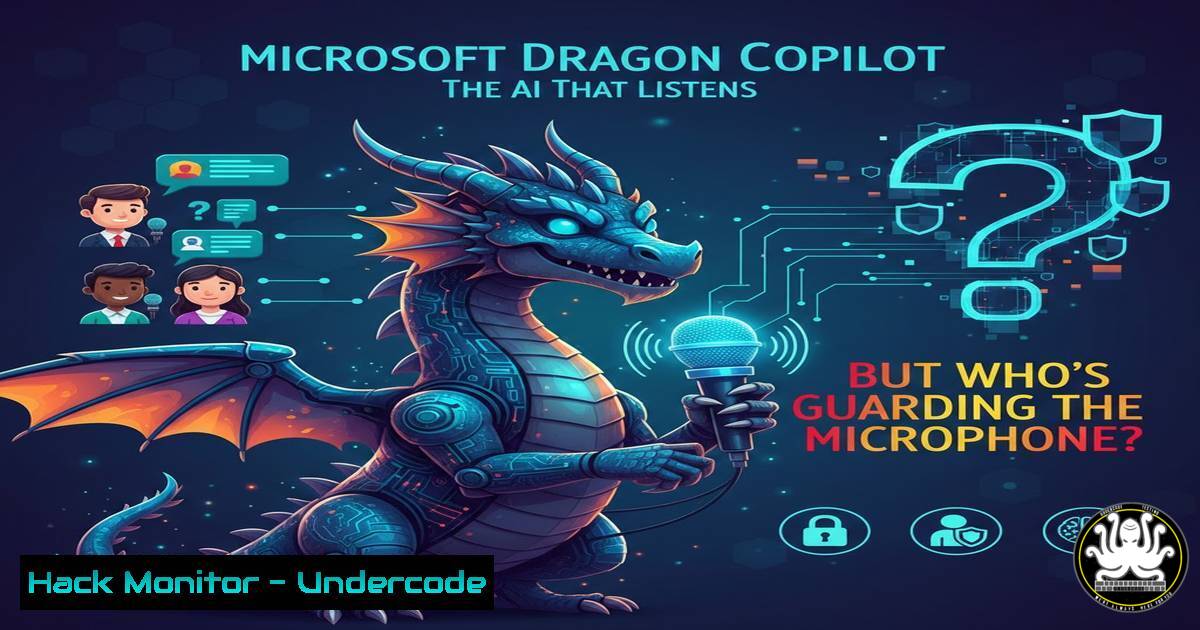
The modern examination room is no longer a private dyad between physician and patient; it is a data-rich environment where every spoken word is a potential liability or a lifesaver. With Microsoft’s launch of Dragon Copilot—an ambient AI solution for clinical documentation—healthcare stands at a crossroads. While this technology promises to return “time and attention” to medical professionals by automating administrative workflows, it simultaneously opens a Pandora’s box of cybersecurity, data privacy, and compliance challenges. This article dissects the technical architecture of ambient clinical intelligence, explores the security hardening required for its deployment, and provides a practical guide for IT professionals to secure AI-driven voice infrastructure.
Learning Objectives:
- Understand the underlying AI and cloud architecture of ambient clinical documentation tools like Dragon Copilot.
- Identify the specific cybersecurity risks associated with voice-to-data pipelines in healthcare (HIPAA/GDPR).
- Implement network segmentation, endpoint security, and API hardening to protect sensitive patient conversations.
- Configure Windows and Linux environments to support secure, low-latency AI processing at the edge or in the cloud.
- Develop incident response strategies for potential data leaks involving ambient listening devices.
You Should Know:
- The Anatomy of an Ambient AI Scribe: How Dragon Copilot Actually Works
Before securing a system, you must understand its data flow. Ambient clinical intelligence (ACI) solutions like Microsoft’s Dragon Copilot, often integrated with partners like ChipSoft (as mentioned in the original post), operate on a three-tier architecture: Capture, Process, and Output.
- Capture (The Endpoint): The conversation occurs in a physical room. A microphone array (often a smart speaker, a dedicated medical device, or a smartphone app) captures the audio. This is the attack surface zero. If this device is compromised, the entire conversation is exfiltrated in real-time.
- Process (The Cloud/Edge): The audio stream is encrypted and sent to a backend. Here, Automatic Speech Recognition (ASR) converts speech to text, and Natural Language Processing (NLP) models (likely Azure OpenAI Service or custom models) extract medical entities (medications, symptoms, procedures) to structure the clinical note.
- Output (The EHR): The structured data is pushed into the Electronic Health Record (EHR) system via APIs (like HL7/FHIR).
- Securing the Ambient Listening Pipeline: A Step-by-Step Hardening Guide
To deploy this securely, you cannot rely on Microsoft’s security alone. You must harden the environment from the exam room to the data center.
Step 1: Endpoint Security and Network Segmentation
The capture device must be treated as an IoT device with zero trust.
– Windows Endpoint (If using a PC):
– Apply AppLocker or Windows Defender Application Control (WDAC) to ensure only the approved Dragon Copilot client runs.
– Disable unnecessary USB ports and Bluetooth to prevent peripheral implants.
– Command: `Get-SmbConnection` (to check for unauthorized network shares) and `Set-MpPreference -DisableRealtimeMonitoring $false` to ensure Defender is active.
– Network Isolation:
– Place the capture devices on a separate VLAN (VLAN 100 – Medical-IoT). Use strict firewall rules allowing outbound traffic only to the specific Azure regional endpoints (list provided by Microsoft) on port 443 (HTTPS). Block all inbound traffic.
– Linux Gateway/Router Rule (iptables example):
iptables -A FORWARD -i VLAN_IoT -o VLAN_WAN -d [bash] -p tcp --dport 443 -j ACCEPT
iptables -A FORWARD -i VLAN_IoT -o VLAN_WAN -j DROP
Step 2: API Security and Data-in-Transit Hardening
The handshake between the local environment and Azure must be invulnerable to Man-in-the-Middle (MitM) attacks.
– Certificate Pinning: Ensure the client application validates the server certificate against a known public key, not just any certificate signed by a trusted CA. This prevents interception by rogue proxy servers.
– TLS 1.3 Enforcement: Disable older protocols on the gateways.
– Windows Server (IIS): In the registry, set `Schannel` protocols to disable TLS 1.0/1.1.
– Linux (Nginx Reverse Proxy):
server {
listen 443 ssl http2;
ssl_protocols TLSv1.3;
ssl_ciphers 'TLS_AES_256_GCM_SHA384';
 ... rest of config
}
Step 3: Data-at-Rest and Logical Segmentation in Azure
Once the data hits Microsoft’s cloud, it resides in storage and databases.
– Customer Managed Keys (CMK): Do not rely on Microsoft-managed keys for encryption. Use Azure Key Vault to store your own keys. This ensures that if Microsoft’s infrastructure is compromised, the data remains encrypted without your key.
– Private Endpoints: Do not expose your storage accounts or databases to the public internet. Use Azure Private Link to connect the processing service to the storage via the Microsoft backbone network, bypassing the public internet entirely.
– Data Residency: Configure policies to ensure data never leaves the specific geo-boundary (e.g., EU Data Boundary for GDPR compliance). Use Azure Policy to enforce location restrictions.
Step 4: Monitoring and Threat Detection
You cannot secure what you cannot see. Ambient AI generates a constant stream of sensitive data.
– SIEM Integration: Forward logs from Azure Sentinel (or your on-prem SIEM) regarding access to the Dragon Copilot service.
– KQL (Kusto Query Language) Query for Anomaly Detection:
Look for unusual access times or data volumes that might indicate a breach or insider threat.
// Detect large data exports from the Clinical AI storage
StorageBlobLogs
| where TimeGenerated > ago(1h)
| where OperationName == "GetBlob"
| where StatusCode == 200
| summarize TotalBytes = sum(ResponseBodySize) by AccountName, UserAgent, ClientIP
| where TotalBytes > 100000000 // Threshold for large download
Step 5: Simulating a Training Module for Staff
The human element remains the weakest link. Here is a mini-tutorial on phishing resistance related to AI tools.
– Scenario: An attacker sends an email claiming to be “Dragon Copilot Support” asking the doctor to “update their voice profile” by clicking a link and entering credentials.
– Mitigation: Implement a training lab using a virtualized environment.
– Linux Command to simulate malicious site block:
Edit `/etc/hosts` to redirect fake support domains to a loopback address for training purposes.
echo "127.0.0.1 dragon-support-fake.com" >> /etc/hosts
– Windows PowerShell to check for persistence:
Teach staff how to run a basic check for suspicious startup programs if they accidentally click something.
Get-CimInstance Win32_StartupCommand | Select-Object Name, command, Location, User
Step 6: Vulnerability Exploitation Simulation (Ethical Hacking Perspective)
Understanding how an attacker might exploit this system is crucial for defense.
– The Attack Vector: An attacker gains access to the local network (via a compromised patient kiosk or Wi-Fi). They attempt to spoof the EHR API endpoint to inject false data or extract patient notes.
– Defensive Command (Packet Capture analysis on Linux):
Monitor for ARP spoofing attempts.
tcpdump -i eth0 arp and ether broadcast
A sudden flood of ARP replies claiming to be the gateway indicates an ARP spoofing attack aiming to intercept traffic.
Step 7: Cloud Hardening for the EHR Integration
The final step is where the structured data lands: the Electronic Health Record.
– FHIR API Rate Limiting: Configure the API gateway to limit the number of requests from the Dragon Copilot service to prevent a denial-of-service attack on the EHR.
– Input Sanitization: Even though the data comes from an “authorized” AI service, ensure the EHR endpoint sanitizes input to prevent NoSQL injection or XSS attacks if the notes are rendered in a web interface.
What Undercode Say:
The integration of AI like Dragon Copilot into healthcare is not merely an IT upgrade; it is a fundamental shift in the human-machine interface. The core takeaway is that AI acts as a force multiplier—for both productivity and risk. By moving the “listening” function to the edge and the “thinking” to the cloud, we create a highly complex distributed system that demands a holistic security posture.
The narrative in the original post highlights the human benefit—regaining attention. However, from a cybersecurity perspective, we must ensure that the technology regaining that attention is not simultaneously leaking the most intimate details of a patient’s life to the dark web. The security model must move from “castle-and-moat” to “zero-trust,” treating every microphone, every API call, and every data packet as a potential threat until proven otherwise. We must shift left, embedding security into the design of these ambient environments, rather than bolting it on after a breach.
Key Takeaway 1: Ambient AI transforms physical spaces into data centers.
The exam room is now a server room. Organizations must conduct physical security audits, acoustic isolation checks (to prevent bleed-over of conversations), and strict device management for any IoT hardware used for capture.
Key Takeaway 2: Compliance is a technical configuration, not a checkbox.
HIPAA and GDPR compliance for AI requires verifiable technical controls: data minimization (AI models should not retain audio longer than necessary), purpose limitation, and robust audit trails. If your cloud tenant is misconfigured, you are violating compliance, regardless of Microsoft’s certifications.
Prediction:
Within the next 24 months, we will witness the emergence of specialized “Ambient Security” frameworks. As ambient intelligence becomes ubiquitous in healthcare, legal, and financial services, we will see a surge in “audio-jacking” attacks—where malicious actors inject noise or commands into the environment that are inaudible to humans but are interpreted by the AI as legitimate data or instructions. Furthermore, regulatory bodies will begin to mandate “ambient audit trails,” requiring organizations to log not just who accessed data, but which AI model and which specific acoustic environment generated that data. The battle for cybersecurity will shift from the keyboard to the conversation itself.
▶️ Related Video (86% Match):
🎯Let’s Practice For Free:
IT/Security Reporter URL:
Reported By: Femcornelissen Ik – Hackers Feeds
Extra Hub: Undercode MoN
Basic Verification: Pass ✅


