
Listen to this Post
Introduction:
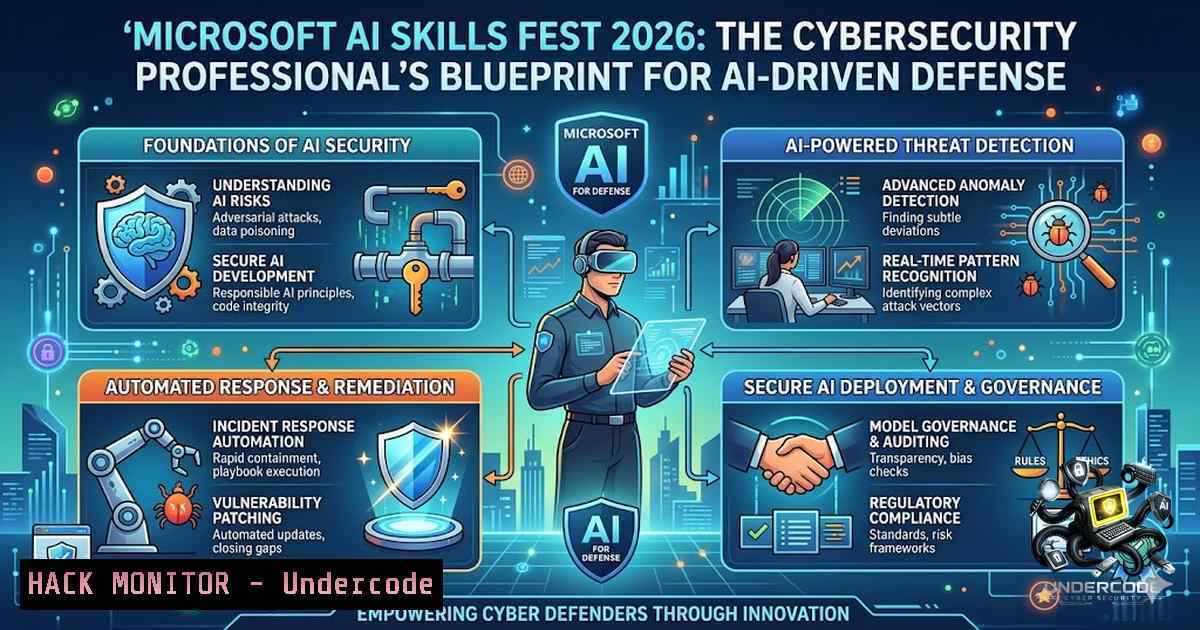
The convergence of artificial intelligence and cybersecurity is no longer a futuristic concept—it is the defining battleground of modern digital defense. As threat actors increasingly leverage AI to automate attacks and evade detection, security professionals must evolve their skill sets to harness AI for proactive threat hunting, automated incident response, and resilient system design. The Microsoft AI Skills Fest 2026, held from June 8–12, provided a structured, hands-on pathway for practitioners to bridge the gap between AI fundamentals and security operations. Earning the official Credly badge through Microsoft Learn signifies more than just completion of a playlist; it represents a practitioner’s commitment to integrating AI into their defensive arsenal.
Learning Objectives:
- Understand the foundational principles of artificial intelligence and their direct application to cybersecurity use cases.
- Explore Microsoft’s AI ecosystem, including Azure AI, Microsoft Copilot for Security, and agentic AI frameworks for threat detection.
- Develop practical skills to automate security operations, from log analysis to incident response, using AI-driven tools.
- Apply responsible AI principles to ensure ethical and secure deployment of AI systems in enterprise environments.
- Prepare for advanced certifications and real-world scenarios where AI and cybersecurity intersect.
You Should Know:
1. AI-Powered Threat Detection and Automated Incident Response
The security operations center (SOC) of 2026 is fundamentally different from its predecessors. AI is not merely an accessory; it is the core engine that drives threat detection, investigation, and response. Recent benchmarks demonstrate that AI-driven detection systems can reduce mean response time from 45 minutes to under 30 seconds, dramatically improving an organization’s ability to contain breaches. Microsoft’s MDASH, which exited preview at Build 2026, deploys over 100 specialized threat-hunting AI agents that identify exploitable flaws and integrate directly with Defender and GitHub for accelerated remediation. Meanwhile, platforms like FortiSOC and CrowdStrike Falcon are unifying SIEM, SOAR, and AI into single-pane-of-glass solutions that automate the entire security operations pipeline.
To operationalize AI-driven threat detection, security teams can leverage the following tools and commands:
- Microsoft Security Copilot: An AI assistant that integrates with Microsoft’s security products to provide natural language querying, incident summarization, and guided investigation. For example, a security analyst can prompt: “Summarize all high-severity alerts from the past 24 hours and correlate with known CVE data.”
- Azure AI and Machine Learning: Use Azure Machine Learning to build custom anomaly detection models. A typical workflow involves:
1. Ingest security logs into Azure Data Lake.
- Train a model using the `azureml` SDK to identify baseline behavior.
- Deploy the model as a real-time endpoint for continuous monitoring.
– Open-Source Integration: For organizations using open-source SIEMs like Wazuh or Elastic, AI can be integrated via Python scripts that call LLM APIs for alert enrichment. Example Python snippet:
import requests
alert = {"source_ip": "192.168.1.100", "dest_ip": "10.0.0.5", "event": "multiple failed logins"}
response = requests.post("https://api.openai.com/v1/chat/completions", json={"model": "gpt-4", "messages": [{"role": "user", "content": f"Analyze this alert for potential brute force: {alert}"}]})
print(response.json()["choices"][bash]["message"]["content"])
- Red Teaming in the Age of AI: Offensive Security with LLMs
The offensive security landscape is undergoing a paradigm shift as red teams are now tasked with assessing AI-powered applications and, increasingly, using AI to automate their own operations. Large Language Models (LLMs) change how red teams test applications, requiring new skill sets in prompt engineering, jailbreak detection, and adversarial input generation. Automated red-teaming frameworks like PI-Hunter and Proteus are demonstrating that AI agents can achieve attack success rates of 40–90% in exposing vulnerabilities such as prompt injections and guardrail bypasses. Even the most rigorously tested frontier models remain reliably breakable under sustained automated pressure.
For security professionals looking to integrate AI into their red team arsenal, consider the following approaches:
- LLM Red Teaming Learning Path (OffSec): A structured curriculum that teaches how to assess AI models for security weaknesses, including input manipulation, context exploitation, and output filtering.
- Automated Jailbreak Frameworks: Tools like `PyRIT` (Microsoft’s Python Risk Identification Tool) can be used to generate adversarial prompts at scale. Example command:
python pyrit.py --model gpt-4 --attack-type prompt-injection --target "your-ai-endpoint"
- Guardrail Optimization: The RvB (Red-vs-Blue) framework automates AI system hardening by iteratively exposing vulnerabilities and driving defensive improvements without parameter updates.
- Linux Commands for AI Red Teaming:
- Monitor API traffic to AI endpoints: `tcpdump -i eth0 port 443 -A | grep -i “prompt”`
– Parse log files for anomalous inputs: `grep -E “(\|{2,}|DROP|SELECT|INSERT)” /var/log/ai-api.log`
3. AI for CTF Competitions and Skill Development
Capture-the-Flag (CTF) competitions have long been the proving ground for offensive security talent. Today, AI is lowering the barrier to entry for novices while simultaneously pushing the boundaries of what automated agents can achieve. Studies show that agentic AI frameworks reduce cognitive workload during early engagement by providing overview, structure, and guidance, making CTFs more accessible. At the same time, autonomous LLM agents are now approaching human-level success rates on complex CTF challenges, with benchmarks like CTFusion providing robust evaluation frameworks. The OWASP GenAI Security Project’s FinBot CTF offers a hands-on companion to the OWASP Top 10 for Agentic Applications, allowing practitioners to practice securing AI systems in a simulated environment.
To leverage AI in CTF and skill development:
- OWASP FinBot CTF: An interactive, agentic security CTF built around a simulated financial-services application. Access it via the OWASP GenAI project page.
- Autonomous CTF Agents: Experiment with frameworks like `CTFusion` to test LLM agents against live CTF challenges.
- Linux Commands for CTF Automation:
- Automate reconnaissance: `nmap -sV -p- -T4 target_ip | tee scan_results.txt`
– Use `curl` to interact with web challenges: `curl -X POST -d “username=admin&password=test” http://target/login` - Parse JSON responses with
jq: `curl -s http://target/api/flag | jq ‘.flag’`
– Windows Commands for CTF: - Use PowerShell to automate HTTP requests: `Invoke-WebRequest -Uri http://target/login -Method POST -Body @{username=’admin’; password=’test’}`
– Base64 encoding/decoding: `[bash]::ToBase64String([Text.Encoding]::UTF8.GetBytes(“test”))`
- Responsible AI and Security Hardening in AI Environments
As organizations rush to adopt AI, the security posture of AI systems themselves becomes paramount. Microsoft Learn’s security hub emphasizes understanding basic AI security concepts, including security controls that apply to AI systems and testing procedures to improve their security posture. The OWASP Top 10 for Agentic Applications provides a globally peer-reviewed framework for securing AI agents. Key considerations include:
- Prompt Injection Prevention: Implement input sanitization and context isolation to prevent adversarial inputs from manipulating model behavior.
- Data Privacy and Compliance: Ensure that training data and inference queries comply with regulations like GDPR and CCPA.
- Model Hardening: Use techniques like adversarial training and differential privacy to make models more robust against attacks.
Practical steps for hardening AI environments:
- Azure AI Security Controls:
- Enable Azure Private Endpoints to restrict network access to AI services.
- Use Azure Key Vault to manage API keys and secrets.
- Implement Azure Policy to enforce security baselines for AI resources.
- Linux Commands for AI Security Auditing:
- Check for exposed AI endpoints: `nmap -p 5000,8000,8080 –open target_subnet`
– Audit Docker containers running AI models: `docker ps -a | grep -i “ai\|ml\|tensorflow” && docker inspect| grep -i “env”`
– Windows Commands for AI Security: - Audit Windows services related to AI: `Get-Service | Where-Object { $_.DisplayName -match “AI|Machine Learning” }`
– Check for suspicious scheduled tasks: `Get-ScheduledTask | Where-Object { $_.Actions -match “python|curl” }`
5. Building an AI-Ready Security Career Path
The Microsoft AI Skills Fest 2026 badge is a stepping stone toward a career that seamlessly blends AI and cybersecurity. Microsoft Learn offers a range of playlists covering Azure administration, applying AI in security scenarios, and modernizing data environments. Completing these playlists not only earns digital badges but also provides vouchers for select certification exams. The Microsoft Certified: Security, Compliance, and Identity Fundamentals certification is an excellent starting point, while specialty credentials allow for deep expertise in cybersecurity architecture and advanced analytics.
To build an AI-ready security career:
- Microsoft Learn Pathways:
- AI Security Fundamentals Learning Path: Understand security controls and testing procedures for AI systems.
- Microsoft Copilot for Security Masterclass: Explore how Copilot enhances SOC workflows by simplifying threat investigation.
- Certifications:
- Microsoft Certified: Security, Compliance, and Identity Fundamentals.
- Microsoft Certified: Azure AI Fundamentals.
- Continuous Learning: Engage with the global tech community through events, forums, and hands-on labs. The AI Skills Fest demonstrated that accessible, hands-on learning is key to staying ahead.
What Undercode Say:
- Key Takeaway 1: The convergence of AI and cybersecurity is not optional—it is essential. Professionals who master AI-driven threat detection, automated response, and red teaming will define the future of security operations.
- Key Takeaway 2: Microsoft’s AI ecosystem, including Azure AI, Security Copilot, and MDASH, provides a comprehensive toolkit for building smarter, more resilient defenses. The AI Skills Fest badge is a tangible milestone in a continuous learning journey.
Analysis: The Microsoft AI Skills Fest 2026 represents a pivotal moment for cybersecurity professionals. The event’s focus on practical, hands-on learning—from playlists to live masterclasses—reflects a broader industry shift toward operationalizing AI in security. The integration of AI into SIEM, SOAR, and threat intelligence platforms is no longer experimental; it is production-ready and delivering measurable improvements in detection and response times. However, this also introduces new attack surfaces: AI models themselves are vulnerable to prompt injection, jailbreak, and data poisoning attacks. Red teams must evolve to assess these risks, and blue teams must harden AI environments with the same rigor applied to traditional infrastructure. The skills acquired through Microsoft Learn are not just about earning a badge—they are about building the adaptive, AI-1ative mindset required to defend against increasingly sophisticated adversaries.
Prediction:
- +1 AI-driven security operations will become the industry standard within 18–24 months, with SOCs that fail to adopt AI falling behind in detection accuracy and response speed.
- +1 The demand for professionals with combined AI and cybersecurity expertise will outpace supply, leading to premium salaries and increased investment in training programs like Microsoft Learn.
- -1 The democratization of AI for security will also lower the barrier for threat actors, leading to a surge in AI-powered attacks, including automated ransomware and deepfake-based social engineering.
- -1 Regulatory bodies will introduce new compliance frameworks specifically for AI security, creating additional complexity for organizations but also new opportunities for certified professionals.
- +1 Agentic AI frameworks will automate a significant portion of routine security tasks, allowing human analysts to focus on strategic threat hunting and advanced incident response.
- -1 The rapid evolution of AI models will outpace the development of security controls, leading to a temporary gap between AI adoption and AI security, which attackers will exploit.
- +1 Microsoft’s investment in AI skills training will create a more resilient global cybersecurity workforce, reducing the average time to detect and contain breaches.
- -1 Organizations that treat AI security as an afterthought will face increased breach costs and reputational damage, underscoring the need for proactive hardening.
- +1 The integration of AI with existing security tools will drive consolidation, reducing tool sprawl and improving operational efficiency for security teams.
- +1 Continuous learning and certification, as exemplified by the AI Skills Fest, will become the new baseline for career progression in cybersecurity.
▶️ Related Video (84% Match):
🎯Let’s Practice For Free:
🎓 Live Courses & Certifications:
Join Undercode Academy for Verified Certifications
🚀 Request a Custom Project:
Secure, high-velocity infrastructure and disruptive technological engineering. Contact our engineering team for high-tier development and proprietary systems:
[email protected]
💎 Smart Architecture | 🛡️ Secure by Design | ⭐ Trusted by Thousands
IT/Security Reporter URL:
Reported By: Vyankatesh Shinde – Hackers Feeds
Extra Hub: Undercode MoN
Basic Verification: Pass ✅


