Listen to this Post
Introduction:
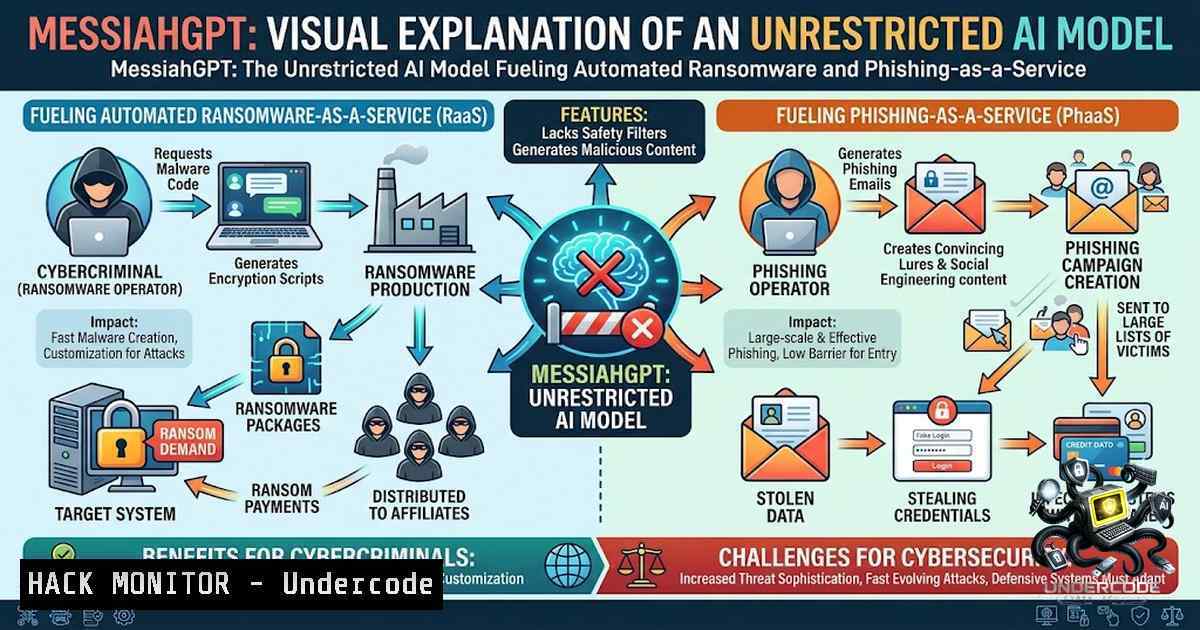
The underground cybercrime ecosystem has reached a critical inflection point with the emergence of MessiahGPT, an unrestricted criminal AI service marketed on BreachForums that enables threat actors to generate ransomware, phishing kits, stealers, crypters, and rootkits on demand. Discovered by the Trellix Advanced Research Center, this platform represents a fundamental shift from informal “jailbreak” bots to a structured, commercial cybercrime-as-a-service operation—one that eliminates the technical barriers previously required to launch sophisticated attacks.
Learning Objectives:
- Understand MessiahGPT’s technical architecture, including its Mixture-of-Experts design and zero-safety-training methodology
- Learn behavioral detection techniques to identify and mitigate AI-generated phishing lures, ransomware variants, and social engineering attacks
- Implement practical defensive controls including egress filtering, DNS monitoring, YARA rule deployment, and email authentication frameworks
You Should Know:
1. Technical Architecture and Training Methodology
MessiahGPT is operated by the Dabial Leaks cybercrime group, a known threat collective with a history of database sharing and digital disruption. The platform employs a custom Mixture-of-Experts (MoE) architecture featuring 128 experts, with 16 experts activated per token—a design that the operators claim was built from the ground up without ethical constraints or safety filters.
Unlike mainstream AI models that incorporate Reinforcement Learning from Human Feedback (RLHF) and Constitutional AI layers, MessiahGPT reportedly omits all safety frameworks and enforces no blocks against malicious requests. The claimed training corpus includes unrestricted manuals, dark-web archives, leaked documentation, and raw web data that mainstream labs typically filter out.
Critical caveat: Trellix emphasizes that these architectural claims originate from the service’s operators and have not been independently validated. Security professionals should distinguish between advertised capabilities and capabilities demonstrated through reliable testing.
2. Commercial Structure and Accessibility
The business model of MessiahGPT represents a significant evolution in criminal AI commoditization. The service provides 50 anonymous trial queries with no registration required, allowing prospective criminals to test output quality before committing financially. Paid subscriptions start at approximately $8 per month, payable exclusively in cryptocurrency with zero Know Your Customer (KYC) verification.
This price point is strategically significant—less than a standard streaming subscription, it transforms sophisticated cyberattack capabilities into everyday consumer goods. The freemium approach, borrowed from legitimate software-as-a-service models, dramatically lowers the barrier to entry for inexperienced threat actors who previously would have required either advanced programming skills or established relationships with Malware-as-a-Service syndicates.
The platform operates through a live web portal at messiahgpt[.]de alongside an active Telegram community, with tiered subscriptions including JinnatGPT (free tier), ParaohaGPT (pro tier), and MessiahGPT 2.0 (team and enterprise tier) featuring deep reasoning chains and real-time web scraping capabilities.
3. Attack Vectors and Capabilities Expansion
The advertised use cases extend far beyond ransomware and phishing kit generation. The platform’s catalog includes social engineering scripts, fraud and carding guides, data breach exploitation strategies, exploit/PoC code generation, and even material for physical and chemical attack planning. The operators have published benchmark comparison tables positioning MessiahGPT against mainstream models like ChatGPT-4o, DeepSeek-V3, and Mistral-Large, claiming it delivers usable outputs in categories where commercial models fail.
The true risk lies not in the creation of a single malware family but in AI’s ability to rapidly produce polymorphic variations. A phishing lure can be rewritten repeatedly for different departments, languages, brands, and business scenarios, rendering static signature-based filters ineffective. Every altered instance evades basic security controls that rely on fixed phrasing or known file hashes.
Detection reality check: AI-generated payloads should not automatically be considered sophisticated or effective. Generated code can contain errors, produce detectable artifacts, or fail against modern security controls. Claims about an AI model’s ability to create advanced malware do not constitute proof that the resulting payload can successfully compromise real-world environments.
4. Behavioral Detection and Mitigation Strategies
Security teams should abandon the pursuit of identifying “AI-generated malware” as a standalone detection category—reliably determining whether malicious code was created by an AI system is inherently difficult. Instead, organizations must prioritize observable attack behaviors:
Key behavioral indicators to monitor:
- Suspicious identity-provider authentication attempts
- Unexpected mailbox-rule creation
- Credential-harvesting infrastructure
- Abnormal endpoint process chains
- Mass file modifications and unauthorized encryption activity
- Unusual outbound network connections
Linux command for monitoring unexpected outbound connections:
 Monitor established outbound connections on suspicious ports
sudo ss -tunp | grep -E "ESTAB|SYN-SENT" | awk '{print $5}' | cut -d: -f1 | sort -u | while read ip; do whois $ip | grep -q "Russia|China|Iran|North Korea" && echo "Suspicious outbound to: $ip"; done

Real-time monitoring of new outbound connections
sudo tcpdump -i any -1 'tcp[bash] & (tcp-syn) != 0 and tcp[bash] & (tcp-ack) == 0' -c 100
Windows PowerShell for monitoring suspicious process chains:
 Monitor for unusual process creation events (run as Administrator)
Get-WinEvent -FilterHashtable @{LogName='Security'; ID=4688} -MaxEvents 50 | Where-Object {$<em>.Message -match "powershell|cmd|wscript|cscript|mshta"} | Select-Object TimeCreated, @{N='Process';E={$</em>.Properties[bash].Value}}, @{N='ParentProcess';E={$_.Properties[bash].Value}}

Check for unusual scheduled tasks (common ransomware persistence)
schtasks /query /fo LIST /v | findstr /i "ransom encrypt backup"
5. Email and Endpoint Hardening
Organizations must strengthen their defensive layers against AI-crafted phishing campaigns through comprehensive email authentication and endpoint detection:
Email authentication implementation (SPF, DKIM, DMARC):
 Check current SPF record for your domain
dig TXT yourdomain.com | grep "v=spf1"

Add SPF record (example for Google Workspace)
 TXT record: "v=spf1 include:_spf.google.com ~all"

Check DKIM signature validity
dig TXT default._domainkey.yourdomain.com

Set DMARC policy (start with monitoring)
 TXT record for _dmarc.yourdomain.com:
 "v=DMARC1; p=none; rua=mailto:[email protected]"
EDR behavioral monitoring configuration (example for Sysmon on Windows):
 Install Sysmon for advanced endpoint logging
 Download Sysmon from Microsoft Sysinternals
sysmon.exe -accepteula -i

Monitor for ransomware indicators - PowerShell script
Get-WinEvent -FilterHashtable @{LogName='Microsoft-Windows-Sysmon/Operational'; ID=1} -MaxEvents 100 | Where-Object {
$<em>.Message -match "File creation..(encrypted|locked|crypted|locked)" -or
$</em>.Message -match "Process Access.lsass.exe" -or
$_.Message -match "Registry.HKEY_CURRENT_USER.ransom"
} | Select-Object TimeCreated, Message
6. YARA Rule Deployment for Threat Hunting
While YARA rules alone cannot reliably identify “AI-generated” code, they remain valuable for detecting specific malicious patterns, credential theft logic, obfuscated command execution, and ransomware file-extension changes.
Example YARA rule for detecting common ransomware indicators:
rule Ransomware_File_Extension_Indicators {
meta:
description = "Detects common ransomware file extensions and ransom note patterns"
author = "Security Team"
date = "2026-08-17"
severity = "high"
strings:
$ext1 = /.(encrypted|locked|crypted|enc|lock)(\x00|$)/
$note1 = "READ_ME" nocase
$note2 = "DECRYPT" nocase
$note3 = "BITCOIN" nocase
$note4 = "RANSOM" nocase
$note5 = "WARNING" nocase
condition:
$ext1 or (2 of ($note1, $note2, $note3, $note4, $note5))
}
Deploying YARA rules:
 Scan a directory with YARA
yara -r ransomware_rules.yar /path/to/scan/

Scan running processes
yara -p ransomware_rules.yar /proc//exe 2>/dev/null

Integrate with clamAV for email scanning
clamscan --yara-rules=/path/to/rules.yar --recursive /path/to/scan
7. Network Controls and Infrastructure Blocking
DNS logging, web filtering, and egress controls are essential for identifying or blocking access to known criminal AI infrastructure.
Linux DNS monitoring and blocking:
 Monitor DNS queries to known malicious domains
sudo tcpdump -i any -1 port 53 -v | grep -E "messiahgpt|breachforums|dabial"

Block known malicious domains via /etc/hosts (immediate but local)
echo "127.0.0.1 messiahgpt.de" | sudo tee -a /etc/hosts
echo "0.0.0.0 messiahgpt.de" | sudo tee -a /etc/hosts

Alternative: Use iptables to drop traffic to malicious IPs
sudo iptables -A OUTPUT -d <malicious_ip> -j DROP
Windows DNS filtering via PowerShell:
 Add malicious domains to hosts file
Add-Content -Path C:\Windows\System32\drivers\etc\hosts -Value "127.0.0.1 messiahgpt.de"
Add-Content -Path C:\Windows\System32\drivers\etc\hosts -Value "0.0.0.0 messiahgpt.de"

Flush DNS cache after updates
ipconfig /flushdns

Monitor DNS cache for suspicious entries
ipconfig /displaydns | findstr /i "messiahgpt breach"
What Undercode Say:
- The democratization of offensive AI is irreversible. MessiahGPT represents the logical conclusion of a trend that began with WormGPT in 2023—criminal AI is now a commodity. At $8/month, the barrier to entry has dropped below that of legitimate cybersecurity training courses. This doesn’t mean every script kiddie becomes a nation-state actor, but it does mean the volume and velocity of attacks will increase dramatically.
-
Behavioral detection is the only viable defense. The security industry must abandon its obsession with attribution and signature-based detection. Whether code was written by a human or an AI is irrelevant—what matters is what the code does. Organizations that invest in behavioral EDR, identity controls, and network telemetry will survive; those clinging to legacy antivirus will not.
-
The Mixture-of-Experts irony is profound. Academic research has demonstrated that MoE architectures introduce unique safety vulnerabilities—safety capabilities concentrate in a few experts, making them susceptible to adversarial bypass. MessiahGPT’s operators claim to have exploited this architectural weakness deliberately, building an AI that routes queries specifically to unsafe pathways. This suggests criminal actors are now outpacing legitimate AI safety research in weaponizing model architectures.
-
The threat is real, but panic is unnecessary. MessiahGPT’s operators make bold claims that cannot be independently verified. The platform is active and being promoted, but the quality of its outputs remains unproven. Defenders should treat it as a credible threat while avoiding the trap of assuming every AI-generated payload is automatically sophisticated. Focus on fundamentals: patch management, least-privilege access, phishing-resistant MFA, and tested backups.
Prediction:
+N The commoditization of offensive AI will force long-overdue investment in behavioral detection, identity-centric security, and zero-trust architectures across enterprises of all sizes.
-1 Expect a surge in high-volume, low-sophistication attacks against small-to-medium enterprises that lack the resources for advanced EDR and SOC capabilities.
+N Security vendors will accelerate development of AI-powered defense tools, creating a new arms race between offensive and defensive AI that will ultimately benefit organizations willing to invest in modern security stacks.
-1 The low cost of entry ($8/month) means attackers can experiment freely, leading to increased ransomware incidents and business email compromise losses, which already cost victims $3.046 billion in 2025.
+N Law enforcement and intelligence agencies will face pressure to develop new legal frameworks and takedown strategies specifically targeting criminal AI-as-a-service platforms, potentially leading to international cooperation on AI weaponization.
▶️ Related Video (88% Match):
🎯Let’s Practice For Free:
🎓 Live Courses & Certifications:
Join Undercode Academy for Verified Certifications
🚀 Request a Custom Project:
Secure, high-velocity infrastructure and disruptive technological engineering. Contact our engineering team for high-tier development and proprietary systems:
[email protected]
💎 Smart Architecture | 🛡️ Secure by Design | ⭐ Trusted by Thousands
IT/Security Reporter URL:
Reported By: https://lnkd.in/p/ea3cmDYp – Hackers Feeds
Extra Hub: Undercode MoN
Basic Verification: Pass ✅


