Listen to this Post
Introduction:
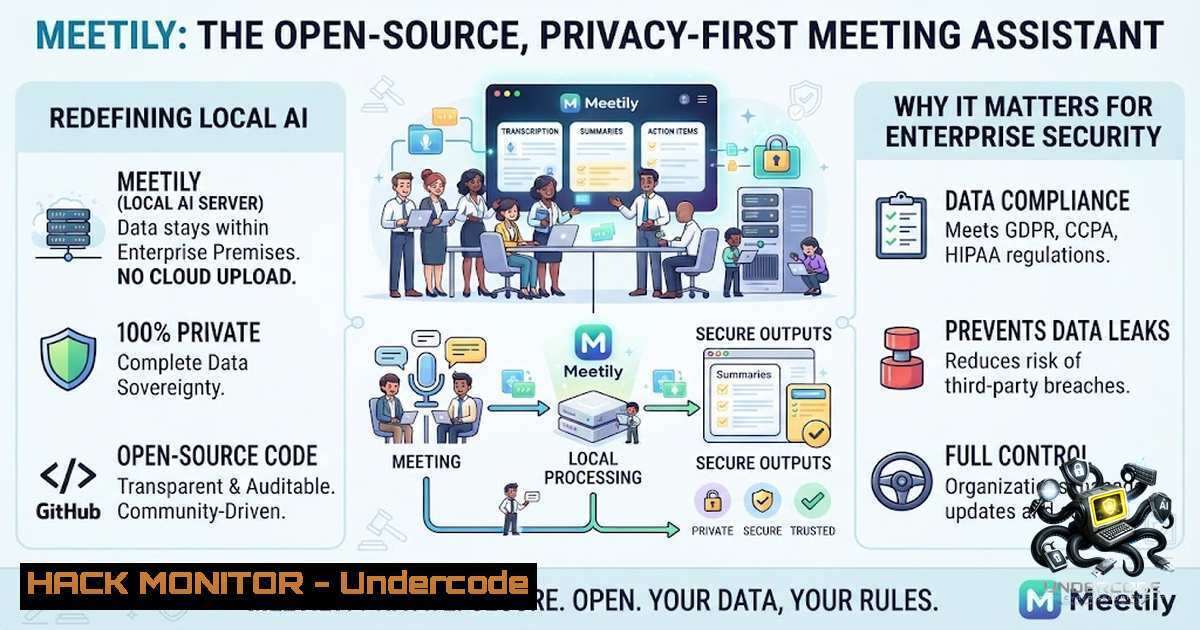
The enterprise AI landscape is witnessing a paradigm shift as organizations grapple with the tension between AI-powered productivity and data sovereignty. Meetily, a newly launched open-source meeting assistant built on Rust and Tauri, addresses this head-on by offering 100% local processing for transcription and summarization. In an era where cloud-based AI tools expose sensitive corporate discussions to potential breaches and compliance violations, Meetily represents a critical advancement in privacy-first technology.
Learning Objectives:
- Understand the architecture and privacy implications of local-first AI meeting assistants
- Master the deployment and configuration of Meetily across macOS, Windows, and Linux environments
- Learn to optimize local LLM inference using GPU acceleration (Metal, CUDA, Vulkan) and Ollama integration
You Should Know:
- Why Local AI Processing Is a Security Imperative, Not Just a Feature
The core value proposition of Meetily lies in its uncompromising approach to data privacy. Unlike traditional meeting tools like Otter.ai or Granola.ai that transmit audio to the cloud, Meetily processes everything on your local hardware. This isn’t merely a convenience feature—it’s a security necessity. With the average cost of a data breach reaching $4.4 million and GDPR fines surpassing €5.88 billion, organizations can no longer afford to route sensitive boardroom discussions through third-party servers. Meetily’s architecture ensures that audio never leaves your machine, with transcription handled locally via Whisper or Parakeet models and summarization routed through Ollama or custom OpenAI-compatible endpoints. The project’s privacy policy explicitly states: “You own all meeting data, transcripts, and recordings”—a stark contrast to the opaque data practices of most SaaS providers.
- Technical Deep Dive: GPU-Accelerated Transcription and System Architecture
Meetily’s technical foundation is what sets it apart from Electron-based alternatives. Built with Tauri (Rust) for the backend and Next.js for the frontend, the application achieves near-1ative performance with a fraction of the memory footprint. The audio pipeline captures raw PCM streams directly from CoreAudio (macOS), WASAPI (Windows), or ALSA (Linux). Transcription leverages Parakeet ONNX models running natively on Metal (M-series Macs), CUDA (NVIDIA GPUs), or Vulkan (AMD/Intel). The build system automatically detects your hardware and compiles the appropriate backend—no manual configuration required.
For organizations concerned about summarization quality, Meetily offers flexible LLM integration. You can run Ollama locally for完全 offline operation, or connect to OpenAI-compatible endpoints like Claude, Groq, or OpenRouter. This hybrid approach allows teams to balance privacy with performance: sensitive meetings stay local, while less critical sessions can leverage cloud models for enhanced summarization quality.
3. Step-by-Step Installation and Configuration Guide
Deploying Meetily is straightforward, though users should be aware of the hardware requirements for optimal performance.
For macOS (Apple Silicon):
 Clone the repository
git clone https://github.com/Zackriya-Solutions/meetily.git
cd meetily

Install dependencies
brew install node rust
cargo install tauri-cli

Build with Metal acceleration
./scripts/build-gpu.sh  Auto-detects Metal backend
cargo build --release --features metal
pnpm install
pnpm run tauri build
For Windows (NVIDIA GPU):
 Ensure NVIDIA drivers and CUDA toolkit are installed
 Build with CUDA support
.\scripts\build-gpu.ps1  Auto-detects CUDA
cargo build --release --features cuda
pnpm install
pnpm run tauri build
For Linux (AMD/Intel GPU):
 Install Vulkan drivers
sudo apt install vulkan-tools libvulkan-dev

Build with Vulkan backend
./scripts/build-gpu.sh  Auto-detects Vulkan
cargo build --release --features vulkan
pnpm install
pnpm run tauri build
Ollama Integration:
 Install Ollama
curl -fsSL https://ollama.com/install.sh | sh

Pull a model (e.g., Llama 3.2)
ollama pull llama3.2:3b

Configure Meetily to use Ollama
 In Settings → AI Provider → Select "Ollama" → Set endpoint to http://localhost:11434
For systems unable to handle local summarization, you can route to an external OpenAI-compatible endpoint while keeping transcription local—a pragmatic compromise that preserves privacy for the most sensitive data (the raw audio and transcript).
4. Advanced Features: Speaker Diarization and Multi-Language Support
Meetily’s speaker diarization goes beyond simple voice clustering, employing embedding vectors combined with temporal modeling to accurately distinguish between participants. This is particularly valuable for enterprise meetings where multiple stakeholders contribute. The latest Pro version (1.1.1) introduces support for 98 languages, with language-aware summaries that automatically generate output in the meeting’s primary language. For multilingual teams, this means German meetings produce German summaries, French meetings produce French summaries—without manual configuration.
The import and enhance feature allows users to re-transcribe existing audio files with improved models, making it possible to upgrade transcript quality retroactively. This is especially useful for organizations migrating from cloud-based solutions who want to bring historical meeting data under local control.
5. Security Considerations and Compliance Implications
From a security perspective, Meetily’s local-first approach addresses multiple compliance requirements simultaneously. For HIPAA-covered entities, the ability to process protected health information entirely on-device eliminates the need for complex BAA agreements with cloud providers. For organizations subject to GDPR, the absence of data transfers to third countries removes a major compliance hurdle. The MIT license ensures complete code transparency, allowing security teams to audit every line.
However, organizations should note that routing summarization to external endpoints (e.g., Claude, Groq) reintroduces some cloud dependencies. As one commenter noted: “No cloud dependency until someone routes summarization to an OpenAI-compatible endpoint because the local GPU can’t keep up. That’s the line to watch on the privacy claim”. For maximum privacy, organizations should invest in adequate local hardware (at minimum, an M-series Mac or NVIDIA GPU with 8GB+ VRAM) to run Ollama models locally.
6. Troubleshooting and Performance Optimization
Common issues and their solutions:
- GPU not detected: Ensure drivers are installed and run `nvidia-smi` (NVIDIA) or `vulkaninfo` (Vulkan) to verify.
- Poor transcription accuracy: Switch to a larger Whisper model or adjust the language setting.
- Summarization quality: Use a larger Ollama model (e.g., Llama 3.2 7B instead of 3B) or enable GPU acceleration for Ollama.
- Audio capture issues on Windows: Check that the correct input device is selected in system settings; Meetily v0.0.3 specifically addressed Windows audio capture issues.
For real-time performance, the project recommends at least 8GB RAM and a dedicated GPU. The build system’s `build-gpu.sh` script handles hardware detection automatically, but users can force specific backends using Cargo features.
What Undercode Say:
- Local AI Is the Future of Enterprise Security: Meetily demonstrates that high-quality AI meeting assistance doesn’t require cloud dependency. The project’s 10,000+ GitHub stars and 900+ forks signal a massive appetite for privacy-preserving AI tools. Organizations that delay adopting local-first solutions risk both security breaches and compliance penalties.
-
The Hybrid Model Is a Pragmatic Compromise: While fully local operation is ideal for sensitive meetings, the ability to route summarization to external endpoints provides flexibility for less critical sessions. This dual-mode approach allows organizations to scale AI capabilities without compromising on privacy where it matters most.
Analysis: Meetily’s emergence reflects a broader trend in enterprise AI: the realization that convenience cannot come at the cost of data sovereignty. The project’s technical excellence—Rust’s memory safety, Tauri’s lightweight footprint, and multi-backend GPU support—positions it as a serious alternative to established cloud players. However, the hardware barrier remains significant; organizations with older machines may struggle with local LLM inference, potentially forcing them into the hybrid model that reintroduces some cloud dependencies. The project’s rapid development cycle (233 commits in one release) suggests active maintenance, but enterprises should evaluate the 137 open issues before production deployment. The true test will be whether Meetily can sustain its momentum and build the ecosystem needed to challenge incumbents like Otter.ai and Microsoft Teams’ transcription features.
Prediction:
+1 Meetily will accelerate the commoditization of local AI inference, forcing major cloud providers to offer on-premise or hybrid deployment options for their meeting intelligence products within 18–24 months.
+1 The project’s success will inspire a new wave of privacy-first enterprise tools across adjacent domains—email summarization, document processing, and customer call analysis—all built on similar local-first architectures.
-1 Without sustainable funding or a clear monetization path (the Pro version is a start), Meetily risks becoming another abandoned open-source project, leaving enterprises that adopted it scrambling for alternatives.
+1 Regulatory pressure (GDPR, HIPAA, China’s PIPL) will increasingly mandate local processing for sensitive data, making Meetily’s architecture a template for compliance-ready AI solutions.
-1 The hardware gap between high-end workstations and standard enterprise laptops will create a two-tier system where only well-funded teams can fully benefit from local AI, potentially exacerbating the digital divide within organizations.
▶️ Related Video (72% Match):
🎯Let’s Practice For Free:
🎓 Live Courses & Certifications:
Join Undercode Academy for Verified Certifications
🚀 Request a Custom Project:
Secure, high-velocity infrastructure and disruptive technological engineering. Contact our engineering team for high-tier development and proprietary systems:
[email protected]
💎 Smart Architecture | 🛡️ Secure by Design | ⭐ Trusted by Thousands
IT/Security Reporter URL:
Reported By: Charlywargnier I – Hackers Feeds
Extra Hub: Undercode MoN
Basic Verification: Pass ✅


