
Listen to this Post
Introduction:
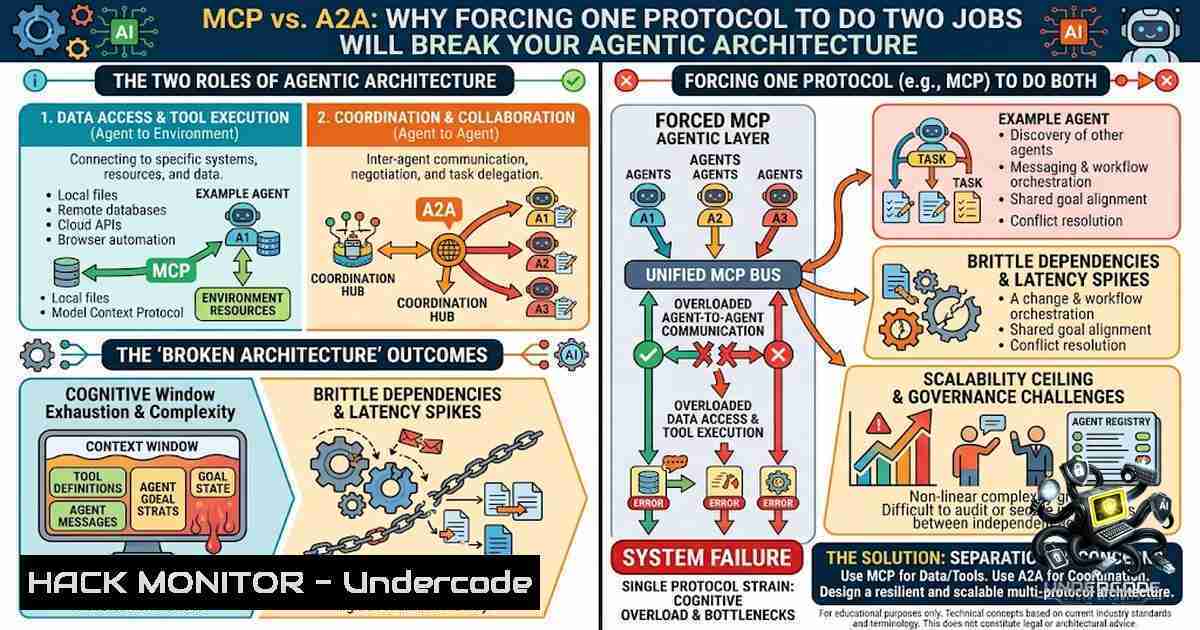
The rapid adoption of agentic AI has introduced two critical protocols—Model Context Protocol (MCP) and Agent-to-Agent (A2A)—that serve fundamentally different purposes. Yet many architects collapse them into a single communication channel, creating systems that fail at scale. Understanding when to reach down for capabilities versus when to reach across to peers is the difference between a resilient agentic system and a brittle one that breaks exactly where you stopped drawing the line.
Learning Objectives:
- Distinguish between MCP (vertical tool invocation) and A2A (horizontal peer coordination) and apply each correctly in agentic architectures
- Map the four-layer agentic topology to the appropriate protocol for each boundary
- Implement secure, scalable agentic systems using both protocols in complementary layers
- Avoid common architectural failures that arise from protocol misuse
You Should Know:
- The Vertical-Horizontal Split: Reaching Down vs. Reaching Across
The core insight from David Matousek’s protocol stack analysis is that reaching down to capabilities and reaching across to peers are different problems that require different protocols. Method calls and message passing represent the same line object-oriented programmers spent thirty years learning to draw, now redrawn one layer up in agentic systems.
Model Context Protocol (MCP) defines a client-server architecture in which an AI model discovers and invokes tools, reads resources, and receives notifications from MCP servers. MCP is how an agent reaches down to the capabilities it depends on—the databases it queries, the files it reads, the tools it invokes. It standardizes how LLM agents securely discover, invoke, and interact with enterprise tools, APIs, and data services.
Agent-to-Agent (A2A) enables seamless communication and collaboration between AI agents across different frameworks, vendors, and platforms. A2A is how an agent reaches across to a peer that has its own context and its own way of working. It provides the definitive common language for agent interoperability in a world where agents are built using diverse frameworks.
The topology tells you what your system is. The protocol stack tells you how the layers actually move work between each other.
Step-by-Step Implementation Guide:
To implement this split correctly:
- Identify the boundary type: Determine whether communication flows vertically (agent to tool/resource) or horizontally (agent to peer agent)
- Select the protocol: Use MCP for vertical tool invocation; use A2A for horizontal peer coordination
3. Map the four-layer topology:
- Orchestrator to agent → A2A
- Agent to tool → MCP
- Agent to peer → A2A
- Subagent → No protocol (ephemeral)
- Skill → No wire (lives inside the agent)
- Never collapse the two: Forcing a peer-coordination problem through a tool-invocation pipe breaks the architecture
-
The Failure Modes: What Happens When You Collapse the Stack
The collapse shows up two ways in production:
Failure Mode 1: Push peer coordination through MCP
When you force peer coordination through MCP, the agent on the other side must pretend it is a stateless tool, throwing away the context that made it worth calling. MCP tools are designed to be model-controlled, where the language model discovers and invokes tools automatically. They are not designed for bidirectional, stateful peer conversations. Each invocation goes through the model—you cannot pipe one MCP tool’s output into another or script them without an LLM in the loop.
Failure Mode 2: Push tool access through A2A
Push tool access through A2A and every database read inherits a full task lifecycle it never needed. A2A introduces task-centric communication with well-defined lifecycle states (submitted, working, completed, failed). Databases don’t need task lifecycles—they need simple queries.
The Org Chart Analogy
The org chart already solved this problem. Nobody walks into another department’s database to pull a record, and nobody coordinates a project by writing a query. Your agents need the same two channels.
Verification Commands:
To audit your agentic system for protocol misuse:
Linux/macOS (checking MCP server endpoints):
 Test if an MCP server is exposing tools correctly
curl -X POST http://localhost:8080/mcp \
-H "Content-Type: application/json" \
-d '{"jsonrpc":"2.0","method":"tools/list","id":1}'

Check for A2A agent card discovery
curl http://localhost:8081/.well-known/agent-card.json | jq '.'
Windows (PowerShell):
 Test MCP tools/list
Invoke-RestMethod -Uri "http://localhost:8080/mcp" `
-Method Post `
-ContentType "application/json" `
-Body '{"jsonrpc":"2.0","method":"tools/list","id":1}'

Check A2A agent card
Invoke-RestMethod -Uri "http://localhost:8081/.well-known/agent-card.json" | ConvertFrom-Json
3. The Four-Layer Topology: Mapping Protocols to Boundaries
Agentic systems typically follow a four-layer architecture. Matousek’s mapping provides clear protocol assignments for each boundary:
| Boundary | Protocol | Rationale |
|-|-|–|
| Orchestrator → Agent | A2A | Peer coordination with task delegation |
| Agent → Tool | MCP | Tool invocation and resource access |
| Agent → Peer Agent | A2A | Horizontal collaboration |
| Subagent | None | Ephemeral, no persistent protocol needed |
| Skill | None | Lives inside the agent like a method body |
Step-by-Step Architecture Design:
- Layer 1 – Reasoning (LLM): Plans, critiques, decides which tools to call
- Layer 2 – Orchestration: Manages execution flow, uses A2A to coordinate with other agents
- Layer 3 – Tool Bus: Uses MCP for tool discovery and invocation
- Layer 4 – Adapters: Connect to external systems via MCP
For each layer, ask: “Is this reaching down or reaching across?” The answer determines your protocol.
4. Security Implications of Protocol Separation
Because A2A and MCP operate at different layers, each has distinct security implications:
MCP Security Considerations:
- Tools represent arbitrary code execution and must be treated with appropriate caution
- Tool descriptions and annotations should be considered untrusted unless obtained from a trusted server
- Hosts must obtain explicit user consent before invoking any tool
- MCP uses a JSON-RPC protocol with `tools/list` and `tools/call` methods for tool discovery and invocation
A2A Security Considerations:
- Agents publish Agent Cards advertising capabilities and endpoints
- Agents communicate while preserving privacy and proprietary internal processes
- Authentication and authorization must be implemented at the agent level
- Task delegation requires proper identity verification
Security Hardening Commands:
Linux/macOS (restrict MCP tool permissions):
 Set up MCP server with tool-level access control
 Create a tool policy file
cat > /etc/mcp-tool-policy.json << EOF
{
"tools": {
"database_query": { "allowed_roles": ["analyst"] },
"file_read": { "allowed_roles": ["admin"] },
"api_call": { "allowed_roles": ["user"] }
}
}
EOF

Run MCP server with policy enforcement
mcp-server --policy /etc/mcp-tool-policy.json --port 8080
Windows (PowerShell – implement A2A agent authentication):
 Generate an API key for A2A agent authentication
$apiKey = [bash]::ToBase64String([System.Text.Encoding]::UTF8.GetBytes((New-Guid).ToString()))
Write-Host "A2A Agent API Key: $apiKey"

Store in environment variable for A2A server
[bash]::SetEnvironmentVariable("A2A_API_KEY", $apiKey, "Machine")
- When to Use MCP vs. A2A: Practical Decision Framework
The industry consensus is clear: these are not competing standards—they are complementary layers in a scalable agent system.
Use MCP when:
- An agent must interface with a tool, database, or service that expects a fixed input/output format
- You need to expose tools that can be invoked by language models
- You’re connecting an AI model to external data sources and tools
- You want to standardize AI integrations with enterprise systems
Use A2A when:
- Agents need to negotiate, collaborate, or share varied types of information
- You’re orchestrating multiple autonomous agents that coordinate as peers
- You need capability discovery and task delegation across agent boundaries
- You’re building distributed multi-agent systems with different frameworks
Real-World Workflow Example:
A planner agent reaches out to other agents via A2A, which in turn uses MCP to fetch tools. Separating tool integration from agent orchestration logic makes your system more secure and easier to maintain.
Architecture Verification Script (Python):
 Verify your agentic architecture follows the protocol split
import json

def validate_agent_architecture(agent_config):
"""Validate that MCP and A2A are used correctly."""
errors = []

for agent in agent_config.get('agents', []):
 Check: Does an agent use MCP for peer communication?
if agent.get('type') == 'peer' and agent.get('protocol') == 'MCP':
errors.append(f"Agent {agent['name']} uses MCP for peer coordination - should use A2A")

Check: Does a tool use A2A?
if agent.get('type') == 'tool' and agent.get('protocol') == 'A2A':
errors.append(f"Tool {agent['name']} uses A2A - should use MCP")

return errors

Example configuration
config = {
"agents": [
{"name": "orchestrator", "type": "peer", "protocol": "A2A"},
{"name": "database_tool", "type": "tool", "protocol": "MCP"},
{"name": "research_agent", "type": "peer", "protocol": "A2A"}
]
}

print(validate_agent_architecture(config))  Returns empty list if correct
6. Enterprise Deployment: Running Both Protocols at Scale
Enterprises are deploying MCP at scale and hitting gaps the protocol does not yet address. Streamable HTTP gave MCP a production-ready transport, but running it at scale has revealed gaps around horizontal scaling, stateless operation, and middleware patterns.
Production Deployment Checklist:
1. MCP Server Configuration:
- Implement tool discovery with `tools/list`
– Handle tool invocation with `tools/call`
– Use JSON-RPC for predictable request/response patterns
2. A2A Server Configuration:
- Publish Agent Cards for capability discovery
- Implement task lifecycle management (submitted, working, completed, failed)
- Support streaming for long-running tasks
3. Infrastructure:
- Deploy A2A for inter-agent communication as scalable microservices
- Use MCP for tool integration within each agent
- Layer protocols thoughtfully: A2A for orchestration, MCP for execution
Kubernetes Deployment Example:
 MCP Server Deployment
apiVersion: apps/v1
kind: Deployment
metadata:
name: mcp-tool-server
spec:
replicas: 3
selector:
matchLabels:
app: mcp-tool
template:
metadata:
labels:
app: mcp-tool
spec:
containers:
- name: mcp-server
image: mcp-server:latest
ports:
- containerPort: 8080
env:
- name: MCP_TOOL_POLICY
value: "/etc/mcp-policy.json"

A2A Agent Service
apiVersion: v1
kind: Service
metadata:
name: a2a-agent-service
spec:
selector:
app: a2a-agent
ports:
- port: 8081
targetPort: 8081
What Undercode Say:
- Key Takeaway 1: MCP and A2A are not competing standards—they are complementary layers addressing different problems in agentic systems. MCP handles vertical integration (agent to tools/data), while A2A handles horizontal orchestration (agent to agent). Collapsing them into one protocol creates systems that fail at the boundary where you stopped drawing the line.
-
Key Takeaway 2: The four-layer topology provides a clear mapping for protocol selection. Orchestrator-to-agent and agent-to-peer boundaries require A2A for proper coordination. Agent-to-tool boundaries require MCP for stateless, predictable tool invocation. Subagents and skills need no protocol at all—they are ephemeral or internal.
Analysis:
David Matousek’s protocol stack analysis arrives at a critical moment in agentic AI adoption. As organizations rush to deploy multi-agent systems, the temptation to simplify by using one protocol for everything is strong but dangerous. The analogy to object-oriented programming’s method call vs. message passing distinction is apt—developers spent decades learning when to use each. Agentic systems require the same discipline one layer up.
The security implications are particularly significant. MCP tools can execute arbitrary code and require explicit user consent. A2A agents must authenticate and authorize peer requests. Mixing these security models creates vulnerabilities: a tool invoked through A2A might inherit unnecessary lifecycle permissions, while peer coordination through MCP strips away the context needed for proper authorization.
The industry is moving toward a clear consensus: use MCP for tools, use A2A for agents. Organizations that adopt this split early will build more resilient, scalable, and secure agentic systems. Those that collapse the stack will debug failures exactly where they stopped drawing the line.
Prediction:
- +1 The clear separation of MCP (vertical) and A2A (horizontal) will become a standard architectural pattern, reducing integration complexity and enabling more sophisticated multi-agent workflows across enterprises.
-
+1 As MCP addresses gaps around horizontal scaling and stateless operation, and A2A continues to gain adoption with over 150 organizations already committed, the two protocols will form the foundation of the agentic AI stack for years to come.
-
-1 Organizations that fail to distinguish between reaching down (MCP) and reaching across (A2A) will experience production failures, security incidents, and scaling bottlenecks that could have been avoided with proper protocol separation.
-
+1 The Linux Foundation’s alignment of both protocols ensures long-term stability and interoperability, making early investment in proper architecture a strategic advantage.
-
-1 The rapid adoption of MCP compared to A2A’s slower burn may lead some organizations to over-invest in MCP for all communication needs, creating technical debt that will be expensive to refactor later.
▶️ Related Video (76% Match):
https://www.youtube.com/watch?v=2LJ4f7s5hjE
🎯Let’s Practice For Free:
🎓 Live Courses & Certifications:
Join Undercode Academy for Verified Certifications
🚀 Request a Custom Project:
Secure, high-velocity infrastructure and disruptive technological engineering. Contact our engineering team for high-tier development and proprietary systems:
[email protected]
💎 Smart Architecture | 🛡️ Secure by Design | ⭐ Trusted by Thousands
IT/Security Reporter URL:
Reported By: Davidmatousek Do – Hackers Feeds
Extra Hub: Undercode MoN
Basic Verification: Pass ✅


