Listen to this Post
Introduction:
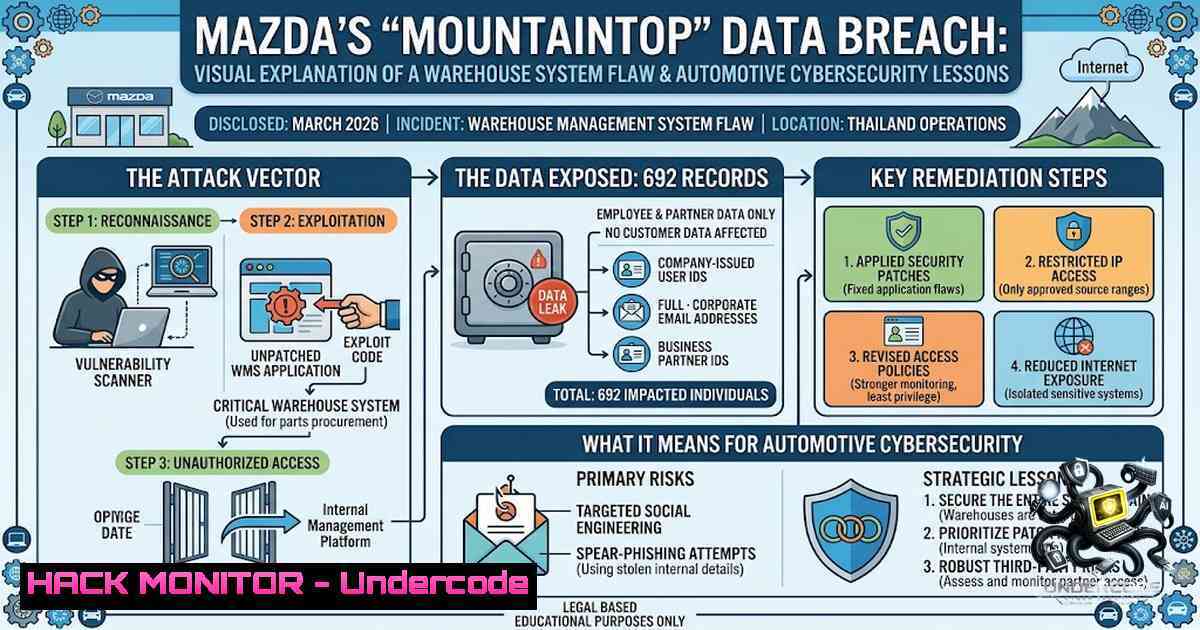
In late 2025, Japanese automotive giant Mazda Motor Corporation detected unauthorized external access to a warehouse management system tied to parts procured from Thailand. The incident, which exposed 692 records containing employee and business partner data—including user IDs, full names, email addresses, company names, and partner IDs—was only publicly disclosed in March 2026 after regulatory reporting and forensic investigation. While no customer data was compromised and no ransomware was confirmed, the breach underscores a critical reality: operational systems, often overlooked in favor of customer-facing applications, represent a growing attack surface that threat actors are actively exploiting.
Learning Objectives:
- Understand the technical mechanics of how an unpatched warehouse management system vulnerability can lead to data exfiltration
- Identify common attack vectors—SQL injection, authentication bypass, and insecure API configurations—used to compromise operational systems
- Apply practical hardening measures across Linux, Windows, and cloud environments to prevent similar supply chain–related breaches
- The Vulnerability Landscape: Unpatched Systems in Operational Technology
Mazda’s breach originated from a vulnerability in a system used for warehouse operations—a classic example of how legacy or poorly maintained internal applications become entry points for attackers. According to Mazda’s investigation, the attackers exploited security weaknesses that allowed unauthorized external access. While the company did not specify the exact vulnerability type, industry analysis points to likely techniques including SQL injection, authentication bypass, or insecure direct object references (IDOR) in the application layer.
How Attackers Exploit Warehouse Management Systems
Modern warehouse management systems (WMS) often expose web interfaces, APIs, and database connections to facilitate supply chain integration. When these components are left unpatched or misconfigured, they become prime targets:
- SQL Injection (SQLi): Attackers inject malicious SQL queries through input fields to dump database contents, including user credentials and PII.
- Authentication Bypass: Weak session management or default credentials allow attackers to access administrative functions without proper authorization.
- IDOR Vulnerabilities: Sequential or predictable record identifiers (e.g.,
?id=123) enable attackers to enumerate and access records belonging to other users.
Step‑by‑Step: Testing for SQL Injection in a Web Application
Linux (using `sqlmap`):
 Identify a vulnerable parameter (e.g., 'id')
sqlmap -u "http://target-wms.example.com/part?id=123" --batch --dump
This command automates detection and exploitation of SQL injection vulnerabilities, dumping database contents if successful.
Windows (using `sqlmap` via Python):
python sqlmap.py -u "http://target-wms.example.com/part?id=123" --batch --dump
Mitigation – Input Validation and Parameterized Queries (Python Example):
 Vulnerable code (DO NOT USE)
cursor.execute("SELECT  FROM parts WHERE id = " + request.GET['id'])

Secure code (use parameterized queries)
cursor.execute("SELECT  FROM parts WHERE id = %s", (request.GET['id'],))
- Supply Chain Risks: When Third‑Party Integration Becomes an Attack Vector
Mazda’s breach specifically targeted a system managing parts sourced from Thailand. This highlights a growing trend: attackers are pivoting from direct corporate network attacks to exploiting supply chain–connected systems that may have weaker security postures. In Q1 2026 alone, VicOne recorded 405 cybersecurity incidents across the automotive ecosystem, up from 378 in Q4 2025, with ransomware remaining persistent and EV charging infrastructure incidents more than tripling.
Why Supply Chain Systems Are Vulnerable
- Legacy Integration: Systems connecting to external suppliers often run outdated software with known vulnerabilities.
- Reduced Monitoring: Operational systems are frequently excluded from centralized SIEM monitoring.
- Weak Access Controls: Default or shared credentials are common across supplier portals.
Step‑by‑Step: Hardening Third‑Party API Access
Linux – Restrict API Access with iptables:
 Allow only trusted supplier IP ranges
iptables -A INPUT -p tcp --dport 443 -s 192.168.1.0/24 -j ACCEPT
iptables -A INPUT -p tcp --dport 443 -j DROP
Windows – Configure Windows Firewall via PowerShell:
 Block all inbound traffic to port 443 except trusted IPs
New-1etFirewallRule -DisplayName "Block API except trusted" -Direction Inbound -LocalPort 443 -Protocol TCP -Action Block
 Then add allow rule for specific IP
New-1etFirewallRule -DisplayName "Allow Trusted Supplier" -Direction Inbound -LocalPort 443 -RemoteAddress 192.168.1.0/24 -Protocol TCP -Action Allow
API Key Rotation and Least Privilege (Linux – using `curl` and jq):
 Generate a new API key via management endpoint
curl -X POST https://api-manager.example.com/keys -H "Authorization: Bearer $ADMIN_TOKEN" | jq '.key'
 Revoke old key
curl -X DELETE https://api-manager.example.com/keys/$OLD_KEY_ID -H "Authorization: Bearer $ADMIN_TOKEN"
- Incident Response: What Mazda Did Right (and What You Should Do)
Upon detecting the breach in mid-December 2025, Mazda took several key actions:
- Reported the incident to Japan’s Personal Information Protection Commission.
- Engaged an external specialist organization for forensic investigation.
3. Revised the system to minimize internet communication.
- Restricted access sources and promptly applied security patches.
- Strengthened access monitoring for early detection of suspicious activities.
These steps align with industry best practices for incident response. However, the three‑month gap between detection and public disclosure raises questions about notification timelines—a common tension between forensic thoroughness and transparency.
Step‑by‑Step: Building a Minimal Incident Response Playbook
Linux – Isolate a Compromised System:
 Block all outgoing traffic except to internal monitoring
iptables -A OUTPUT -d 0.0.0.0/0 -j DROP
iptables -A OUTPUT -d 192.168.0.0/16 -j ACCEPT
Windows – Disable Network Interfaces via PowerShell:
 Disable network adapter to contain breach
Disable-1etAdapter -1ame "Ethernet0" -Confirm:$false
Collect Forensic Artifacts (Linux):
 Capture running processes, network connections, and open files
ps auxf > /tmp/forensic_ps.txt
netstat -tulpn > /tmp/forensic_netstat.txt
lsof > /tmp/forensic_lsof.txt
 Create a disk image for offline analysis
dd if=/dev/sda of=/mnt/forensic/sda.img bs=4M status=progress
- Cloud and API Security: Preventing the Next Breach
The Mazda incident serves as a stark reminder that API security is often the weakest link in modern enterprise architectures. Researchers have repeatedly demonstrated that vulnerable APIs can enable remote control of vehicle features using nothing more than a license plate number or VIN. As vehicles become software-defined, the attack surface expands far beyond infotainment to include telemetry, diagnostics, and over‑the‑air update functions.
Common API Vulnerabilities in Automotive Systems
- Broken Object Level Authorization (BOLA): Attackers manipulate object IDs to access unauthorized resources.
- Broken Authentication: Weak token generation or lack of MFA enables account takeover.
- Excessive Data Exposure: APIs return more data than necessary, leaking sensitive fields.
Step‑by‑Step: Securing APIs with OAuth2 and Rate Limiting
Linux – Configure NGINX Rate Limiting:
 /etc/nginx/nginx.conf
limit_req_zone $binary_remote_addr zone=mylimit:10m rate=5r/s;
server {
location /api/ {
limit_req zone=mylimit burst=10 nodelay;
proxy_pass http://api_backend;
}
}
Linux – Validate JWT Tokens with `jwt-cli`:
 Decode and verify a JWT
jwt decode --secret $JWT_SECRET $TOKEN
 Check expiration
jwt decode --secret $JWT_SECRET $TOKEN | jq '.payload.exp'
Windows – Use Postman for API Security Testing:
- Import the OpenAPI specification.
- Run collection tests for unauthorized access attempts (e.g., modifying object IDs).
- Automate with Newman: `newman run collection.json –environment env.json`
5. Hardening Warehouse Management Systems: A Practical Checklist
Based on Mazda’s response and industry guidelines, here is a comprehensive hardening checklist for any organization operating supply chain–connected systems:
| Category | Action | Verification |
|–|||
| Patch Management | Apply security patches within 48 hours of release | `apt list –upgradable` (Linux) / `wmic qfe list` (Windows) |
| Access Control | Enforce MFA for all administrative accounts | Audit with `Get-LocalUser` (PowerShell) |
| Network Exposure | Minimize internet-facing interfaces | `nmap -sV -p-
| Monitoring | Enable logging and SIEM integration | `auditd` (Linux) / `Event Viewer` (Windows) |
| Backup | Maintain offline, encrypted backups | `rsync -avz –backup` (Linux) / `wbadmin` (Windows) |
Step‑by‑Step: Automating Patch Audits
Linux – Check for Missing Security Updates:
 Debian/Ubuntu
apt-get update && apt-get upgrade --dry-run | grep "^Inst"
 RHEL/CentOS
yum check-update --security
Windows – Audit Installed Patches via PowerShell:
Get-HotFix | Where-Object {$_.InstalledOn -lt (Get-Date).AddDays(-30)}
 Compare against known CVEs
Invoke-WebRequest -Uri "https://api.msrc.microsoft.com/cvdb/v1.0/cves" | ConvertFrom-Json
- The Human Element: Phishing and Social Engineering Risks
Mazda explicitly warned that exposed email addresses and names could be used for future phishing or spam campaigns. With 692 records now in the hands of attackers—or potentially sold on underground forums—affected employees and partners face heightened risk of spear‑phishing attacks that leverage insider knowledge to appear legitimate.
Practical Defenses Against Phishing
- Email Filtering: Implement SPF, DKIM, and DMARC to prevent domain spoofing.
- User Training: Conduct regular simulated phishing exercises.
- Incident Reporting: Establish a clear channel for reporting suspicious emails.
Step‑by‑Step: Configuring DMARC on Linux Mail Servers
 Add DMARC record to DNS (using dig to verify)
dig TXT _dmarc.example.com
 Expected output: "v=DMARC1; p=reject; rua=mailto:[email protected]"
Windows – Enable Advanced Threat Protection in Exchange Online:
Set-ATPPhishSimOverrideRule -Identity "Default" -PhishSimOverrideAction Block
What Undercode Say:
- Key Takeaway 1: The Mazda breach is a textbook case of how unpatched operational systems—not just customer‑facing applications—can become the weakest link in an organization’s security posture. Attackers are increasingly targeting supply chain and warehouse management systems because they often lack the same level of scrutiny as core business applications.
-
Key Takeaway 2: Incident response velocity matters. The three‑month gap between detection and disclosure, while legally and forensically justified, underscores the need for organizations to balance thorough investigation with timely transparency. Delayed notifications can erode trust and leave affected parties exposed to secondary attacks like phishing.
-
Key Takeaway 3: The automotive industry faces a convergence of IT and OT security challenges. As vehicles become software‑defined and APIs proliferate, the attack surface expands exponentially. Organizations must adopt a zero‑trust architecture that treats every system—internal or external—as potentially compromised and enforces strict access controls, continuous monitoring, and rapid patch cycles.
Prediction:
-
+1 The Mazda incident will accelerate regulatory scrutiny of supply chain cybersecurity in the automotive sector, leading to mandatory disclosure requirements and stricter penalties for delayed notifications by 2027.
-
-1 The breach’s limited scope (692 records) may lead some organizations to underestimate the risk, creating a false sense of security that leaves similar operational systems vulnerable to larger‑scale attacks.
-
-1 Threat actors will increasingly pivot to exploiting warehouse and logistics systems, as these are often less monitored and patched than corporate networks, making them attractive entry points for ransomware and data extortion.
-
+1 The incident will drive adoption of automated vulnerability scanning and patch management tools specifically designed for operational technology (OT) and supply chain environments, reducing the average time‑to‑patch from months to days.
-
-1 Exposed email addresses and partner IDs will be used in targeted phishing campaigns against Mazda’s business partners, potentially leading to secondary breaches across the automotive supply chain ecosystem.
-
+1 Mazda’s proactive engagement of external forensic experts and regulatory reporting sets a positive precedent for incident transparency, encouraging other manufacturers to follow suit rather than conceal breaches.
-
-1 The breach highlights a persistent skills gap in securing hybrid IT/OT environments; until organizations invest in specialized training, similar incidents will remain common across manufacturing and logistics sectors.
🎯Let’s Practice For Free:
🎓 Live Courses & Certifications:
Join Undercode Academy for Verified Certifications
🚀 Request a Custom Project:
Secure, high-velocity infrastructure and disruptive technological engineering. Contact our engineering team for high-tier development and proprietary systems:
[email protected]
💎 Smart Architecture | 🛡️ Secure by Design | ⭐ Trusted by Thousands
IT/Security Reporter URL:
Reported By: Well See – Hackers Feeds
Extra Hub: Undercode MoN
Basic Verification: Pass ✅


