Listen to this Post
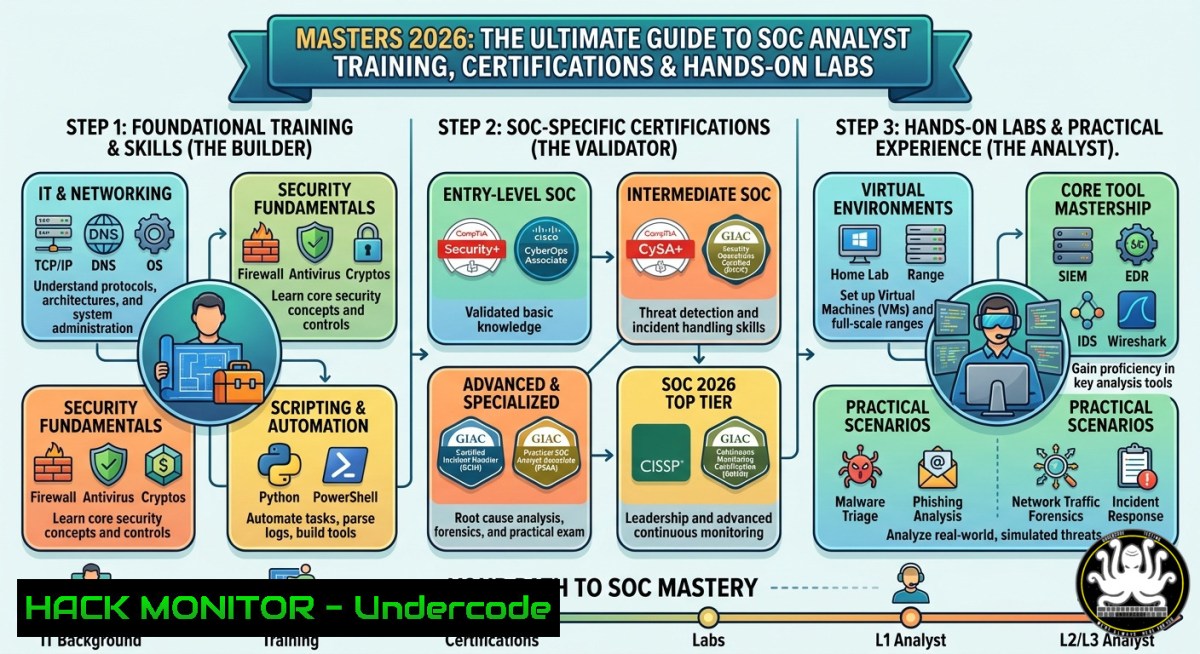
Introduction:
The global cybersecurity workforce gap has reached 4.8 million unfilled positions, with SOC analysts representing the most in-demand cybersecurity role today demanding a 31% year-over-year increase in hiring. Modern SOC operations have evolved dramatically, integrating AI-driven threat detection, cloud-native security monitoring across AWS, Azure and GCP, and automated incident response workflows, while the foundational tasks of log analysis, alert triage, and SIEM management remain essential frontline skills. This guide provides a comprehensive roadmap for aspiring SOC analysts, covering training pathways, hands-on lab environments, command-line toolkits, certification strategies, and the technical fundamentals needed to secure entry-level positions in this rapidly growing field.
Learning Objectives:
- Master essential Linux and Windows command-line utilities for system interrogation, log analysis, and incident response across SOC environments
- Implement SIEM detection rules using Splunk SPL and correlation techniques to identify malicious activities and reduce false positives
- Execute incident response playbooks and understand SOAR automation workflows for triage, enrichment, containment, and remediation
- Apply cloud security monitoring and hardening practices across AWS, Azure, and GCP platforms
You Should Know:
- Building Your Core SOC Analyst Toolkit: Essential Linux, Windows and SIEM Commands
SOC analysts must develop proficiency in both Linux and Windows command-line environments for rapid investigation. On Linux systems, essential commands include `netstat -tulpn` for examining active network connections, `ss -tulwn` as a modern replacement for network socket statistics, `ps auxf` for visualizing process trees, `lsof -i` to list open network files, and `journalctl -xe` for centralized log analysis. For Windows forensic collection, critical commands consist of `netstat -anob` to display connections with associated processes, `tasklist /svc` to reveal services running under each process, `wevtutil qe Security /c:100 /rd:true /f:text` for extracting recent security event logs, and `Get-WinEvent -FilterHashtable @{LogName=’Security’; ID=4625}` in PowerShell for failed login audits.
Step‑by‑step guide: Begin by setting up a virtual lab environment with both Ubuntu 22.04 LTS and Windows Server 2019 or Windows 10 in virtualization software such as VMware Workstation Player or VirtualBox. Install Sysmon on Windows with a default configuration using `Sysmon64 -accepteula -i` to enhance event logging. Practice triage scenarios by simulating attacks and then investigating using the command set above. On Linux, configure `auditd` to monitor critical file paths like `/etc/passwd` and /etc/ssh/sshd_config. For SIEM integration, deploy the free tier of Splunk Enterprise or Elastic Stack, ingest Windows Event Logs via Splunk Universal Forwarder, and create search queries such as `index=windows EventCode=4625` to investigate failed logon patterns. Enable real-time alerting by converting Sigma rules into SPL syntax, as demonstrated in the IronCircle Certified SOC Analyst curriculum.
- Structured SOC Learning Pathways and Hands-On Lab Platforms
Several structured training programs offer progressive skill development for SOC analysts. The EC-Council Certified SOC Analyst (CSA) v2 certification covers eight comprehensive modules encompassing security operations management, log correlation, SIEM deployment, threat hunting, incident response, cloud security monitoring, and forensic investigation, with a 120-minute exam comprising 100 questions requiring a 70% passing score. The INE Security eSOC Level 1 Learning Path integrates AI-supported analysis techniques and hands-on labs focused on logging, threat detection, and incident investigation. For beginners requiring no prior experience, the EC-Council SOC Essentials (SCE) course provides 10+ hours of video training, 6 hands-on labs, and CTF-based capstone projects. The Cisco CyberOps Associate certification prepares candidates for junior SOC analyst roles through coursework on security monitoring, network traffic analysis, and incident investigation fundamentals.
Step‑by‑step guide: Access the TryHackMe SOC Level 1 Learning Path, which has been completely rebuilt with real-world analysis scenarios across essential defensive security topics. Start with foundational rooms including “SOC Role in Blue Team,” “Introduction to SIEM,” and “Introduction to EDR” before progressing to advanced rooms such as “Volt Typhoon APT Detection,” “Windows Threat Detection,” and “Linux Threat Detection”. Each room provides browser-based virtual machines requiring no local setup. For SOC SIM capabilities, TryHackMe offers a simulated SOC environment where users handle real-time alerts, perform triage using runbooks, and escalate incidents appropriately. The free SOC (Security Operations Center) Fundamentals training from NICCS provides basic conceptual understanding of SOC operations and investigation tools for complete beginners. Google has also launched 8 free, hands-on SOC courses covering threat detection, log analysis, and incident response, directly applicable to blue team daily operations.
3. SIEM Deployment, Log Management and Correlation Techniques
Security Information and Event Management systems serve as the central nervous system of SOC operations, aggregating security data from network devices, servers, endpoints, and cloud platforms to detect threats through correlation rules. The average SOC receives over 4,400 alerts daily, making effective log management and triage essential for analyst efficiency. Key log management components include generation (source systems produce logs), collection (forwarders aggregate data), centralization (SIEM platform stores normalized data), parsing (extracting structured fields), transmission (secure transport protocols), storage (retention policies), archival (long-term preservation), and disposal (compliance-driven deletion). Organizations must implement SIEM solutions to comply with regulatory frameworks including PCI-DSS, HIPAA, ISO 27001, and RMiT while protecting sensitive data from internal and external threats. Modern SOC analysts must also monitor cloud-native logs from AWS CloudTrail, Azure Activity Logs, and Google Cloud Audit Logs alongside on-premises telemetry.
Step‑by‑step guide: Deploy Elastic Stack (Elasticsearch, Logstash, Kibana) using Docker Compose with a configuration file specifying Elasticsearch version 8.x, Kibana port mappings, and volume mounts for persistent storage. For Splunk, install the free tier which indexes up to 500 MB per day, sufficient for lab environments. Configure data inputs by navigating to Settings → Data inputs → Files & Directories, then specify paths such as `/var/log/auth.log` on Linux or `C:\Windows\System32\winevt\Logs\Security.evtx` on Windows. Create correlation rules using SPL: `index=main sourcetype=secure “Failed password” | stats count by src_ip | where count > 5` identifies brute-force attempts. For advanced detection, implement Sigma rule conversion: identify a Sigma rule for suspicious PowerShell execution, translate the detection logic into SPL syntax, configure real-time alerts, and validate through attack simulation using tools like Atomic Red Team. Use Wireshark to capture live traffic with tshark -i eth0 -w capture.pcap, then analyze packet captures to identify scanning techniques, device activity, and targeted systems during network intrusions.
- Incident Response Playbooks, SOAR Automation and Proactive Threat Hunting
Security Orchestration, Automation, and Response platforms transform incident response from manual, time-consuming processes into automated workflows that increase remediation speed and reduce analyst burnout, which currently affects 71% of SOC professionals due to alert overload and tool sprawl. A typical SOAR workflow follows five distinct stages: intake (alert ingestion from SIEM, email, or API), triage (initial classification and prioritization), decision (enrichment and context gathering), response (automated containment and remediation), and closure (evidence preservation and reporting). Proactive threat hunting complements automated detection, enabling analysts to search for advanced persistent threats that evade signature-based rules. Integration of threat intelligence with SIEM helps reduce false positives and enables faster, more accurate alert triage. The EC-Council CSA v2 curriculum dedicates 12% of exam domains to proactive threat detection and 25% to comprehensive incident response procedures.
Step‑by‑step guide: Begin by mapping high-confidence detection triggers to automated response actions in a SOAR platform such as Chronicle SOAR, Splunk SOAR, or Palo Alto XSOAR. Create a phishing incident playbook that follows these steps: upon alert ingestion, extract email headers and attachments; submit URLs to threat intelligence APIs like VirusTotal; block sender address via email gateway API; quarantine the recipient’s mailbox; isolate the affected endpoint using EDR integration; and generate a report for Tier 2 analysts. Codify playbook actions in the SOAR console, test in observe mode before full automation, and validate containment effectiveness. For threat hunting, collect endpoints running Sysmon and export Event ID 1 (process creation) logs. Use KQL or SPL queries to hunt for LOLBins (Living-Off-the-Land Binaries) such as `powershell.exe -EncodedCommand` patterns. Analyze process trees for anomalous parent-child relationships—for instance, `winword.exe` spawning `cmd.exe` indicates possible macro-based malware. Document hunting results, create detection rules for newly identified TTPs, and feed findings back into SIEM alerting.
- Cloud Security Monitoring across AWS, Azure and Google Cloud Platform
Modern SOC analysts must extend monitoring capabilities to cloud environments, where configuration drift, leaked credentials, insecure APIs, supply chain compromise, and container vulnerabilities represent the primary risks. Cloud security monitoring requires platform-specific tools: AWS GuardDuty for threat detection, Azure Defender for Cloud (now Microsoft Defender for Cloud), and GCP Security Command Center provide native threat detection capabilities. The EC-Council CSA v2 curriculum dedicates a full module to SOC operations in cloud environments, covering monitoring, incident detection, automated response, and security controls using cloud-native tools across all three major providers. Key cloud hardening practices include enforcing least-privilege access through IAM policies, enabling multi-factor authentication for all user accounts, implementing CIS benchmark baselines, encrypting data at rest and in transit, configuring comprehensive logging (CloudTrail, Flow Logs, Diagnostic Settings), and establishing automated snapshots before containment actions.
Step‑by‑step guide: Enable AWS GuardDuty by navigating to the GuardDuty console and clicking “Get Started” — GuardDuty immediately begins analyzing CloudTrail events, VPC Flow Logs, and DNS logs for threat indicators. Configure alert notifications to SNS topics that integrate with email, Slack, or PagerDuty for real-time SOC alerting. For Azure environments, enable Microsoft Defender for Cloud at the subscription level, configure continuous export of security alerts to Log Analytics workspaces, and create Azure Sentinel analytic rules for detection. Perform cloud incident containment by revoking compromised credentials using AWS CLI: `aws iam list-access-keys –user-name compromised-user` followed by aws iam update-access-key --access-key-id KEYID --status Inactive. Isolate resources by applying restrictive security group rules: `aws ec2 authorize-security-group-ingress –group-id sg-12345678 –protocol tcp –port 22 –cidr 0.0.0.0/0` for emergency lockdown, or use Azure CLI: az network nsg rule create --resource-group myResourceGroup --nsg-name myNSG --name BlockAll --priority 100 --direction Inbound --access Deny --protocol '' --source-address-prefixes '' --source-port-ranges '' --destination-address-prefixes '' --destination-port-ranges ''. Before any containment, create forensic snapshots using `aws ec2 create-snapshot –volume-id vol-1234567890abcdef0` and preserve CloudTrail logs to write-protected S3 buckets for evidence integrity.
What Undercode Say:
- The SOC analyst role is evolving toward AI-augmented operations: automation handles Tier 1 alert triage while human analysts focus on threat hunting, complex investigations, and supervision of AI systems
- Command-line proficiency on both Linux and Windows remains non-negotiable despite advancing automation tools — manual investigation skills separate effective analysts from dashboard watchers
- Multi-cloud security monitoring has become a core SOC competency as organizations adopt AWS, Azure, and GCP simultaneously, requiring analysts to understand platform-native security tools and API-driven response workflows
The projected 29% job growth for information security analysts through 2034, combined with the 4.8 million global cybersecurity workforce gap, confirms that SOC analyst positions represent one of the most accessible and in-demand entry points into cybersecurity careers. However, the field increasingly differentiates between candidates who possess only theoretical knowledge and those who have completed hands-on lab environments, built home labs, and earned practical certifications. The most effective learning path combines structured training courses from EC-Council or INE with extensive practice on platforms like TryHackMe and LetsDefend, supplemented by building a personal SIEM lab using Elastic Stack or Splunk free tier. As AI integration deepens across security operations, analysts who develop skills in AI-supported analysis and investigation will find the most rapid career advancement opportunities, with salaries ranging from $75,000 to $137,000 depending on experience level and tier placement. The practical guide “SOC Analyst Is Not Dead” by Izzmier Izzuddin Zulkepli offers targeted insights into real SOC work, investigation methodologies, and career progression strategies for aspiring analysts.
Prediction:
By 2028, the SOC analyst role will bifurcate into two distinct tracks: AI-Augmented SOC Specialists who manage automated detection systems and focus exclusively on complex threat hunting, and Cloud-Native SOC Engineers who specialize in multi-cloud incident response across serverless architectures, Kubernetes clusters, and identity federation systems. Traditional SIEM consoles will evolve toward autonomous threat detection platforms that generate human-readable investigation narratives rather than raw alerts, fundamentally changing how analysts interact with security data. Entry-level certification requirements will shift from multiple-choice examinations to practical performance-based assessments conducted in live SOC simulation environments, mirroring the hands-on evaluation models already adopted by platforms like TryHackMe and Hack The Box. Organizations will adopt hybrid SOC models where Tier 1 functions become heavily automated while Tier 2 and Tier 3 analysts work remotely using cloud-based investigation platforms, reducing physical SOC infrastructure costs while expanding talent pools geographically. The most immediate opportunities for career changers without traditional IT degrees will emerge in managed security service provider SOCs, where high demand and structured training programs create accessible entry pathways for motivated candidates regardless of prior formal education.
▶️ Related Video (80% Match):
🎯Let’s Practice For Free:
IT/Security Reporter URL:
Reported By: Izzmier Want – Hackers Feeds
Extra Hub: Undercode MoN
Basic Verification: Pass ✅


