Listen to this Post
Introduction:
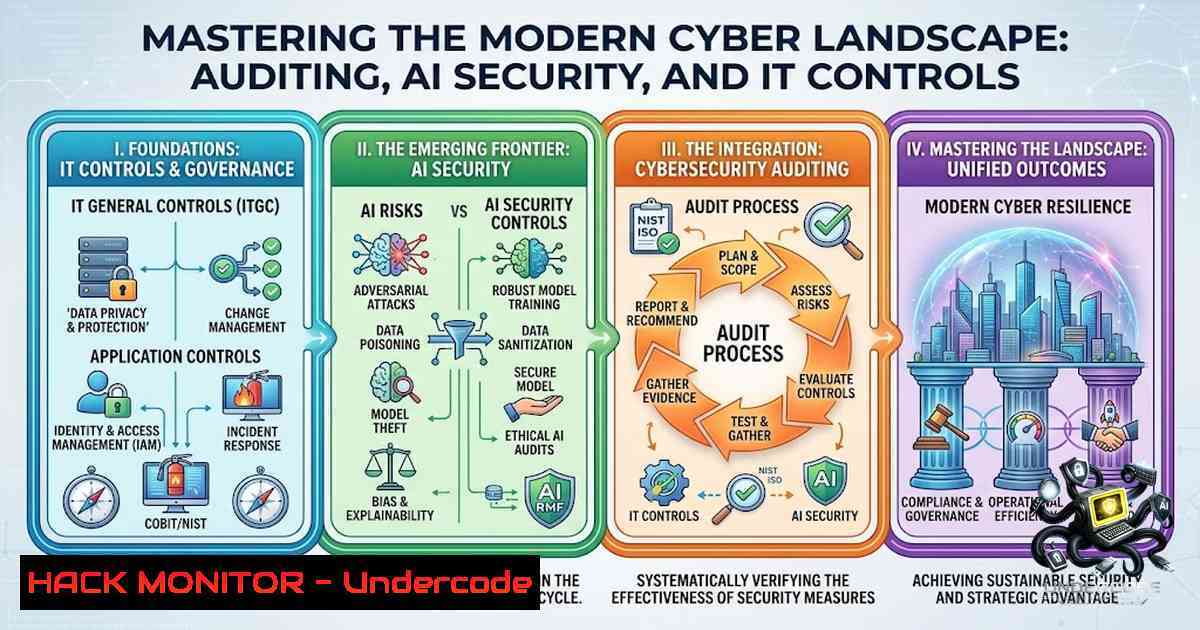
As organizations accelerate their digital transformation, the convergence of traditional IT auditing, cybersecurity frameworks, and emerging artificial intelligence (AI) threats creates a complex risk environment. The demand for skilled professionals who can navigate this triad—from conducting ISO 27001 compliance audits to securing machine learning pipelines—has surged, reflecting a critical skills gap in the industry. This article explores the core competencies required for these evolving roles, providing actionable technical insights into auditing, AI security, and control implementation.
Learning Objectives:
- Understand the practical application of IT General Controls (ITGCs) and IT Application Controls (ITACs) within hybrid cloud environments.
- Learn how to secure AI environments through threat modeling and governance controls.
- Master command-line techniques for auditing system configurations and conducting basic security assessments.
You Should Know:
1. Bridging IT Audit and Cybersecurity Frameworks
A Senior Cyber Security Auditor’s role extends beyond checklist compliance to actively identifying vulnerabilities in real-time. This involves aligning technical audits with frameworks like ISO 27001 and NIST. For instance, auditing access controls requires verifying that the principle of least privilege is enforced at the system level. On a Linux server, you can audit user permissions by listing all users and their groups: `cut -d: -f1 /etc/passwd` and groups
</code>. For Windows, using PowerShell to audit local group memberships is crucial: <code>Get-LocalGroupMember -Group "Administrators"</code>. A step-by-step guide to a basic access control audit involves: (1) Inventorying all active user accounts; (2) Reviewing group memberships for administrative privileges; (3) Checking for dormant accounts using `lastlog` (Linux) or `Get-LocalUser | Where-Object {$_.LastLogon -lt (Get-Date).AddDays(-90)}` (PowerShell); and (4) Validating that all privileged access is logged and monitored. This process not only ensures compliance but also reduces the attack surface.

<h2 style="color: yellow;">2. The AI Security Manager’s Arsenal</h2>

Managing AI security requires a shift from traditional perimeter defense to protecting the data pipeline and model integrity. Risks include adversarial attacks, data poisoning, and model inversion. Implementing governance for AI involves creating a secure software development lifecycle (SDLC) for AI models. For a self-hosted AI environment, securing the API endpoints is paramount. If using Nginx as a reverse proxy to an AI model API, you can harden it by adding rate-limiting and IP whitelisting. Example Nginx configuration snippet:
[bash]
location /api/ {
limit_req zone=one burst=5;
allow 192.168.1.0/24;
deny all;
proxy_pass http://localhost:5000;
}
Additionally, monitoring for adversarial inputs involves logging input data distributions and setting alerts for anomalies. A practical step is to implement input validation and sanitization using Python libraries like `pydantic` to enforce schemas, thus mitigating injection risks before they reach the model.
- Mastering ITGCs and SOX Compliance in Complex Environments
A Senior IT Auditor must ensure that ITGCs, which include controls over the IT environment, computer operations, access to programs and data, and program development and program changes, are robust. In a cloud environment, this involves auditing Identity and Access Management (IAM) policies. For AWS, using the CLI to list all users and their attached policies is essential: `aws iam list-users` andaws iam list-attached-user-policies --user-1ame</code>. For SOX compliance, change management controls are critical. Auditors should verify segregation of duties by reviewing system logs for unauthorized changes. On Windows, auditing file access can be enabled via <code>auditpol /set /subcategory:"File System" /success:enable /failure:enable</code>. Then, reviewing the Security Event Log for Event ID 4663 (File Access) provides a trail of modifications. A step-by-step guide to validating a change management process includes: (1) Requesting a list of all production changes from the ticketing system; (2) Correlating these changes with system logs (<code>/var/log/syslog</code> for Linux or `Get-WinEvent` for Windows); (3) Verifying that all changes have proper approval documentation; and (4) Ensuring that a rollback plan exists and is tested.</li> </ol> <h2 style="color: yellow;">4. Step-by-Step Configuration for Attack Surface Reduction</h2> Reducing the attack surface is a key goal for both auditors and security managers. This involves systematically disabling unnecessary services and ports. On a Linux server, you can audit open ports using <code>ss -tulpn</code>. To harden the system, you can use `ufw` to block all ports except those explicitly required. For example: `sudo ufw default deny incoming` and <code>sudo ufw allow ssh</code>. On Windows, using PowerShell to disable unnecessary services is effective: `Get-Service | Where-Object {$_.Status -eq 'Running'}` and <code>Set-Service -1ame "ServiceName" -StartupType Disabled</code>. For cloud hardening, specifically in Azure, using Just-In-Time (JIT) access reduces exposure. You can configure JIT via the Azure Portal or CLI. The CLI command to enable JIT on a VM is: <code>az vm jit-policy set --resource-group MyResourceGroup --location eastus --vm-1ame MyVM --rules "tcp=22,3389"</code>. This forces administrators to request access, which is then audited, significantly reducing persistent attack vectors. <h2 style="color: yellow;">5. Navigating Emerging AI Threats and Mitigations</h2> AI-specific threats, such as prompt injection in large language models (LLMs), require novel mitigation strategies. Unlike traditional SQL injection, prompt injection manipulates the model's instruction context. A mitigation technique is to implement a filtering layer that sanitizes user input using a policy like "deny-list" for common jailbreak patterns. Additionally, data leakage prevention is crucial. For a team developing an AI assistant, implementing differential privacy can protect training data. A practical guide to implement output sanitization involves using a regular expression to scan for sensitive data patterns (e.g., API keys, PII) before the model returns its response. This can be coded in Python as: [bash] import re def sanitize_output(text): api_key_pattern = r'sk-[a-zA-Z0-9]{20,}' if re.search(api_key_pattern, text): return "[bash]" return textThis serves as a final defense layer, ensuring that even if the model is manipulated, it does not expose sensitive data.
6. Integrating Automation and Continuous Monitoring
Modern auditing and security management rely heavily on automation. Continuous monitoring of security configurations involves tools like OpenSCAP for Linux, which can generate compliance reports.
oscap xccdf eval --profile xccdf_org.ssgproject.content_profile_standard --results results.xml /usr/share/xml/scap/ssg/content/ssg-rhel9-ds.xml. For Windows, the PowerShell Security Compliance Toolkit allows for local GPO audits:Test-SCCompliancePolicy -PolicyPath "C:\Policy.xml". Integrating these tools into a CI/CD pipeline ensures that security is validated at every deployment stage. A simplified CI script using GitHub Actions would involve running a security scanning tool like Trivy for container vulnerabilities:trivy image --severity HIGH,CRITICAL myapp:latest. If critical vulnerabilities are found, the build fails, enforcing a "security as code" culture.What Undercode Say:
- Key Takeaway 1: The job market is rapidly shifting toward professionals who can combine traditional ITGC audits with a deep understanding of AI-specific risks. This hybrid skillset is becoming non-1egotiable for leadership positions.
- Key Takeaway 2: Practical, command-line auditing and automated compliance checks are the bedrock of effective security. Moving beyond theoretical frameworks to technical verification provides a tangible security posture improvement and satisfies regulatory demands.
Analysis: The current threat landscape is evolving faster than governance frameworks can adapt. While the roles of IT Auditor and Cyber Security Auditor are mature, the emergence of the "AI Security Manager" signals a pivotal moment where security must shift from a reactive posture to a proactive, architecturally-centric approach. The focus on securing AI environments, rather than just the network, is a clear indicator that AI adoption has outpaced security capabilities. The absence of visa sponsorship in these roles also highlights a localized talent war, where organizations are prioritizing immediate, in-region experts. Moreover, the integration of compliance (SOX) with technical audit (ITGCs) underscores that regulatory pressures are forcing a deeper fusion of finance and IT risk management, making automation and continuous monitoring not just trends, but necessities for survival.
Prediction:
+1: The demand for AI Security Managers will lead to the formalization of new industry certifications, creating a multi-billion-dollar training market within the next 18 months.
+1: Automation tools for IT audit will evolve to integrate AI-driven anomaly detection, drastically reducing manual testing time and improving accuracy.
-1: The shortage of qualified candidates will likely cause salary inflation for these roles, potentially driving smaller organizations to outsource entirely, which introduces third-party risk vectors.
-1: If AI security governance remains a niche skill, we will see a significant rise in high-profile data breaches attributed to manipulated AI models, causing a backlash in AI adoption in regulated sectors.▶️ Related Video (86% Match):
🎯Let’s Practice For Free:
🎓 Live Courses & Certifications:
Join Undercode Academy for Verified Certifications
🚀 Request a Custom Project:
Secure, high-velocity infrastructure and disruptive technological engineering. Contact our engineering team for high-tier development and proprietary systems:
[email protected]
💎 Smart Architecture | 🛡️ Secure by Design | ⭐ Trusted by ThousandsIT/Security Reporter URL:
Reported By: https://lnkd.in/p/eUAcEp2S - Hackers Feeds
Extra Hub: Undercode MoN
Basic Verification: Pass ✅🔐JOIN OUR CYBER WORLD [ CVE News • HackMonitor • UndercodeNews ]
📢 Follow UndercodeTesting & Stay Tuned:


