
Listen to this Post
Introduction:
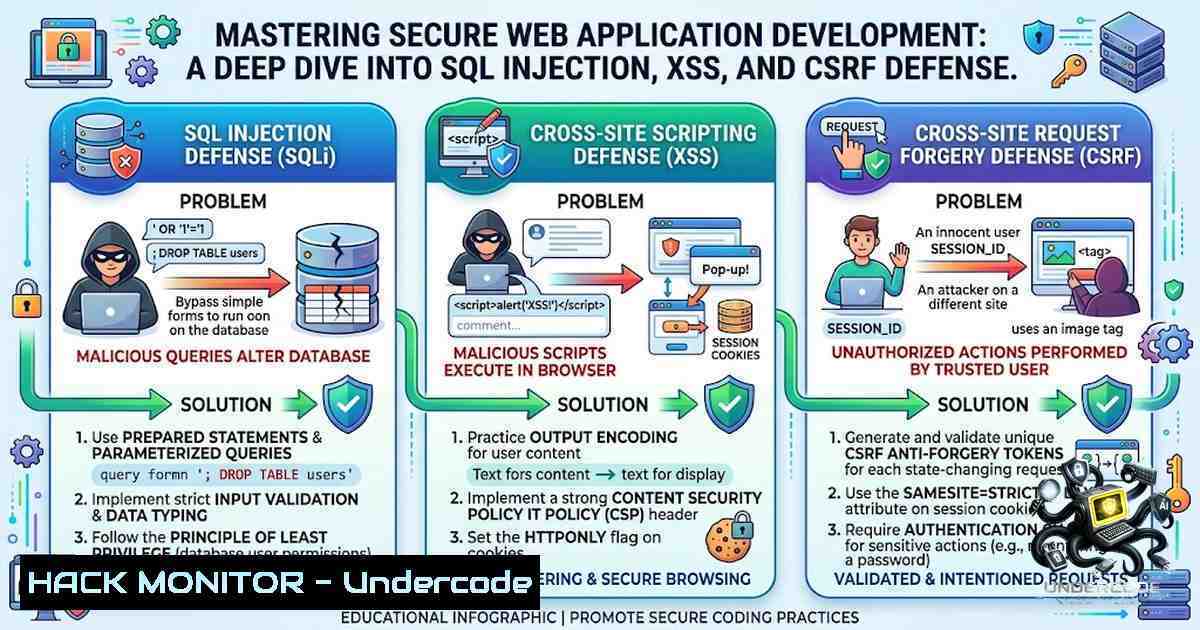
In an era where web applications are the backbone of digital business, the integrity of code is paramount. Secure coding is not merely a best practice but a fundamental requirement of modern software development, integrating security controls throughout the development lifecycle to protect against evolving cyber threats. The OWASP Top 10 for 2025 highlights that security misconfiguration is now the second most critical risk, with 100% of tested applications showing some form of it. This article provides a technical, hands-on guide to identifying and mitigating three of the most critical vulnerabilities—SQL Injection, Cross-Site Scripting (XSS), and Cross-Site Request Forgery (CSRF)—equipping developers with the knowledge to build resilient and compliant web applications.
Learning Objectives & Secrets:
- Objective 1: Eradicate SQL Injection Vulnerabilities
Learn to implement parameterized queries and prepared statements as the definitive defense, treating user input as data, not executable code. Secret Tip: Combine prepared statements with the principle of least privilege by creating database users with the minimum permissions necessary for their role, such as a read-only user for API queries. -
Objective 2: Neutralize Cross-Site Scripting (XSS) Attacks
Master context-aware output encoding to ensure untrusted data is rendered safely in the browser. Secret Tip: Implement a strict Content Security Policy (CSP) with `script-src` directives as a defense-in-depth layer. CSP is not a replacement for output encoding but a critical secondary control that can block script execution even if an encoding flaw exists. -
Objective 3: Prevent Cross-Site Request Forgery (CSRF) Exploits
Deploy anti-CSRF tokens that are unique per user session and validated on the server for every state-changing request. Secret Tip: Use the `SameSite` cookie attribute set to `’Strict’` or `’Lax’` to provide a robust, browser-enforced layer of CSRF protection.
You Should Know:
1. SQL Injection: The Art of Parameterized Queries
SQL Injection remains one of the most widespread and critical web application vulnerabilities. It occurs when untrusted user input is embedded directly into SQL queries, enabling attackers to manipulate query logic, bypass authentication, or destroy data. The primary and most effective defense is the use of parameterized queries (prepared statements), which separate SQL code from data values, making injection impossible.
Step‑by‑Step Guide: Implementing Parameterized Queries
- Step 1: Identify Vulnerable Code. Look for any SQL query built using string concatenation that includes user input.
VULNERABLE - Never do this
username = request.args.get('username')
query = "SELECT  FROM users WHERE username = '" + username + "'"
cursor.execute(query)
An attacker could input `’ OR ‘1’=’1` to bypass authentication or `’; DROP TABLE users; –` to destroy data.
-
Step 2: Rewrite with Parameterized Queries. Use placeholders and pass values separately.
- Python (psycopg2/MySQLdb):
SAFE - Parameterized query cursor.execute("SELECT FROM users WHERE username = %s", (username,)) - Node.js (mysql2):
const mysql = require('mysql2/promise'); async function getUserByUsername(username) { const [bash] = await connection.execute( 'SELECT id, email FROM users WHERE username = ?', [bash] ); return rows[bash]; } -
Java (JDBC):
String sql = "SELECT  FROM users WHERE username = ?";
PreparedStatement stmt = conn.prepareStatement(sql);
stmt.setString(1, username);
ResultSet rs = stmt.executeQuery();
-
Step 3: Implement Least Privilege. Even with parameterized queries, restrict database permissions to limit potential damage.
-- Create a read-only user for the API
CREATE USER 'api_readonly'@'app-server' IDENTIFIED BY 'StrongPassword!';
GRANT SELECT ON mydb.users TO 'api_readonly'@'app-server';
2. Cross-Site Scripting (XSS): A Defense-in-Depth Strategy
XSS vulnerabilities arise when applications incorporate untrusted data into web pages without proper validation or encoding, enabling attackers to inject and execute malicious scripts in users’ browsers. Modern XSS attacks can lead to complete account takeover, credential theft, and malware distribution. No single defense is sufficient; a layered approach is essential.
Step‑by‑Step Guide: Implementing XSS Defenses
- Step 1: Context-Aware Output Encoding. Encode untrusted data based on where it will be rendered. A string must be HTML-encoded for HTML body text, attribute-encoded for HTML attributes, and JavaScript-encoded for JavaScript string literals. Using the wrong encoding is still vulnerable.
-
Step 2: Implement a Strict Content Security Policy (CSP). Add CSP headers to restrict the sources from which scripts can be loaded and executed. A nonce-based policy can stop inline script execution. Configure your web server to send the following header:
Content-Security-Policy: default-src 'self'; script-src 'self' 'nonce-{random}';This policy allows scripts only from the same origin and those with a matching nonce attribute, significantly reducing the XSS attack surface.
-
Step 3: Sanitize Rich Content. For content that requires HTML (like a blog post), use a robust sanitization library (e.g., DOMPurify) to strip out malicious code while preserving safe formatting.
3. Cross-Site Request Forgery (CSRF): Token-Based Protection
CSRF attacks trick a victim’s browser into making unauthorized requests to a web application on which they are authenticated. This can result in unauthorized transactions, account compromise, and data manipulation.
Step‑by‑Step Guide: Implementing CSRF Protection
- Step 1: Generate a CSRF Token. The server creates a unique, unpredictable token for each user session and sends it to the client, typically in a cookie or as a hidden form field.
Example: Generating a token (conceptual)
csrf_token = secrets.token_urlsafe(32)
-
Step 2: Include the Token in Requests. For server-side rendered forms, include the token in a hidden input field.
</p></li>
</ul>

<form method="post" action="/update-profile">
<input type="hidden" name="csrf_token" value="{{ csrf_token }}">
<!-- other fields -->
</form>

<p>
For AJAX requests, send the token in a custom HTTP header, such as
X-CSRFToken.fetch("/api/delete", { method: "POST", headers: { "X-CSRFToken": getCookie("csrf_token") }, credentials: "include" });- Step 3: Validate the Token on the Server. Every state-changing request must be validated. The server compares the token from the request (header or body) with the one stored in the user’s session or a secure cookie. If they do not match, the request is rejected.
-
Step 4: Use `SameSite` Cookie Attributes. As an additional layer, set the `SameSite` attribute on your session cookies to `Strict` or
Lax. This instructs the browser not to send the cookie with cross-site requests, providing a robust defense against CSRF.
What Undercode Say:
-
Key Takeaway 1: Secure coding is a proactive, continuous process, not a one-time checklist. Integrating security from the design phase through to deployment and monitoring is crucial for building resilient applications.
-
Key Takeaway 2: Relying on a single security control is a recipe for failure. A defense-in-depth strategy—combining output encoding, CSP, parameterized queries, and token-based validation—creates overlapping layers that make exploitation exponentially more difficult. The OWASP Top 10 2025’s inclusion of “Software Supply Chain Failures” as a new category at 3 underscores the importance of managing dependencies deliberately.
Prediction:
- +1 The integration of AI-powered coding assistants will accelerate the adoption of secure coding practices. These tools can be configured with OWASP security rules to auto-apply best practices, potentially reducing the prevalence of common vulnerabilities like SQL injection and XSS.
- -1 The rapid pace of development and the increasing complexity of supply chains will lead to a surge in security misconfigurations and dependency-related vulnerabilities, as highlighted by the OWASP Top 10 2025. Organizations that fail to implement automated security testing and robust dependency management will face significant risks.
- +1 The adoption of modern web frameworks with built-in security features (React, Angular, Django, Spring) will raise the baseline security posture for many applications, making it harder for attackers to exploit common vulnerabilities like XSS and CSRF.
- -1 As defenses against traditional vulnerabilities improve, attackers will increasingly pivot to exploiting business logic flaws and API misconfigurations. The OWASP API Security Top 10 will become a critical reference for developers building modern, microservices-based applications.
▶️ Related Video (78% Match):
https://www.youtube.com/watch?v=-GfSbk_VqSk
🎯Let’s Practice For Free:
🎓 Live Courses & Certifications:
Join Undercode Academy for Verified Certifications
🚀 Request a Custom Project:
Secure, high-velocity infrastructure and disruptive technological engineering. Contact our engineering team for high-tier development and proprietary systems:
[email protected]
💎 Smart Architecture | 🛡️ Secure by Design | ⭐ Trusted by ThousandsIT/Security Reporter URL:
Reported By: https://lnkd.in/p/eCkdj4Uj – Hackers Feeds
Extra Hub: Undercode MoN
Basic Verification: Pass ✅🔐JOIN OUR CYBER WORLD [ CVE News • HackMonitor • UndercodeNews ]
📢 Follow UndercodeTesting & Stay Tuned:


