
Listen to this Post
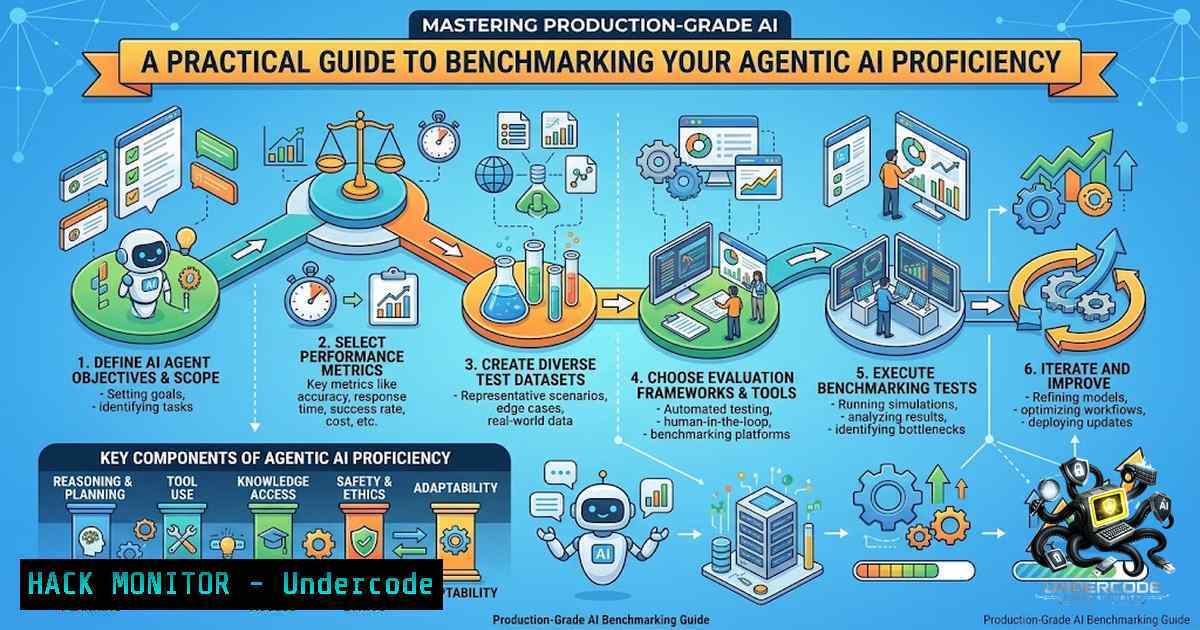
Introduction:
In the rapidly evolving landscape of artificial intelligence, theoretical knowledge often outpaces practical, production-ready implementation. The gap between understanding AI concepts and deploying resilient, scalable agentic systems is a critical challenge for engineers and architects. The recommendation to leverage platforms like Mercor for virtual technical interviews highlights a broader industry need: moving beyond passive learning to active, real-time validation of applied AI skills. This article explores how such benchmarking tools can reveal strengths and blind spots in your AI engineering expertise, focusing on the technical depth required to design, deploy, and secure agentic workflows in enterprise environments.
Learning Objectives & Secrets:
- Objective 1: Benchmark Architectural Decision-Making. Learn to articulate trade-offs between different AI architectures (e.g., RAG vs. fine-tuning, multi-agent vs. monolithic pipelines) under interview pressure, mirroring production design reviews.
- Objective 2 Secret Tips: Productionize with Observability. Secret: The virtual interview likely probes “failure scenarios” — mastering this means implementing structured logging, distributed tracing, and metric aggregation (e.g., Prometheus + Grafana) from day one, not as an afterthought.
- Objective 3 Secret Tips: Optimize for Cost and Latency. Secret: Cracking these interviews requires demonstrating awareness of token usage, caching strategies (e.g., semantic caching with Redis), and model quantization techniques (e.g., GPTQ, AWQ) to balance performance with operational expenditure in real-time systems.
You Should Know:
1. Designing Resilient Agentic Workflows
The core of modern AI engineering is the agentic system, where LLMs interact with tools and external APIs to complete tasks. Unlike simple chatbots, these systems must handle state management, error recovery, and tool selection autonomously. A common pattern is the ReAct (Reasoning + Acting) loop, where the agent iteratively reasons about a query, acts by calling a function (e.g., get_weather(), query_database()), and observes the result to formulate the final answer. To harden this for production, you must implement robust retry logic with exponential backoff for transient API failures, define clear timeouts for each agent step, and enforce strict input/output validation using Pydantic models to prevent injection attacks. The following is a Python snippet using the LangChain framework to create a basic tool-calling agent with error handling:
from langchain.agents import create_tool_calling_agent, AgentExecutor
from langchain.tools import Tool
from langchain_openai import ChatOpenAI
import time

def safe_tool_call(query):
try:
 Simulate tool execution
if "error" in query.lower():
raise ValueError("Simulated tool failure")
return f"Result for: {query}"
except Exception as e:
return f"Tool error: {str(e)}"

tools = [Tool(name="QueryTool", func=safe_tool_call, description="Fetches data")]
model = ChatOpenAI(temperature=0, model="gpt-4-turbo")
agent = create_tool_calling_agent(model, tools, prompt=None)  Simplified
executor = AgentExecutor(agent=agent, tools=tools, max_iterations=3)
response = executor.invoke({"input": "Fetch data for user 123"})
print(response)
This demonstrates the critical practice of wrapping tool calls in error handlers, ensuring the agent can recover gracefully rather than crashing the entire workflow.
2. Securing the AI Supply Chain
As AI models and datasets become core assets, securing the supply chain is paramount. This includes protecting against model poisoning, data leakage, and dependency vulnerabilities. Implementing a Zero-Trust architecture for your AI pipeline means verifying every component—from the base Docker image to the Hugging Face model weights. Tools like Trivy or Grype can scan container images for known CVEs before deployment. Furthermore, when using third-party models via API (e.g., OpenAI, Anthropic), you must enforce strict content filters and data loss prevention (DLP) policies to ensure sensitive data isn’t inadvertently sent to external services. On Linux, you can automate model integrity verification using checksums:
 Calculate SHA-256 checksum of downloaded model file
sha256sum your_model.bin > model_checksum.txt
 Verify integrity before loading
sha256sum -c model_checksum.txt
If the checksum fails, the model may have been tampered with, and the pipeline should halt. For Windows, the equivalent command is CertUtil -hashfile your_model.bin SHA256; integrating this into a CI/CD pipeline ensures every model artifact is cryptographically verified.
3. Mastering API Security and Rate Limiting
Agentic systems often act as orchestrators, making numerous API calls to internal microservices and external SaaS platforms. This creates a massive attack surface. API keys must be managed using a secrets manager (e.g., HashiCorp Vault, Azure Key Vault) and never hard-coded in code or environment variables exposed in logs. Additionally, aggressive rate limiting is crucial to prevent your agents from overwhelming backend services or incurring exorbitant costs from pay-per-use APIs. Implement a token bucket algorithm using Redis to throttle requests per agent session. Below is an example of using `redis-py` for rate limiting:
import redis
import time

r = redis.Redis(host='localhost', port=6379, db=0)

def rate_limit(user_id, max_requests=10, window=60):
key = f"rate_limit:{user_id}"
current = r.get(key)
if current is None:
r.setex(key, window, 1)
return True
if int(current) >= max_requests:
return False
r.incr(key)
return True
This code ensures each user or agent session cannot exceed a defined number of requests per minute, protecting both your system and the external services you depend on.
4. Evaluating and Monitoring Agent Performance
Benchmarking is not a one-time event; it requires continuous evaluation. Metrics like task completion rate, average latency, and cost per successful task should be tracked over time. Tools like Weights & Biases (W&B) or MLflow can log these metrics, allowing you to compare performance across different model versions or prompt templates. A critical secret from the virtual interview is the emphasis on “explaining architecture”—this translates to having a clear, documented evaluation framework. For a RAG system, this involves evaluating retrieval precision and generation quality. Consider implementing a CI job that runs a suite of unit and integration tests every time the prompt or context window is updated. A simple Bash script can kick off a test suite:
!/bin/bash
 test_rag_pipeline.sh
echo "Starting RAG evaluation..."
python evaluate_retrieval.py --test-set data/test_queries.json
if [ $? -eq 0 ]; then
echo "Retrieval tests passed."
else
echo "Retrieval tests failed. Investigate changes."
exit 1
fi
 Deploy only if all tests pass
This enforces a quality gate, preventing performance regressions from reaching production.
5. Optimizing for Production Deployments
Deploying AI models at scale requires careful consideration of infrastructure. Containerization with Docker and orchestration via Kubernetes are standard. However, the key is configuring resource limits to avoid noisy neighbor issues and setting up Horizontal Pod Autoscaling (HPA) based on custom metrics like queue length or request latency. For GPU-accelerated inference, using NVIDIA’s Triton Inference Server can drastically improve throughput. A typical `Dockerfile` for a FastAPI-based agent service should be optimized for layer caching:
FROM python:3.10-slim
WORKDIR /app
COPY requirements.txt .
RUN pip install --1o-cache-dir -r requirements.txt
COPY . .
CMD ["uvicorn", "main:app", "--host", "0.0.0.0", "--port", "8000"]
In production, you would combine this with Kubernetes readiness and liveness probes to ensure the service is healthy and can handle traffic. Understanding these deployment details is essential for any senior AI engineering role.
What Undercode Say:
- Key Takeaway 1: The true test of AI proficiency lies in explaining real-time trade-offs, implementation choices, and failure scenarios—not just reciting algorithms.
- Key Takeaway 2: Platforms like Mercor force a self-assessment that reveals weaknesses in production-oriented skills, such as system design, security, and cost management.
- Analysis: The industry is shifting towards “agentic engineers” who can build systems that are not only intelligent but also secure, observable, and cost-effective. The static Q&A format is obsolete; dynamic, conversational interviews that adapt to the candidate’s responses better mirror the complexity of building autonomous systems. This trend suggests that future hiring will favor practitioners who can defend their architectural decisions under pressure, emphasizing a holistic understanding of the technology stack.
Expected Output:
The output is a comprehensive professional article that extracts technical content from the source text, expands on the principles of AI engineering, and provides actionable code, commands, and architectures to validate and enhance practical skills in AI, security, and cloud-1ative deployments.
Prediction:
- +1: The adoption of AI benchmarking platforms will lead to a more standardized and skilled workforce, raising the bar for AI engineering and accelerating the development of robust, production-ready systems.
- +1: This trend will drive innovation in AI Observability and MLOps tools, as organizations demand deeper insights into agent behavior to meet the rigorous scrutiny of such technical interviews.
- -1: The emphasis on high-pressure, rapid-fire interviews may inadvertently favor candidates skilled in improvisation over deep, methodical engineering, potentially leading to brittle architectures if not paired with rigorous peer review and long-term project evaluation.
▶️ Related Video (84% Match):
🎯Let’s Practice For Free:
🎓 Live Courses & Certifications:
Join Undercode Academy for Verified Certifications
🚀 Request a Custom Project:
Secure, high-velocity infrastructure and disruptive technological engineering. Contact our engineering team for high-tier development and proprietary systems:
[email protected]
💎 Smart Architecture | 🛡️ Secure by Design | ⭐ Trusted by Thousands
IT/Security Reporter URL:
Reported By: https://lnkd.in/p/eaXiAtyA – Hackers Feeds
Extra Hub: Undercode MoN
Basic Verification: Pass ✅


