Listen to this Post
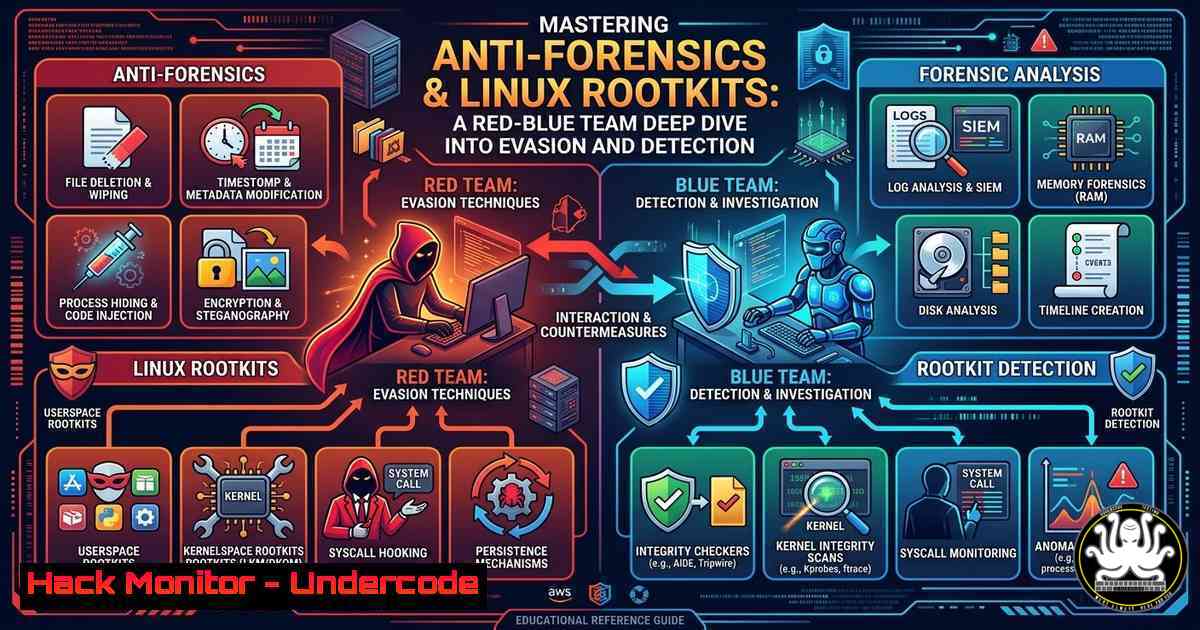
Introduction:
In the ever-evolving landscape of cybersecurity, the cat-and-mouse game between attackers and defenders has intensified within the digital forensics domain. Anti-forensics encompasses a set of techniques used by adversaries to actively hinder investigation efforts, degrade the quality of evidence, and prevent incident responders from reconstructing a breach. This article explores a comprehensive training approach that bridges the gap between red team evasion tactics and blue team detection methodologies, focusing on practical, hands-on techniques across operating systems, including an advanced dive into Linux rootkits.
Learning Objectives:
- Understand the core principles of anti-forensics from both an adversarial and defensive perspective.
- Learn to implement and detect common anti-forensics techniques, including log wiping, timestamp manipulation, and file obfuscation.
- Explore the architecture and deployment of Linux rootkits, alongside methods for their identification and removal.
You Should Know:
1. The Adversary’s Toolkit: Anti-Forensics Fundamentals
Anti-forensics is not a single tool but a methodology designed to frustrate forensic analysis. From a red team perspective, the goal is to cover tracks post-exploitation. This includes clearing command history, deleting or manipulating logs, and using timestomping to alter file system metadata. For defenders, understanding these methods is crucial to building detection rules that spot the absence of logs or anomalous metadata patterns.
Linux Commands for Track Covering:
– `history -c` && `rm ~/.bash_history` – Clears the current session history and deletes the history file.
– `shred -z -u /var/log/auth.log` – Overwrites a log file multiple times to prevent data recovery, then removes it.
– `touch -r /bin/ls malicious.sh` – Changes the timestamp of `malicious.sh` to match the trusted `/bin/ls` binary (timestomping).
Windows Counterparts:
– `Clear-History` (PowerShell) – Clears the PowerShell command history.
– `wevtutil cl System` – Clears the Windows System event log.
– Using `Set-MpPreference -DisableRealtimeMonitoring $true` to disable AV temporarily before executing tools.
2. Linux Rootkits: Stealth at the Kernel Level
Rootkits represent the pinnacle of stealth, operating at the kernel level to manipulate system behavior. They can hide processes, files, network connections, and even grant backdoor access while evading standard system administration tools like ps, ls, and netstat. The training mentioned in the post focuses on this advanced topic, providing hands-on experience in deploying and, more importantly, detecting these threats.
Step‑by‑step guide to understanding rootkit behavior:
- Load a Kernel Module: Adversaries often use `insmod` or `modprobe` to load a malicious kernel module (rootkit). Example:
insmod rootkit.ko. - System Call Hooking: The rootkit hooks critical system calls (e.g., `getdents64` for directory listing). When `ls` is executed, the hooked call filters out the malicious file name from the results.
- Hiding Processes: A rootkit modifies the kernel process list (task_struct) to unlink a specific process, making it invisible to `ps` and
top. - Persistence: The rootkit is often added to `/etc/modules` or `/etc/modules-load.d/` to load automatically on boot.
Detection and Mitigation:
- Use `chkrootkit` or
rkhunter: These tools scan for known rootkit signatures and anomalies.sudo rkhunter --check
- Memory Analysis: Since rootkits operate in memory, capturing a memory dump with `LiME` (Linux Memory Extractor) and analyzing it with `Volatility` can reveal hidden artifacts that live system tools miss.
Capture memory (requires LiME compiled)
sudo insmod lime.ko "path=/root/mem.lime format=lime"
3. Bridging the Gap: Blue Team Detection Strategies
For defenders, the training emphasizes techniques to circumvent or work around anti-forensics. The key is not to rely solely on the compromised system’s native tools. Instead, defenders must collect data from alternative sources and use integrity checking.
Step‑by‑step guide for incident responders:
- Leverage Endpoint Detection and Response (EDR) Agents: Unlike local logs, EDR telemetry is sent to a central console. If an adversary clears local logs, the EDR retains a record of the process (e.g., `wevtutil.exe` execution).
- Implement File Integrity Monitoring (FIM): Tools like `AIDE` (Advanced Intrusion Detection Environment) or `Tripwire` create a baseline of file hashes. If a binary like `ps` is replaced or timestamps are altered, FIM will flag the change.
Initialize AIDE database
sudo aideinit
Perform a check
sudo aide --check
- Centralized Logging: Forward logs to a remote syslog server or SIEM. Commands like `wevtutil` may clear local logs, but if logs were being forwarded via Sysmon or Winlogbeat, the data is already in a secure, remote location.
- Memory Forensics: Capture RAM from the live system. This is immune to file-level anti-forensics because it captures the running state of the rootkit.
Windows: Use `DumpIt` or `WinPmem` to capture memory.
Analysis: Use Volatility 3 to examine processes, network connections, and injected code that might be hidden from OS APIs.
4. Tool Configurations and API Security in Forensics
Modern anti-forensics increasingly targets APIs and cloud environments. Attackers use API calls to disable logging services or delete cloud trails. During training, practical exercises often involve configuring security tools to be resilient to tampering.
Hardening Recommendations:
- Sysmon (System Monitor): Configure Sysmon with a robust configuration file to log process creation, network connections, and file changes. Ensure its service is protected.
- Linux Auditd: Configure auditd to monitor sensitive syscalls and file access. If an adversary attempts to stop the service, an alert should be triggered.
Audit rule to monitor /etc/passwd
auditctl -w /etc/passwd -p wa -k password_changes
- CloudTrail (AWS): Enable CloudTrail for all regions and configure it to deliver logs to a separate, immutable S3 bucket. Use MFA-delete to prevent an adversary from destroying evidence.
5. Vulnerability Exploitation and Mitigation in Training Contexts
Hands-on training often involves exploiting vulnerabilities to deploy anti-forensic tools. A typical scenario might involve a web application vulnerability (like Log4Shell) to gain initial access, followed by deploying a rootkit to maintain persistence and evade detection.
Mitigation Strategy:
- Patch Management: Regularly apply patches for known vulnerabilities to prevent initial access vectors.
- Least Privilege: Ensure applications and services run with the least privileges necessary. A rootkit requires root access; limiting local privilege escalation opportunities is key.
- Container Security: If running applications in containers, use read-only root filesystems and disable privileged mode to prevent kernel module loading.
Docker security example
security_opt:</li>
</ol>

- no-new-privileges:true
read_only: true
What Undercode Say:
- Holistic Training is Critical: The division between red and blue teams is artificial in modern security. Professionals must understand both how attacks are executed (red) and how they are detected (blue) to be truly effective.
- Kernel-Level Threats Are Real: The inclusion of Linux rootkits highlights a growing trend where adversaries move to kernel space to evade detection. Traditional file-based scanning is insufficient against these threats.
- Proactive vs. Reactive: While anti-forensics is reactive (covering tracks after a breach), the best defense is proactive: robust logging, integrity monitoring, and memory analysis capabilities deployed before an incident occurs.
- The Importance of Hands-On Practice: Reading about rootkits is not enough. The value of the training lies in actually deploying them in a lab environment and observing how they manipulate system behavior, which builds an intuitive understanding of detection methods.
Prediction:
As enterprise environments continue to adopt Linux and cloud-native technologies, the demand for deep expertise in Linux anti-forensics and rootkit detection will surge. Attackers are already adapting their tradecraft to target Linux endpoints and Kubernetes clusters. Future security training will increasingly focus on kernel-level security, eBPF-based observability for detection, and automated memory analysis to counter the next generation of stealthy malware that aims to leave zero traces on disk. The professional who masters both the art of the attack and the science of the defense will become the cornerstone of resilient cybersecurity operations.
▶️ Related Video (80% Match):
🎯Let’s Practice For Free:
IT/Security Reporter URL:
Reported By: Stephan Berger – Hackers Feeds
Extra Hub: Undercode MoN
Basic Verification: Pass ✅🔐JOIN OUR CYBER WORLD [ CVE News • HackMonitor • UndercodeNews ]
📢 Follow UndercodeTesting & Stay Tuned:


