Listen to this Post
Introduction:
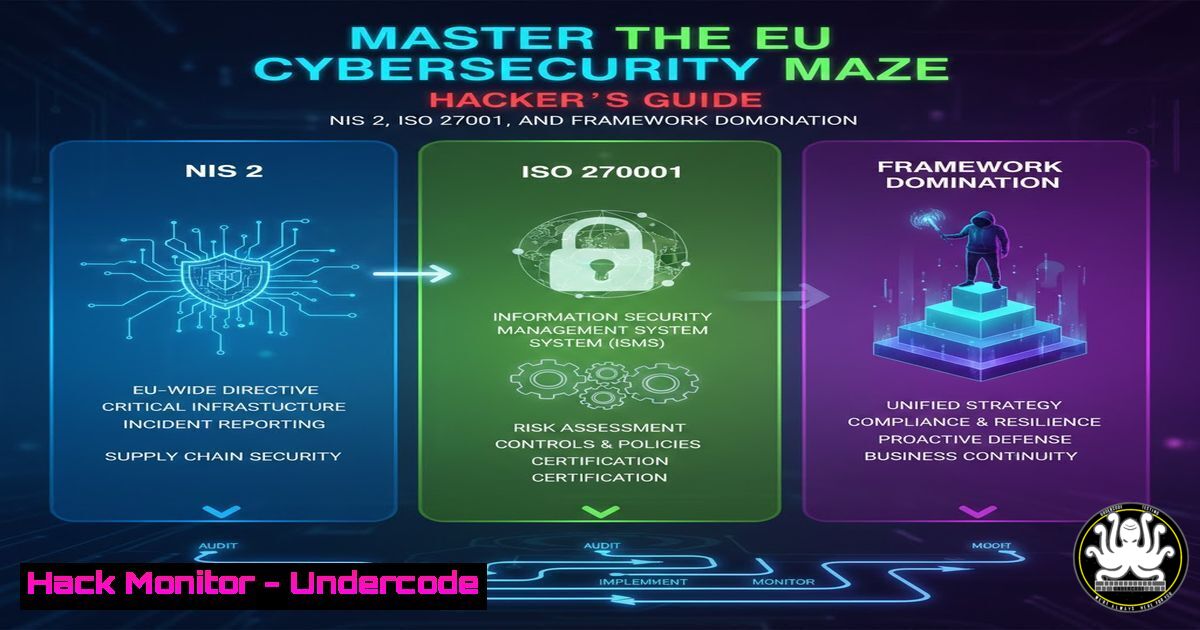
In today’s rapidly evolving digital threat landscape, European organizations face a complex web of mandatory regulations, voluntary standards, and best-practice frameworks. Understanding the interplay between prescriptive ISO standards, binding EU Acts like NIS 2, and flexible cybersecurity frameworks is no longer academic—it’s a critical survival skill for building genuine cyber resilience. This guide decodes this triad of knowledge, providing a practical roadmap for technical professionals and security leaders to navigate compliance and build robust defenses.
Learning Objectives:
- Decipher the three core groups of information security knowledge: ISO Standards, Legislative Acts, and Cybersecurity Frameworks.
- Learn how to map technical controls from frameworks like NIST CSF and CIS to specific requirements of regulations like NIS 2.
- Develop a actionable, step-by-step strategy for achieving and demonstrating compliance through technical implementation.
You Should Know:
1. Decoding the Triad: Standards, Acts, and Frameworks
The foundational model presented distinguishes three pillars of security governance. ISO Standards (e.g., ISO 27001) are globally recognized, prescriptive benchmarks for building an Information Security Management System (ISMS). Compliance is auditable and leads to certification but allows for justified deviations. EU Acts (e.g., NIS 2, DORA, GDPR) are legally binding regulations and directives. Regulations are directly applicable, while directives like NIS 2 are transposed into national law, creating nuances between member states. Cybersecurity Frameworks (e.g., NIST CSF, CIS Controls, ENISA’s guides) are voluntary, flexible collections of best practices and technical controls designed to manage risk.
Step 1: Contextual Analysis. Identify which pillars apply to your organization. Are you in a critical sector under NIS 2 (e.g., energy, transport, digital infrastructure)? Does your industry have specific rules like DORA (finance)? The answer dictates your mandatory (Acts) and strategic (Standards/Frameworks) priorities.
Step 2: Gap Assessment. Perform a mapping exercise. If targeting ISO 27001 certification, map its Annex A controls to your chosen framework’s safeguards (e.g., CIS Control 8: Audit Log Management maps to ISO 27001:2022 A.8.15). This creates a unified control set.
Step 3: Strategic Selection. Choose your primary path. For NIS 2 in Belgium, you might select the official “CyberFundamentals” framework. Alternatively, you could use ISO 27001 as a comprehensive baseline, ensuring the national “extra conditions” are met. Frameworks like NIST CSF are excellent for risk assessment and gap analysis, regardless of the formal path.
- The ISO 27001 Certification Path: More Than a Checklist
Achieving ISO 27001 certification is a rigorous process that formalizes your security posture. It involves establishing, implementing, maintaining, and continually improving an ISMS.Step 1: Initiation & Scope Definition. Secure leadership commitment. Define the scope of your ISMS—will it cover the entire organization or a specific business unit? Document this in the Statement of Applicability (SoA).
Step 2: Risk Assessment & Treatment. This is the core. Identify assets, threats, and vulnerabilities. Assess risks and define a risk treatment plan. This is where technical controls are justified. For example, to treat the risk of unauthorized server access, you might implement control A.9.4.1 (Information access restriction).
Step 3: Implementation of Controls. Roll out your selected controls. Technically, this involves:
Linux Example (Access Control): Enforce privilege separation. Create a user `appuser` for running services and use `sudo` rules to restrict root access.Create a limited user sudo adduser --system --shell /bin/bash appuser Configure sudo to allow specific commands only for admin group visudo: %admin ALL=(ALL) /usr/bin/systemctl restart nginx, /usr/bin/apt update
Windows Example (Audit Logging): Enable detailed auditing via Group Policy (
gpedit.msc) or PowerShell to meet A.12.4.1 (Event logging).Enable detailed process tracking audit policy via PowerShell Auditpol /set /subcategory:"Process Creation" /success:enable /failure:enable
Step 4: Internal Audit & Management Review. Conduct internal audits to check conformity. Management must review the ISMS performance and approve improvements.
Step 5: Certification Audit. An accredited external auditor conducts a two-stage audit (document review, then on-site assessment) against the ISO 27001 standard. -
Navigating the NIS 2 Directive: From Legal Text to Technical Controls
NIS 2 is a key EU directive mandating cybersecurity risk management measures for essential and important entities. Compliance is not optional.Step 1: Determine Applicability. Check the national law transposing NIS 2. Are you classified as an “essential” or “important” entity based on your sector and size?
Step 2: Understand National Nuances. Member states define compliance routes. In the Netherlands, the Baseline Informatiebeveiliging Overheid (BIO) might be referenced. In Belgium, it’s CyberFundamentals or ISO 27001 with add-ons. Consult your national Computer Security Incident Response Team (CSIRT) or regulatory authority.
Step 3: Map to Technical Actions. NIS 2 Articles require concrete measures. For example, 21 mandates basic cyber hygiene. This translates to:
Patch Management: Implement automated patching. For Linux, useunattended-upgrades. For Windows, configure Windows Update for Business.Configure automatic security updates on Ubuntu sudo dpkg-reconfigure --priority=low unattended-upgrades
Multi-Factor Authentication (MFA): Enforce MFA on all remote access and admin interfaces. Use solutions like FreeRADIUS integrated with TOTP apps or hardware tokens.
Incident Handling: Prepare technical incident response playbooks. Have network isolation scripts ready.Emergency script to isolate a compromised host by firewall rule (Linux example) sudo iptables -A INPUT -s <COMPROMISED_IP> -j DROP sudo iptables -A OUTPUT -d <COMPROMISED_IP> -j DROP
4. Leveraging Cybersecurity Frameworks for Agile Defense
Frameworks provide the “how” to achieve the “what” defined by standards and regulations.
Step 1: Select a Core Framework. NIST CSF (Identify, Protect, Detect, Respond, Recover) is excellent for governance. The CIS Critical Security Controls (CIS Controls) are more technically prescriptive and ideal for implementation.
Step 2: Implement CIS Controls Technically. Start with Implementation Group 1 (IG1) for basic hygiene.
CIS Control 4: Secure Configuration. Harden your OS. Use the CIS-CAT tool or manual benchmarks.
 Example: Disable IPv6 if not needed (common hardening step, assess suitability)
sudo sysctl -w net.ipv6.conf.all.disable_ipv6=1
sudo sysctl -w net.ipv6.conf.default.disable_ipv6=1
CIS Control 9: Email and Web Browser Protections. Deploy DNS filtering solutions (e.g., Pi-hole with blocklists) and configure email gateways for DKIM/SPF/DMARC to prevent phishing.
Step 3: Integrate with ENISA Guidance. Use ENISA’s threat landscape reports and frameworks like the Cybersecurity Culture Guidelines to address specific risks and human factors highlighted by NIS 2.
5. Building Your Unified Compliance Roadmap
The goal is a single, efficient program that satisfies all requirements.
Step 1: Create a Master Control Matrix. Use a spreadsheet or GRC tool. List every requirement from NIS 2 (national law), ISO 27001 Annex A, and your chosen framework (e.g., CIS Controls).
Step 2: Map Evidence. For each control, document the technical evidence (screenshots, config files, script outputs, SIEM alerts). For example, evidence for “malware defenses” (CIS Control 8, ISO A.8.21) could be `clamscan` logs or EDR console reports.
Step 3: Automate Evidence Collection. Use scripts to gather evidence continuously, aiding audits.
 Script to collect key compliance evidence (Linux)
 Check firewall status
sudo ufw status verbose > /var/compliance/$(date +%Y%m%d)_fw_status.txt
 Check if automatic updates are enabled
cat /etc/apt/apt.conf.d/20auto-upgrades >> /var/compliance/$(date +%Y%m%d)_auto_updates.txt
6. Technical Implementation: Cloud and API Security Hardening
Modern environments require specific attention.
Step 1: Cloud Hardening (AWS Example). Apply the CIS AWS Foundations Benchmark.
Enable AWS CloudTrail logs in all regions and integrate with a secure S3 bucket.
Enforce IAM password policy and require MFA for root and privileged users.
Use `aws` CLI to audit configurations:
 Check for unrestricted security groups
aws ec2 describe-security-groups --filter "Name=ip-permission.cidr,Values=0.0.0.0/0" --query "SecurityGroups[].[GroupId,GroupName]"
Step 2: API Security. APIs are critical attack surfaces.
Implement strict authentication (OAuth 2.0, API keys) and authorization.
Use a API gateway to enforce rate limiting, input validation, and schema validation.
Regularly scan API endpoints with tools like OWASP ZAP:
 Basic ZAP API scan
docker run -v $(pwd):/zap/wrk/:rw -t owasp/zap2docker-stable zap-api-scan.py -t https://api.yourdomain.com/openapi.json -f openapi -r report.html
7. Continuous Monitoring and Audit Preparedness
Compliance is a continuous cycle, not a point-in-time audit.
Step 1: Deploy a SIEM. Centralize logs from firewalls, servers, endpoints, and applications. Use alerting rules to detect control failures (e.g., failed login thresholds, disabled antivirus).
Step 2: Conduct Penetration Tests & Vulnerability Scans. Regularly test your environment. Use credentialed scans with Nessus or OpenVAS to find unpatched systems.
 Example OpenVAS scan setup (simplified)
 Create target and task via GVM (Greenbone Vulnerability Management) CLI
gvm-cli --gmp-username admin --gmp-password password socket --xml "<create_target><name>Internal_Network</name><hosts>192.168.1.1-254</hosts></create_target>"
Step 3: Document and Review. Maintain all policies, procedures, and evidence. Before an audit, run a formal internal review against your Master Control Matrix to ensure no gaps have emerged.
What Undercode Say:
- Compliance is a Security Baseline, Not the Ceiling. Regulations like NIS 2 define the minimum acceptable level of security. True resilience comes from integrating these mandates with proactive, threat-informed frameworks like NIST CSF and technical best practices from CIS Controls. The goal is to exceed compliance, not just meet it.
- National Implementation is Everything for NIS 2. The directive’s technical requirements are ultimately defined by your member state’s transposing law. Ignoring national specifics (like Belgium’s endorsement of CyberFundamentals) can lead to non-compliance, even if you follow the EU text perfectly. Engaging with national CSIRTs and regulators is not optional.
The analysis underscores a shift from viewing standards, acts, and frameworks as separate silos to treating them as interconnected layers of a defense-in-depth strategy. The most resilient organizations will use the mandatory nature of Acts as the driving force, the structure of ISO standards as the management backbone, and the practical agility of frameworks as the engine for technical implementation. This holistic approach turns regulatory burden into a strategic advantage, systematically reducing risk while providing clear proof of due diligence.
Prediction:
The convergence of Standards, Acts, and Frameworks will accelerate, driven by AI and automation. We predict the emergence of “Compliance as Code” platforms that will automatically translate regulatory texts (like NIS 2) into executable security policies for cloud environments, container orchestrators, and SaaS applications. AI-powered tools will continuously monitor technical controls, auto-generate audit evidence, and predict compliance gaps based on threat intelligence. Furthermore, the success of NIS 2 will spur similar, more technically detailed cross-border regulations for emerging technologies like AI systems and IoT, making the integrated approach outlined here not just best practice, but the only viable method for operating in the future European digital single market.
▶️ Related Video (76% Match):
🎯Let’s Practice For Free:
IT/Security Reporter URL:
Reported By: Jetrow When – Hackers Feeds
Extra Hub: Undercode MoN
Basic Verification: Pass ✅


