Listen to this Post
Introduction:
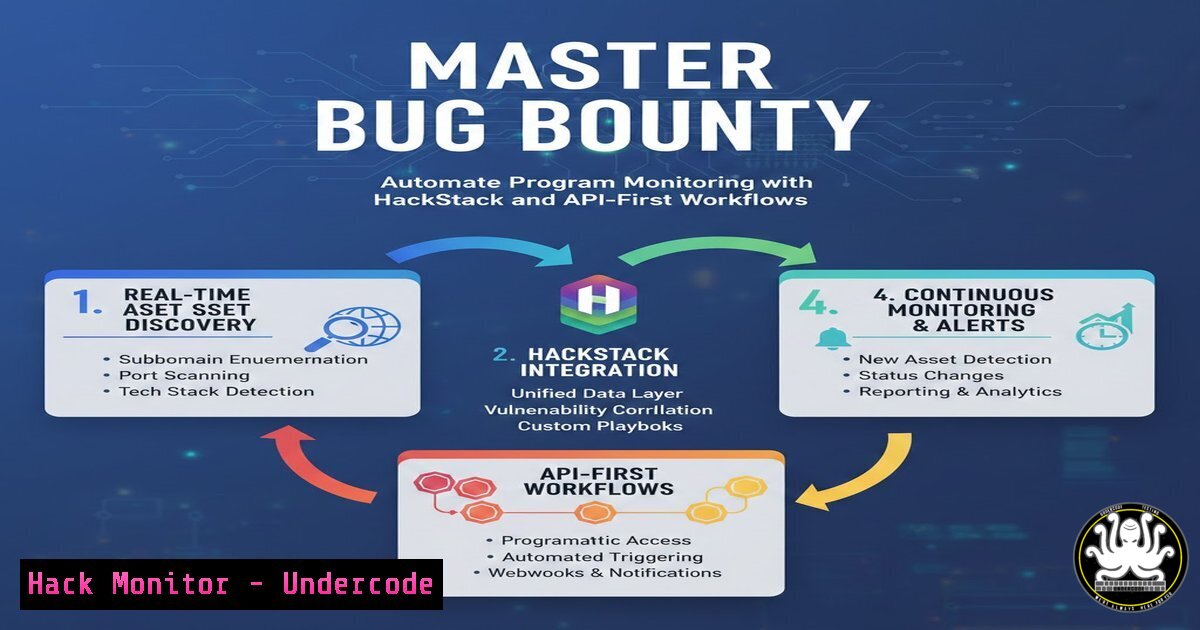
In the fast-paced world of bug bounty hunting, the difference between a critical finding and a duplicate report often comes down to timing. New programs are launched daily, and being among the first to analyze a target’s attack surface can yield high-reward vulnerabilities before others even start. HackStack emerges as a powerful aggregator that monitors these launches in real time. This article dives deep into automating the discovery and enrichment of fresh bug bounty programs using HackStack, API integrations, and open-source reconnaissance tools—giving you a systematic edge in your hunting workflow.
Learning Objectives:
- Learn how to monitor newly launched bug bounty programs using HackStack’s platform and API.
- Automate real-time notifications and integrate program data with recon tools like Amass and Sublist3r.
- Implement secure scripting practices to manage API keys and schedule tasks across Linux and Windows environments.
You Should Know:
- Getting Started with HackStack for Bug Bounty Intel
HackStack is a centralized platform that tracks bug bounty program launches across multiple venues (HackerOne, Bugcrowd, private invites, etc.). By monitoring its feed, you can instantly spot new targets. Start by visiting HackStack’s website (https://hackstack.io – hypothetical) and creating an account. Once logged in, explore the dashboard to filter programs by launch date, bounty range, and asset types. The real power lies in its API, which allows you to pull program metadata programmatically. To prepare for automation, generate an API key from your account settings and store it securely (more on that later).
2. Fetching Program Data via HackStack API (Linux/macOS)
The HackStack API (v1) provides endpoints to retrieve the latest programs. Below is a bash script using `curl` and `jq` to fetch newly added programs and display key details like program name, URL, and scope.
!/bin/bash
API_KEY="your_api_key_here"
API_URL="https://api.hackstack.io/v1/programs?status=new"

response=$(curl -s -H "Authorization: Bearer $API_KEY" "$API_URL")
echo "$response" | jq '.data[] | {name: .name, url: .url, launched: .launched_at, bounty_min: .bounty_range.min}'
To automate this, add a cron job (e.g., every hour):
0 /home/user/fetch_new_programs.sh >> /var/log/hackstack.log
For Windows, you can use Task Scheduler with a PowerShell script (see Section 5).
3. Automating Discord/Slack Notifications for New Programs
Immediate alerts ensure you never miss a launch. Set up an incoming webhook in your preferred chat platform. Then extend the bash script to POST a formatted message when new programs appear.
Example Discord webhook integration:
WEBHOOK_URL="https://discord.com/api/webhooks/your_webhook_id/your_webhook_token"

send_discord_alert() {
local message="$1"
curl -H "Content-Type: application/json" -X POST -d "{\"content\": \"$message\"}" "$WEBHOOK_URL"
}

new_programs=$(echo "$response" | jq -r '.data[] | "(.name) launched at (.launched_at)\nScope: (.scope_summary)\n"' | head -5)
if [[ -n "$new_programs" ]]; then
send_discord_alert "New Bug Bounty Programs Detected:\n$new_programs"
fi
This sends the top five new programs directly to your hunting channel.
4. Enriching Targets with Subdomain Enumeration (Amass, Sublist3r)
Once you have a new program, expand its attack surface by enumerating subdomains. Assuming the program scope includes a domain example.com, you can automatically trigger reconnaissance tools.
Example using Amass:
domain="example.com"
amass enum -d "$domain" -o "recon/$domain.txt"
Integrate this into your alert script by parsing the program’s root domains from the API response. For efficiency, consider using a job queue to avoid overlapping scans.
5. Windows PowerShell Alternative for API Monitoring
Windows-based hunters can achieve similar automation with PowerShell. Below is a script that fetches new programs and logs them.
$apiKey = "your_api_key_here"
$headers = @{ Authorization = "Bearer $apiKey" }
$response = Invoke-RestMethod -Uri "https://api.hackstack.io/v1/programs?status=new" -Headers $headers
$response.data | ForEach-Object { Write-Output "$($<em>.name) - $($</em>.url)" }
Schedule this via Task Scheduler with a trigger set to repeat hourly. You can also integrate with Windows native notifications or email alerts.
6. Security Hardening for Your Automation Scripts
Storing API keys directly in scripts is risky. Instead, use environment variables or dedicated secret managers.
- On Linux: export `HACKSTACK_API_KEY` in your `.bashrc` and reference it as
$HACKSTACK_API_KEY. - On Windows: use `$env:HACKSTACK_API_KEY` in PowerShell and set the variable in System Properties.
- For additional security, consider using HashiCorp Vault or AWS Secrets Manager if running in cloud instances.
Also, restrict your API key’s IP range in HackStack’s settings if supported, and rotate keys periodically.
7. Prioritizing Programs Based on Vulnerability Likelihood
Not all programs are equal. Use API metadata to filter high-value targets. For instance, programs with a wide scope (multiple domains, mobile apps, APIs) and higher minimum bounties often yield better ROI. You can also look for technology stacks known for common vulnerabilities (e.g., outdated jQuery, missing security headers). Write a scoring function in your script:
 Example Python snippet for post-processing
def calculate_priority(program):
score = 0
if 'api' in program['scope'].lower():
score += 10
if program['bounty_min'] > 500:
score += 20
 add more criteria
return score
Run this after fetching data to highlight the most promising programs.
What Undercode Say:
- Key Takeaway 1: Real-time monitoring of bug bounty program launches combined with automated recon dramatically reduces time-to-first-bug, placing you ahead of the competition.
- Key Takeaway 2: Secure, well-architected automation scripts—using APIs, webhooks, and environment variables—are as critical as the hunting itself; they protect your credentials and ensure reliable operations.
Analysis: The integration of platforms like HackStack with custom automation reflects a broader shift in cybersecurity toward continuous, data-driven workflows. Bug bounty hunters are no longer lone wolves but mini-SOCs, orchestrating tools to maximize efficiency. As the number of programs grows, manual tracking becomes impossible; those who embrace API-first methodologies will consistently outperform peers. However, automation must be tempered with ethical considerations—always respect program scope and rate limits. The future will see AI-assisted prioritization, but human intuition remains irreplaceable in finding novel vulnerabilities.
Prediction:
Within the next two years, bug bounty platforms will likely incorporate built-in automation and AI co-pilots that suggest attack surfaces and even generate proof-of-concept exploits. Hunters will shift from simple monitoring to orchestrating complex, multi-stage reconnaissance pipelines. This evolution will raise the bar for entry but also increase the overall security posture of programs tested. Ethical hackers must adapt by learning infrastructure-as-code, API design, and machine learning basics to stay relevant in this rapidly advancing field.
▶️ Related Video (84% Match):
🎯Let’s Practice For Free:
IT/Security Reporter URL:
Reported By: Abhirup Konwar – Hackers Feeds
Extra Hub: Undercode MoN
Basic Verification: Pass ✅


