Listen to this Post
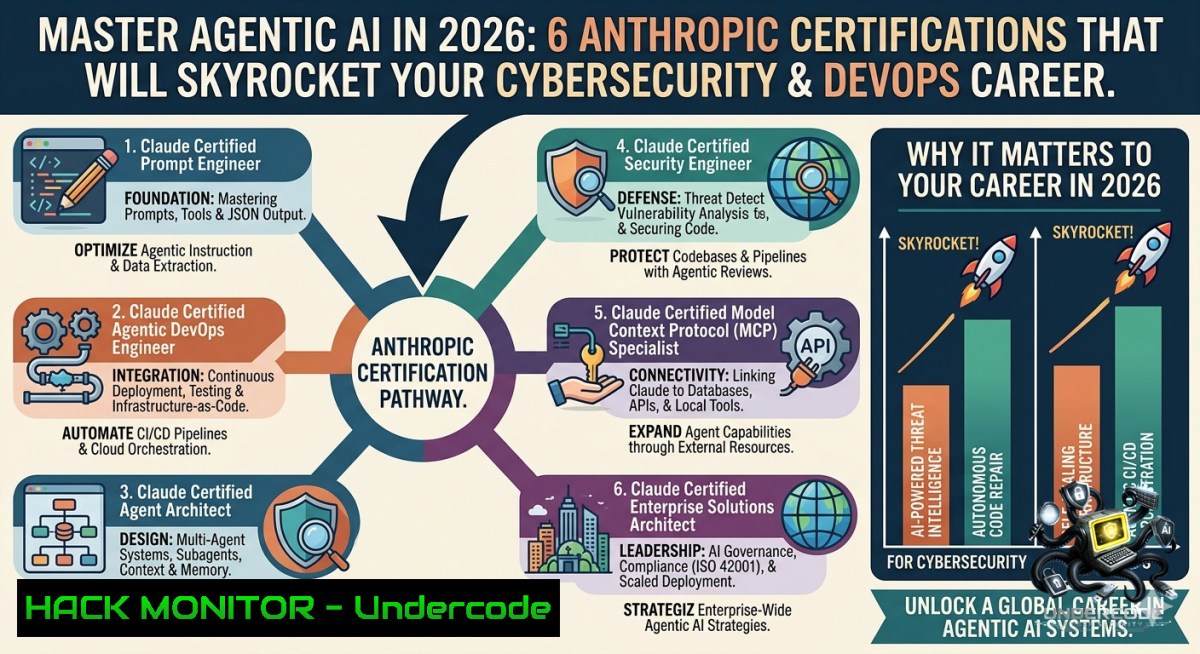
Introduction:
AI fluency has evolved from a “nice‑to‑have” to a core competency for IT, cybersecurity, and cloud professionals. As enterprises adopt agentic AI and multi‑agent orchestration, understanding how to delegate, verify, and secure AI workflows becomes critical—especially when AI directly interacts with infrastructure, code, and sensitive data.
Learning Objectives:
- Apply the 4D Framework (Delegation, Diligence, Description, Discernment) to confidently integrate AI into security operations and DevOps pipelines.
- Build and deploy agentic AI skills using Claude’s function calling, tool use, and Model Context Protocol (MCP) for real‑world automation.
- Identify AI limitations—hallucinations, bias, context window constraints—and implement responsible AI controls in enterprise and cloud environments.
You Should Know:
- Teaching AI Fluency: The 4D Framework in Practice
The 4D Framework (Delegation, Diligence, Description, Discernment) is a mental model for working with large language models (LLMs) like Claude. Delegation means assigning AI tasks that match its strengths (e.g., summarizing logs, drafting IaC templates). Diligence involves verifying outputs—never trust AI blindly. Description refers to crafting precise prompts (prompt engineering). Discernment decides when to rely on AI versus human judgment.
Step‑by‑step guide to apply the 4D Framework in a security context:
- Delegation: Identify a repetitive, low‑risk task, e.g., parsing firewall logs for anomalies.
- Diligence: Run a sample log through Claude (using API or web) and compare its output with known ground truth. Use a script to automate validation.
3. Description: Write a structured prompt:
You are a SOC analyst. Given the following firewall log lines, extract source IP, destination port, and action (allow/deny). Flag any port > 1024 as suspicious. Output JSON.
4. Discernment: For high‑severity alerts, require human review. For low‑severity events, allow automated response only after 95% confidence.
Linux command to log AI queries for audit (using `jq` to format API responses):
curl -s https://api.anthropic.com/v1/messages \
-H "x-api-key: $ANTHROPIC_API_KEY" \
-H "anthropic-version: 2023-06-01" \
-H "content-type: application/json" \
-d '{
"model": "claude-3-opus-20240229",
"max_tokens": 1024,
"messages": [{"role": "user", "content": "Explain the 4D Framework for AI fluency."}]
}' | jq '.' | tee -a ai_audit.log
- Introduction to Agent Skills – Building Your First AI Agent
Agent skills enable Claude to perform actions: web search, file operations, code execution, and API calls. This shifts AI from a chatbot to an autonomous worker. The core is tool use (function calling) where the model decides which tool to invoke and with what parameters.
Step‑by‑step guide to build a file‑analysis agent (Linux/macOS/Windows WSL):
- Define a tool (Python example) that reads a file and returns its metadata:
file_tool.py import os, json, datetime def get_file_metadata(filepath): stat = os.stat(filepath) return { "size_bytes": stat.st_size, "modified": datetime.datetime.fromtimestamp(stat.st_mtime).isoformat(), "is_readable": os.access(filepath, os.R_OK) } -
Create a Claude API request that includes the tool definition:
curl https://api.anthropic.com/v1/messages \ -H "x-api-key: $ANTHROPIC_API_KEY" \ -H "anthropic-version: 2023-06-01" \ -H "content-type: application/json" \ -d '{ "model": "claude-3-5-sonnet-20241022", "max_tokens": 4096, "tools": [{ "name": "get_file_metadata", "description": "Get metadata of a file", "input_schema": { "type": "object", "properties": {"filepath": {"type": "string"}}, "required": ["filepath"] } }], "tool_choice": {"type": "auto"}, "messages": [{"role": "user", "content": "Analyze /var/log/auth.log"}] }' -
Run the agent pipeline: Parse Claude’s tool call, execute locally, feed result back to Claude for final analysis.
Windows PowerShell alternative (using `Invoke-RestMethod`):
$body = @{
model = "claude-3-5-sonnet-20241022"
max_tokens = 4096
tools = @(@{
name = "get_file_metadata"
description = "Get file metadata"
input_schema = @{
type = "object"
properties = @{ filepath = @{ type = "string" } }
required = @("filepath")
}
})
messages = @(@{ role = "user"; content = "Analyze C:\Windows\System32\drivers\etc\hosts" })
} | ConvertTo-Json -Depth 10
Invoke-RestMethod -Uri https://api.anthropic.com/v1/messages -Method Post -Headers @{
"x-api-key" = $env:ANTHROPIC_API_KEY
"anthropic-version" = "2023-06-01"
"content-type" = "application/json"
} -Body $body
- Introduction to Subagents – Orchestrating AI Teams at Scale
Subagents allow you to create an “orchestrator” AI that delegates tasks to specialized sub‑agents (e.g., one for code review, one for log analysis, one for report writing). This parallel execution dramatically speeds up complex workflows. The Model Context Protocol (MCP) standardizes how subagents exchange data.
Step‑by‑step guide to build a security incident triage orchestration:
1. Design the orchestrator prompt:
You are an incident response orchestrator. You have three subagents:
- LogAnalyzer: examines syslog/auth.log for brute force patterns
- NetChecker: runs 'ss -tunap' to list active connections
- IocHunter: checks running processes against known malicious hashes

For a given alert, instruct the appropriate subagents in sequence, then synthesize their reports.
- Implement subagent calls via API (pseudocode orchestration loop):
subagents = { "LogAnalyzer": lambda: call_claude("Analyze /var/log/auth.log for failed SSH attempts", system_prompt="You are a log analysis expert."), "NetChecker": lambda: call_claude("Run `ss -tunap` and identify unusual listening ports", system_prompt="You are a network security expert."), } orchestrator_response = call_claude(orchestrator_prompt + alert_details) for subagent_name in parse_subagent_calls(orchestrator_response): result = subagents<a href="">subagent_name</a> store_in_mcp_context(subagent_name, result) final_report = call_claude("Synthesize all subagent results into a JSON incident report", mcp_context) -
MCP integration for cloud hardening (example using local MCP server):
Install MCP Python SDK
pip install mcp
Run MCP server that exposes cloud APIs (AWS, Azure) to subagents
mcp serve --transport sse --port 5000 --config cloud_tools.json
-
AI Capabilities & Limitations – Mitigating Hallucinations and Bias
LLMs are stochastic (non‑deterministic), trained on finite data, and behave as black boxes. Key limitations: hallucination (confidently wrong answers), context window (memory limits, e.g., 200K tokens for Claude), bias from training data. In cybersecurity, trusting an AI to produce an iptables rule without verification can open a breach.
Step‑by‑step mitigation for enterprise AI deployment:
- Constitutional AI – define a “constitution” (rules) for the model. Example prompt prefix:
You must obey: 1) Never suggest disabling SELinux/AppArmor. 2) Never output hardcoded secrets. 3) For any command, prepend a safety remark.
2. Hallucination detection script (using consistency checks):
import anthropic
client = anthropic.Anthropic()
def ask_with_verification(prompt, n=3):
responses = []
for _ in range(n):
resp = client.messages.create(model="claude-3-haiku-20240307", max_tokens=500, messages=[{"role":"user","content":prompt}])
responses.append(resp.content[bash].text)
 If responses vary significantly (low semantic similarity), flag as hallucination risk
return responses
- Context window management – chunk long log files. Use this Linux command to split a 500MB log:
split -l 10000 /var/log/syslog syslog_chunk_
Windows equivalent (PowerShell):
Get-Content C:\Logs\large.log -ReadCount 10000 | % { $_ -join "<code>r</code>n" | Out-File "chunk_$([bash]::NewGuid()).log" }
- AI for Cybersecurity & Cloud Hardening – Practical Playbook
Anthropic’s agentic AI can automate cloud misconfiguration scanning, IAM policy generation, and threat hunting. For example, use a subagent to continuously evaluate AWS S3 bucket policies against CIS benchmarks.
Step‑by‑step cloud hardening with Claude + AWS CLI:
- Create a prompt to generate a security baseline:
As a cloud security expert, generate an AWS IAM policy that enforces least privilege for an EC2 instance needing only S3 read access to bucket "my-secure-bucket". Output JSON.
2. Automate the feedback loop (Linux/Mac):
 Get current policy
aws iam get-policy-version --policy-arn arn:aws:iam::123456789012:policy/MyPolicy --version-id v1 > current.json
 Send to Claude for review
cat current.json | jq -R -s '{model:"claude-3-haiku-20240307", messages:[{role:"user",content:"Review this IAM policy for over-privilege: (.)"}]}' | curl -H "x-api-key: $ANTHROPIC_API_KEY" -H "content-type:application/json" -d @- https://api.anthropic.com/v1/messages
3. Windows (PowerShell) using AWS Tools:
$policy = Get-IAMPolicyVersion -PolicyArn "arn:aws:iam::123456789012:policy/MyPolicy" -VersionId "v1"
$body = @{ model = "claude-3-haiku-20240307"; messages = @(@{ role = "user"; content = "Review this IAM policy: $($policy.Document)" }) } | ConvertTo-Json
Invoke-RestMethod ...  same API call as before
- AI Fluency for Small Businesses & Nonprofits – ROI‑Focused Automation
For small teams, AI can automate customer service, donor outreach, and social media. The key is to measure ROI: time saved vs. API costs. Use Claude to generate marketing copy, then A/B test with tools like Google Optimize.
Step‑by‑step guide to automate email campaigns using Claude and SendGrid API:
1. Generate email content:
curl https://api.anthropic.com/v1/messages -H "x-api-key: $ANTHROPIC_API_KEY" -H "content-type:application/json" -d '{
"model":"claude-3-haiku-20240307",
"max_tokens":500,
"messages":[{"role":"user","content":"Write a persuasive fundraising email for a nonprofit that provides coding classes to underprivileged youth. Keep it under 200 words."}]
}' | jq -r '.content[bash].text' > email_body.txt
2. Send via SendGrid (Linux/Windows with curl):
curl -X POST https://api.sendgrid.com/v3/mail/send \
-H "Authorization: Bearer $SENDGRID_API_KEY" \
-H "Content-Type: application/json" \
-d "{\"personalizations\":[{\"to\":[{\"email\":\"[email protected]\"}]}],\"from\":{\"email\":\"[email protected]\"},\"subject\":\"Help us teach AI to future leaders\",\"content\":[{\"type\":\"text/plain\",\"value\":\"$(cat email_body.txt)\"}]}"
What Undercode Say:
- AI fluency is no longer optional – professionals who master delegation, diligence, description, and discernment will lead the next decade of IT and security.
- Agentic AI and subagents are the new DevOps – orchestrating AI teams with MCP will replace many static automation scripts, but requires rigorous validation to avoid security blind spots.
The post highlights a crucial shift: enterprise technology leaders must now treat AI as a core competency, not an add‑on. The 6‑course Anthropic Academy curriculum covers both strategic (4D Framework, responsible AI) and tactical (agent skills, subagents, MCP) layers. For cybersecurity, this means we can deploy AI to hunt threats, harden cloud infrastructure, and respond to incidents at machine speed—provided we respect limitations like hallucinations and context windows. The inclusion of small business and nonprofit tracks shows AI is democratizing, but the underlying need for governance and human discernment remains paramount. As the author notes with 100% quiz scores, certification is just the start; real value comes from integrating these patterns into daily engineering workflows.
Prediction:
+1 AI agent pipelines will become standard in SOC automation by 2027, reducing false positive triage time by 70%.
+1 Model Context Protocol (MCP) will emerge as a critical interoperability standard for multi‑agent security orchestrators, similar to how REST APIs transformed cloud services.
-1 Until robust hallucination detection and audit trails mature, enterprises will experience at least one major breach caused by an over‑trusted AI‑generated firewall rule or IAM policy.
+1 Small businesses leveraging AI for customer service and marketing will see 30‑50% operational cost reductions, widening the competitive gap against laggards.
-1 The “black box” nature of LLMs will complicate compliance with regulations like PCI DSS and HIPAA, requiring new certification frameworks for AI‑assisted security decisions.
▶️ Related Video (76% Match):
🎯Let’s Practice For Free:
🎓 Live Courses & Certifications:
Join Undercode Academy for Verified Certifications
🚀 Request a Custom Project:
Secure, high-velocity infrastructure and disruptive technological engineering. Contact our engineering team for high-tier development and proprietary systems:
[email protected]
💎 Smart Architecture | 🛡️ Secure by Design | ⭐ Trusted by Thousands
IT/Security Reporter URL:
Reported By: Shahzadms Artificialintelligence – Hackers Feeds
Extra Hub: Undercode MoN
Basic Verification: Pass ✅


