Listen to this Post
Introduction:
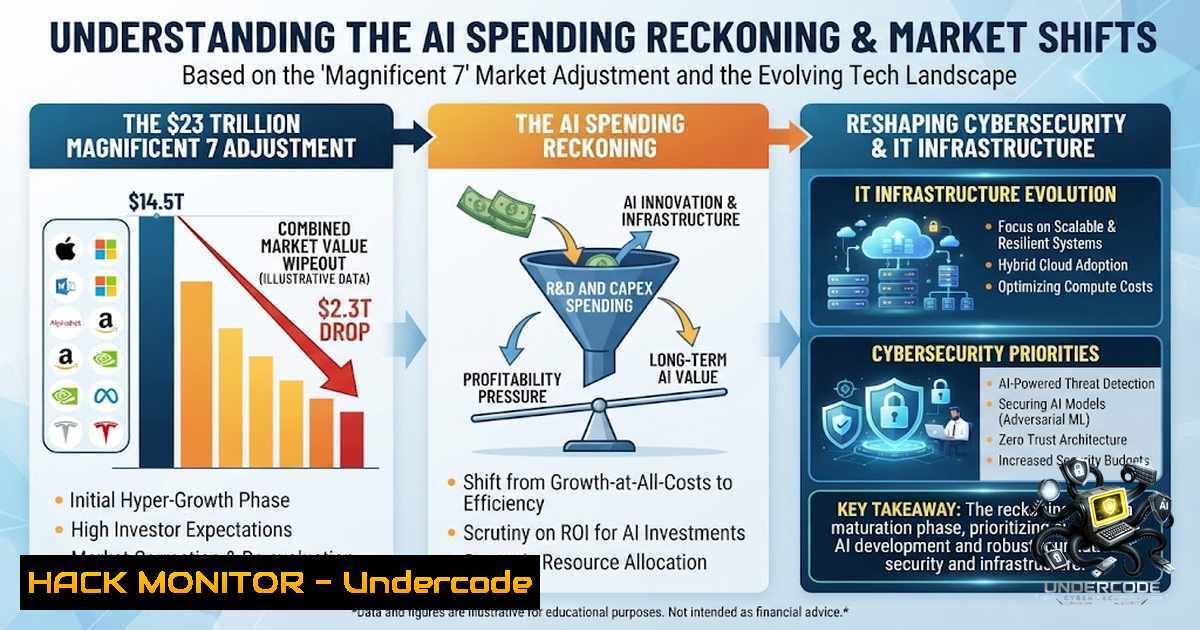
The Magnificent Seven—Microsoft, Nvidia, Alphabet, Apple, Meta, Tesla, and Amazon—collectively lost $2.3 trillion in market value during June 2026 as investor patience wore thin over runaway AI infrastructure spending. With industry-wide AI capital expenditures on track to surpass $700 billion in 2026—a year-over-year surge of roughly 70%—the market is now demanding tangible returns on what Dan Ives of Wedbush Securities calls a “once-in-a-generation tech buildout”. For cybersecurity and IT professionals, this seismic shift signals a critical inflection point: as AI spending comes under intense scrutiny, security teams must navigate a landscape where AI-driven threats are accelerating, defense budgets are tightening, and the infrastructure powering the next generation of computing must be hardened against increasingly sophisticated attacks.
Learning Objectives:
- Understand the macroeconomic forces behind the Magnificent Seven’s $2.3 trillion selloff and their implications for enterprise AI security budgets.
- Master practical techniques for hardening AI infrastructure across cloud, on-premise, and hybrid environments, including Zero Trust implementation and least-privilege access controls.
- Learn to deploy automated security controls and monitoring frameworks to protect AI workloads from emerging threats like prompt injection, model poisoning, and supply chain vulnerabilities.
You Should Know:
- Securing the AI Infrastructure Pipeline: From Development to Deployment
The $700 billion AI buildout is not merely a financial story—it is a massive expansion of attack surface. As organizations rush to deploy AI models and the infrastructure that supports them, security teams must secure every layer of the pipeline. This includes provisioning secure Virtual Private Clouds (VPCs) with private networking to mitigate unsolicited traffic, hardening development instances against bootkits and privilege escalation, and enforcing least-privilege access for service accounts and API keys. The National Institute of Standards and Technology (NIST) AI Risk Management Framework provides a useful starting point, but practical implementation requires hands-on configuration.
Step‑by‑Step Guide: Hardening a Cloud-Based AI Development Environment (AWS Example)
Step 1: Provision a Secure VPC with Private Subnets
– Create a VPC with CIDR block 10.0.0.0/16.
– Deploy private subnets in at least two Availability Zones.
– Ensure no public internet gateway is attached to subnets hosting AI workloads.
– Configure VPC Flow Logs to capture all network traffic for analysis.
Step 2: Deploy a Bastion Host with Strict Access Controls
– Launch a bastion EC2 instance in a public subnet with security group rules restricting inbound SSH to your organization’s trusted IP range only.
– Use AWS Systems Manager Session Manager as an alternative to SSH, eliminating the need for open inbound ports entirely.
Step 3: Harden the AI Workbench Instance
- Launch a Vertex AI Workbench instance (or equivalent Jupyter-based environment) in a private subnet.
- Enable Shielded VMs to protect against bootkits and rootkits:
Enable secure boot and vTPM (GCP example)
gcloud compute instances create my-ai-instance \
--shielded-secure-boot \
--shielded-vtpm \
--shielded-integrity-monitoring
- Disable root login and enforce key-based authentication:
sudo sed -i 's/PermitRootLogin yes/PermitRootLogin no/' /etc/ssh/sshd_config
sudo systemctl restart sshd
Step 4: Enforce Least-Privilege IAM Policies
- Create a custom IAM role for the AI instance with only the minimum required permissions:
{
"Version": "2012-10-17",
"Statement": [
{
"Effect": "Allow",
"Action": [
"s3:GetObject",
"s3:PutObject"
],
"Resource": "arn:aws:s3:::my-ai-bucket/"
},
{
"Effect": "Deny",
"Action": "",
"Resource": "",
"Condition": {
"BoolIfExists": {
"aws:SecureTransport": "false"
}
}
}
]
}
Step 5: Enable Encryption at Rest and in Transit
– Configure AWS KMS (or equivalent) to encrypt all S3 buckets and EBS volumes used for AI training data.
– Enforce TLS 1.3 for all API endpoints and inter-service communication.
2. Zero Trust Architecture for Distributed AI Systems
The transition from centralized data centers to distributed AI spanning cloud, on-premise, and edge environments demands a Zero Trust security model. Continuous verification, micro-segmentation, and least-privilege access are no longer optional—they are mandatory. Attackers are increasingly targeting AI-specific vectors, including prompt injection (manipulating model inputs to produce unintended outputs) and model poisoning (corrupting training data to compromise model integrity).
Step‑by‑Step Guide: Implementing Zero Trust for AI Workloads
Step 1: Establish Continuous Identity Verification
- Deploy an Identity Provider (IdP) with multi-factor authentication (MFA) for all users and service accounts.
- Implement short-lived credentials using AWS STS or equivalent:
Generate temporary credentials valid for 1 hour
aws sts assume-role --role-arn "arn:aws:iam::123456789012:role/AI-Workload-Role" \
--role-session-1ame "AI-Session" \
--duration-seconds 3600
Step 2: Implement Micro-Segmentation with Network Policies
- Use Kubernetes Network Policies (if running AI workloads in containers) to restrict pod-to-pod communication:
apiVersion: networking.k8s.io/v1
kind: NetworkPolicy
metadata:
name: ai-model-1etwork-policy
spec:
podSelector:
matchLabels:
app: ai-model
policyTypes:</li>
<li>Ingress</li>
<li>Egress
ingress:</li>
<li>from:</li>
<li>podSelector:
matchLabels:
app: api-gateway
egress:</li>
<li>to:</li>
<li>podSelector:
matchLabels:
app: database
Step 3: Deploy Runtime Security Monitoring
- Install Falco or similar runtime security tool to detect anomalous behavior:
Install Falco on Kubernetes
helm repo add falcosecurity https://falcosecurity.github.io/charts
helm install falco falcosecurity/falco \
--set falco.jsonOutput=true \
--set falco.httpOutput.enabled=true \
--set falco.httpOutput.url=http://security-siem:8080/
- Create custom Falco rules to detect unauthorized model file access:
</li>
<li>rule: Unauthorized Model File Access
desc: Detect access to model files outside of authorized paths
condition: >
open_read and
(fd.name startswith "/models/" or fd.name startswith "/app/models/") and
not proc.name in (authorized_processes)
output: >
Unauthorized model file access (%user.name %proc.name read %fd.name)
priority: CRITICAL
Step 4: Implement API Security with Mutual TLS (mTLS)
– Enforce mTLS for all API calls between AI services using Istio or similar service mesh:
 Enable mTLS in Istio
kubectl apply -f - <<EOF
apiVersion: security.istio.io/v1beta1
kind: PeerAuthentication
metadata:
name: default
namespace: ai-1amespace
spec:
mtls:
mode: STRICT
EOF
3. Automated Security Controls for AI Resources
AWS recently launched a set of 31 automated security controls specifically designed to detect when deployed AI resources do not align with security best practices. These controls cover critical domains including network isolation, encryption at rest and in transit, VPC placement, KMS key usage, private container registry requirements, and authorization controls. Implementing automated compliance scanning is essential for organizations deploying AI at scale.
Step‑by‑Step Guide: Deploying Automated AI Security Scanning
Step 1: Enable AWS Security Hub with AI Security Best Practices Standard
– Navigate to AWS Security Hub and enable the AI Security Best Practices standard.
– Review the 31 automated controls and their compliance status.
Step 2: Implement Infrastructure-as-Code (IaC) Security Scanning
- Use tools like Checkov or Terrascan to scan Terraform/CloudFormation templates for AI-specific misconfigurations:
Scan Terraform for AI security violations
checkov -d ./terraform/ --framework terraform \
--check CKV_AWS_245  Ensure AI resources are in private subnets
Step 3: Enforce Private Container Registry Requirements
- Configure Amazon ECR (or equivalent) with private access only:
Set repository policy to deny public access
aws ecr set-repository-policy \
--repository-1ame my-ai-repo \
--policy-text '{
"Version": "2012-10-17",
"Statement": [
{
"Sid": "DenyPublicAccess",
"Effect": "Deny",
"Principal": "",
"Action": "ecr:",
"Condition": {
"Bool": {
"aws:PrincipalIsAWS": "false"
}
}
}
]
}'
Step 4: Continuous Vulnerability Scanning of AI Containers
- Integrate container scanning into your CI/CD pipeline using Trivy:
Scan container image for vulnerabilities
trivy image my-ai-image:latest \
--severity CRITICAL,HIGH \
--ignore-unfixed \
--exit-code 1
- Defending Against AI-Specific Threats: Prompt Injection and Model Poisoning
As attackers move beyond traditional hacking methods, they are increasingly targeting AI systems with sophisticated techniques like prompt injection and model poisoning. These attacks can compromise model integrity, leak sensitive training data, or cause models to produce harmful outputs. Defending against these threats requires a combination of input validation, output filtering, and adversarial training.
Step‑by‑Step Guide: Mitigating Prompt Injection Attacks
Step 1: Implement Input Sanitization and Validation
- Create an input validation layer that strips or escapes potentially malicious characters:
import re</li>
</ul>

def sanitize_prompt(prompt: str) -> str:
 Remove common injection patterns
prompt = re.sub(r'ignore previous instructions', '', prompt, flags=re.IGNORECASE)
prompt = re.sub(r'you are now', '', prompt, flags=re.IGNORECASE)
 Escape special characters
prompt = prompt.replace('"', '\"').replace("'", "\'")
return prompt
Step 2: Deploy Output Filtering with Allowlists
- Implement an output filter that only allows responses matching predefined safe patterns:
import re</li>
</ul>

def filter_output(response: str) -> str:
 Only allow responses that match safe patterns
safe_patterns = [
r'^[A-Za-z0-9\s.,!?-]+$',  Basic alphanumeric and punctuation
]
if any(re.match(pattern, response) for pattern in safe_patterns):
return response
return "[Response blocked due to security policy]"
Step 3: Implement Model Poisoning Detection
- Monitor model performance drift and training data integrity:
Track model accuracy over time
python -c "
import json
import boto3
Log accuracy metrics to CloudWatch
cloudwatch = boto3.client('cloudwatch')
cloudwatch.put_metric_data(
Namespace='AI/Model',
MetricData=[
{
'MetricName': 'Accuracy',
'Value': 0.95,
'Unit': 'None'
}
]
)
"
- Linux and Windows Hardening Commands for AI Infrastructure
Securing the underlying operating systems hosting AI workloads is equally critical. Below are essential hardening commands for both Linux and Windows environments.
Linux Hardening Commands
 Disable unnecessary services
systemctl list-unit-files --state=enabled | grep -E "cups|bluetooth|avahi" | awk '{print $1}' | xargs -I {} systemctl disable {}

Enforce strong password policies
echo "minlen=12" >> /etc/security/pwquality.conf
echo "dcredit=-1" >> /etc/security/pwquality.conf  Require at least one digit
echo "ucredit=-1" >> /etc/security/pwquality.conf  Require at least one uppercase

Configure audit logging for AI model access
auditctl -w /models/ -p rwxa -k model_access

Harden kernel parameters
echo "net.ipv4.tcp_syncookies=1" >> /etc/sysctl.conf
echo "net.ipv4.conf.all.rp_filter=1" >> /etc/sysctl.conf
echo "net.ipv4.conf.default.rp_filter=1" >> /etc/sysctl.conf
sysctl -p

Install and configure fail2ban
apt-get install fail2ban -y
cp /etc/fail2ban/jail.conf /etc/fail2ban/jail.local
systemctl enable fail2ban
systemctl start fail2ban
Windows Hardening Commands (PowerShell)
 Disable unnecessary services
Stop-Service -1ame "Spooler" -Force
Set-Service -1ame "Spooler" -StartupType Disabled
Stop-Service -1ame "PrintNotify" -Force
Set-Service -1ame "PrintNotify" -StartupType Disabled

Enable Windows Defender real-time protection
Set-MpPreference -DisableRealtimeMonitoring $false
Set-MpPreference -DisableBehaviorMonitoring $false

Configure Windows Firewall for AI workload ports
New-1etFirewallRule -DisplayName "Block All AI Ports Except 443" `
-Direction Inbound `
-Action Block `
-Protocol TCP `
-LocalPort 8000,8080,5000

Enable BitLocker for AI data drives
Enable-BitLocker -MountPoint "D:" -EncryptionMethod XtsAes256

Configure audit policies for model access
auditpol /set /subcategory:"File System" /success:enable /failure:enable
What Undercode Say:
- Key Takeaway 1: The $2.3 trillion Magnificent Seven selloff is not a rejection of AI itself but a demand for financial discipline. For cybersecurity professionals, this means AI security budgets will face increased scrutiny—ROI on security investments must be clearly demonstrable.
- Key Takeaway 2: As AI infrastructure spending slows or becomes more targeted, attackers will exploit the gaps left by rushed deployments. Organizations must prioritize Zero Trust architectures, automated compliance scanning, and runtime threat detection to protect AI workloads.
Analysis:
The shift from AI hype to financial rigor presents both challenges and opportunities for cybersecurity. CrowdStrike CEO George Kurtz recently warned that unchecked AI spending is accelerating security vulnerabilities, not just creating job losses. Meanwhile, Forrester predicts enterprises will defer 25% of planned AI spend into 2027 as financial rigor slows production deployments. This pullback, however, does not extend to automated cybersecurity—adoption of AI-driven security tools has remained nearly flat, dropping only a single percentage point month-over-month. The message is clear: organizations are cutting speculative AI projects but doubling down on defensive AI that reduces breach costs by an average of $1.9 million per incident. Security teams must position themselves as enablers of efficient, secure AI deployment rather than obstacles to innovation. The $700 billion AI buildout will continue, but it will be governed by stricter cost controls, automated compliance, and a relentless focus on measurable security outcomes.
Prediction:
- +1 The AI spending correction will accelerate the adoption of automated security controls and Infrastructure-as-Code scanning, creating new opportunities for cybersecurity professionals skilled in DevSecOps and AI security frameworks.
- -1 Organizations that slash AI security budgets in response to spending pressures will face increased breach risks, particularly from prompt injection and model poisoning attacks that exploit poorly secured AI pipelines.
- +1 The rotation of capital from Magnificent Seven companies to semiconductor and memory suppliers will drive innovation in hardware-based security, including in-silicon visibility and trusted execution environments for AI workloads.
- -1 The projected deferral of 25% of AI spend into 2027 will leave many AI models and infrastructure components in a partially deployed, poorly monitored state—a prime target for adversaries.
- +1 Zero Trust architecture adoption for distributed AI systems will become a competitive differentiator, with early adopters gaining both security and operational efficiency advantages.
▶️ Related Video (78% Match):
🎯Let’s Practice For Free:
🎓 Live Courses & Certifications:
Join Undercode Academy for Verified Certifications
🚀 Request a Custom Project:
Secure, high-velocity infrastructure and disruptive technological engineering. Contact our engineering team for high-tier development and proprietary systems:
[email protected]
💎 Smart Architecture | 🛡️ Secure by Design | ⭐ Trusted by ThousandsIT/Security Reporter URL:
Reported By: Maximilianfeldthusen Httpslnkdinetpkbp69 – Hackers Feeds
Extra Hub: Undercode MoN
Basic Verification: Pass ✅🔐JOIN OUR CYBER WORLD [ CVE News • HackMonitor • UndercodeNews ]
📢 Follow UndercodeTesting & Stay Tuned:
- Monitor model performance drift and training data integrity:
- Implement an output filter that only allows responses matching predefined safe patterns:


