
Listen to this Post
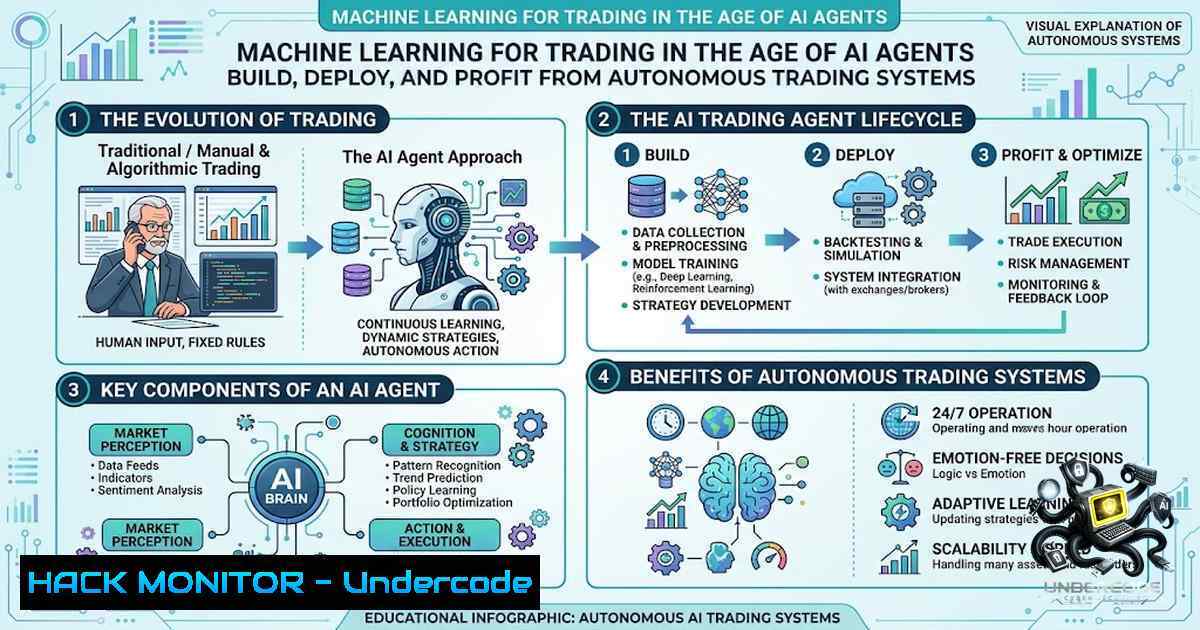
Introduction:
The convergence of artificial intelligence and financial markets has entered a new era. No longer confined to static models and rule-based algorithms, the modern quantitative trading landscape is being reshaped by autonomous AI agents capable of performing end-to-end research, decision-making, and execution. At the forefront of this revolution is Stefan Jansen, author of the definitive practitioner reference Machine Learning for Trading (3rd ed., 2026), whose work has garnered over 19,000 GitHub stars and influenced a generation of AI-driven traders. His upcoming hands-on Packt workshop, “Machine Learning for Trading in the Age of AI Agents,” offers a rare opportunity to learn directly from a master who doesn’t just write about AI—he builds the systems that run on it.
Learning Objectives:
- Build an End-to-End ML Trading Pipeline: Construct a complete workflow from raw data sourcing to live execution, utilizing real market data and a disciplined research process.
- Integrate AI Agents into Quantitative Research: Understand how to deploy generative AI, multi-agent systems, and retrieval-augmented generation (RAG) to automate research, signal discovery, and strategy validation.
- Master Production-Grade MLOps for Trading: Learn to implement drift detection, safe rollouts, circuit breakers, and governance to ensure strategies remain robust in live markets.
You Should Know:
- The Seven-Stage Workflow: From Idea to Live Execution
The third edition of Machine Learning for Trading is organized around a single, coherent workflow that takes a research idea from conception to a deployable, monitorable strategy. This isn’t a collection of disparate techniques; it’s a disciplined path that forces you to confront the realities of trading, including costs, risk, and the inevitable decay of predictive edge.
Step-by-Step Guide to the Workflow:
- Stage 1: Data Sourcing & Infrastructure: Begin by acquiring market and alternative data. The companion repository provides tooling for sourcing data from various providers.
- Stage 2: Feature Engineering & Signal Extraction: Transform raw data into predictive signals. Use libraries like `pandas` and `Polars` to engineer features.
- Stage 3: Model Development: Train a diverse toolkit of models. The third edition covers gradient boosting (XGBoost, LightGBM, CatBoost), deep time-series architectures (PatchTST, iTransformer, TCN, Mamba), and newer tabular models (TabPFN, TabM).
- Stage 4: Strategy Design & Backtesting: This is where a raw signal becomes a strategy. New dedicated chapters cover transaction costs and risk management. Backtesting must respect the “evidence boundary”—a clear separation between exploration (training) and confirmation (testing) to avoid overfitting.
- Stage 5: Portfolio Construction: Size your positions and construct a portfolio that aligns with your risk appetite and capital constraints.
- Stage 6: Deployment & Live Execution: Connect to live trading systems via APIs (Interactive Brokers, Alpaca, QuantConnect).
- Stage 7: Monitoring & Governance: Implement MLOps practices—drift detection, circuit breakers, and experiment tracking—to manage the strategy in production.
2. The Rise of Multi-Agent Forecasting Systems
Perhaps the most significant advancement in the third edition is the integration of autonomous AI agents into the trading workflow. Stefan Jansen’s dedicated workshop, “Building Multi-Agent Forecasting Systems,” provides a practical blueprint for this paradigm. This system, inspired by Bridgewater’s AIA Forecaster, uses a team of specialized agents to produce more reliable forecasts than a single model.
How to Build a Multi-Agent Forecasting Pipeline:
- Clone the Repository: Start with the official codebase. The workshop provides a repo that you can run with a deterministic replay, requiring no API keys or network connection.
- Set Up Your Environment: Use `uv sync` to install dependencies, including a local Ollama setup for running open-source LLMs.
- Run the Research Agents: The system reformulates a vague question into precise sub-questions. Parallel “research agents” then gather and structure evidence. Run a local Ollama pass on real prediction-market questions and inspect each agent’s findings in the trace UI.
- Implement the Supervisor: A supervisor agent reconciles disagreements among the researchers. It can clarify and conduct additional searches when agents diverge.
- Aggregate & Calibrate: The system uses sophisticated aggregation methods (e.g., Neyman extremize) and calibration techniques like Platt scaling to produce a final, honest probability estimate.
- Evaluate with Brier Scores: Generate calibration curves and Brier scores on a set of resolved questions to honestly assess your system’s performance.
- Productionize the System: Wire a read-only connector to a market (e.g., Polymarket, Kalshi) and run a daily cycle end-to-end: pull → forecast → track.
3. Production-Grade Python Libraries and Open-Source Ecosystem
Stefan Jansen doesn’t just teach theory; he provides the tools to implement it. The ML4T ecosystem includes six production Python libraries that facilitate substantial parts of the trading workflow. These libraries, along with 112 primers and 56 agent skills, form a comprehensive toolkit for the practitioner.
Key Tools in the Ecosystem:
- Zipline: A backtesting library that the quant community relies on.
- Data Libraries: Tooling for sourcing and managing market and alternative data.
- ML Libraries: Integrations for training and tuning models with XGBoost, LightGBM, and deep learning frameworks.
- Agent Libraries: Building blocks for creating multi-agent systems, including ReAct agent loops and calibration techniques.
- MLOps Libraries: Components for drift detection, experiment tracking, and governance.
Getting Started with the Code:
 Clone the repository
git clone https://github.com/stefan-jansen/machine-learning-for-trading.git

Navigate to the directory
cd machine-learning-for-trading

Install dependencies (using uv)
uv sync

Run a specific notebook or script
jupyter notebook
4. Advanced Techniques: Causal Inference and Reinforcement Learning
The third edition moves beyond predictive modeling to address the fundamental question: why does a strategy work? It introduces causal machine learning to separate genuine predictive effects from spurious correlations, a critical capability for building robust strategies.
Implementing Causal ML in Trading:
- Understand the Problem: Many correlations in financial data are spurious. A strategy that works on historical data may fail because it was exploiting a non-causal relationship.
- Use Double ML: Implement Double Machine Learning (Double ML) to estimate causal effects while controlling for confounders.
- Apply Bayesian Structural Time Series: Use Bayesian structural time series to model the causal impact of an event or intervention.
- Validate with Walk-Forward Cross-Validation: Always use walk-forward cross-validation to test your strategy’s robustness out-of-sample.
Reinforcement learning (RL) is also a major addition. The book covers RL for optimal execution, market making with inventory management, and deep hedging—moving from prediction to action in a dynamic environment.
5. Synthetic Data Generation for Robust Validation
When historical data is scarce or non-representative, synthetic data generation becomes a powerful tool. The third edition covers techniques like TimeGAN, Tail-GAN, and diffusion-based generators to create realistic synthetic financial data for validation.
Using Synthetic Data Generators:
- Install Required Libraries: Ensure you have the necessary deep learning libraries (e.g., PyTorch, TensorFlow) installed.
- Select a Generator: Choose a generator appropriate for your data type. TimeGAN is suitable for time-series data.
- Train the Generator: Train the generator on your historical data. It learns the underlying statistical properties.
- Generate Synthetic Samples: Produce new, realistic samples that preserve the statistical characteristics of the original data.
- Validate the Synthetic Data: Compare the statistical properties of the synthetic data to the real data to ensure it is representative.
- Use for Validation: Use the synthetic data to test the robustness of your strategies, especially for scenarios not well-represented in historical data.
-
Linux and Windows Commands for the ML4T Stack
Setting up a robust ML trading environment requires familiarity with both Linux and Windows command-line tools. Here are essential commands for managing your development environment:
Linux/macOS:
 Create a virtual environment
python3 -m venv ml4t_env
source ml4t_env/bin/activate

Install dependencies from requirements.txt
pip install -r requirements.txt

Install a specific library (e.g., LightGBM)
pip install lightgbm

Run a Jupyter notebook server
jupyter notebook --ip=0.0.0.0 --port=8888 --1o-browser

Clone the ML4T repository
git clone https://github.com/stefan-jansen/machine-learning-for-trading.git

Navigate to the project directory
cd machine-learning-for-trading

Check Python version
python --version
Windows (PowerShell or Command Prompt):
 Create a virtual environment
python -m venv ml4t_env
ml4t_env\Scripts\activate

Install dependencies
pip install -r requirements.txt

Run a Jupyter notebook server
jupyter notebook --ip=0.0.0.0 --port=8888 --1o-browser

Clone the repository
git clone https://github.com/stefan-jansen/machine-learning-for-trading.git

Navigate to the project directory
cd machine-learning-for-trading

Check Python version
python --version
7. Hardening API Security for Live Trading
When deploying strategies that connect to broker APIs (Interactive Brokers, Alpaca), security is paramount. Here’s a step-by-step guide to hardening your API security:
- Use Environment Variables: Never hardcode API keys in your code. Use environment variables or a `.env` file.
import os API_KEY = os.environ.get('ALPACA_API_KEY') SECRET_KEY = os.environ.get('ALPACA_SECRET_KEY') - Implement Rate Limiting: Respect the API’s rate limits to avoid being blocked.
- Use Read-Only Keys for Research: When testing, use read-only API keys to prevent accidental live trading.
- Enable Two-Factor Authentication (2FA): Always enable 2FA on your trading accounts.
- Audit API Calls: Log all API calls for audit and debugging purposes.
- Use Secure Connections: Ensure all API calls are made over HTTPS.
- Implement Circuit Breakers: In your code, implement circuit breakers that halt trading if certain risk thresholds are exceeded.
What Undercode Say:
- Key Takeaway 1: Stefan Jansen’s work represents a gold standard in the applied AI for finance space. His ability to bridge cutting-edge research (multi-agent systems, causal inference) with production-grade, open-source code is unparalleled. The third edition of Machine Learning for Trading is not just a book; it’s a comprehensive, executable blueprint for modern quantitative trading.
-
Key Takeaway 2: The integration of AI agents is a paradigm shift, not just an incremental improvement. The multi-agent forecasting system, replicating Bridgewater’s AIA Forecaster, provides a concrete, auditable path to building autonomous research systems. This moves AI from a tool for analysis to an active participant in the research and decision-making process.
Analysis:
Stefan Jansen’s approach stands out because it treats methodological rigor as a first-class citizen. The emphasis on the “evidence boundary,” walk-forward validation, and tools like the Deflated Sharpe Ratio directly confronts the overfitting problem that plagues most quantitative research. The companion ecosystem—with its 19,000+ GitHub stars, six production libraries, and hundreds of primers and skills—is a testament to the practical, battle-tested nature of the work. For practitioners, the opportunity to learn directly from Jansen in his live cohort courses and workshops is invaluable, offering not just knowledge but a working, extensible codebase. This is a rare instance where the person writing the book is also actively building the systems described within it.
Prediction:
- +1: The adoption of multi-agent systems in finance will accelerate dramatically over the next 2-3 years. The blueprint provided by Jansen’s work, particularly the Bridgewater AIA replication, will become a standard pattern for quantitative research teams, democratizing access to sophisticated AI-driven research capabilities.
-
+1: The integration of causal inference and reinforcement learning will lead to a new generation of trading strategies that are more robust, explainable, and adaptable to changing market conditions. Strategies will move beyond pattern recognition to understanding the underlying drivers of market behavior.
-
-1: The rapid advancement of AI agents in trading will intensify the arms race in financial markets, potentially leading to increased volatility and new forms of systemic risk. The ability to deploy autonomous agents at scale will require new regulatory frameworks and risk management practices.
-
+1: The open-source nature of Jansen’s work, combined with his live training, will continue to lower the barrier to entry for quantitative trading, enabling a new wave of innovators and researchers to participate in and shape the future of AI-driven finance.
▶️ Related Video (72% Match):
https://www.youtube.com/watch?v=4LJOrDE8Kfc
🎯Let’s Practice For Free:
🎓 Live Courses & Certifications:
Join Undercode Academy for Verified Certifications
🚀 Request a Custom Project:
Secure, high-velocity infrastructure and disruptive technological engineering. Contact our engineering team for high-tier development and proprietary systems:
[email protected]
💎 Smart Architecture | 🛡️ Secure by Design | ⭐ Trusted by Thousands
IT/Security Reporter URL:
Reported By: Analyticsanshul There – Hackers Feeds
Extra Hub: Undercode MoN
Basic Verification: Pass ✅


